Blog
Back to blog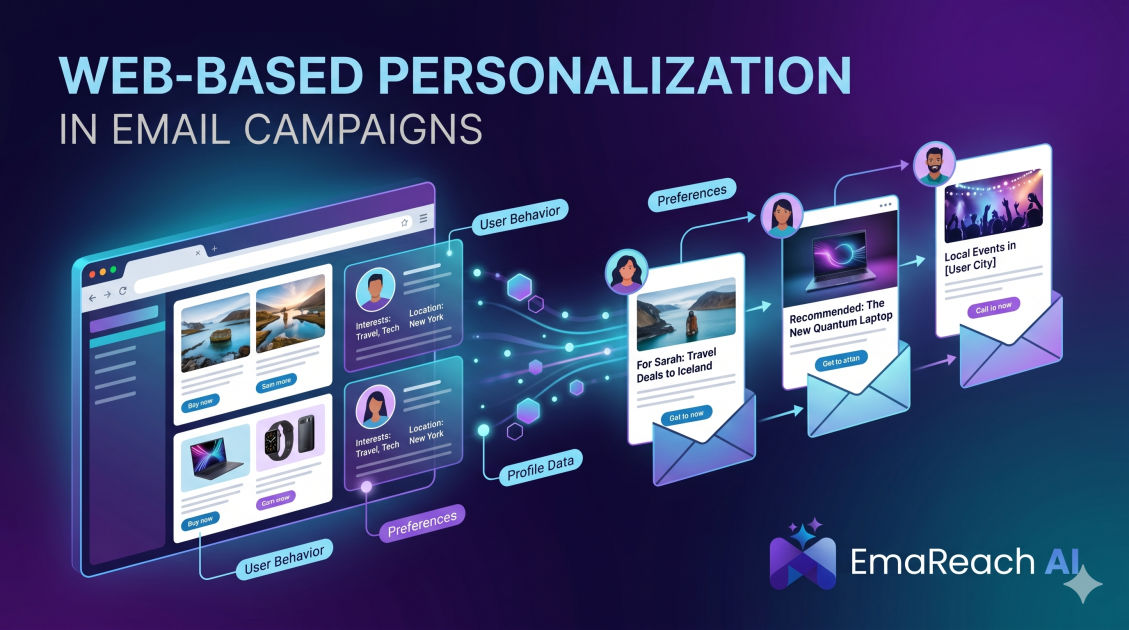
Web-Based Personalization in Email Campaigns
email marketingpersonalizationmarketing automationbehavioral trackingcustomer experienceconversion optimizationdigital strategy
Introduction to Web-Based Personalization
In the modern digital landscape, the inbox has become one of the most competitive environments for consumer attention. Businesses no longer compete merely with their direct rivals; they compete with every notification, social media alert, and personal message vying for a user’s time. Standard email marketing, once a revolutionary tool for reaching audiences at scale, has evolved. Static, one-size-fits-all broadcasts are increasingly ignored, filtered, or relegated to the promotions tab. The solution to this engagement crisis lies in Web-Based Personalization—a strategy that bridges the gap between a user’s behavior on a website and the content they receive in their inbox.
Web-based personalization in email is the practice of using real-time and historical data from a user’s web interactions to tailor the email experience. It moves beyond simply using a recipient's first name in the subject line. Instead, it leverages deep insights into what products a user viewed, how long they spent on specific pages, and their overall journey through a digital ecosystem to create a hyper-relevant communication loop.
The Evolution of Email Personalization
To understand where we are today, we must look at how personalization has progressed. Early email marketing relied on basic segmentation—dividing a list by gender, location, or broad interest categories. While effective at the time, these methods were reactive and often lacked the nuance required to resonate with individual needs.
As tracking technology improved, we moved into the era of transactional triggers. Abandoned cart emails became the gold standard, proving that sending an email based on a specific web action could yield significantly higher conversion rates than a standard newsletter. However, web-based personalization today goes much further. It integrates cross-channel data to predict future needs, provide personalized recommendations, and maintain a consistent brand voice that adapts to the user’s current stage in the buyer's journey.
The Shift from Static to Dynamic Content
Static content is fixed at the time of sending. Dynamic content, however, is generated at the moment the email is opened. By using web-based data, marketers can serve images, offers, and text that reflect the most current state of the brand’s website and the user’s relationship with it. This level of agility ensures that the email remains relevant even if several days pass between the send time and the open time.
Core Components of Web-Based Personalization
Successful web-based personalization relies on a robust infrastructure of data collection, analysis, and execution. There are three primary pillars that support this strategy:
1. Behavioral Tracking
Everything begins with the data layer. By implementing tracking scripts on a website, marketers can monitor user actions such as:
- Page Views: Which categories or topics is the user interested in?
- Dwell Time: How much interest do they have in a specific service or product?
- Search Queries: What specific problems are they trying to solve?
- Click Patterns: Which calls-to-action (CTAs) are most effective for this individual?
2. User Identity Resolution
To personalize an email, you must connect web behavior to an email address. This is typically achieved through 'identity resolution,' where a user’s browser cookie is linked to their profile in a Customer Data Platform (CDP) or Email Service Provider (ESP) once they log in or click through from a previous email.
3. Real-Time Data Processing
The value of web data diminishes over time. If a user spends twenty minutes looking at hiking boots on Tuesday, an email about those boots on Tuesday afternoon is highly relevant. On Friday, it might already be too late. Modern systems use real-time processing to trigger emails within minutes of a web interaction.
Strategies for Implementing Web-Based Personalization
Dynamic Product Recommendations
Using collaborative filtering and web history, you can populate an email with products that the user is likely to buy. If a user has been browsing mid-century modern furniture on your site, the next email they receive should feature those specific styles rather than a generic furniture sale. This mimics the personalized experience of a high-end retail store where the clerk remembers your preferences.
Content Customization Based on Lifecycle Stage
Your website knows if a visitor is a first-time guest or a long-time loyalist. Web-based personalization allows you to change the tone and content of your emails accordingly. A first-time visitor might receive an email highlighting the brand’s story and a welcome discount, while a returning customer might get an email focusing on loyalty rewards or advanced features of a product they already own.
Abandoned Browse Triggers
While abandoned cart emails are well-known, 'abandoned browse' is a more subtle and powerful tool. If a user explores a specific category page (like 'Men's Running Shoes') but never adds anything to their cart, a personalized email can be triggered to send them a curated list of top-rated items in that category, helping them move from the consideration phase to the intent phase.
The Role of AI in Personalization
Artificial Intelligence has moved web-based personalization from a set of 'if-this-then-that' rules to a sophisticated predictive engine. AI can analyze vast amounts of web data to identify patterns that a human marketer might miss. For example, it can determine the 'Optimal Send Time' for each individual based on when they typically browse the website, ensuring the email sits at the top of their inbox when they are most likely to be online.
When it comes to the technical side of outreach, especially in the B2B space, the quality of your personalized content is only as good as your ability to reach the inbox. This is where specialized platforms come into play. Stop Landing in Spam. Cold Emails That Reach the Inbox. EmaReach AI (https://www.emareach.com/) combines AI-written cold outreach with inbox warm-up and multi-account sending—so your emails land in the primary tab and get replies. By leveraging AI to craft the message and ensure deliverability, you bridge the gap between high-level web personalization and effective communication.
Integrating Web Events into Your Email Workflow
To make web-based personalization a reality, you need to map out your customer journey and identify 'high-intent' web events.
Step 1: Audit Your Website for Data Points
Identify which pages on your site signal a high probability of purchase or engagement. These usually include pricing pages, detailed product descriptions, and FAQ sections.
Step 2: Set Up Event Listeners
Use your marketing automation platform to listen for these specific events. When a user spends more than 60 seconds on a pricing page without converting, that is an event that should trigger a specific email workflow.
Step 3: Create Modular Email Templates
Personalization is difficult if every email has to be built from scratch. Instead, create modular templates where certain blocks (like the hero image or the product grid) are dynamic. These blocks will pull data from the web-tracking feed to display relevant content to each recipient.
Best Practices for Data Privacy and Transparency
While personalization is effective, it must be balanced with privacy. Modern consumers are savvy and can be put off by marketing that feels 'creepy.'
- Transparency: Always be clear about what data you are collecting and why.
- Value Exchange: Personalization should always provide value to the user. If an email feels helpful (e.g., 'Here is the guide you were looking at earlier'), it is viewed positively. If it feels like surveillance, it fails.
- Consent: Ensure that your web tracking complies with regional data protection regulations. Use first-party data (data you collect yourself) rather than relying on third-party cookies, which are increasingly being phased out by browsers.
The Technical Challenges of Real-Time Integration
Implementing web-based personalization is not without its hurdles. One of the biggest challenges is 'data silos'—where your website data and your email data live in different systems that don't talk to each other. Overcoming this requires a unified data layer.
Latency Issues
In the world of web-based personalization, speed is everything. If there is a delay of several hours between a web action and the email trigger, the context is lost. Marketers must ensure that their tech stack can handle high volumes of event data and trigger responses in near real-time.
Maintaining Data Accuracy
Users often switch devices. A user might browse your site on a mobile phone during a commute but check their email on a desktop later. Effective personalization requires 'cross-device tracking' to ensure that the email they see on their desktop reflects the browsing they did on their phone.
Metrics for Success in Personalized Campaigns
How do you know if your web-based personalization is working? Look beyond simple open rates.
- Click-to-Open Rate (CTOR): This measures how many people who opened the email actually clicked. High CTOR is a strong indicator that the personalized content was relevant.
- Conversion Rate per Session: Track how many users who clicked through from a personalized email completed a purchase compared to those from a generic email.
- Revenue per Email (RPE): This is the ultimate metric. Personalized emails almost always yield a higher RPE because they are targeted at users who have already shown intent on your website.
- Unsubscribe Rate: If your personalization is too aggressive or feels intrusive, your unsubscribe rate will climb. Monitoring this helps you find the right balance.
Looking Ahead: The Future of Web-Based Personalization
The future of this field lies in hyper-individualization. We are moving toward a 'segment of one,' where every single subscriber receives a unique email generated specifically for them by AI. We will see more integration with Augmented Reality (AR), where a user looking at a pair of glasses on a website might receive an email allowing them to virtually 'try them on' within the email client itself.
Furthermore, the integration of predictive analytics will allow brands to send 'anticipatory' emails. By analyzing web behavior over months, a brand might predict that a user is about to run out of a consumable product (like coffee or skincare) and send a personalized reorder reminder before the user even realizes they need it.
Conclusion
Web-based personalization is no longer an optional luxury for email marketers; it is a fundamental requirement for staying relevant. By closing the loop between what happens on your website and what arrives in the inbox, you create a seamless, helpful, and highly effective brand experience. It requires a shift in mindset—from thinking about 'campaigns' to thinking about 'conversations.' When you leverage real-time behavioral data, use AI to optimize delivery, and prioritize the user's needs, your email marketing becomes a powerful engine for growth, loyalty, and customer satisfaction. The technology is available; the data is there. The brands that succeed will be those that use these tools to build genuine connections with their audience, one personalized email at a time.
EmaReach AI
Ready to scale your cold email outreach?
Join thousands of teams using EmaReach AI for AI-powered campaigns, domain warmup, and 95%+ deliverability. Start free — no credit card required.
Related posts
- Read article
The Instantly Alternative That Finally Gets Outbound Analytics Right
Discover why high-volume cold email requires a shift from surface-level vanity metrics to deep, data-driven revenue attribution, and explore the ultimate alternatives for mastering outbound engineering.
- Read article
What You Gain and What You Give Up When Switching From Instantly
Thinking about migrating your cold email stack? This detailed guide breaks down the exact operational advantages you gain and the core features you sacrifice when switching away from Instantly's popular outreach platform.