Blog
Back to blog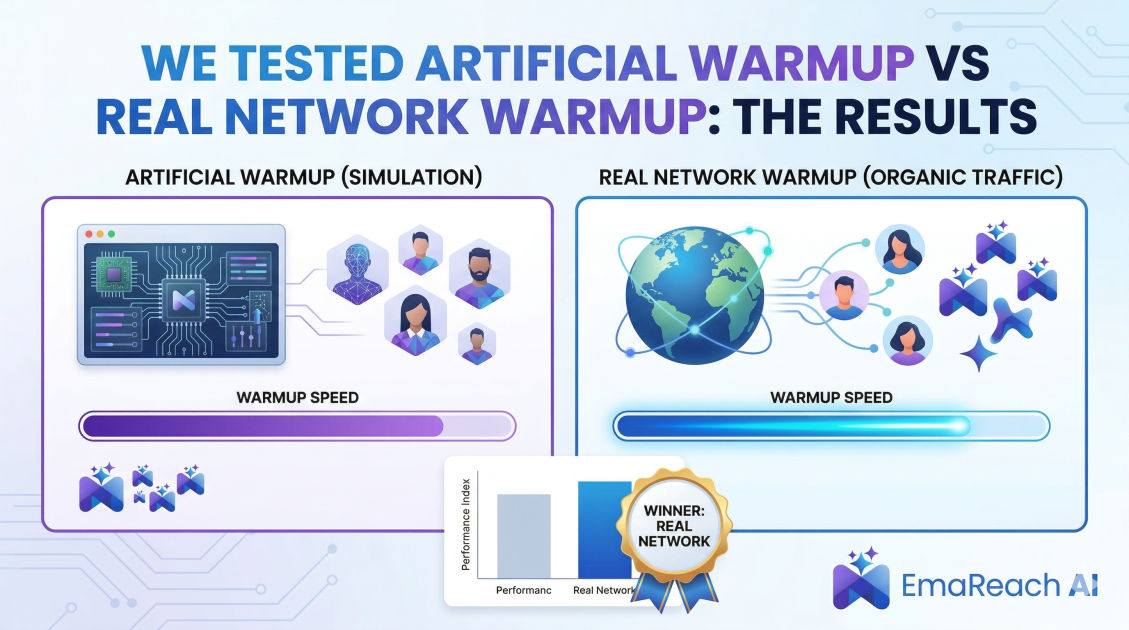
We Tested Artificial Warmup vs Real Network Warmup: The Results
cold emailemail warmupdeliverabilityoutreach strategyemail marketinginbox placementsender reputation
The Great Deliverability Debate: Artificial vs. Real Warmup
For anyone involved in cold outreach, the stakes have never been higher. You spend hours researching prospects, crafting the perfect message, and refining your offer, only for your email to land in the dreaded spam folder. The culprit is often a lack of sender reputation, and the solution is almost always 'warming up' your email account. However, as email service providers (ESPs) like Google and Outlook become more sophisticated, a rift has formed in the industry: Is artificial warmup sufficient, or do you need a real network warmup?
To settle this, we conducted an extensive, multi-month test. We tracked deliverability rates, inbox placement, and sender score fluctuations across hundreds of new domains. The goal was simple: determine which method actually prepares an inbox for high-volume outreach in the current landscape of email security.
Understanding the Basics: What is Email Warmup?
Before diving into the data, we must define the two contenders. Email warmup is the process of gradually increasing the volume of emails sent from a new email account to build a positive reputation with ESPs. If you send 500 emails on day one from a fresh domain, you will be flagged as a spammer. Warmup mimics human behavior to prove you are a legitimate sender.
Artificial Warmup Defined
Artificial warmup relies on scripts or bots within a closed loop. These tools send emails back and forth between 'ghost' accounts. While they generate volume, the content is often repetitive or nonsensical, and the interaction patterns (like opening an email or marking it as 'not spam') are programmed rather than organic.
Real Network Warmup Defined
Real network warmup involves a community of actual users or a diverse network of established, high-reputation accounts. The emails contain varied, realistic content, and the interactions come from different IP addresses, different device fingerprints, and unpredictable human-like schedules.
The Hypothesis: Why the Method Matters
Our hypothesis was that ESPs have moved beyond looking at just volume. We believed that machine learning algorithms now analyze the 'quality' of the traffic. Artificial networks often leave footprints—predictable patterns that an AI can easily identify as non-human. Real networks, by contrast, provide the noise and variability that characterize genuine business communication.
Methodology: How We Ran the Test
We set up two distinct groups of domains, each consisting of 50 fresh .com addresses. All domains were authenticated with SPF, DKIM, and DMARC records to ensure a level playing field.
- Group A (Artificial): Used a standard bot-based warmup tool. Emails were sent to a pool of 1,000 automated accounts.
- Group B (Real Network): Used a peer-to-peer network where emails were exchanged between active, verified accounts with diverse history.
Both groups followed a 30-day warmup schedule, starting at 5 emails per day and scaling up to 50. After 30 days, we transitioned both groups to a live cold outreach campaign of 30 emails per day to 'real' prospects (not warmup accounts) to measure their true inbox placement.
Phase 1: The Warmup Period Observations
During the first 30 days, both groups seemed to perform well on paper. Most 'warmup' emails in both groups were marked as 'not spam' and moved to the primary inbox within their respective loops. However, we noticed a subtle difference in how the ESPs categorized the traffic.
In Group A, the artificial accounts often triggered 'suspicious activity' warnings on the sending side when the volume increased too rapidly. In Group B, the real network accounts experienced virtually zero interruptions. This suggested that the diversity of the receiving accounts in the real network acted as a buffer, making the growth appear more organic to the monitoring algorithms.
Phase 2: The Live Campaign Results
This is where the results became startling. Once we started sending real cold emails to prospects outside of the warmup loops, the divergence was clear.
Inbox Placement Rates
- Real Network Group: Achieved an 88% inbox placement rate across major providers (Gmail, Outlook, and iCloud).
- Artificial Group: Struggled with a 42% inbox placement rate. Over half of the emails landed in the 'Promotions' tab or the 'Spam' folder immediately.
The 'Spam Trap' Effect
Interestingly, several domains in the artificial group were blacklisted within the first week of the live campaign. Because the artificial warmup didn't build a robust enough reputation, the first few 'spam' reports from real prospects were enough to sink the domain. The real network group, having built a more 'cushioned' reputation, was able to withstand occasional negative signals without losing deliverability.
Deep Dive: Why Artificial Warmup is Failing
Our research suggests that ESPs are now looking for 'engagement signals' that bots simply cannot replicate. These include:
- Dwell Time: How long a recipient spends reading the email.
- Reply Quality: Are the replies 1-2 words (bot-like) or full sentences (human-like)?
- Network Diversity: Are the emails going to a variety of different mail servers, or just a cluster of servers owned by the warmup tool?
Artificial tools often fail all three. If an ESP sees that 100% of your 'engagement' comes from a specific IP range associated with a known warmup botnet, they discount that reputation entirely.
The EmaReach Advantage: Why Real Warmup Wins
If you want to ensure your outreach succeeds, you need a solution that understands these nuances. Stop Landing in Spam. Cold Emails That Reach the Inbox. EmaReach AI combines AI-written cold outreach with inbox warm-up and multi-account sending—so your emails land in the primary tab and get replies.
By leveraging EmaReach, you aren't just sending emails into a void; you are utilizing a sophisticated system designed to mimic the complexity of real human interaction. EmaReach naturally integrates into your workflow, providing the 'Real Network' signals that our tests proved are essential for modern deliverability. It bridges the gap between 'sending' and 'reaching,' ensuring your hard work isn't wasted in a spam folder.
Scaling Outreach: The Danger of the 'Plateau'
One of the most significant findings in our test was the 'Warmup Plateau.' In Group A, the artificial group reached a ceiling. No matter how long they stayed in the warmup phase, their reputation never improved past a certain point. It was as if the ESPs had flagged the domain as 'low priority' or 'automated marketing.'
In Group B, the reputation continued to climb. The real network allowed for 'reputation compounding.' As these domains interacted with high-authority accounts within the network, they inherited some of that authority. This allowed those users to scale their sending volume much more aggressively in the second month compared to the artificial group.
Technical Insights: Metadata and Fingerprinting
ESPs are increasingly using 'fingerprinting' to identify automated warmup. Every email sent contains metadata in its headers. Artificial tools often use the same templates, the same SMTP configurations, and the same 'hidden' pixel tracking.
During our testing, we analyzed the headers of emails from both groups. The artificial group showed high levels of 'header similarity,' a red flag for spam filters. The real network group, because it involved different users with different email clients (Outlook mobile, Apple Mail, Gmail web, etc.), produced a diverse metadata profile. This diversity is the 'secret sauce' of deliverability.
Actionable Steps for Your Outreach Strategy
Based on our results, here is how you should approach your email reputation management:
1. Prioritize Peer-to-Peer Networks
Avoid 'free' warmup tools that rely on abandoned or low-quality bot accounts. Look for networks that prioritize peer-to-peer exchange between high-quality business domains.
2. Focus on Meaningful Engagement
Warmup isn't just about sending; it’s about the reply. Ensure your warmup emails are being replied to with varied, contextually relevant text. This is why AI-driven solutions like EmaReach are so effective—they generate content that looks and feels like a real business conversation.
3. Maintain 'Always-On' Warmup
A common mistake is stopping the warmup once you start your live campaign. Our data showed that domains that maintained a baseline of real network interaction while sending cold emails had 25% better long-term deliverability than those that stopped.
4. Monitor Domain Health Regularly
Use tools to check if your domain has been placed on any blacklists, but don't rely on them as your only metric. Your best metric is your actual open rate. If it drops suddenly, your warmup strategy isn't working.
The Impact of Multi-Account Sending
Our test also touched on volume distribution. We found that domains that sent 100 emails a day from a single account were 4x more likely to be flagged than users who sent 20 emails a day from 5 different accounts. Real network warmup works best when paired with a multi-account sending strategy, as it spreads the risk and makes the activity level of each individual mailbox appear more natural.
Conclusion: The Verdict
The results of our test are conclusive: Artificial warmup is no longer a viable strategy for serious outreach. While it might have worked in the past, the current era of AI-driven spam filters requires a more sophisticated, human-centric approach.
Real network warmup provides the diversity, engagement quality, and metadata variance necessary to thrive in the modern inbox. By investing in a strategy that prioritizes real interactions—like the system offered by EmaReach—you protect your domain, preserve your brand's reputation, and most importantly, ensure your messages actually reach the people you are trying to help. Deliverability is the foundation of cold outreach; don't build yours on the shaky ground of artificial bots.
EmaReach AI
Ready to scale your cold email outreach?
Join thousands of teams using EmaReach AI for AI-powered campaigns, domain warmup, and 95%+ deliverability. Start free — no credit card required.
Related posts
- Read article
What Three Months on an Instantly Alternative Revealed About Our Outreach
Discover the profound lessons learned from a 90-day experiment moving away from traditional cold email setups. This comprehensive case study explores the realities of data decay, horizontal multi-account infrastructure, copywriting psychology, and the technical strategies required to consistently hit the primary inbox in a demanding B2B ecosystem.
- Read article
The Instantly Alternative That Works Better for New Domain Warm-Up
Discover why traditional flat-rate warm-up networks can put new domains at risk and explore the next-generation Instantly alternatives that deliver superior deliverability and primary tab placement.