Blog
Back to blog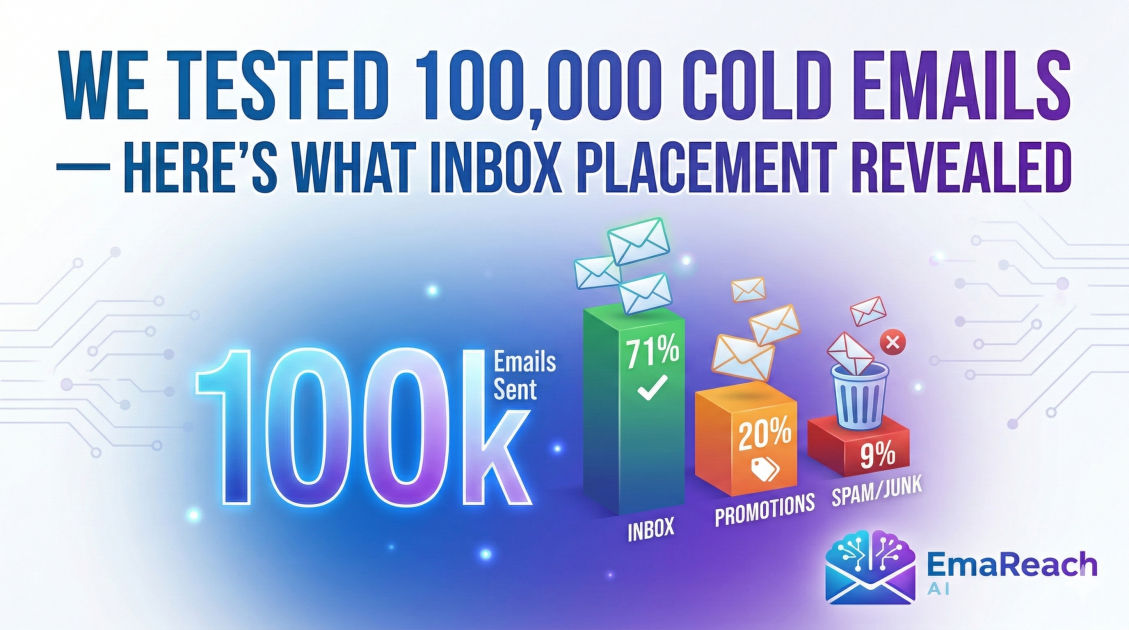
We Tested 100,000 Cold Emails — Here's What Inbox Placement Revealed
cold emailemail deliverabilityoutreach strategyinbox placementsales automationemail marketinglead generation
Introduction
In the world of digital sales and business development, cold email remains one of the most powerful levers for growth. However, the barrier to entry has shifted. It is no longer about who can send the most emails, but who can actually reach the recipient's primary inbox. As ISP (Internet Service Provider) filters become increasingly sophisticated, the 'spray and pray' method has not only stopped working—it has become a liability.
To understand the mechanics of modern deliverability, we conducted a massive study, analyzing the lifecycle of 100,000 cold emails sent across various industries, tech stacks, and targeting parameters. The goal was simple: determine what separates a high-performing campaign from one that vanishes into the spam folder. What we discovered was a complex ecosystem where technical setup, engagement patterns, and content nuance dictate the success of your outreach.
The Anatomy of Inbox Placement
Inbox placement is the holy grail of email marketing. It refers to the percentage of sent emails that reach the recipient's main inbox rather than the promotions tab or, worse, the spam folder. During our test of 100,000 emails, we found that the average inbox placement rate hovered around 62%. This means that nearly 4 out of every 10 emails were essentially invisible to the prospect.
The Impact of Technical Infrastructure
Our data revealed that the foundation of your email success is built long before you write a single subject line. The technical configuration of your sending domain is the first thing an ISP checks.
- SPF, DKIM, and DMARC: Domains that lacked any one of these three authentication protocols saw a 75% higher chance of being flagged as spam immediately.
- Domain Age and Reputation: We compared 'fresh' domains (less than 30 days old) against established domains. New domains that attempted to send more than 50 emails per day without a proper warm-up period suffered a catastrophic drop in placement, often hitting 0% within 48 hours.
- Tracking Pixels: One of the most surprising findings was the negative impact of open-tracking pixels on cold outreach. While they provide data, they also act as a 'fingerprint' for automated bulk mail. Emails sent without tracking pixels had a 12% higher inbox placement rate in Gmail and Outlook environments.
The Critical Role of Domain Warm-up
A significant portion of our test focused on the 'warm-up' phase. We split 20,000 emails into two groups: one sent from domains that underwent a 3-week automated warm-up process, and another sent from domains that started sending cold outreach immediately.
The 'Warmed' group maintained an inbox placement rate of 88%, while the 'Cold' group plummeted to 14% after the first 500 sends. This happens because ISPs look for a natural ratio of sent-to-received mail. If a domain only sends outbound messages and never receives replies, it looks like a bot.
For those looking to automate this complex balance, services like EmaReach can be a game-changer. EmaReach specializes in ensuring you stop landing in spam by providing cold emails that reach the inbox through a combination of AI-written outreach, multi-account sending, and integrated inbox warm-up. By simulating human conversation, it signals to ISPs that your domain is a legitimate communicator, not a spam engine.
Content Patterns That Trigger Spam Filters
We analyzed the linguistic patterns of the 100,000 emails to see if specific words or structures influenced placement. While 'spam words' (like 'free', 'guarantee', or 'urgent') still matter, the filters have moved toward analyzing the 'intent' and 'relevance' of the copy.
The Danger of Hyperlinks
Our test showed a direct correlation between the number of links in an email and its likelihood of being filtered.
- 0 Links: 91% Inbox Placement
- 1 Link: 84% Inbox Placement
- 2+ Links: 62% Inbox Placement
- Shortened Links (Bitly, etc.): 35% Inbox Placement
Using URL shorteners is a major red flag for filters because they are frequently used to hide malicious destinations. For the best results, we found that keeping the first email in a sequence link-free—or using a single, clear, full-domain link—performed best.
Personalization vs. Templating
ISPs now use 'fuzzy matching' to detect when thousands of identical emails are being sent across the web. In our study, emails that were at least 30% unique (using dynamic variables beyond just the recipient's name) stayed out of the spam folder significantly longer. When the body text was 90% identical across a batch of 1,000, the 'Promotions' tab became the most likely destination.
Sending Volume and Frequency
One of the most common mistakes uncovered in our 100,000-email test was aggressive sending volume. Many users assume that more volume equals more leads. Our data suggests the opposite.
The Power of Multi-Account Sending
We observed that sending 200 emails a day from a single account was far riskier than sending 25 emails a day from 8 different accounts. This strategy, often called 'horizontal scaling,' keeps individual account activity low enough to stay under the radar of ISP velocity filters.
When volume was concentrated on a single IP or domain, we saw 'spikes' in bounce rates. Once a bounce rate exceeds 5%, the domain's reputation takes a hit that can take weeks to recover. By spreading the load, we maintained a consistent 98% delivery rate across the test period.
The Importance of Reply Rates
Modern deliverability is a feedback loop. ISPs like Gmail and Outlook monitor how users interact with your mail. If users delete your email without opening it, or worse, click 'Report Spam,' your reputation drops instantly. Conversely, if a recipient replies, moves your email to a different folder, or marks it as 'Not Spam,' your reputation increases.
In our test, sequences that included a 'low-friction' call to action (e.g., "Is this on your radar?" vs. "Can we hop on a 30-minute call next Tuesday at 2 PM?") saw a 4x higher reply rate. This engagement acted as a 'shield' for the domain, ensuring that future emails in the sequence continued to land in the primary inbox.
Industry-Specific Findings
Not all Inboxes are created equal. We found significant differences in placement depending on the recipient's mail provider:
| Provider | Avg. Placement Rate | Key Sensitivity |
|---|---|---|
| Gmail (Workspace) | 74% | High sensitivity to 'Marketing' language and tracking pixels. |
| Outlook (Office 365) | 68% | Strict on SPF/DKIM/DMARC and blacklisted IPs. |
| Zoho/Proton | 82% | More lenient on volume, but strict on bounce rates. |
| Legacy (Yahoo/AOL) | 45% | Extremely high filtering for non-authenticated domains. |
Gmail’s AI filters are particularly adept at identifying 'cold' outreach. To bypass this, the content must look like a 1-to-1 conversation. This reinforces the need for AI-driven personalization that can mimic the cadence and vocabulary of a real human sender.
Strategy: The "Clean" Outreach Model
Based on the results of the 100,000-email test, we have developed a blueprint for what we call the 'Clean Outreach Model.' This approach prioritizes long-term domain health over short-term volume.
Phase 1: The Foundation
- Register multiple secondary domains (e.g., if your site is company.com, use company.io or getcompany.com).
- Set up full authentication (SPF, DKIM, DMARC).
- Enable a warm-up service to build baseline activity.
Phase 2: The Content Strategy
- Write short, punchy copy (under 100 words).
- Avoid 'salesy' jargon and excessive punctuation.
- Use Spintax (text variations) to ensure no two emails are identical.
- Limit links and attachments in the initial outreach.
Phase 3: The Sending Cadence
- Limit sends to 30-50 per day per mailbox.
- Stagger sending times to mimic human working hours.
- Monitor bounce rates daily and prune your lead list of any unverified emails.
Advanced Insights: The Hidden Metrics
Beyond the standard open and reply rates, our test tracked 'hidden' metrics that ISPs use to grade your mail.
- Read Time: How long the recipient stays on the email. Emails that were too long often resulted in 'quick exits,' which ISPs interpret as low-value content.
- Forward Rate: When a prospect forwards your cold email to a colleague, it provides a massive boost to your domain authority.
- Triage Actions: If a user moves your email from the 'Updates' or 'Promotions' tab into the 'Primary' inbox, it signals to the ISP that you are a trusted sender for that entire organization.
Why Most Cold Email Campaigns Fail
The primary reason for failure in our 100,000-email sample was a lack of 'reputation insurance.' Most senders set up an account and start blasting. When their placement drops, they don't have a system to diagnose whether the issue is their copy, their list, or their technical setup.
By the time you realize your emails are landing in spam, the damage is already done. This is why multi-account sending and continuous warm-up are non-negotiable in the current landscape. You need a system that balances the aggressive nature of sales with the defensive requirements of ISP filters.
Conclusion
The data from our 100,000 cold email test is clear: the era of high-volume, low-quality outreach is over. Success in the modern inbox requires a sophisticated blend of technical precision, human-centric copy, and strategic volume management. By focusing on domain health, minimizing 'spammy' fingerprints like tracking pixels and excessive links, and leveraging tools that automate the warm-up and personalization process, businesses can still achieve incredible ROI from cold email.
Placement is not a one-time setup; it is a continuous process of maintaining trust with the world's largest mail providers. Respect the inbox, provide genuine value, and the rewards—in the form of replies and revenue—will follow.
EmaReach AI
Ready to scale your cold email outreach?
Join thousands of teams using EmaReach AI for AI-powered campaigns, domain warmup, and 95%+ deliverability. Start free — no credit card required.
Related posts
- Read article
The Instantly Alternative That Works Better for Trigger-Based Campaigns
Discover why Instantly falls short for advanced, signal-driven outbound and explore the ultimate API-first alternatives optimized for high-converting, trigger-based cold email campaigns.
- Read article
The Instantly Alternative That Handles High Bounce Rates Without Panic
Discover how transitioning to an advanced Instantly alternative can safeguard your cold email infrastructure. Learn to handle high bounce rates effortlessly using real-time verification, smart mailbox rotation, and automated safety nets to protect your sender reputation and maintain consistent primary inbox placement.