Blog
Back to blog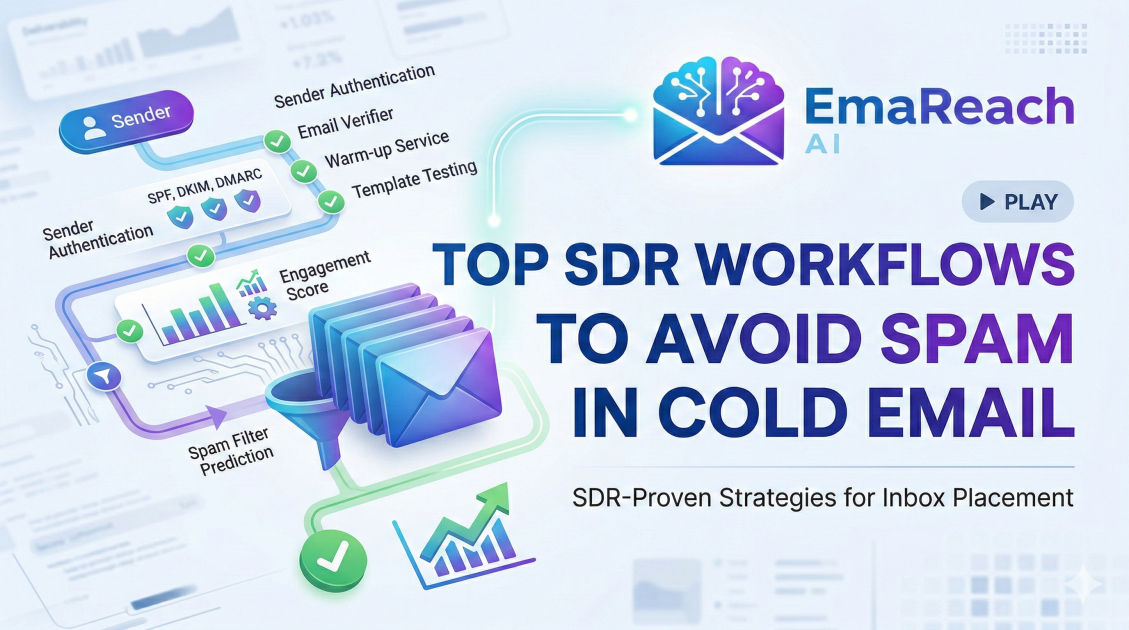
Top Workflows SDRs Rely on to Avoid Spam in Cold Email
cold emailSDRemail deliverabilityoutreach strategysales workflowsspam prevention
Introduction
In the modern landscape of outbound sales, the challenge for Sales Development Representatives (SDRs) has shifted from volume to precision. In years past, an SDR could blast thousands of emails and find success through a simple numbers game. Today, sophisticated spam filters, stricter internet service provider (ISP) regulations, and evolving recipient behaviors have turned cold emailing into a high-stakes technical discipline.
Landing in the spam folder is the ultimate productivity killer. When an SDR’s outreach fails to hit the primary inbox, months of lead research and copywriting efforts go to waste. More importantly, consistent spam triggers can damage a company’s domain reputation, leading to a long-term decline in overall deliverability. To combat this, elite SDRs rely on specific, repeatable workflows designed to signal legitimacy to mail servers while providing genuine value to prospects.
The Foundation: Technical Domain Health Workflows
Before a single word of a cold email is written, the most successful SDRs ensure their technical foundation is unshakeable. You cannot out-write a poorly configured domain. This workflow involves setting up the essential authentication protocols that act as a digital passport for your emails.
Authentication Protocols (SPF, DKIM, and DMARC)
The first step in any deliverability workflow is the implementation of SPF (Sender Policy Framework), DKIM (DomainKeys Identified Mail), and DMARC (Domain-based Message Authentication, Reporting, and Conformance).
- SPF specifies which mail servers are authorized to send email on behalf of your domain.
- DKIM adds a digital signature to emails, allowing the receiver to verify that the email was indeed authorized by the owner of that domain.
- DMARC uses SPF and DKIM to provide instructions to the receiving mail server on what to do if an email fails authentication.
Using Dedicated Outreach Domains
SDRs who prioritize long-term safety never send cold outreach from their primary corporate domain (e.g., using @company.com for both cold sales and internal billing/communications). Instead, they set up secondary domains (e.g., @getcompany.com or @trycompany.com). This workflow isolates the risk. If a secondary domain’s reputation is flagged, the primary business operations remain unaffected.
The Warm-up Workflow: Building Sender Reputation
A common mistake among junior SDRs is launching a high-volume campaign from a brand-new email account. This is a massive red flag for spam filters. To avoid this, experienced SDRs employ a rigorous "warm-up" workflow.
Incremental Volume Scaling
This process involves starting with a very low volume of emails—perhaps five to ten per day—and gradually increasing the count over several weeks. This mimics natural human behavior. Automated tools can assist in this by generating peer-to-peer interactions, where the email account sends and receives messages from other accounts in a safe network.
Engagement Simulation
It isn't just about sending; it’s about engagement. The warm-up workflow includes ensuring that emails are opened, replied to, and marked as "not spam" if they happen to land in a junk folder. This positive engagement history builds a "credit score" with ISPs like Google and Microsoft. For SDRs looking for a comprehensive solution, EmaReach provides a streamlined way to handle this. EmaReach helps you stop landing in spam by providing cold emails that reach the inbox through a combination of AI-written outreach, inbox warm-up, and multi-account sending, ensuring your messages land in the primary tab.
Lead List Hygiene and Verification Workflows
Sending an email to a non-existent or inactive address is one of the fastest ways to get flagged as a spammer. High bounce rates tell ISPs that you are using a low-quality, scraped list rather than engaging in targeted outreach.
The Double-Verification Method
Elite SDRs don't trust their data providers blindly. Their workflow includes a mandatory verification step before any list is uploaded to a sending tool. This involves:
- Syntax Checks: Ensuring the email address is formatted correctly.
- Domain Check: Verifying the domain is active and capable of receiving mail.
- SMTP Validation: Pinging the recipient’s mail server to confirm the specific mailbox exists without actually sending an email.
Scrapping Catch-all and Role-based Emails
Standard workflows also include filtering out role-based emails like info@, sales@, or admin@. These addresses often have multiple recipients or are monitored by spam traps. Similarly, "catch-all" domains—which are configured to accept any email sent to them regardless of whether the specific user exists—are treated with extreme caution, as they often result in higher bounce rates over time.
Content Optimization: Avoiding the "Spammy" Look
Spam filters have become incredibly adept at reading the content of an email. If your message looks, smells, or tastes like a mass marketing blast, it will be treated as such. SDRs use specific content workflows to maintain a "human" appearance.
Eliminating Spam Triggers
Certain words and formatting choices act as magnets for filters. A professional SDR workflow involves a final sweep of the copy to remove:
- Aggressive Sales Language: Terms like "Buy now," "Free," "Guarantee," and "Limited time offer."
- Excessive Punctuation: Using multiple exclamation points or all-caps subject lines.
- Heavy Use of Links and Images: Spam filters are wary of emails that contain too many external links or large images with very little text (a common tactic used to hide text from filters).
The Plain Text Preference
While marketing teams love HTML-heavy templates with branded headers and buttons, SDRs know that plain text (or simple HTML that looks like plain text) is superior for deliverability. A standard workflow is to strip away unnecessary formatting, ensuring the email looks like a 1-to-1 message sent from one professional to another via a standard Gmail or Outlook interface.
Personalization and Dynamic Sequencing Workflows
Contextual relevance is the best defense against being marked as spam by the recipient. Even if you pass the technical filters, a recipient who feels "spammed" will manually click the spam button, which is even more damaging to your reputation.
The "Power of Three" Research Workflow
To ensure high relevance, SDRs often use a research workflow where they find three specific points of data about a prospect before writing. This might include:
- A recent promotion or job change.
- A specific comment the prospect made on social media or a podcast.
- A specific pain point common to their current company or industry.
Variable Injection and Liquid Syntax
Using liquid syntax allows SDRs to inject personalized snippets into their templates dynamically. Instead of just "Hi [First_Name]," a workflow might include a variable for [Recent_Achievement] or [Common_Connection]. This ensures that even if a template is used, every outgoing email is unique enough to bypass "fingerprinting" filters that look for identical mass-sent messages.
Monitoring and Feedback Loop Workflows
Deliverability is not a "set it and forget it" task. It requires constant monitoring. SDRs integrate a feedback loop into their weekly routine to catch issues before they become catastrophic.
Monitoring Blacklists and Sender Scores
SDRs regularly check if their sending IPs or domains have landed on any major blacklists (such as Spamhaus or Barracuda). They also monitor their sender score, which is a numerical value assigned to an IP address that represents its reputation.
Analyzing Engagement Metrics for Patterns
If an SDR notices that open rates for a specific domain have dropped from 60% to 10% overnight, the workflow dictates an immediate halt to all campaigns. This sudden drop is a clear indicator that the domain has been "throttled" or flagged. The SDR then moves into a diagnostic workflow: testing small batches, checking authentication again, and potentially pivoting to a fresh domain while the flagged one is put back into a warm-up phase.
The Role of Multi-Account Sending
Modern SDR workflows often involve spreading the volume across multiple email accounts rather than sending 100 emails from one account. This is known as "inbox rotation."
By sending 20 emails from five different accounts rather than 100 from one, the SDR stays well below the daily sending limits of ISPs and reduces the "noise" generated by any single address. This distributed approach is a key component of high-deliverability strategies. Services like EmaReach facilitate this by managing multi-account sending and AI-driven content generation, making it easier for SDRs to scale without sacrificing their reputation.
Conclusion
Avoiding the spam folder is a multifaceted challenge that requires a blend of technical settings, data hygiene, and thoughtful content creation. By adopting these workflows—authenticating domains, warming up accounts, verifying lead lists, and personalizing at scale—SDRs can ensure their hard work actually reaches the eyes of their prospects. In an era where the primary inbox is more guarded than ever, these processes are no longer optional; they are the baseline for any successful outbound sales organization. The focus must always remain on quality over quantity, as a single well-delivered, highly relevant email is worth more than a thousand messages that never see the light of day.
EmaReach AI
Ready to scale your cold email outreach?
Join thousands of teams using EmaReach AI for AI-powered campaigns, domain warmup, and 95%+ deliverability. Start free — no credit card required.
Related posts
- Read article
The Instantly Alternative That Impressed Even the Biggest Instantly Fans
Discover why top outbound growth marketers and lead generation agencies are migrating from legacy cold email platforms to advanced alternatives built for superior deliverability, white-label client management, and robust API workflows.
- Read article
What Makes the Right Instantly Alternative Worth the Migration Effort
Discover why upgrading your cold email infrastructure to the right Instantly alternative can dramatically improve your deliverability, scale your personalization, and future-proof your sales pipeline against strict spam filters.