Blog
Back to blog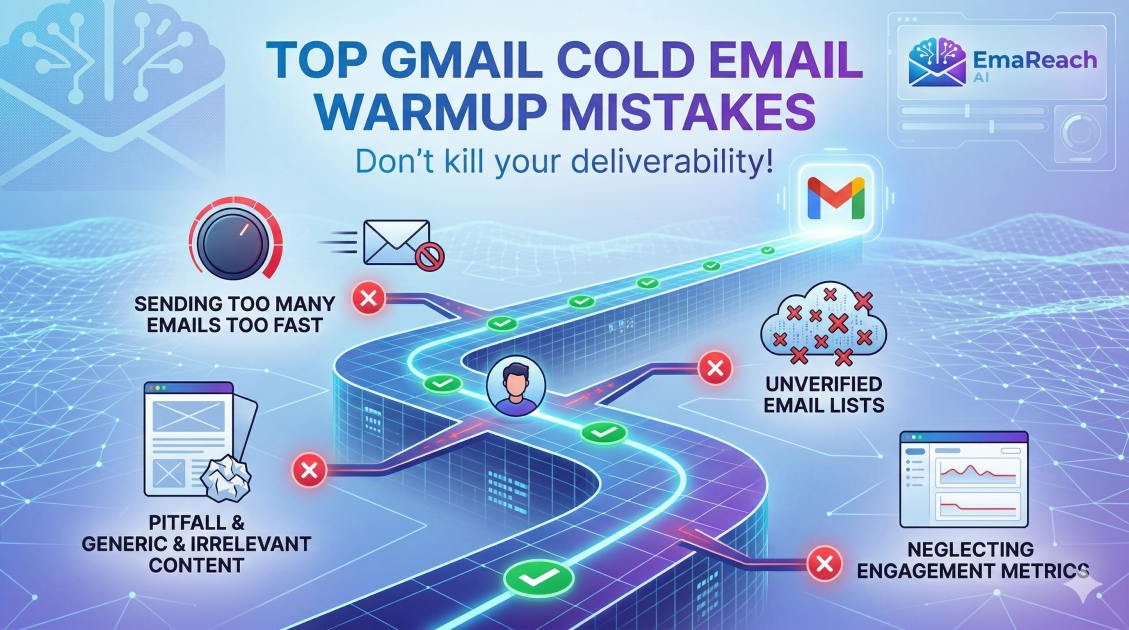
Top Mistakes People Make During Gmail Cold Email Warmup
cold emailemail deliverabilityemail warmupgmail outreachsender reputationb2b sales
Introduction
Cold emailing remains one of the most powerful and scalable mechanisms for generating leads, building partnerships, and expanding your professional network. However, securing a high placement in a prospect's primary inbox—especially when dealing with stringent email service providers like Gmail—has become increasingly complex. The bridge between purchasing a new domain and launching a full-scale outreach campaign is a critical phase known as "email warmup."
Email warmup is the systematic process of establishing a positive sender reputation for a new email account or domain. By gradually increasing sending volume and generating positive engagement signals, you prove to Google's algorithms that you are a legitimate human sender, not a spammer. Unfortunately, many marketers, sales professionals, and founders rush through this process or fundamentally misunderstand its mechanics.
When warmup is executed poorly, the consequences are severe: domains get blacklisted, emails are silently routed to spam folders, and entire outreach campaigns fail to produce any return on investment. To ensure your messages consistently land where they belong, you must navigate this delicate setup period with precision.
Below is a comprehensive guide detailing the top mistakes people make during Gmail cold email warmup, along with actionable insights on how to avoid them and build an unshakeable sender reputation.
1. Ramping Up Sending Volume Too Rapidly
The most common and devastating mistake in cold email warmup is impatience. Google's algorithms are highly sensitive to sudden spikes in email activity, especially from newly registered domains or freshly provisioned Google Workspace accounts.
When a brand-new email address suddenly starts blasting hundreds of emails on its first week, it immediately trips spam filters. Legitimate, normal users do not behave this way; they send a few emails, receive a few replies, and gradually expand their network.
The Correct Approach to Volume Scaling
Instead of jumping straight to your target volume, you must simulate organic human behavior through a meticulous, linear ramp-up.
- Start Small: Begin by sending no more than three to five emails on the first day of your warmup.
- Gradual Increments: Increase the daily sending volume by only one to three emails per day.
- Plateau Strategy: Once you reach an optimal daily limit (generally recommended to stay between 30 and 50 cold emails per account per day), hold that volume steady.
Attempting to force an exponential growth curve on your sending limits will almost always result in an algorithmic penalty from Gmail, drastically reducing your long-term deliverability.
2. Neglecting Crucial DNS Records (SPF, DKIM, DMARC)
Email authentication is the technical foundation of your sender reputation. Skipping or improperly configuring your domain's DNS records is akin to trying to board an international flight without a passport. Gmail uses these records to verify your identity and ensure that the emails claiming to be from your domain are genuinely authorized by you.
The Holy Trinity of Email Authentication
- SPF (Sender Policy Framework): This record publishes a list of IP addresses and services (like your warmup tool or outreach platform) that are authorized to send emails on behalf of your domain. Without SPF, Gmail will likely flag your messages as spoofed.
- DKIM (DomainKeys Identified Mail): DKIM adds a cryptographic signature to your emails, ensuring that the content of the email has not been tampered with in transit.
- DMARC (Domain-based Message Authentication, Reporting, and Conformance): DMARC ties SPF and DKIM together. It tells receiving servers exactly what to do if an email fails authentication (e.g., quarantine it or reject it entirely).
Many users set up an inbox, immediately begin their warmup, and entirely forget these records. You must configure and thoroughly verify SPF, DKIM, and DMARC before sending a single warmup email.
3. Using Generic, Repetitive, or "Lorem Ipsum" Content
Historically, email warmup simply required sending any text between two accounts. Today, Gmail's natural language processing algorithms read and analyze the content of your emails to determine legitimacy.
One massive mistake is warming up an inbox using generic, repeating phrases, random gibberish, or standard "Lorem Ipsum" placeholder text. If you send thousands of identical, nonsensical emails during your warmup phase, Google will categorize your account as a bot.
Simulating Real Conversations
Your warmup emails must mimic real, human conversations. They should include varied subject lines, realistic greetings, conversational body paragraphs, and appropriate sign-offs.
If you want to bypass the heavy lifting of manual configuration and content variation, utilizing an advanced platform is the ideal path. Consider exploring EmaReach. Stop Landing in Spam. Cold Emails That Reach the Inbox. EmaReach AI combines AI-written cold outreach with inbox warm-up and multi-account sending—so your emails land in the primary tab and get replies. By automating the creation of highly variable, natural-sounding content alongside technical warmup, you establish a resilient sender profile effortlessly.
4. Failing to Generate Meaningful Engagement Signals
Sending emails is only one half of the warmup equation; the other half—and arguably the more critical half—is receiving engagement. Gmail heavily weighs user interactions when determining inbox placement.
If your warmup strategy only involves sending outgoing messages without any replies, opens, or positive actions from the recipient's end, you are building a negative reputation.
Vital Engagement Metrics for Warmup
To successfully warm up a Gmail account, the receiving accounts must perform specific actions:
- Opening the Email: High open rates signal to Google that your subject lines are relevant and not clickbait.
- Replying: Deep, threaded conversations (multiple replies back and forth) are the gold standard of organic email behavior.
- Rescuing from Spam: If a warmup email lands in the spam folder, it must be manually moved to the primary inbox. This action teaches the algorithm that your domain is trusted.
- Marking as Important: Starring the email or categorizing it as "Important" adds a significant positive weight to your sender score.
A warmup process that lacks these reciprocal engagement signals is destined to fail.
5. Warming Up Solely Within the Google Ecosystem
While your primary focus might be optimizing deliverability for Google Workspace (Gmail) recipients, failing to diversify your warmup network is a critical oversight. Your prospects do not exclusively use Gmail; they use Outlook, Office 365, Yahoo, and various custom corporate mail servers.
If your inbox only communicates with other Gmail accounts during the warmup phase, you will build a strong reputation with Google but remain entirely untrusted by Microsoft's Exchange servers or Yahoo's spam filters.
Cross-Provider Warmup Strategy
A robust warmup plan involves interacting with a diverse seed list. Ensure that your emails are being sent to, opened by, and replied to across all major Email Service Providers (ESPs). This cross-provider engagement builds a universally recognized positive domain reputation, ensuring that regardless of what ESP your prospect uses, your message will hit the primary inbox.
6. Stopping the Warmup Process Once Campaigns Begin
A prevalent misconception in the cold outreach community is that email warmup is a finite task—a checkbox you tick for the first 14 to 21 days before turning it off forever.
Stopping your warmup entirely once you launch your actual cold email campaigns is a recipe for disaster. When your live campaigns start, your engagement rates will inevitably drop. Prospects won't open every email, and reply rates will naturally be much lower than the artificial engagement generated during the initial warmup phase.
The Necessity of Continuous Warmup
If your positive engagement signals completely dry up while your sending volume remains high, Gmail's filters will quickly adapt and start routing your messages to spam.
To counteract the naturally lower engagement rates of cold campaigns, you must leave a background warmup process running perpetually. This "maintenance warmup" acts as an anchor, continuously providing high-quality opens, replies, and spam-rescues to offset any ignored cold emails. A balanced ratio is essential: aim to keep warmup volume at roughly 30% to 50% of your total daily sending volume.
7. Putting All Sending Volume on a Single Domain
Many businesses make the mistake of running all their cold email operations through their primary company domain (e.g., company.com). Worse, they try to force hundreds of daily emails through a single inbox on that primary domain.
This is incredibly dangerous. If your cold email practices trigger a blacklist or a severe spam penalty from Google, your company's primary domain reputation is destroyed. This means essential transactional emails, internal communications, and messages to existing clients will start going to spam.
The Multi-Domain and Multi-Inbox Architecture
To protect your primary domain and effectively scale your outreach, you must adopt a horizontal scaling strategy:
- Use Secondary Domains: Purchase variations of your main domain (e.g.,
getcompany.com,trycompany.com,company.io). - Distribute Volume: Instead of sending 200 emails from one inbox, create four separate secondary domains, host one inbox on each, and send 50 emails per inbox.
- Isolate Risk: By distributing the load, you protect your main business operations. If one secondary domain gets burned, you can simply pause it, discard it, and rotate in a newly warmed-up domain without halting your entire sales engine.
8. Ignoring Google Workspace Account Maturity Profile
Google doesn't just evaluate the emails you send; it evaluates the entity sending them. Creating a bare-bones Google Workspace account, skipping all profile settings, and immediately linking it to an automated sending tool looks highly suspicious to anti-spam algorithms.
To maximize deliverability, you must fully flesh out the digital identity of the sender.
Humanizing the Inbox
Take the time to complete the account setup as if a real employee were using it:
- Upload a Profile Picture: Accounts with actual human faces in their profile pictures often receive subtle algorithmic leniency compared to faceless avatars.
- Set Up Recovery Information: Add a recovery email and a recovery phone number. Enable Two-Factor Authentication (2FA). This proves to Google that the account is secure and managed by a real administrator.
- Subscribe to Newsletters: Sign the new email address up for a few industry newsletters. Receiving inbound emails from reputable senders helps mimic normal inbox behavior.
- Simulate Organic Web Activity: Occasionally log into the Google Workspace account via a web browser, use Google Drive, create a Google Doc, or conduct a search while logged in. Activity across the Google ecosystem validates the account's authenticity.
9. Tracking Open Rates with Invasive Tracking Pixels During Warmup
While tracking opens and clicks is standard practice in cold outreach, using invasive tracking pixels or link-wrapping services during the warmup phase can severely hinder your progress.
Google and other ESPs are highly suspicious of tracking pixels embedded in emails from new domains. Furthermore, custom tracking links often redirect through shared servers that might have poor reputations, dragging your new domain's reputation down with them.
Best Practices for Tracking
During the initial two to three weeks of dedicated warmup, disable open tracking and link tracking entirely. Focus purely on establishing trust through plain, text-based conversations. Once your domain has established a solid baseline reputation and you are transitioning into live campaigns, you can cautiously reintroduce tracking—ideally using a custom tracking domain that matches your sending domain, rather than a generic shared tracker provided by your outreach software.
10. Failing to Monitor Deliverability Health Proactively
Finally, the ultimate mistake is treating warmup as a "set it and forget it" process. Even with all best practices in place, algorithmic shifts, accidental blacklistings, or temporary network issues can disrupt your sender reputation.
If you aren't actively monitoring your domain's health, you won't realize you have a problem until your leads dry up entirely.
Constant Vigilance
You must utilize deliverability monitoring tools to keep a pulse on your warmup progress. Regularly check:
- Blacklist Status: Ensure your sending IPs and domains have not been flagged by organizations like Spamhaus or Barracuda.
- Spam Placement Rates: Monitor what percentage of your warmup emails are landing in the spam folder versus the primary inbox across different providers.
- Google Postmaster Tools: Register your domains with Google Postmaster Tools. This free utility provides direct feedback from Google regarding your domain reputation (Low, Medium, or High) and authentication success rates.
Conclusion
Successfully warming up a Gmail cold email account requires patience, technical precision, and a deep understanding of how email service providers evaluate sender behavior. By avoiding the temptation to scale volume too rapidly, ensuring your DNS authentication is flawless, simulating real human engagement, and distributing your sending infrastructure across multiple domains, you can build an ironclad sender reputation. Remember that warmup is not a temporary hurdle to sprint past, but rather a foundational, ongoing practice. By treating the warmup process with the rigorous attention it deserves, you secure your placement in the primary inbox, safeguard your domain's reputation, and ultimately unlock the full revenue-generating potential of your cold outreach campaigns.
EmaReach AI
Ready to scale your cold email outreach?
Join thousands of teams using EmaReach AI for AI-powered campaigns, domain warmup, and 95%+ deliverability. Start free — no credit card required.
Related posts
 Read article
How to Make Every Cold Email Subject Line Feel Like It Was Written Just for Them
Learn the psychological strategies and technical tactics to craft cold email subject lines that demand attention by feeling uniquely personal. Master the art of hyper-personalization and ensure your emails reach the inbox with advanced outreach strategies.

The Cold Email Subject Line Patterns That Trigger Spam Filters
Learn the specific subject line patterns that cause cold emails to be flagged as spam. This comprehensive guide covers linguistic triggers, formatting errors, and technical mistakes that destroy deliverability, while offering actionable strategies to reach the primary inbox.