Blog
Back to blog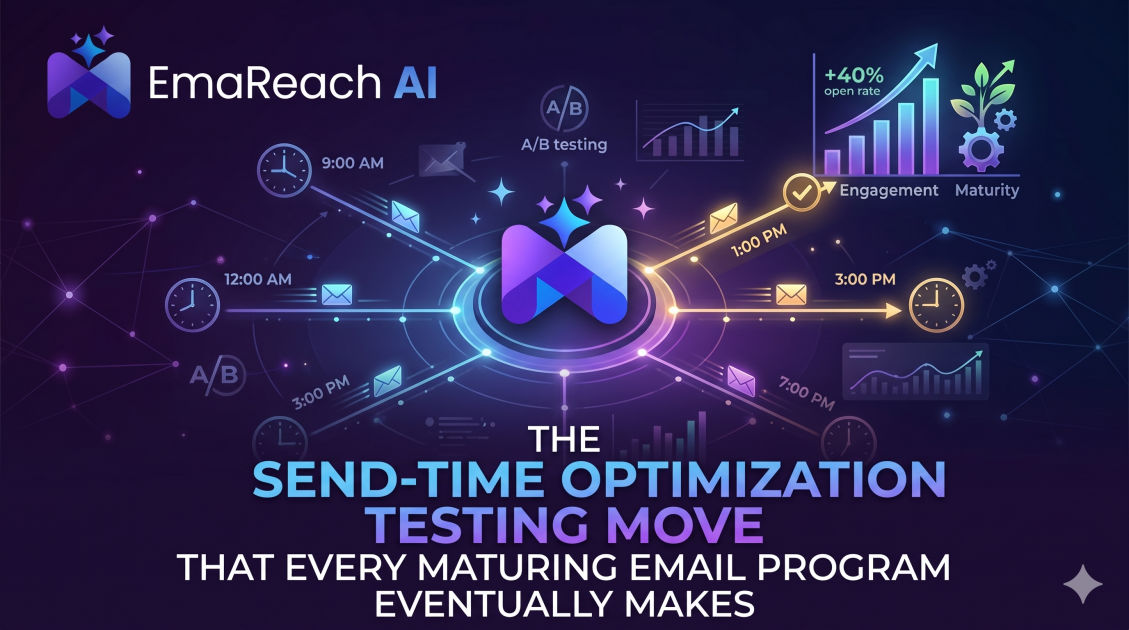
The Send-Time Optimization Testing Move That Every Maturing Email Program Eventually Makes
email marketingsend time optimizationmarketing automationemail deliverabilityab testingb2b outreach
Introduction
In the early stages of building an email marketing program, success is measured by foundational milestones. You focus on securing clean lists, setting up authentication protocols, crafting compelling copy, and ensuring basic technical health. Sending an email campaign usually involves picking a time slot that sounds reasonable—say, Tuesday at 10:00 AM—and hitting the send button.
However, as an email program matures, these broad-stroke strategies begin to yield diminishing returns. When you are sending to hundreds of thousands of subscribers, or scaling up complex automated sequences, a one-size-fits-all schedule becomes a bottleneck. The data starts screaming a clear truth: your audience does not live, work, or check their inboxes on a single, uniform schedule.
This realization marks a critical juncture for growing marketing teams. To unlock the next level of revenue, engagement, and retention, every maturing email program must transition from static batch scheduling to advanced, data-driven delivery timing. This is the definitive narrative of the send-time optimization testing move—why it matters, how it transforms performance, and the precise playbook for executing it successfully.
The Evolution of Email Scheduling: From Guesswork to Automation
To appreciate the impact of advanced send-time testing, it helps to look at the three distinct evolutionary phases of an enterprise email program.
Phase 1: The Single Batch
In the infancy of a program, emails are dispatched all at once based on the sender's local time or a generalized best practice found online. This approach ignores geographic dispersion, lifestyle variations, and behavioral differences among subscribers.
Phase 2: Time-Zone Rolling
As teams realize that a 9:00 AM send in New York arrives at an inconvenient 6:00 AM in Los Angeles, they transition to time-zone rolling. The campaign is scheduled to drop at the same local time for every recipient based on their location data. While this is a step forward, it still treats every individual within that time zone as a monolith.
Phase 3: True Send-Time Optimization (STO)
This is the ultimate testing move. Rather than relying on geographic averages, a maturing program analyzes historical, individual-level engagement data. It uncovers exactly when a specific subscriber is most likely to open, click, and convert, and delivers the message to their inbox precisely at that moment.
Why This Move is Inevitable for Maturing Programs
When your list is small, timing errors are minor hiccups. When your list scales, poor timing means thousands of missed opportunities and lost revenue. There are three primary forces driving mature programs toward individual-level optimization testing.
1. The Battle for the Top of the Inbox
The modern inbox is a crowded, hyper-competitive environment. If your email arrives at 8:00 AM, but your subscriber does not check their phone until noon, your message will be buried under dozens of newer notifications. By the time they open their app, your email has fallen below the fold. Optimization ensures your message lands right as the user is actively sorting through their mail.
2. Diversification of the Modern Workspace
The traditional desk job is no longer the universal standard. Audiences are split between remote workers, shift workers, gig economy participants, and global teams. Assuming that everyone checks their personal or professional email during standard corporate windows is an outdated mindset that actively harms campaign performance.
3. Maximizing the ROI of Existing Traffic
Acquiring a subscriber is expensive. Once they are on your list, squeezing incremental gains out of your existing database is the most cost-effective way to scale operations. Moving from static scheduling to optimized delivery requires no additional content creation or list acquisition costs, yet it routinely delivers double-digit lifts in core metrics.
Navigating the Intersection of Outreach and Deliverability
While marketing broadcasts benefit heavily from behavioral timing algorithms, a maturing email program often expands its horizons into high-volume cold outreach and B2B pipeline generation. This expansion introduces an entirely different set of rules around timing, volume, and inbox placement.
In standard marketing broadcasts, sending 100,000 emails simultaneously can cause temporary ISP throttling, but standard warm IP pools handle it. In cold outreach, however, abrupt spikes in volume or sending automated patterns to corporate domains without proper infrastructure will land your messages straight in the junk folder.
For teams scaling up their outbound sales and business development efforts alongside their core marketing loops, specialized infrastructure is mandatory. This is where dedicated outreach solutions become essential. Stop Landing in Spam. Cold Emails That Reach the Inbox. EmaReach AI combines AI-written cold outreach with inbox warm-up and multi-account sending—so your emails land in the primary tab and get replies. Balancing your automated internal marketing sends with a decoupled, highly optimized outbound architecture ensures that your brand's overarching sender reputation remains pristine across all channels.
The Core Mechanics of an STO Testing Playbook
Transitioning to a sophisticated optimization model is not as simple as flipping a switch in your marketing automation platform. It requires a structured testing methodology to validate the shift and accurately measure the performance delta.
Step 1: Define Your True North Metric
Before launching an optimization test, you must isolate the exact metric you are trying to move. While open rates are the most immediate indicator of good timing, click-through rates (CTR) and conversion rates are far more reflective of true engagement. An email opened during a chaotic morning commute might get a quick glance, but an email opened during a quiet evening window is far more likely to drive a purchase.
Step 2: Establish a Clean Control Group
To prove the efficacy of individual-level timing, split your target audience into two perfectly randomized segments:
- The Control Group: Receives the email at a fixed, historically reliable static time (or a standard time-zone rolled schedule).
- The Treatment Group: Receives the email via an optimization algorithm that determines the ideal window for each recipient over a 24-hour period.
Step 3: Account for the "Window Catch-Up" Bias
One of the most common mistakes in timing tests is failing to give the control and treatment groups equal time to perform. If your optimization algorithm distributes sends over a 24-hour window, you cannot evaluate the results until at least 48 to 72 hours after the last email has been deployed. Early reporting will naturally bias toward the control group because all of its members received the message simultaneously.
Overcoming the Structural Challenges of Deployed Timing
As you execute this testing transition, your team will encounter logistical complexities that do not exist in traditional batch-and-blast workflows. Anticipating these challenges is key to a smooth rollout.
| Challenge | Impact on Campaign | Resolution Strategy |
|---|---|---|
| Time-Sensitive Sales & Deadlines | Flash sales or urgent promos may expire before a subscriber's optimized window opens. | Use hybrid scheduling: force a hard deadline batch send for final notices, but use optimization for early announcements. |
| Data Sparsity for New Users | New subscribers lack historical open and click data, giving the algorithm nothing to calculate. | Assign a default "fallback" profile based on cohort averages until the user generates 3-5 engagement actions. |
| Server & API Load Distribution | Spreading sends over 24 hours can conflict with real-time transactional data syncing. | Work closely with data engineering to schedule high-volume data updates outside of primary optimization windows. |
Balancing Fresh Content with Predictive Windows
Another internal hurdle is coordinating content creation with rolling deployments. For example, if you run a daily news curation program, an email optimized to send at 11:00 PM might contain articles that feel like old news compared to a morning send. Marketers must carefully categorize their campaigns into "perennial/evergreen" and "breaking/urgent" buckets, applying behavioral optimization exclusively to content that retains value across a wider temporal window.
Analyzing the Data: What Success Looks Like
When a maturing email program successfully implements individual-level delivery testing, the shift in performance data generally follows a predictable trajectory.
Initially, teams often notice a modest 5% to 10% lift in raw unique open rates. However, the true transformation appears deeper in the funnel. Because emails are surfacing at moments when the user has the cognitive bandwidth to engage, the Click-to-Open Rate (CTOR) routinely sees much higher growth, sometimes spiking by 15% to 25%.
Furthermore, the long-term benefit manifests as a flattening of the unsubscribed curve. When messages arrive at disruptive hours, annoyed subscribers tend to opt-out entirely. By respecting the natural digital rhythms of your audience, your brand establishes a frictionless presence in the inbox, extending customer lifetime value and preserving your underlying list health over quarters and years.
Conclusion
The leap from basic geographic scheduling to true personalized send-time optimization is a watershed moment for any enterprise email program. It marks the transition from treating your audience as an anonymous crowd to respecting them as individuals with unique lifestyles, habits, and preferences. While the testing framework requires analytical discipline and a willingness to solve minor operational hurdles, the rewards—higher conversion rates, preserved sender reputation, and maximized revenue per subscriber—are undeniable. As your program continues to expand, making this definitive optimization move ensures your messaging remains relevant, timely, and consistently ahead of the competition.
EmaReach AI
Ready to scale your cold email outreach?
Join thousands of teams using EmaReach AI for AI-powered campaigns, domain warmup, and 95%+ deliverability. Start free — no credit card required.
Related posts
 Read article
The Smartlead Alternative That Earns Trust Before It Earns Your Business
Discover why the legacy volume-first cold email playbook is broken and how next-generation alternatives prioritize deliverability, AI-driven personalization, and sender reputation to earn your trust and land consistently in the primary inbox.
The Smartlead Alternative That Outperforms on Inbox Placement Consistently
Discover how transitioning to a next-generation cold email infrastructure can dramatically improve your outbound deliverability. Learn how modern AI-driven personalization, humanized multi-account sending, and advanced behavioral warm-up networks outperform legacy platforms like Smartlead to consistently land your messages in the primary inbox.
