Blog
Back to blog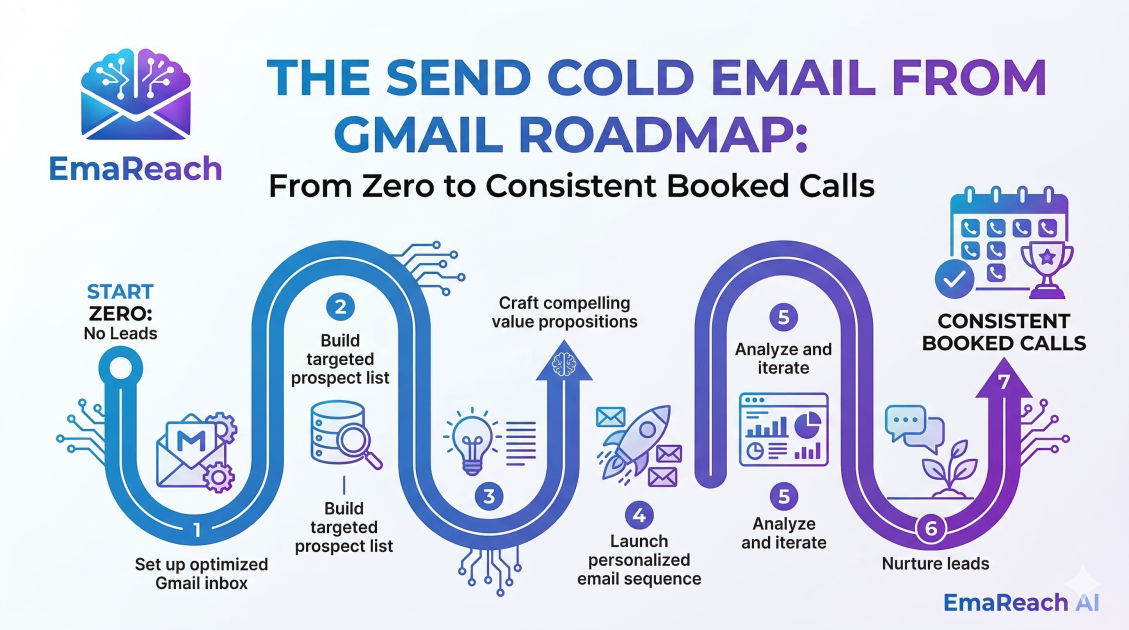
The Send Cold Email from Gmail Roadmap from Zero to Consistent Booked Calls
cold emaillead generationgmail outreachsales strategyemail deliverabilityb2b marketingoutreach automation
Introduction
Moving from a stagnant calendar to a consistent stream of booked calls is the primary challenge for any B2B service provider, agency owner, or consultant. While there are countless platforms available for outreach, Gmail remains the gold standard for many due to its familiarity, powerful interface, and high-level integration capabilities. However, sending cold emails from Gmail isn't as simple as hitting 'compose' and typing a few notes to strangers.
To achieve a sustainable flow of meetings, you need a systematic roadmap that covers technical setup, lead sourcing, copywriting, and sequence management. This guide outlines the exact transition from a fresh account to a high-performing outreach engine that lands in the primary inbox and converts prospects into appointments.
Phase 1: The Technical Foundation (Inbox Deliverability)
Before you send a single pitch, your technical infrastructure must be flawless. Gmail is highly sensitive to spam signals. If you skip this phase, your emails will end up in the 'Promotions' tab or, worse, the spam folder.
Domain Diversity and Secondary Accounts
Never send cold emails from your primary business domain (e.g., yourname@company.com). If your domain gets flagged for spam, your internal team communications and client emails will also be blocked. Instead, purchase secondary domains that are variations of your main brand (e.g., getcompany.com or usecompany.com).
SPF, DKIM, and DMARC
These are the three pillars of email authentication. They prove to Google and other receiving servers that you are who you say you are.
- SPF (Sender Policy Framework): Specifies which mail servers are authorized to send email on behalf of your domain.
- DKIM (DomainKeys Identified Mail): Adds a digital signature to your emails, ensuring the content hasn't been tampered with in transit.
- DMARC (Domain-based Message Authentication, Reporting, and Conformance): Tells receiving servers what to do if an email fails SPF or DKIM checks.
The Warm-Up Period
New Gmail accounts have no 'sender reputation.' If you suddenly start sending 50 emails a day from a brand-new account, Google will treat it as suspicious. You must gradually increase your volume over several weeks. This process, known as 'warming up,' involves sending small batches of emails that receive engagement (opens, replies, and being marked as 'not spam').
For those looking to automate this complex technical layer, EmaReach offers a streamlined solution. EmaReach AI combines AI-written cold outreach with inbox warm-up and multi-account sending—so your emails land in the primary tab and get replies, effectively handling the 'heavy lifting' of deliverability for you.
Phase 2: Identifying the High-Value Target (Lead Sourcing)
A perfect email sent to the wrong person is a waste of digital space. Consistent booked calls depend on the quality of your lead list.
Defining the Ideal Customer Profile (ICP)
Instead of targeting 'Small Business Owners,' get granular. Define your ICP by:
- Industry: (e.g., SaaS, E-commerce, Commercial Real Estate)
- Revenue: (e.g., $1M - $10M ARR)
- Headcount: (e.g., 10-50 employees)
- Recent Events: (e.g., Recent funding, new hires, or a specific technology they use)
Data Accuracy and Verification
Using outdated or guessed email addresses leads to high bounce rates, which destroys your Gmail sender reputation. Use reputable data providers to find leads and always run your list through an email verification tool before sending. Aim for a bounce rate of less than 3%.
Phase 3: The Psychology of the Cold Pitch
Most cold emails fail because they focus on the sender rather than the recipient. To book calls, you must pivot from 'selling' to 'solving.'
The Subject Line: The Gatekeeper
Your subject line has one job: to get the email opened. Avoid 'salesy' language or all-caps. The best subject lines are short (2-4 words) and look like something a colleague would send.
- Example: 'question re: [Company Name]'
- Example: 'ideas for [Department]'
The Opening Line: Breaking the Ice
Avoid 'I hope this finds you well.' It’s a dead giveaway of a cold email. Instead, use a personalized observation or a 'low-friction' opening. If you can’t personalize every single email, use 'segment-based personalization'—referencing a problem common to their specific niche.
The Value Proposition (The 'Bridge')
This is where you connect their problem to your solution. Don't list features. Instead, talk about outcomes.
- Instead of: 'We provide SEO services.'
- Try: 'We helped a company similar to [Company Name] increase their organic leads by 40% in six months.'
The Call to Action (CTA): The Low-Friction Close
Don't ask for a 30-minute demo immediately. That is a high-friction request for someone who doesn't know you. Ask for interest instead of time.
- Example: 'Would you be opposed to seeing a short video on how we did this?'
- Example: 'Is this something that's on your radar for this quarter?'
Phase 4: Building the Multi-Step Sequence
Rarely does a lead book a call on the first email. Persistence is key, but it must be polite and value-driven.
The Cadence
A standard high-performing sequence often looks like this:
- Day 1: The Initial Pitch.
- Day 3: The 'Gentle Bump' (Short follow-up, no new info).
- Day 7: The Value Add (Share a relevant case study or resource).
- Day 14: The 'Thoughts?' (Final check-in).
- Day 21: The Break-up Email (Letting them know you'll stop reaching out).
Handling Replies
Gmail is a conversational platform. Once a prospect replies, the automated portion ends, and the human element begins. Respond quickly. If they ask a question, answer it directly and suggest a specific time to chat. Using a scheduling tool link in your signature can help, but offering two specific time slots (e.g., 'Tuesday at 2 PM or Wednesday at 10 AM?') often results in higher conversion rates.
Phase 5: Optimization Through Analytics
To move from zero to consistent calls, you must treat your outreach like a science experiment. You cannot improve what you do not measure.
Key Metrics to Track
- Open Rate: If this is below 50%, your subject lines or deliverability (DNS settings) are the issue.
- Reply Rate: If people are opening but not replying, your offer or ICP targeting is off. Aim for 5-10%.
- Booked Call Rate: This measures how many replies actually turn into meetings. If this is low, you need to work on your lead qualification or your 'reply-to-meeting' sales script.
A/B Testing
Never assume you know which copy works best. Test one variable at a time. Run two different subject lines against the same lead list. Once you find a winner, test two different value propositions. Over time, these small optimizations compound into a high-performance machine.
Phase 6: Scaling the Operation
Once you have a sequence that works and your Gmail accounts are seasoned, you can begin to scale. Scaling involves adding more secondary domains and accounts to increase volume without hitting Google's daily sending limits (generally 2,000 for Workspace, though staying under 50 per account is safer for cold outreach).
Management and Centralization
Managing 5-10 different Gmail accounts individually is a recipe for chaos. Use a 'master inbox' or a centralized tool that allows you to see all replies in one place. This ensures no lead falls through the cracks and your response time remains lightning-fast.
Common Pitfalls to Avoid
As you navigate this roadmap, watch out for these common mistakes that can derail your progress:
- Using Tracking Links Too Early: Custom tracking domains are better, but sometimes plain text emails with no links at all have the highest deliverability.
- Large Attachments: Never send attachments in cold emails; they are a major red flag for spam filters.
- Neglecting the 'Opt-Out': Always provide a clear way for people to unsubscribe. It's not just a legal requirement; it prevents people from marking you as spam, which protects your reputation.
- Inconsistency: Sending 500 emails one day and zero for the next week confuses spam filters and leads to an erratic sales pipeline. Consistency is the 'secret sauce' to consistent calls.
Conclusion
Building a cold email engine inside Gmail is a journey of technical precision and psychological insight. By establishing a solid foundation of authenticated domains, sourcing high-quality leads, and crafting low-friction, value-driven copy, you transform your email from a nuisance into a welcomed business opportunity.
Remember that cold outreach is a marathon, not a sprint. The 'zero to consistent' transition happens when you stop looking for 'hacks' and start focusing on a repeatable system. Maintain your deliverability, refine your message based on data, and stay persistent with your follow-ups. With this roadmap, the goal of a calendar filled with qualified leads is not just a possibility—it is an inevitable outcome of a well-executed process.
EmaReach AI
Ready to scale your cold email outreach?
Join thousands of teams using EmaReach AI for AI-powered campaigns, domain warmup, and 95%+ deliverability. Start free — no credit card required.
Related posts
- Read article
The Instantly Alternative That Finally Gets Outbound Analytics Right
Discover why high-volume cold email requires a shift from surface-level vanity metrics to deep, data-driven revenue attribution, and explore the ultimate alternatives for mastering outbound engineering.
- Read article
What You Gain and What You Give Up When Switching From Instantly
Thinking about migrating your cold email stack? This detailed guide breaks down the exact operational advantages you gain and the core features you sacrifice when switching away from Instantly's popular outreach platform.