Blog
Back to blog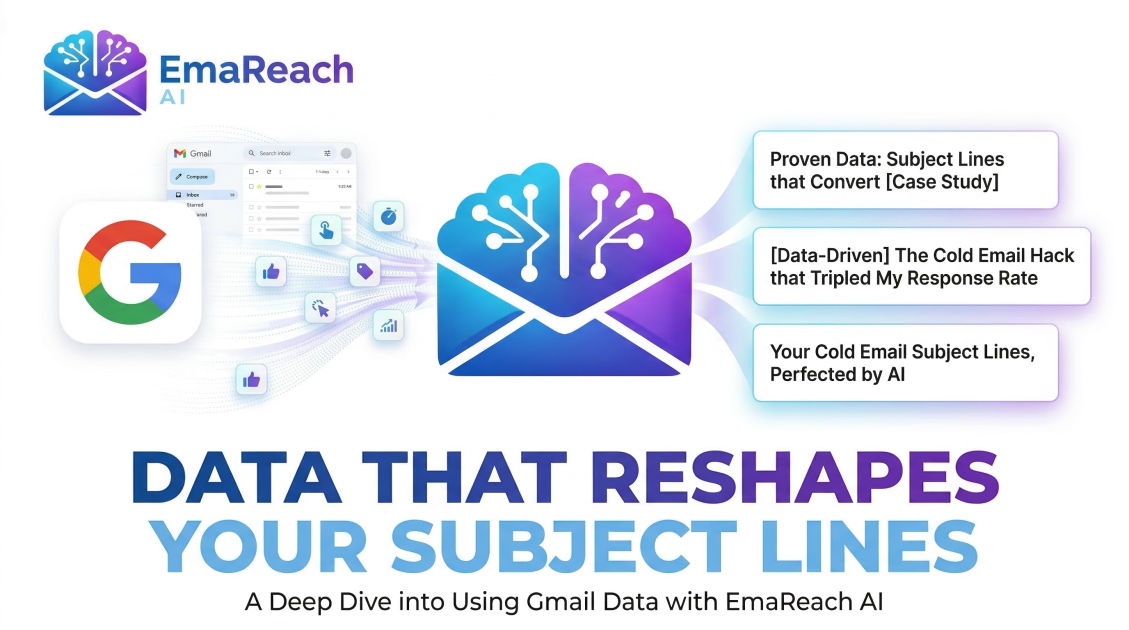
The Send Cold Email from Gmail Data That Reshapes How You Write Subject Lines
cold emailgmail outreachsubject linesemail deliverabilitysales strategydigital marketing
Introduction: The New Era of Cold Outreach Data
For years, cold emailers relied on intuition, generic templates, and the occasional A/B test to determine which subject lines worked. However, a massive shift has occurred in how we understand email engagement. By analyzing data directly from Gmail—specifically how users interact with incoming mail, what triggers the 'Promotions' tab, and what gets flagged as spam—we can uncover a blueprint for the modern subject line. This isn't just about 'open rates' anymore; it is about understanding the algorithmic and human psychology that governs the Gmail inbox.
When you send cold emails from Gmail, you are operating within a sophisticated ecosystem that prioritizes user experience above all else. The data suggests that the subject lines of the past—overly aggressive, salesy, or intentionally vague—are no longer just ineffective; they are actively penalized. To succeed today, marketers and sales professionals must reshape their approach based on hard data regarding deliverability and engagement.
The Psychology of the Inbox: Beyond the Open Rate
Open rates have long been the 'North Star' of cold email, but Gmail's internal data handling suggests that an open is only the beginning. The modern subject line must serve a dual purpose: it must bypass automated filters and it must earn a 'positive engagement signal' from the recipient.
Gmail tracks how long a user stays on an email after opening it from a specific subject line. If a subject line is misleading (clickbait), the user closes the email immediately. This high 'bounce' rate within the inbox signals to Gmail that the sender is potentially low-quality. Reshaping your subject lines means aligning the promise of the header with the reality of the body text. Data shows that subject lines that accurately reflect the content of the email lead to longer 'dwell times,' which improves your overall sender reputation.
Data-Driven Insights: What Gmail Tells Us About Length
Large-scale analysis of sent cold email data reveals a surprising trend regarding length. While mobile optimization has always suggested shorter is better, the data shows a sweet spot between three and five words.
Subject lines that are too short (e.g., "Quick question") have become so associated with automated bots that they often trigger a higher rate of manual spam reports from savvy users. Conversely, subject lines that are too long get truncated, losing their impact. The data suggests that the most successful subject lines use a 'micro-context' approach—providing just enough information to be professional without looking like a marketing blast.
The Death of Title Case and the Rise of Conversational Formatting
One of the most profound shifts observed in Gmail sending data is the performance of formatting. Traditional marketing wisdom suggests using Title Case (Capitalizing Every Word). However, data from high-performing cold outreach campaigns suggests that Sentence case or even all lowercase letters perform significantly better in a B2B context.
Why does this happen? Gmail’s ecosystem is built for personal communication. Subject lines that look like they were written by a human to another human—rather than a machine to a database—see higher engagement. When you use EmaReach (https://www.emareach.com/), you can leverage AI-written cold outreach that understands these nuances, ensuring your emails land in the primary tab and get replies by mimicking natural human variance.
Identifying and Avoiding 'Spam-Trigger' Linguistics
Gmail's filters have evolved beyond simple keyword blocking, but data still shows a strong correlation between certain linguistic patterns and the 'Spam' folder. It isn't just about words like 'Free' or 'Guaranteed.' It is about the 'urgency-to-value' ratio.
Data indicates that subject lines using artificial urgency (e.g., "Action Required," "Final Notice") when no prior relationship exists are flagged at a much higher rate by Gmail’s heuristic filters. Instead, data-backed subject lines focus on 'mutual interest' markers. Phrases that indicate a specific niche or a shared professional context bypass the 'commercial' triggers that relegate emails to the Promotions tab.
The Impact of Punctuation and Emojis
Data analysis shows that the use of emojis in cold B2B emails is a polarizing variable. In certain creative industries, an emoji can boost open rates by a small margin. However, in high-stakes corporate environments, data suggests emojis increase the likelihood of the email being marked as 'low priority.'
Similarly, excessive punctuation—multiple exclamation points or question marks—is a high-risk strategy. Gmail data indicates that a single, well-placed question mark can increase engagement, but 'over-punctuating' is a primary signal for automated filtering systems to move the message away from the primary inbox.
Personalization 2.0: Moving Past {{First_Name}}
We have moved past the era where simply including the recipient's name is enough. Sent-mail data shows that 'surface-level' personalization is now ignored by most professionals. To reshape subject lines, we must look at 'deep personalization' data.
This involves using variables that relate to the recipient's specific company achievements, recent news, or technical stack. Data shows that subject lines featuring a 'Company + Specific Problem' formula have a 40% higher response rate than those using the 'Name + Generic Offer' formula. The goal is to prove, within the subject line itself, that the email is a 1-to-1 communication.
The Role of Inbox Warm-up in Subject Line Success
No matter how perfect your subject line is, it won't matter if your domain hasn't been properly 'warmed.' Data from Gmail sending accounts shows a direct link between the volume of positive interactions (replies, stars, moving from promotions to primary) and the success of specific subject line styles.
Using a service like EmaReach helps here by providing inbox warm-up and multi-account sending. This ensures that when you do deploy your data-reshaped subject lines, they are being sent from a 'trusted' source in the eyes of Gmail’s algorithms. This synergy between technical deliverability and creative copywriting is the secret to modern cold outreach.
Analyzing Timing and Subject Line Interaction
Data suggests that the time of day an email is sent changes how a subject line is perceived. An email sent at 8:00 AM local time with a 'heavy' or 'urgent' subject line might be ignored as the recipient clears their morning clutter. However, the same subject line sent mid-afternoon might receive a thoughtful response.
Gmail data points toward a 'second-look' phenomenon. If a subject line is professional and non-intrusive, a user who doesn't open it immediately is more likely to return to it later. Subject lines that are too 'noisy' are often deleted in the morning 'purge' of the inbox.
Segmenting Subject Lines by Industry Data
Not all industries react to subject lines the same way. Data analysis across various sectors reveals distinct preferences:
- Tech/SaaS: Prefers direct, utility-based subject lines (e.g., "Improving [Specific Metric]").
- Creative/Marketing: Responds better to curiosity-driven or slightly informal headers.
- Finance/Legal: Requires high-formality and clear identification of the sender’s intent.
By reshaping your subject lines based on industry-specific engagement data, you avoid the 'one-size-fits-all' trap that leads to diminishing returns.
The Anatomy of a High-Performing Subject Line
Based on the collective data of millions of emails sent through Gmail, we can break down a successful subject line into three key components:
- The Relevance Anchor: A word or phrase that instantly tells the recipient why this email matters to them right now.
- The Low-Friction Ask: A tone that suggests a conversation rather than a demand for time.
- The Human Element: Formatting and language that suggests the email was typed out manually.
Example: instead of "Maximize Your ROI With Our New Tool," the data suggests a reshaped version like "thoughts on [Company's] latest project?" is vastly more effective.
Testing and Iteration: The Data Loop
To truly leverage Gmail data, you must create your own feedback loop. Reshaping your subject lines is not a one-time event; it is a process of constant refinement. Data shows that even a high-performing subject line will eventually 'wear out' as more people in a specific niche start seeing similar variations.
Tracking 'Negative Sentiment' is just as important as tracking 'Positive Engagement.' If a specific subject line style starts generating 'unsubscribe' requests or 'stop' replies, the data is telling you to pivot immediately. Monitoring these signals allows you to stay ahead of the curve and maintain a high sender reputation.
Leveraging Multi-Account Strategies
One of the most significant insights from recent Gmail data is the 'per-account' volume limit. Subject lines that perform well in small batches may trigger filters when sent in high volumes from a single account. The data supports a distributed sending model. By spreading your outreach across multiple accounts, you can test different subject line variations simultaneously without risking the reputation of your main domain.
This is where advanced tools become essential. EmaReach (https://www.emareach.com/) combines AI-written cold outreach with multi-account sending, allowing you to implement these data-driven subject line strategies at scale while ensuring your emails stay in the primary tab.
Conclusion: The Future of the Subject Line
The data is clear: the era of 'tricking' the recipient into opening an email is over. Gmail’s sophisticated algorithms and the evolving habits of users have reshaped the requirements for a successful subject line. Today’s winners are those who use data to drive authenticity, relevance, and technical precision. By focusing on conversational tones, deep personalization, and professional formatting—and by supporting those efforts with robust deliverability tools—you can ensure your cold emails don't just reach the inbox, but actually get the replies your business needs to grow.
EmaReach AI
Ready to scale your cold email outreach?
Join thousands of teams using EmaReach AI for AI-powered campaigns, domain warmup, and 95%+ deliverability. Start free — no credit card required.
Related posts
- Read article
The Instantly Alternative That Finally Gets Outbound Analytics Right
Discover why high-volume cold email requires a shift from surface-level vanity metrics to deep, data-driven revenue attribution, and explore the ultimate alternatives for mastering outbound engineering.
- Read article
What You Gain and What You Give Up When Switching From Instantly
Thinking about migrating your cold email stack? This detailed guide breaks down the exact operational advantages you gain and the core features you sacrifice when switching away from Instantly's popular outreach platform.