Blog
Back to blog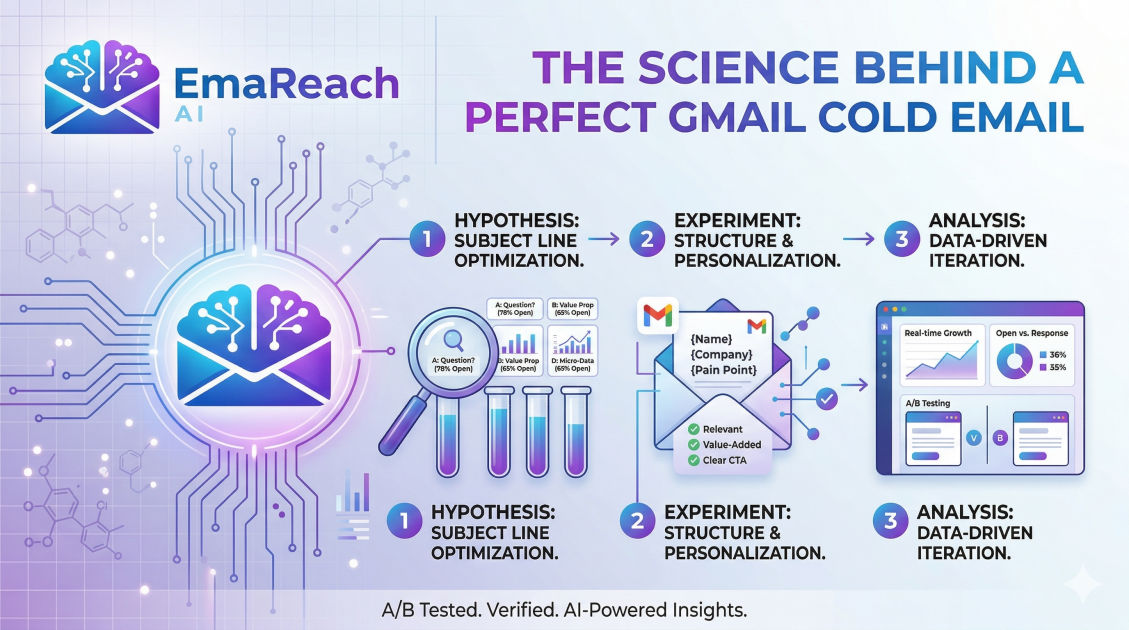
The Science Behind a Perfect Gmail Cold Email
cold emailoutreachdeliverabilitygmail strategyemail marketingsales psychology
Introduction: The Psychology and Physics of the Inbox
Cold email is often treated as a numbers game—a digital lottery where if you pull the lever enough times, a jackpot of responses will eventually fall out. However, the most successful practitioners of outreach understand that it is less about gambling and more about chemistry. When you send a cold email via Gmail, you are initiating a complex chain reaction involving server protocols, spam filters, psychological triggers, and cognitive biases.
To master the art of the cold email, one must understand the science behind it. This involves navigating the technical architecture of Google’s workspace, understanding the linguistics of a compelling subject line, and mastering the timing of the human attention span. In this comprehensive guide, we will dissect every element of a high-performing Gmail cold email, from the metadata to the post-send analysis.
The Technical Foundation: Deliverability Science
Before a human ever reads your words, Google’s algorithms must decide if your message is worthy of the Primary tab. This is the 'physics' of email—the foundational laws that determine whether your message exists in the recipient's world or vanishes into the void of the spam folder.
Authentication and Trust Signals
Gmail uses a sophisticated reputation system. To ensure your emails are delivered, your domain must be properly authenticated. This isn't just a technical chore; it is a declaration of identity. There are three pillars to this:
- SPF (Sender Policy Framework): A list of IP addresses authorized to send email on behalf of your domain.
- DKIM (DomainKeys Identified Mail): A digital signature that ensures the email wasn't tampered with during transit.
- DMARC (Domain-based Message Authentication, Reporting, and Conformance): A policy that tells receiving servers what to do if SPF or DKIM fails.
Without these, you are a 'ghost' in the machine, and Gmail’s filters are designed to hunt ghosts.
The Importance of Warm-Up
You cannot go from zero to one thousand emails a day on a new Gmail account. Google monitors for sudden spikes in volume, which are hallmark signs of a compromised account or a spammer. A scientific approach requires a 'warm-up' period—gradually increasing volume while maintaining high engagement rates. For those looking to automate this complex process, EmaReach provides a vital service. EmaReach AI combines AI-written cold outreach with inbox warm-up and multi-account sending, ensuring that your emails land in the primary tab rather than the promotions or spam folders.
The Anatomy of the Subject Line: The Gateway Equation
The subject line is the most critical variable in the cold email equation. If the subject line fails, the rest of the email effectively does not exist. The science here is rooted in curiosity gaps and cognitive load.
The Curiosity Gap
Human beings are biologically wired to close 'open loops.' When we encounter a piece of information that is incomplete but relevant, our brains experience a mild form of tension that can only be resolved by seeking the missing piece. A perfect Gmail subject line creates a curiosity gap without being 'clickbaity.'
- Bad Example: "Revolutionary New Software for Your Business!"
- Scientific Example: "Question about [Company Name]'s Q3 strategy"
The second example is specific, low-friction, and creates an open loop that the recipient feels compelled to close.
Lowering Cognitive Load
Gmail users often skim their inboxes on mobile devices. Long, complex subject lines increase cognitive load, leading to a 'delete' reflex. Research suggests that subject lines with 3–5 words often see the highest open rates. Keeping it lowercase and informal can also mimic a personal email from a colleague, which bypasses the brain’s 'marketing' filters.
The Opening Line: Breaking the Pattern
Most cold emails begin with a self-introduction: "My name is [Name] and I work at [Company]." From a psychological perspective, this is a disaster. It signals immediately that the sender wants something, triggering a defensive stance in the recipient.
The Reciprocity Principle
Instead of starting with yourself, start with the recipient. The science of persuasion, specifically the principle of reciprocity, suggests that we feel obligated to return favors. A highly personalized opening line—referencing a recent podcast they appeared on, a promotion, or a specific business challenge—serves as a digital 'gift' of attention. This validates the recipient and makes them more likely to read the subsequent paragraphs.
Social Proof and Authority
If you can’t lead with a deep personalization, lead with relevance. Mentioning a competitor you’ve helped or a common pain point in their specific industry establishes you as an authority. This taps into the 'authority bias,' where humans are more likely to be influenced by someone they perceive as an expert.
The Body: The Power of Conciseness
In the science of communication, brevity is the soul of conversion. Every additional sentence in a cold email increases the probability of the reader dropping off.
The Three-Part Structure
- The Context: Why are you emailing them right now? (The 'Trigger').
- The Value: What specific problem do you solve for people exactly like them?
- The Proof: A one-sentence case study or data point that proves you can do what you say.
Avoiding 'I' and Embracing 'You'
Analyze your email draft. Count the number of times you use 'I,' 'me,' or 'my' versus 'you' or 'your.' A perfect cold email flips the ratio. The recipient doesn't care about your company's founding story; they care about their own problems. By focusing on the 'You,' you shift the focus from a sales pitch to a potential solution.
The Call to Action (CTA): Reducing Friction
The goal of a cold email is not to close a deal; it is to start a conversation. A common mistake is asking for a 30-minute demo right away. This is too much 'friction' for a stranger.
The 'Low-Stakes' CTA
Instead of asking for time, ask for interest. This is known as a 'low-friction' CTA.
- "Is this something you're currently prioritizing?"
- "Would you be open to a brief exchange of ideas?"
- "Should I send over a two-minute video explaining how this works?"
By asking for a simple 'yes' or 'no' regarding interest, you make it easy for the recipient to respond. Once the rapport is established, moving to a call is much easier.
The Science of Timing and Follow-ups
Persistence is backed by data. Statistics consistently show that the majority of sales happen after the fourth or fifth touchpoint, yet most people stop after one or two emails.
The Decay of Interest
Following up is a delicate balance. You want to remain 'top of mind' without becoming a 'nuisance.' A scientific follow-up schedule often looks like a Fibonacci sequence or an expanding interval (Day 1, Day 3, Day 7, Day 14, Day 30). This respects the recipient's space while ensuring you are there when the 'timing' finally aligns with their needs.
Providing Value in Follow-ups
Never send a "just checking in" email. These add zero value and can be perceived as passive-aggressive. Instead, each follow-up should offer a new piece of value—an article, a relevant observation, or a different angle on the problem. This reinforces your position as a helpful resource rather than a persistent solicitor.
Gmail-Specific Optimization
Using Gmail for cold outreach requires specific tactical adjustments to stay within their ecosystem's good graces.
Plain Text vs. HTML
While flashy HTML templates look great for newsletters, they are a red flag for cold outreach. Gmail's personal communication is almost entirely plain text. Using high-density HTML, tracking pixels, and multiple images can trigger the 'Promotions' tab. A perfect cold email looks like it was typed manually by a person, for a person.
Unsubscribe Links
While legal requirements (like CAN-SPAM or GDPR) often necessitate a way to opt-out, how you implement it matters. A large 'Unsubscribe' button at the bottom screams 'Mass Marketing.' A scientific approach is to use a polite, text-based opt-out: "P.S. If you'd rather not hear from me again, just let me know and I'll remove you from my list."
Measuring Success: The Feedback Loop
Science requires measurement. To perfect your Gmail outreach, you must track key metrics:
- Open Rate: Measures the effectiveness of your subject line and sender name.
- Reply Rate: Measures the effectiveness of your value proposition and CTA.
- Bounce Rate: Measures the health of your lead list.
- Spam Complaint Rate: Measures how intrusive or irrelevant your emails feel.
By isolating these variables and testing them one at a time (A/B testing), you can iteratively improve your results. Perhaps a shorter subject line increases opens, but a more direct body increases replies. Only through rigorous testing can you find the 'formula' that works for your specific niche.
Conclusion
Mastering the Gmail cold email is a journey through technical precision and psychological insight. By ensuring your domain is authenticated, your subject lines are low-friction, and your content is relentlessly recipient-focused, you transform your outreach from noise into a valuable signal. Remember that behind every email address is a human being with limited time and specific challenges. When you approach them with genuine value and a scientifically sound strategy, the results speak for themselves. Stop landing in spam and start building relationships that drive growth.
EmaReach AI
Ready to scale your cold email outreach?
Join thousands of teams using EmaReach AI for AI-powered campaigns, domain warmup, and 95%+ deliverability. Start free — no credit card required.
Related posts
- Read article
The Instantly Alternative That Finally Gets Outbound Analytics Right
Discover why high-volume cold email requires a shift from surface-level vanity metrics to deep, data-driven revenue attribution, and explore the ultimate alternatives for mastering outbound engineering.
- Read article
What You Gain and What You Give Up When Switching From Instantly
Thinking about migrating your cold email stack? This detailed guide breaks down the exact operational advantages you gain and the core features you sacrifice when switching away from Instantly's popular outreach platform.