Blog
Back to blog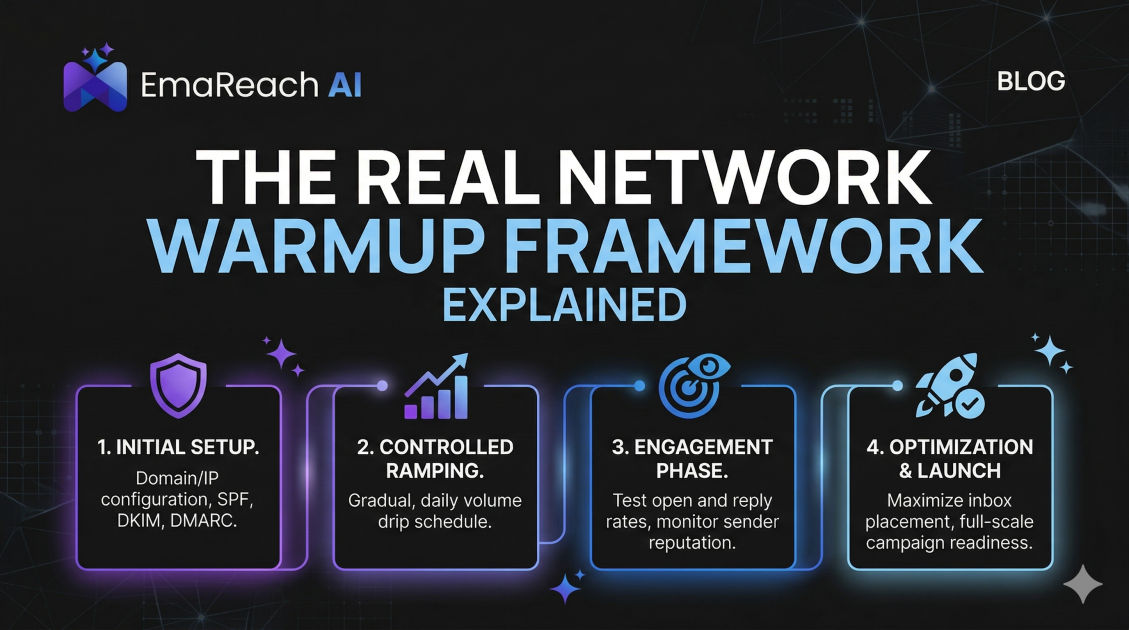
The Real Network Warmup Framework Explained
email deliverabilitynetwork warmupcold outreachinbox placementdigital reputationemail marketingoutreach strategy
Introduction to Network Warmup
In the modern digital landscape, the success of any outreach strategy—whether it is technical networking, social selling, or cold email—hinges on a single concept: reputation. Moving too fast in a digital environment is the quickest way to get flagged, filtered, or ignored. This is where the Network Warmup Framework becomes essential. It is a systematic process of gradually increasing the volume and intensity of digital interactions to establish trust with algorithms, servers, and human recipients.
Without a proper warmup, your messages are often perceived as anomalies. To an ISP (Internet Service Provider) or a social platform's algorithm, a sudden spike in activity looks like a bot or a compromised account. The Real Network Warmup Framework is designed to mimic organic, human behavior, ensuring that your infrastructure remains healthy and your communications reach their intended destination.
The Psychology of Digital Trust
Before diving into the technical mechanics, it is vital to understand the psychology behind network warmup. Trust is not granted; it is earned over time. In the physical world, you wouldn't walk into a networking event and start screaming your pitch at everyone in the room. You would start with small talk, build rapport, and gradually move toward deeper business discussions.
The digital equivalent of this is the warmup. By starting small, you are signaling to the network that you are a legitimate entity. You are providing value or engaging in standard behaviors before scaling up. This framework applies to various verticals, but it is most critically observed in the world of email and professional networking.
Understanding the Infrastructure Layer
Every communication travels through a series of layers. For the Network Warmup Framework to be effective, you must address each layer of your technical infrastructure. This includes your IP reputation, domain age, and account-level activity metrics.
Domain and IP Reputation
Your domain is your digital identity. If you use a brand-new domain for high-volume outreach without a warmup period, you are essentially a stranger with no credit history trying to take out a massive loan. The Network Warmup Framework mandates a 'seasoning' period for new domains. During this time, the domain should send a low volume of high-engagement messages to established, high-reputation recipients.
Similarly, the IP address used to send these messages carries its own weight. If you are using a dedicated IP, the warmup is even more critical. ISPs track the volume of mail coming from specific IPs. A sudden jump from zero to ten thousand emails a day is a red flag that results in immediate blacklisting.
Protocol Authentication
No warmup framework is complete without proper authentication. Before sending your first 'warmup' message, you must ensure that your SPF (Sender Policy Framework), DKIM (DomainKeys Identified Mail), and DMARC (Domain-based Message Authentication, Reporting, and Conformance) records are correctly configured. These protocols serve as your digital passport, proving to the receiving server that you are who you say you are.
Phase 1: The Incubation Period
During the first 14 days of the Network Warmup Framework, the goal is not conversion or leads; it is purely technical validation.
- Low Volume: Start with no more than 10 to 20 interactions per day.
- High Quality: Ensure that these interactions are with known, 'friendly' accounts. This could be internal team members or secondary accounts you control.
- Engagement Loops: A crucial part of this phase is generating replies. Algorithms favor accounts that receive responses. In the context of email, this means the recipient must open the mail, perhaps click a link, and—most importantly—reply.
For those looking to automate this complex dance, tools like EmaReach (https://www.emareach.com/) are game-changers. Stop Landing in Spam. Cold Emails That Reach the Inbox. EmaReach AI combines AI-written cold outreach with inbox warm-up and multi-account sending—so your emails land in the primary tab and get replies. By using such a system, you ensure that the engagement loops are handled naturally and consistently.
Phase 2: The Progressive Scaling Phase
Once the initial incubation period is complete and you have established a baseline of positive engagement, you move into progressive scaling. This phase usually spans weeks three through six.
The Rule of Incremental Growth
In the Network Warmup Framework, we follow a rule of 20% weekly growth. If you successfully sent 20 emails a day in week two without any deliverability issues, you move to 24-25 emails in week three. This slow climb prevents the 'spike' pattern that triggers security filters.
Monitoring Deliverability Metrics
During this phase, you must monitor your metrics with surgical precision. Key indicators include:
- Open Rates: Are they remaining steady as volume increases?
- Bounce Rates: Anything over 2% is a sign of a poor list or a failing warmup.
- Spam Complaints: Even a single complaint during the warmup phase can be devastating.
Phase 3: The Diversification Strategy
The third phase of the Real Network Warmup Framework involves diversifying the types of interactions you are having. If you are only sending one type of message, you are still behaving somewhat like a bot.
To look truly human, your account should engage in a variety of activities:
- Varying Message Lengths: Some short, some long.
- Different Send Times: Avoid sending all your messages at exactly 9:00 AM. Distribute them throughout the day to mimic natural human workflow.
- Multichannel Presence: If you are warming up a professional profile, interact with posts, join groups, and send a few personalized connection requests alongside your outreach.
Content Optimization for Warmup
What you send is just as important as how much you send. During the warmup, avoid 'spammy' trigger words such as 'Free,' 'Buy Now,' or 'Investment Opportunity.' Instead, focus on neutral, conversational language. The goal is to maximize the 'Read Time' and 'Reply Rate.'
AI-Driven Personalization
Modern filters are now smart enough to detect templated content. If 500 people receive the exact same message, it’s a red flag. The Network Warmup Framework encourages the use of AI to vary the structure and wording of each message. This is another area where EmaReach excels. By utilizing AI-written cold outreach, every message feels unique and personalized, which significantly boosts the reputation of the sending account and ensures you stay out of the promotions or spam tabs.
The Role of Inbox Placement Tests
You cannot manage what you cannot measure. Throughout the warmup process, you should conduct regular inbox placement tests. These tests involve sending messages to 'seed lists'—a collection of accounts across different providers (Gmail, Outlook, Yahoo, etc.)—to see where your message actually lands.
If you find that your messages are landing in the 'Promotions' tab, it’s a sign to dial back the volume or increase the engagement (replies) on your account. If they land in 'Spam,' you must stop sending immediately and investigate your technical setup or content quality.
Maintaining a Warm Network
Warmup is not a 'one-and-done' task. It is a continuous maintenance cycle. If you stop sending messages for a month and then suddenly try to resume at high volume, you will find your reputation has decayed.
The 'Never-Cold' Philosophy
A robust Network Warmup Framework includes a maintenance mode. Even when you aren't running an active campaign, you should maintain a low 'pilot light' volume of interactions to keep the account active and the reputation high. This ensures that when you are ready to launch a major campaign, your infrastructure is primed and ready to go.
Common Pitfalls to Avoid
Many professionals fail at network warmup because they succumb to the temptation of speed. Avoid these common mistakes:
- Buying 'Aged' Accounts Without Verification: Just because an account is old doesn't mean it has a good reputation. It may have been used for spam in the past.
- Using Poor Data: Sending warmup messages to non-existent or unverified email addresses will cause high bounce rates, ruining your progress.
- Ignoring the 'Unsubscribe' Signal: If people want out, let them out easily. High complaint rates are the fastest way to kill a domain's reputation.
- Neglecting the Receiving End: Ensure that your own inbox is active. Send and receive emails naturally, sign up for a few newsletters, and engage with them.
Advanced Warmup: Multi-Account Architecture
For high-scale operations, the Framework evolves into a multi-account architecture. Instead of sending 500 emails from one account, the Framework suggests sending 25 emails from 20 different accounts. This distributed approach minimizes the risk to your primary domain and allows for much higher aggregate volume while keeping individual account activity within 'safe' human limits.
Implementing this manually is a logistical nightmare. This is why sophisticated marketers rely on platforms like EmaReach (https://www.emareach.com/). By combining multi-account sending with automated warmup and AI-driven content, EmaReach provides the technical backbone necessary to execute the Real Network Warmup Framework at scale without the manual overhead.
Conclusion: The Long Game of Deliverability
The Real Network Warmup Framework is about playing the long game. In a world where digital noise is at an all-time high, the gatekeepers (ISPs and algorithms) have become incredibly sophisticated. You cannot bypass them with shortcuts; you must work with them by proving your legitimacy over time.
By following the phases of incubation, progressive scaling, and diversification, you build a foundation of trust that ensures your voice is heard. Whether you are building a professional network or launching an ambitious cold outreach campaign, the discipline of a proper warmup is the difference between being a trusted communicator and being a forgotten notification in a spam folder. Invest the time in your warmup today, and your future campaigns will reap the rewards of high deliverability and genuine engagement.
EmaReach AI
Ready to scale your cold email outreach?
Join thousands of teams using EmaReach AI for AI-powered campaigns, domain warmup, and 95%+ deliverability. Start free — no credit card required.
Related posts
- Read article
The Instantly Alternative That Finally Gets Outbound Analytics Right
Discover why high-volume cold email requires a shift from surface-level vanity metrics to deep, data-driven revenue attribution, and explore the ultimate alternatives for mastering outbound engineering.
- Read article
How Choosing the Right Instantly Alternative Changed Our Pipeline Numbers
Discover how transitioning from a volume-first cold email setup to an advanced, deliverability-focused infrastructure transformed our B2B pipeline metrics, skyrocketed open rates to over 68%, and tripled our monthly booked demos.