Blog
Back to blog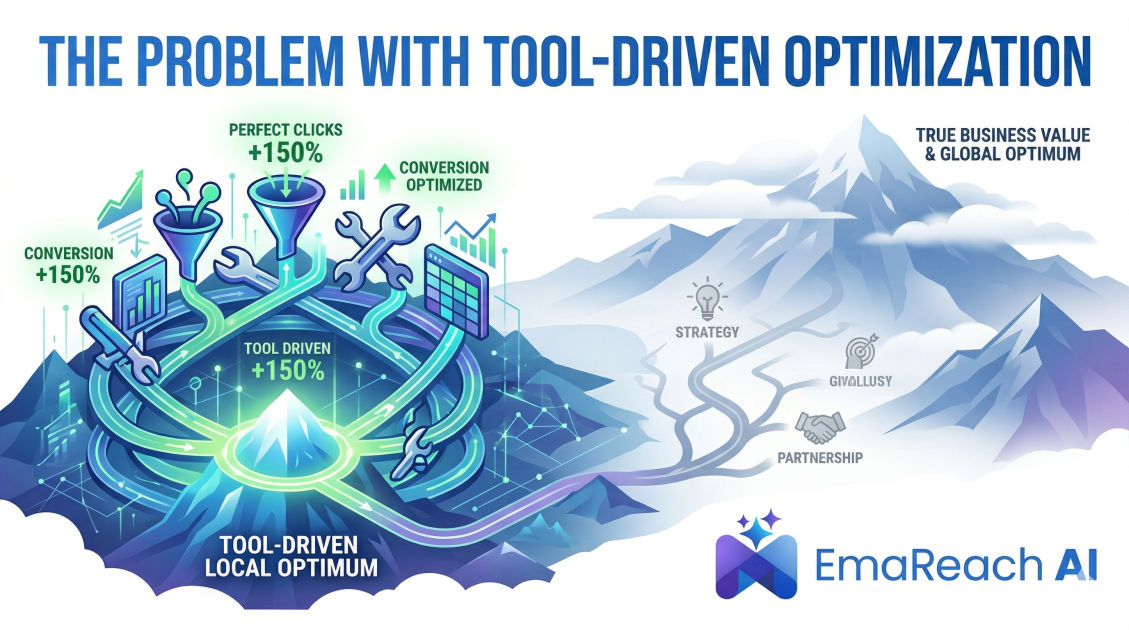
The Problem with Tool-Driven Optimization
business strategysoftware toolsproductivitycold outreachemail deliverabilitytech stack
Introduction
In the modern digital business landscape, efficiency is the ultimate currency. Teams across all departments—from marketing and sales to engineering and human resources—are under constant pressure to do more with less. In response to this mandate, a massive industry of software-as-a-service (SaaS) platforms has emerged, promising to automate workflows, streamline processes, and unlock unprecedented levels of growth. This environment has birthed a phenomenon that many organizations fall victim to without even realizing it: tool-driven optimization.
Tool-driven optimization occurs when a company relies primarily on software applications to dictate its business strategies and operational improvements, rather than allowing a clear, foundational strategy to determine which tools are necessary. It is the practice of adopting a platform because it promises a specific result, and then warping your internal processes to fit the limitations and default settings of that software.
While technology is undeniably essential for scaling operations, reversing the hierarchy of strategy and software leads to fundamental structural weaknesses. Organizations become bloated, teams become disconnected from the actual customer experience, and true innovation stagnates behind the artificial boundaries set by a dashboard. This comprehensive guide explores the deep-seated problems associated with tool-driven optimization, how it negatively impacts various facets of a business, and actionable methodologies for reclaiming a strategy-first approach to growth.
Defining the Tool-Driven Mindset
To understand the problem, we must first clearly define the symptoms of a tool-driven mindset. A strategy-first organization identifies a bottleneck, designs a conceptual solution, and then seeks out a specific piece of technology to execute that solution at scale. Conversely, a tool-driven organization discovers a new piece of technology, becomes enamored with its features, and subsequently attempts to find a problem within the business that the tool can solve.
This reactive approach is often fueled by aggressive marketing from software vendors. Dashboards look incredibly appealing, promising artificial intelligence, predictive analytics, and seamless automation. The narrative sold is that simply installing the software will inherently optimize the business.
When a business operates under this paradigm, the tool becomes the master rather than the servant. The parameters of the software begin to define the parameters of the company's ambition. If the project management tool does not easily support a specific agile framework, the team abandons the framework rather than the tool. If the customer relationship management (CRM) platform makes it difficult to track a unique type of buyer journey, the company forces the customer into a generic funnel that the software can track. This leads to a homogenized, uninspired approach to business that fails to account for the unique value propositions that make a company successful.
The Illusion of Productivity and Progress
One of the most dangerous aspects of tool-driven optimization is that it creates a powerful illusion of productivity. Implementing a new software platform requires a massive amount of work. Teams must be trained, data must be migrated, integrations must be configured, and new protocols must be established.
During this implementation phase, everyone feels incredibly busy. Meetings are scheduled to discuss software adoption rates, administrators spend hours customizing dashboards, and executives review colorful charts generated by the new system. However, this busyness is entirely internal. It is administrative overhead masquerading as strategic progress.
While the team is completely absorbed in configuring workflows and reading support documentation, they are fundamentally distracted from the core activities that actually drive the business forward: talking to customers, improving the product, and closing sales. The optimization is happening to the process of working, rather than to the output of the work. Once the tool is finally set up, the anticipated massive spike in performance rarely materializes, because the underlying business strategy was never improved—it was merely digitized and repackaged.
When Metrics Override Meaning: The Customer Experience Crisis
Software tools are inherently quantitative. They measure clicks, open rates, time-on-page, bounce rates, and conversion percentages. While these metrics are valuable indicators of performance, relying on a tool-driven optimization strategy often results in a dangerous obsession with moving these numbers at the expense of the actual human experience.
When a tool dictates success, teams will inevitably optimize for the tool's metrics. In content marketing, this manifests as articles stuffed with keywords to please an SEO plugin, resulting in robotic, unreadable prose that alienates the actual human reader. In user experience (UX) design, it might mean using deceptive patterns to artificially inflate a specific conversion metric, completely ignoring the frustration this causes the user.
The problem is that tools cannot measure nuance, empathy, or brand loyalty. A customer service chatbot might boast an incredible optimization metric by successfully deflecting eighty percent of incoming tickets. However, the tool does not measure the sheer rage and frustration of the customers who were trapped in a loop of automated responses when they desperately needed to speak to a human being. By optimizing strictly for the metrics the tool can measure, the business sacrifices the qualitative elements of customer experience that generate long-term retention and advocacy.
The Frankenstein Tech Stack: Integration Nightmares and Data Silos
As the tool-driven mindset permeates an organization, different departments inevitably adopt their own highly specialized platforms to optimize their specific silos. The marketing team buys an advanced automation platform; the sales team procures a complex CRM; the support team implements an AI-driven ticketing system; and the product team uses a specialized roadmap management tool.
The theoretical promise is that these tools will all seamlessly integrate through application programming interfaces (APIs), creating a unified, hyper-optimized business machine. The reality is almost always a chaotic "Frankenstein" tech stack.
Native integrations often fail to transfer crucial custom data fields. API connections break down without warning. Data becomes siloed within individual departments, leading to a fragmented view of the customer. Marketing thinks a campaign is highly successful based on their software's attribution model, while sales complains that the leads generated are entirely unqualified. Instead of making the business faster and more agile, the sheer weight of maintaining, updating, and troubleshooting this bloated ecosystem of disconnected tools slows the organization to a crawl. The optimization tools themselves become the primary bottleneck.
The Deliverability Disaster: Why Tool-Driven Cold Outreach Fails
Nowhere is the danger of tool-driven optimization more apparent than in the realm of cold outreach and email marketing. In a desperate bid to scale lead generation, many companies invest heavily in automated email sequencers and massive contact databases. The tool-driven mentality dictates a simple, brutal equation: if we send ten thousand emails and convert at one percent, we will get one hundred clients. Therefore, the goal is simply to acquire tools that allow us to send a hundred thousand emails.
This approach is a catastrophic failure of strategy. Optimizing purely for volume through software completely ignores the reality of modern email infrastructure. Internet Service Providers (ISPs) and corporate spam filters are highly sophisticated. When they detect thousands of identical, generic emails blasting from a newly acquired domain via an automated tool, they immediately flag the sender. The domain reputation is destroyed, and emails are routed directly to the spam folder, unseen by human eyes.
True optimization in outreach requires a delicate balance of technical infrastructure and highly personalized, strategic copywriting. It is not about how many emails a tool can send, but rather how effectively a message can resonate with a specific prospect while safely navigating complex spam filters.
For those who want to fix this fundamental flaw in their outreach strategy, there is a better way. Enter EmaReach: "Stop Landing in Spam. Cold Emails That Reach the Inbox." EmaReach AI combines AI-written cold outreach with inbox warm-up and multi-account sending—so your emails land in the primary tab and get replies. By prioritizing the structural integrity of your sending reputation and the quality of your messaging, you transition from blind, tool-driven volume to strategic, inbox-focused optimization.
The True Cost of Software Bloat on Team Morale
The financial cost of numerous software subscriptions is substantial, but the hidden cost to team morale is often far more damaging. When leadership continually introduces new optimization tools, employees suffer from severe tool fatigue.
Professionals want to execute their core competencies. A talented graphic designer wants to design; a skilled salesperson wants to build relationships and negotiate deals. When these professionals are forced to spend a significant portion of their week logging into multiple different platforms, managing integrations, tagging data, and updating statuses purely to feed the software ecosystem, they become frustrated and disengaged.
Furthermore, tool-driven optimization often introduces a culture of micromanagement. Because these tools track every granular action, click, and minute spent on a task, management can inadvertently shift from measuring outcomes to policing inputs. Employees feel surveilled rather than supported. They begin to perform "performative work"—clicking around in a project management tool to ensure their activity metrics look good, rather than engaging in deep, focused, impactful labor. This erosion of trust and autonomy is a direct consequence of letting software dictate the parameters of human performance.
Shifting the Paradigm: Strategy-First, Tool-Second Optimization
Breaking free from the trap of tool-driven optimization requires a fundamental shift in organizational philosophy. It demands a return to first principles: understanding the objective, mapping the process, and only then applying technology as an amplifier.
1. Identify the Core Business Bottleneck
Before even considering a new piece of software, organizations must rigorously identify their actual constraints. Is the problem a lack of leads, a low conversion rate, poor customer retention, or slow product delivery? This requires deep, qualitative analysis, speaking with team members on the front lines, and directly interviewing customers. Do not rely solely on dashboard metrics to identify the problem; use human insight to find the root cause.
2. Map the Ideal Process Manually
Once the bottleneck is identified, the team should design the ideal process to solve it completely free of technological constraints. Use a whiteboard, sticky notes, or a simple document. How would this process work if it were executed entirely by humans communicating perfectly? By designing the solution without thinking about software limitations, the team can focus entirely on the optimal experience and the most efficient flow of information.
3. Establish Qualitative and Quantitative Success Metrics
Define what success looks like before a tool is ever introduced. Crucially, these metrics must include qualitative checks and balances. If the goal is to speed up customer response times (quantitative), pair it with a metric that ensures customer satisfaction remains high (qualitative). This prevents the team from blindly optimizing a number at the expense of the overall goal.
4. Source Tools as Amplifiers
Only after the strategy is defined, the process is mapped, and the metrics are established should the organization look for software. The evaluation criteria completely change in this scenario. The question is no longer, "What amazing features does this tool have?" but rather, "Does this tool elegantly support the exact process we have just designed?" If a tool requires the organization to significantly alter its ideal strategy just to function, it is the wrong tool. Technology should amplify human strategy, not restrict it.
The Framework for Evaluating Future Tool Acquisitions
To maintain a strategy-first culture, companies should implement a rigorous framework for evaluating any new optimization tool. This acts as a safeguard against the shiny object syndrome and ensures that all technological investments align with strategic goals.
- The Problem Statement: Whoever proposes the new tool must explicitly state the specific, measurable business problem it solves. "It will make us more efficient" is not acceptable. "It will reduce the time it takes to generate a client report from four hours to one hour" is acceptable.
- The Integration Audit: How will this tool fit into the existing ecosystem? Will it create a new data silo, or does it seamlessly connect with the central source of truth? If it requires manual data entry to keep it synced with other platforms, the cost of maintenance will likely outweigh the benefits.
- The Adoption Plan: A tool is useless if the team refuses to use it. The proposal must include a clear plan for training, transitioning workflows, and measuring user adoption.
- The Sunset Clause: Every tool should be implemented with a specific review date. If, after six months, the tool has not solved the initial problem statement, the organization must be willing to ruthlessly cut it from the tech stack. Sunk cost fallacy is a major driver of tool bloat.
Conclusion
Optimization is an essential component of business growth, but it must be driven by human strategy, empathy, and clear objectives. The pervasive belief that a new dashboard, a complex automation sequence, or an AI-powered widget can act as a substitute for foundational business strategy is fundamentally flawed. Tool-driven optimization leads to bloated tech stacks, disjointed customer experiences, compromised deliverability, and demoralized teams.
By recognizing tools for what they truly are—dumb amplifiers of existing processes—organizations can reclaim control over their growth. A flawed strategy amplified by a powerful tool will only fail faster. Conversely, a brilliant, deeply considered strategy, executed with intention, will always succeed—and the right tools will merely help it succeed at an unprecedented scale.
EmaReach AI
Ready to scale your cold email outreach?
Join thousands of teams using EmaReach AI for AI-powered campaigns, domain warmup, and 95%+ deliverability. Start free — no credit card required.
Related posts
- Read article
The Instantly Alternative That Finally Gets Outbound Analytics Right
Discover why high-volume cold email requires a shift from surface-level vanity metrics to deep, data-driven revenue attribution, and explore the ultimate alternatives for mastering outbound engineering.
- Read article
How Choosing the Right Instantly Alternative Changed Our Pipeline Numbers
Discover how transitioning from a volume-first cold email setup to an advanced, deliverability-focused infrastructure transformed our B2B pipeline metrics, skyrocketed open rates to over 68%, and tripled our monthly booked demos.