Blog
Back to blog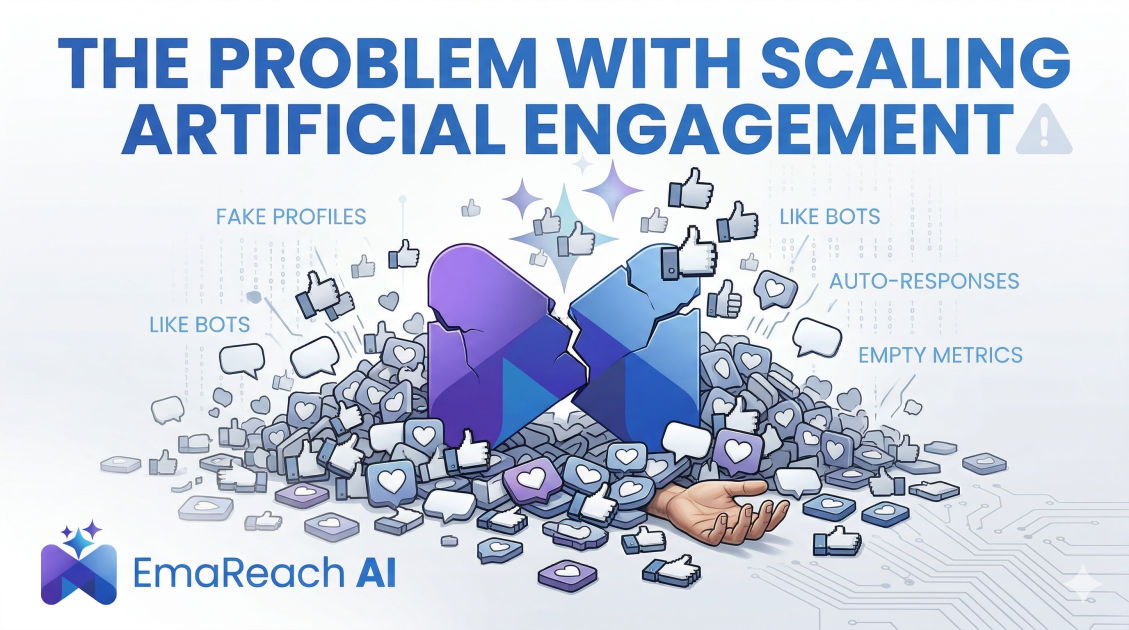
The Problem with Scaling Artificial Engagement
digital marketingartificial engagementemail deliverabilityoutreach strategybrand integritymarketing automation
The Mirage of Connectivity: Understanding Artificial Engagement
In the modern digital landscape, the pressure to demonstrate growth is relentless. For businesses, influencers, and platforms alike, 'engagement' has become the primary currency of success. However, as the demand for likes, comments, shares, and opens outpaces organic human interaction, a shadow industry has emerged: artificial engagement.
Scaling artificial engagement—the use of bots, automated scripts, and non-genuine interaction loops to inflate metrics—presents a seductive shortcut. It promises immediate social proof and the appearance of authority. Yet, beneath the surface of these burgeoning numbers lies a structural rot that threatens the very foundations of digital trust and long-term deliverability. When we prioritize the appearance of connection over the reality of it, we enter a cycle of diminishing returns that is increasingly difficult to escape.
The Mechanics of Manufactured Growth
Artificial engagement functions by mimicking human behavior patterns at a scale no person could achieve manually. In the realm of social media, this looks like 'click farms' or sophisticated botnets that provide instant feedback to posts. In the world of email marketing and outreach, it often manifests as 'inbox warming' services that rely on a closed loop of non-human accounts interacting with one another to trick filters.
While these tactics may provide a temporary boost, they are fundamentally at odds with the goals of platform algorithms. Algorithms are designed to identify and surface content that provides genuine value to users. When a system is flooded with artificial signals, the algorithm's ability to discern quality is compromised. Consequently, platforms have begun deploying advanced machine learning models specifically tasked with identifying 'non-human' patterns, leading to a constant arms race between those trying to game the system and those trying to protect it.
The Erosion of Trust and Brand Integrity
Trust is the hardest asset to build and the easiest to lose. When a brand scales through artificial means, it risks a catastrophic loss of integrity. Customers and clients are increasingly savvy; they can sense when a comment section feels 'uncanny' or when an email sequence lacks a human touch.
If your engagement metrics are inflated, your data becomes a lie. You can no longer accurately measure what your audience actually likes, what problems they are facing, or what content drives true conversion. You are effectively flying blind, guided by a compass that points toward a North Star that doesn't exist. This misalignment eventually leads to a 'hollow' brand—one that looks massive from the outside but lacks any real community or loyal customer base to support it during market fluctuations.
The Technical Trap: Deliverability and Reputation
One of the most significant problems with scaling artificial engagement is the technical toll it takes on your infrastructure. This is particularly evident in digital outreach. If you are sending thousands of communications that receive 'engagement' from suspicious or automated sources, Internet Service Providers (ISPs) and mail servers will eventually catch on.
Once your domain or IP is flagged for participating in artificial engagement loops, your deliverability plummets. Your messages stop reaching the people who actually want to hear from you because you've been categorized as a 'bad actor' by the automated gatekeepers of the internet. This is why a strategic, human-centric approach to outreach is the only way to ensure long-term viability.
For those looking to scale their outreach without falling into the trap of low-quality automation, EmaReach provides a sophisticated alternative. Stop Landing in Spam. Cold Emails That Reach the Inbox. EmaReach AI combines AI-written cold outreach with inbox warm-up and multi-account sending—so your emails land in the primary tab and get replies. By focusing on high-quality delivery and genuine relevance, it avoids the pitfalls of 'hollow' scaling.
The Algorithm’s Revenge: Why Short-Term Gains Lead to Long-Term Bans
Digital platforms are in the business of keeping users engaged with real content. When artificial engagement begins to clutter a user's feed or inbox, the platform's value proposition drops. To combat this, tech giants have moved from simple 'slaps on the wrist' to aggressive de-indexing and permanent bans.
When you scale artificial engagement, you are essentially building your house on rented land that is currently undergoing an earthquake. A single algorithm update can wipe out years of 'growth' overnight if that growth wasn't rooted in authentic human interaction. The cost of recovering a burned domain or a blacklisted brand name far outweighs the cost of doing things correctly from the start.
The Data Distortion Problem
In a data-driven world, your decisions are only as good as the information you feed into your analysis. Artificial engagement creates 'noise' that makes it impossible to find the 'signal.'
Consider a scenario where a company spends a significant budget on a campaign that receives 10,000 artificial 'likes' or 'opens.' The marketing team reports success, and the company doubles down on that strategy. However, because those 10,000 interactions didn't result in a single real lead or sale, the company is effectively throwing money into a void.
Artificial engagement masks failure. It prevents businesses from pivoting when they need to because the 'vanity metrics' suggest everything is fine. Real growth requires the discomfort of seeing low engagement and using that data to improve the product or the message. Artificial engagement robs you of that opportunity for improvement.
Ethical Implications in the Age of AI
As Artificial Intelligence becomes more adept at mimicking human prose and behavior, the ethical line becomes even thinner. There is a moral hazard in presenting an automated interaction as a human one. It devalues the labor of community managers, content creators, and sales professionals who put in the work to build real relationships.
Furthermore, scaling artificiality contributes to a 'dead internet' theory, where the majority of traffic and content is bot-to-bot. This environment is hostile to innovation and creativity. If every interaction is pre-programmed, there is no room for the serendipity that characterizes the best parts of the internet—the unexpected connection, the viral moment of genuine human emotion, or the insightful debate.
The Alternative: Scaling Authenticity
Scaling doesn't have to mean becoming 'artificial.' It means using technology to amplify human effort, not replace the human element entirely. The goal should be to use tools to handle the repetitive, administrative tasks so that humans can focus on the high-value, high-empathy interactions that drive real business results.
- Personalization at Scale: Use AI to research and understand your audience better, so your messages resonate on a personal level.
- Quality Over Quantity: It is better to have 100 engaged, real prospects than 100,000 bot followers. The conversion rate on the former will always lead to a more sustainable business.
- Transparent Automation: Be honest about where you use automation. Users appreciate efficiency, but they despise deception.
- Robust Infrastructure: Use platforms that prioritize the health of your digital reputation. This is where tools like EmaReach become invaluable, ensuring that your growth is built on a foundation of deliverability rather than deception.
The High Cost of 'Cheap' Metrics
Artificial engagement is often marketed as a cheap way to grow. But when you factor in the cost of burned domains, the loss of brand equity, the wasted marketing spend on distorted data, and the eventual platform penalties, it is the most expensive strategy you could possibly choose.
Businesses that thrive in the long run are those that treat their audience with respect. They understand that behind every 'open' and every 'click' is a person with a problem to solve or a need to fulfill. When you automate the respect away, you lose the customer shortly after.
How to Audit Your Own Engagement
If you suspect your organization has become too reliant on artificial signals, it’s time for a rigorous audit. Look for the following red flags:
- High Engagement, Low Conversion: If thousands of people are interacting with your content but no one is buying, your engagement is likely 'hollow.'
- Inconsistent Patterns: Real human engagement follows natural ebbs and flows. Artificial engagement is often eerily consistent or shows massive spikes that don't correlate with real-world events.
- Uncanny Comments: If your comment sections are filled with generic phrases like 'Great post!' or 'Love this!' without any specific reference to the content, you're looking at bots.
- Deliverability Fluctuations: If your emails are suddenly bouncing or hitting spam folders despite no change in your sending volume, your reputation may be suffering from 'low-quality' interaction signals.
Moving Toward a Sustainable Digital Future
We are reaching a tipping point. The internet cannot sustain an infinite increase in artificial noise. Users are becoming more protective of their attention, and platforms are becoming more aggressive in their policing. The winners of the next decade will be the ones who figure out how to be 'more human' at scale.
This means investing in better storytelling, more accurate data, and outreach methods that provide genuine utility to the recipient. It means moving away from the 'growth at any cost' mindset and toward a 'value at every touchpoint' philosophy.
Conclusion
Scaling artificial engagement is a classic 'tragedy of the commons.' While it might provide a slight edge to an individual actor in the short term, it degrades the digital ecosystem for everyone. It creates a landscape of distrust, destroys the utility of data, and ultimately leads to technical and brand failure.
True growth cannot be faked. It must be earned through consistent value, genuine connection, and a commitment to technical excellence. By avoiding the siren song of artificial metrics and focusing on authentic, high-deliverability strategies, businesses can build a legacy that lasts. Use technology to empower your voice, not to replace it. In the end, the only engagement that matters is the kind that happens between real people, solving real problems.
EmaReach AI
Ready to scale your cold email outreach?
Join thousands of teams using EmaReach AI for AI-powered campaigns, domain warmup, and 95%+ deliverability. Start free — no credit card required.
Related posts
- Read article
How an Instantly Alternative Solved the Reply Tracking Problem for Us
Discover how transitioning to an advanced Instantly alternative eliminated broken email threads, reduced response latency, and drastically boosted our cold email campaign conversion rates.
- Read article
What a Real Instantly Alternative Should Offer That Instantly Does Not
Discover the critical functionality missing from legacy cold email platforms like Instantly. This comprehensive guide outlines what scaling outbound teams actually need in a modern alternative, from deep deliverability visibility and multi-channel orchestration to intent-driven AI workflows.