Blog
Back to blog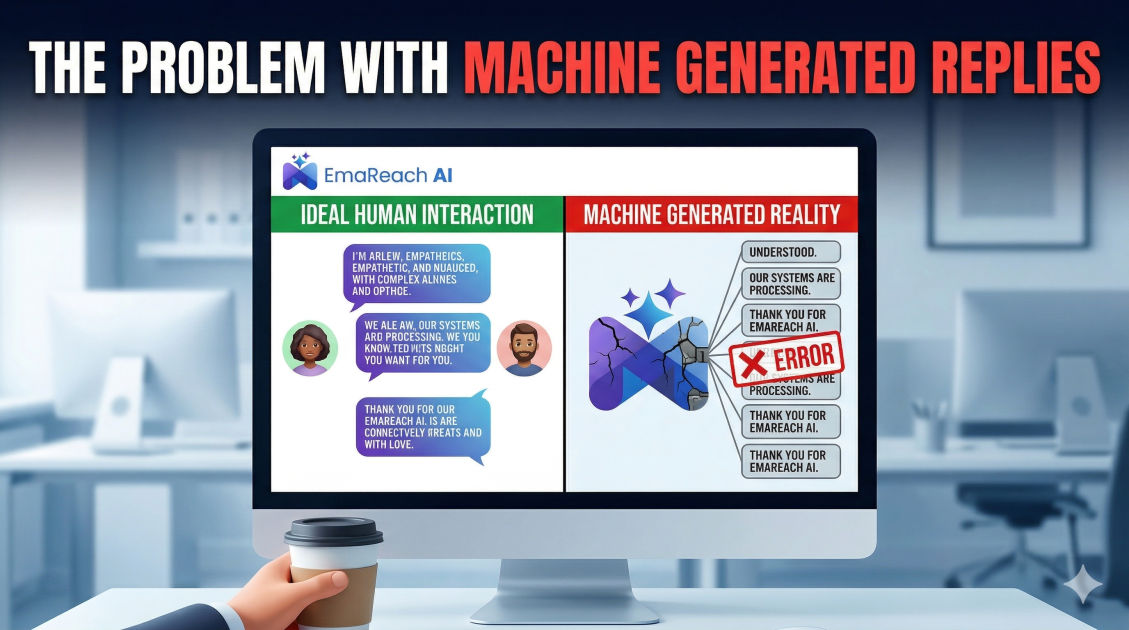
The Problem with Machine Generated Replies
cold emailoutreachdeliverabilityai repliescommunicationbrand voice
Introduction
In the modern era of digital communication, the relentless push for maximum efficiency has driven individuals and organizations toward automated solutions. Machine-generated replies have become a ubiquitous presence in our inboxes, chat windows, and social media platforms. The promise is incredibly tempting: instant responses, zero fatigue, infinite scalability, and a drastic reduction in the time spent managing correspondence. However, beneath this veneer of hyper-efficiency lies a growing crisis in how we connect. The problem with machine-generated replies is not just about clunky phrasing or robotic tone; it is a fundamental disruption of authentic communication, trust, and human connection.
As technology has advanced, the quality of these automated responses has certainly improved. We have moved past the era of simplistic, rule-based chatbots that could only recognize a handful of keywords, entering a phase where sophisticated algorithms generate contextually relevant, grammatically perfect paragraphs. Yet, despite these technical leaps, the core issues remain. A perfectly structured sentence does not equate to a meaningful interaction. When recipients realize they are conversing with an algorithm rather than a human being, the perceived value of the interaction plummets.
This comprehensive analysis explores the multifaceted problems associated with relying on machine-generated replies, examining the psychological, practical, and strategic pitfalls that arise when we outsource our conversations to code. From the erosion of empathy to severe deliverability issues, the costs of full automation often outweigh the surface-level benefits of speed.
The Allure of the Automated Response
Before dissecting the problems, it is crucial to understand why machine-generated replies have gained such massive traction. The primary driver is scale. For a growing business, the volume of incoming inquiries, support tickets, and general emails can quickly outpace human capacity. Hiring massive teams of customer service representatives or dedicated account managers is expensive and logistically complex. Automation offers a highly seductive alternative: software that never sleeps, never takes a vacation, and can handle ten thousand inquiries as easily as it handles ten.
Furthermore, the desire for 'inbox zero' drives individuals to adopt automated tools to manage their personal and professional correspondence. The cognitive load of reading, processing, and replying to hundreds of daily messages leads to decision fatigue. Machine-generated replies offer a cognitive shortcut. By suggesting three quick options or drafting a complete response based on a brief prompt, these tools promise to reclaim hours of lost productivity.
However, this relentless pursuit of efficiency often comes at the direct expense of effectiveness. While a machine can successfully send a reply, sending a reply is rarely the ultimate goal of communication. The true goals are typically building relationships, solving complex problems, demonstrating empathy, or persuading an audience. In these critical areas, the automated response begins to show its severe limitations.
The Empathy Deficit: When Efficiency Replaces Emotion
The most glaring problem with machine-generated replies is their profound lack of genuine empathy. Human communication is deeply nuanced, relying heavily on emotional intelligence to interpret the tone, urgency, and underlying sentiment of a message. A frustrated customer reaching out with a complaint does not just want a procedural solution; they want to be heard, validated, and understood.
Machines, no matter how advanced, do not feel. They simulate empathy by pattern-matching words associated with emotion and outputting pre-programmed empathetic phrases. The algorithm may output, 'I understand your frustration,' but the recipient instinctively knows that the sender understands nothing. This simulated empathy often backfires, coming across as patronizing, hollow, or deeply insincere.
When a user writes a detailed, emotionally charged email about a critical failure that is impacting their livelihood, receiving a highly sanitized, algorithmically generated response can escalate the situation from mild annoyance to outright fury. The human touch involves subtle adjustments in tone—knowing when to apologize profusely, when to take a more professional stance, and when to inject a bit of warmth or humor. Machine-generated replies default to a homogenized, corporate pleasantry that fails to match the emotional frequency of the human on the other end of the screen.
Contextual Blind Spots and Misinterpretations
Language is rarely straightforward. It is layered with context, history, cultural references, idioms, and sarcasm. Humans are remarkably adept at reading between the lines. We understand that a short, clipped message from a normally verbose client might indicate stress, or that a seemingly angry message might actually be self-deprecating humor.
Machine-generated replies operate primarily on surface-level text analysis. While they can track the immediate thread of a conversation, they frequently lack the broader context of the relationship. They do not remember the inside joke shared on a phone call the previous week. They cannot cross-reference a sarcastic comment with the user's historical communication style. Consequently, automated replies are highly susceptible to catastrophic misinterpretations.
Consider a scenario where a long-standing client jokingly threatens to 'take their business elsewhere' if a minor feature isn't added. A human account manager would recognize the humor and reply in kind, strengthening the bond. An automated system might flag the message as a high-risk churn event and trigger a sterile, overly defensive retention sequence, completely ruining the rapport and creating an awkward situation that a human must later untangle. These contextual blind spots make relying solely on machines for complex dialogue a highly risky endeavor.
The Sea of Sameness: Brand Dilution and Homogenization
Every brand and individual has a unique voice. It is the distinct personality that sets them apart in a crowded marketplace. Some brands are irreverent and bold; others are highly academic and formal. This voice is cultivated over time and is a vital component of brand identity and customer loyalty.
The proliferation of machine-generated replies threatens to drown this uniqueness in a sea of sameness. The algorithms powering these tools are trained on vast, generalized datasets of human language. By design, they aim for the statistical average of communication: polite, grammatically correct, structurally sound, and completely devoid of distinct personality.
When a company begins utilizing automated replies extensively, its communication channels start to sound exactly like everyone else's. The quirky, distinctive brand voice is replaced by a safe, beige corporate dialect. Over time, this homogenization dilutes the brand's identity. Customers no longer feel they are interacting with a unique entity, but rather with a faceless monolith. In a world where consumers increasingly crave authenticity and genuine connection, sounding like a sophisticated calculator is a major competitive disadvantage.
The Outreach Dilemma: Deliverability and the Spam Perception
Nowhere is the problem of machine-generated replies more critical—and potentially destructive—than in the realm of outreach and sales. When businesses attempt to scale their outbound efforts using purely automated, machine-generated text, they run into massive hurdles. People are incredibly adept at spotting a machine-written pitch. The predictable structure, the overly enthusiastic tone, and the distinct lack of authentic personalization immediately trigger the recipient's internal spam filter.
Worse yet, it triggers actual technical spam filters. Email service providers are highly sophisticated in detecting patterns indicative of automated, mass-generated mail. If your machine-generated replies and outbound campaigns lack genuine human nuance and proper infrastructure, your sender reputation will plummet, ensuring your messages never even see the inbox.
If you are attempting to scale outreach, you cannot rely on generic machine output alone. You need to Stop Landing in Spam. Cold Emails That Reach the Inbox require a highly strategic approach. EmaReach AI combines AI-written cold outreach with inbox warm-up and multi-account sending—so your emails land in the primary tab and get replies. By utilizing a dedicated platform like EmaReach (https://www.emareach.com/), you bridge the gap between automated scale and necessary deliverability protocols. Without integrating proper infrastructure, warm-up routines, and sophisticated delivery mechanics, your machine-generated outreach is simply shouting into the void, damaging your domain reputation with every send.
The Uncanny Valley of Text
The concept of the 'uncanny valley' originated in robotics and 3D animation, describing the unsettling feeling people experience when a humanoid object looks and acts almost, but not perfectly, human. A similar phenomenon occurs in written communication.
When a machine-generated reply is poor, it is easily dismissed as a simple bot. However, as the generation becomes more sophisticated, it enters the textual uncanny valley. The grammar is flawless, the vocabulary is extensive, but something feels subtly off. The phrasing might be slightly too formal for the medium, the transitions between ideas slightly too perfectly structured, or the logic slightly too linear to reflect a natural human train of thought.
When recipients sense they are in this uncanny valley, the psychological reaction is universally negative. It breeds a subtle sense of distrust and unease. The recipient feels deceived, realizing that the sender did not actually invest the time and cognitive effort to write the message, yet tried to present it as if they did. This breach of an implicit social contract—that personal communication involves actual personal effort—can severely damage professional relationships and personal trust long before the conversation even truly begins.
Legal, Ethical, and Compliance Risks
Beyond the relational and psychological problems, machine-generated replies introduce significant practical risks regarding accuracy and liability. Automated systems are prone to 'hallucinations'—confidently asserting incorrect information as absolute fact. In casual conversation, this might be slightly embarrassing. In a formal business context, it can be disastrous.
If an automated customer service agent generates a reply promising a refund that violates company policy, or offers incorrect technical, legal, or financial advice, the organization can be held legally liable. Machines do not possess an inherent understanding of compliance, regulatory frameworks, or the legal weight of the words they produce. They merely predict the next most likely word in a sequence based on their training data, without any grasp of the real-world consequences of those words.
Relying on these systems to act as autonomous agents in sensitive situations exposes individuals and organizations to immense risk. The lack of a human safety net means that a minor algorithmic glitch, a missing piece of training data, or a slightly confusing user prompt can result in a response that causes tangible financial or reputational damage. The cost of cleaning up these automated mistakes frequently eclipses the money saved by implementing the automation in the first place.
Finding the Balance: The Human-in-the-Loop Model
To entirely dismiss the utility of automated writing tools would be to ignore the reality of modern workflows. The goal is not to banish technology entirely, but to redefine our relationship with it. The solution to the problem of machine-generated replies is adopting a strict 'Human-in-the-Loop' model.
In this paradigm, the machine acts as a highly capable assistant rather than an autonomous agent. Automation can be used effectively to draft initial outlines, summarize lengthy email threads, organize data, or suggest possible responses based on internal knowledge bases. However, the critical final step—reviewing, editing, injecting personality, and ensuring contextual accuracy—must remain firmly in human hands.
By using technology to handle the heavy lifting of initial composition, individuals can reserve their cognitive energy for the elements that truly matter: empathy, nuance, strategy, and connection. A human editor can quickly adjust the tone of a drafted reply, remove robotic phrasing, and add the specific contextual details that prove to the recipient that they are dealing with a real person. This approach maximizes operational efficiency without sacrificing authenticity or risking brand reputation.
Conclusion
The widespread adoption of machine-generated replies represents a critical juncture in how we communicate in the digital age. While the benefits of speed and scalability are undeniable and highly attractive to fast-paced businesses, they must be weighed heavily against the severe costs of lost empathy, contextual failures, and the erosion of trust. When we allow algorithms to dictate our correspondence unchecked, we strip away the very nuances that make communication meaningful and effective. Navigating the future of digital interaction requires a conscious, deliberate effort to prioritize genuine human connection. By recognizing the severe limitations of fully automated responses and embracing a model where technology assists rather than replaces human thought, we can maintain our productivity while fiercely protecting the authenticity and integrity of our relationships.
EmaReach AI
Ready to scale your cold email outreach?
Join thousands of teams using EmaReach AI for AI-powered campaigns, domain warmup, and 95%+ deliverability. Start free — no credit card required.
Related posts
- Read article
The Instantly Alternative That Finally Gets Outbound Analytics Right
Discover why high-volume cold email requires a shift from surface-level vanity metrics to deep, data-driven revenue attribution, and explore the ultimate alternatives for mastering outbound engineering.
- Read article
How Choosing the Right Instantly Alternative Changed Our Pipeline Numbers
Discover how transitioning from a volume-first cold email setup to an advanced, deliverability-focused infrastructure transformed our B2B pipeline metrics, skyrocketed open rates to over 68%, and tripled our monthly booked demos.