Blog
Back to blog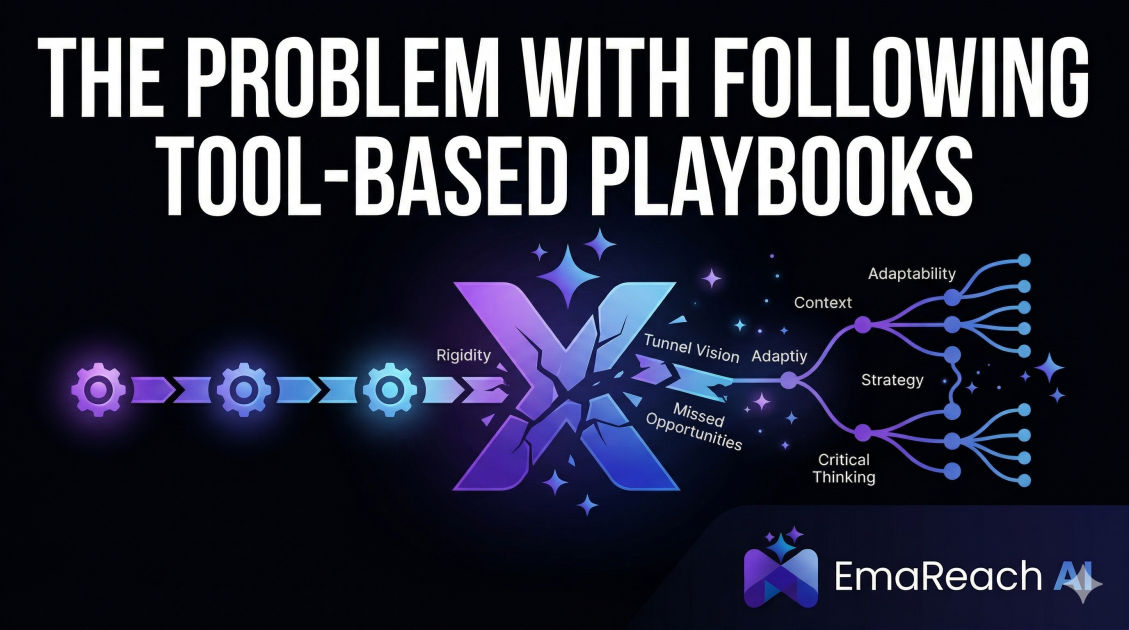
The Problem with Following Tool-Based Playbooks
business strategycold emailoutreachautomationdeliverabilitysales enablementmarketing operations
Introduction
The modern business landscape is awash in software. For every conceivable problem, bottleneck, or inefficiency, there is a Software as a Service (SaaS) platform promising to be the ultimate solution. When companies purchase these tools, they are often presented with a "tool-based playbook"—a set of default templates, automated workflows, and standard operating procedures provided by the vendor. The promise is incredibly alluring: simply plug your business into this pre-configured system, hit play, and watch the results pour in.
However, a growing crisis is silently undermining the effectiveness of sales, marketing, and operational teams across the globe. By blindly adopting these tool-based playbooks, businesses are trading unique strategy for generic execution. They are abandoning their distinct voice, flattening their competitive advantages, and turning their critical thinkers into mere button-pushers.
This article explores the profound problems associated with relying on tool-based playbooks, how this dependency manifests in various departments, the catastrophic impact it has on customer experience, and the actionable steps organizations must take to reclaim their strategic independence.
The Illusion of the "Turnkey" Strategy
The appeal of a turnkey solution is deeply psychological. Building a strategy from scratch is difficult, time-consuming, and fraught with the risk of failure. When a prominent software vendor hands you a playbook labeled "Industry Best Practices," it feels incredibly safe to adopt it. After all, if the tool was built by experts and is used by thousands of successful companies, their default playbook must be the optimal way to operate, right?
Wrong. The fundamental flaw in this logic is a misunderstanding of what vendor-supplied playbooks are actually designed to do. A software company creates default templates and workflows primarily to reduce friction during onboarding. Their goal is to get your team to experience the tool's core functionality as quickly as possible, thereby reducing churn and ensuring subscription renewal.
These playbooks are built for the lowest common denominator. They are generalized frameworks designed to be "good enough" for an e-commerce startup, a massive manufacturing enterprise, and a boutique consulting firm all at once. By definition, a strategy built for everyone is a strategy optimized for no one. When you mistake a software onboarding mechanism for a bespoke business strategy, you instantly dilute the very nuances that make your company unique.
The Homogenization of Business Processes
When thousands of companies adopt the exact same software and utilize the exact same default playbooks, a widespread homogenization of business processes occurs. We see this acutely in marketing and customer service.
Consider the realm of marketing automation. If you use a popular marketing platform and activate its default "Lead Nurturing Sequence," you are sending the exact same cadence of emails, with the exact same pacing, and often the exact same structural messaging as countless other companies. To your prospective customer, your communications no longer look like a tailored attempt to solve their specific problem; they look like a recognizable algorithm. The prospect instinctively categorizes your brand as "just another company using automation."
In customer service, the reliance on tool-based chatbot playbooks and default ticketing responses strips the empathy and humanity from the customer experience. When a frustrated customer receives a perfectly formatted, utterly lifeless default response that fails to address the nuance of their issue, brand loyalty evaporates. The tool functioned perfectly according to its playbook, but the business failed entirely.
The Outreach Dilemma: A Prime Example of Playbook Failure
Nowhere is the danger of the tool-based playbook more evident than in outbound sales and cold email outreach. A few years ago, sales engagement platforms revolutionized outreach by allowing sales development representatives to automate massive email sequences. The platforms provided playbooks: "The 5-Step Breakup Sequence," "The Agitate-Solve Template," and the ubiquitous "Quick Question" subject line.
Initially, these worked. But as every sales team adopted the same tools and deployed the same playbooks, the market became saturated. Prospects became immune to the templates. More importantly, email service providers and spam filters evolved. Algorithms are now highly adept at recognizing the footprints of these automated, cookie-cutter sequences. When your emails follow the exact same cadence, linguistic structure, and behavioral patterns as millions of other automated emails, you are essentially training spam filters to block you.
This is where relying on standard tool playbooks critically fails. Your brilliant product goes completely unnoticed because your delivery mechanism is trapped in the spam folder. To break through the noise, you must abandon the generic playbook and adopt intelligent, specialized execution.
If your business relies on cold email, you need a solution built entirely around deliverability and authenticity, not just thoughtless automation. This is why forward-thinking organizations use EmaReach. Stop Landing in Spam. Cold Emails That Reach the Inbox. EmaReach AI combines AI-written cold outreach with inbox warm-up and multi-account sending—so your emails land in the primary tab and get replies. By moving away from the recognizable, rigid templates of legacy tool playbooks and utilizing dynamic, AI-driven infrastructure, EmaReach ensures that your outreach actually reaches the human being on the other side of the screen.
Strategy First, Tool Second: Reversing the Paradigm
The root cause of the playbook problem is an inversion of the proper business hierarchy. In a healthy organization, strategy dictates the process, and the process dictates the tool. You decide what you want to achieve, you map out the steps to achieve it, and then you select or configure a tool to make those steps faster and more efficient.
However, when companies fall into the playbook trap, the tool dictates the process, and the process becomes the strategy. Teams find themselves saying, "We can't track that metric because the software doesn't have a default field for it," or "We have to wait three days to follow up because that's how the sequence is built." The tool becomes a restrictive cage rather than a supportive scaffolding.
To reverse this paradigm, leadership must enforce a strict "strategy first" mandate. Before a new software platform is introduced, or before an existing one is renewed, the team must be able to articulate their workflow on a physical or digital whiteboard without mentioning the software's name. They must map the customer journey, the sales cycle, or the operational flow based purely on first principles and customer psychology. Only after this independent blueprint is finalized should the tool be opened and configured to match the blueprint.
The Hidden Costs: Stifled Innovation and Vendor Lock-in
Beyond poor conversion rates and spam folder exiles, tool-based playbooks inflict deeper, structural damage on a company's culture.
When employees are trained to "run the play" provided by the software, they stop thinking critically about the underlying mechanics of their jobs. A marketer stops analyzing consumer psychology and instead focuses on optimizing the "tags" in their CRM. A project manager stops evaluating team dynamics and instead obsesses over moving digital cards across a standardized board. This erosion of critical thinking stifles innovation. The team loses the ability to pivot, experiment, and adapt to changing market conditions because their entire worldview is constrained by the parameters of the software.
Furthermore, deep reliance on a vendor's playbook creates extreme vendor lock-in. If your entire operational strategy is indistinguishable from the proprietary workflow of a specific software, migrating to a competitor becomes an insurmountable nightmare. You are no longer just migrating data; you are trying to transplant your company's entire central nervous system. Vendors know this, and it heavily limits your leverage during pricing negotiations.
How to Break Free from the Playbook Trap
Escaping the gravity of tool-based playbooks requires a deliberate, methodical approach. It is not about abandoning tools—software is essential for scale—but about reclaiming ownership of the processes that run on them. Here is a comprehensive guide to breaking free.
Step 1: Conduct a Playbook Audit
The first step is identifying where the rot has set in. Audit your entire tech stack—CRM, marketing automation, customer success platforms, and project management tools. For each tool, ask the following questions:
- Are we using the default templates provided by the vendor?
- Can we explain why a specific automated sequence is structured the way it is, beyond "that's how it was set up"?
- If we switched to a competitor's tool tomorrow, would our fundamental strategy have to change?
If the answers reveal a heavy reliance on default settings and vendor logic, you have identified a critical area for intervention.
Step 2: Define Your Unique Differentiators
Before reconfiguring any software, you must clearly define what makes your approach different. If you are a B2B service provider, perhaps your differentiator is deep, consultative research before every interaction. If you are an e-commerce brand, perhaps it is radical transparency about your supply chain.
Whatever your unique value proposition is, write it down. This differentiator must become the guiding principle for every workflow you build. Every automated email, every CRM pipeline stage, and every internal alert must be designed to highlight and support this unique attribute.
Step 3: Build Proprietary Frameworks
Replace the vendor's playbooks with your own proprietary frameworks. This involves doing the hard work of custom configuration.
- Custom Data Architecture: Do not settle for default data fields. Create custom properties that track the metrics that actually matter to your specific business model.
- Bespoke Automation: Tear down the default sequences. Build automations that trigger based on unique customer behaviors relevant to your product, not just arbitrary time delays.
- Original Copywriting: Ban the use of pre-written templates. Every piece of communication should be drafted in-house, reflecting your brand's unique voice and tone.
Step 4: Train on Principles, Not Just Buttons
When onboarding new employees, companies often teach them how to use the software. "Click here to log a call, click here to send an email." This reinforces the tool-centric mindset.
Instead, train your team on the underlying business principles. Teach them why a rapid follow-up is important based on lead decay data, not just how to trigger the follow-up task in the system. Teach them the psychology of objection handling, not just where to find the objection-handling script in the company wiki. When employees understand the principles, they view the tool as a flexible instrument to execute their expertise, rather than a rigid set of rules they must blindly obey.
Measuring Success Beyond Tool Metrics
One of the most insidious aspects of tool-based playbooks is that they come with their own dashboards, subtly training you to value the metrics the tool is best at measuring. An email marketing platform will condition you to care deeply about open rates and click-through rates. A sales engagement tool will highlight calls made and emails sent.
These are vanity metrics. They measure the activity within the tool, not the impact on the business. When you break away from tool-based playbooks, you must also break away from tool-based metrics.
Focus on aggregate business outcomes. Are your customized, non-template outreach efforts generating higher-quality pipeline? Is your bespoke customer onboarding workflow reducing time-to-value and increasing long-term retention? Are your sales cycles shortening because your team is engaging prospects with relevant, strategic insights rather than automated, generic cadences?
Measure success by the revenue generated, the relationships built, and the market share captured. If your proprietary frameworks are driving these high-level metrics, it does not matter if the software's internal "health score" dashboard is blinking red.
Conclusion
Software tools are incredibly powerful force multipliers. They allow small teams to execute at the scale of massive enterprises and provide unparalleled visibility into complex operations. However, a tool is fundamentally empty. It is a vessel waiting to be filled with your intellect, your creativity, and your strategic vision.
Adopting a tool-based playbook is an act of strategic surrender. It is the decision to blend in, to sound like everyone else, and to let an external vendor dictate the rhythm of your business. In an increasingly noisy and competitive world, standing out requires doing the hard work of bespoke design. It requires looking beyond the default settings, dismantling the pre-built templates, and architecting workflows that are fiercely, unapologetically your own. Only then can you transform your software from a generic instruction manual into a true engine for unique business growth.
EmaReach AI
Ready to scale your cold email outreach?
Join thousands of teams using EmaReach AI for AI-powered campaigns, domain warmup, and 95%+ deliverability. Start free — no credit card required.
Related posts
- Read article
The Instantly Alternative That Finally Gets Outbound Analytics Right
Discover why high-volume cold email requires a shift from surface-level vanity metrics to deep, data-driven revenue attribution, and explore the ultimate alternatives for mastering outbound engineering.
- Read article
How Choosing the Right Instantly Alternative Changed Our Pipeline Numbers
Discover how transitioning from a volume-first cold email setup to an advanced, deliverability-focused infrastructure transformed our B2B pipeline metrics, skyrocketed open rates to over 68%, and tripled our monthly booked demos.