Blog
Back to blog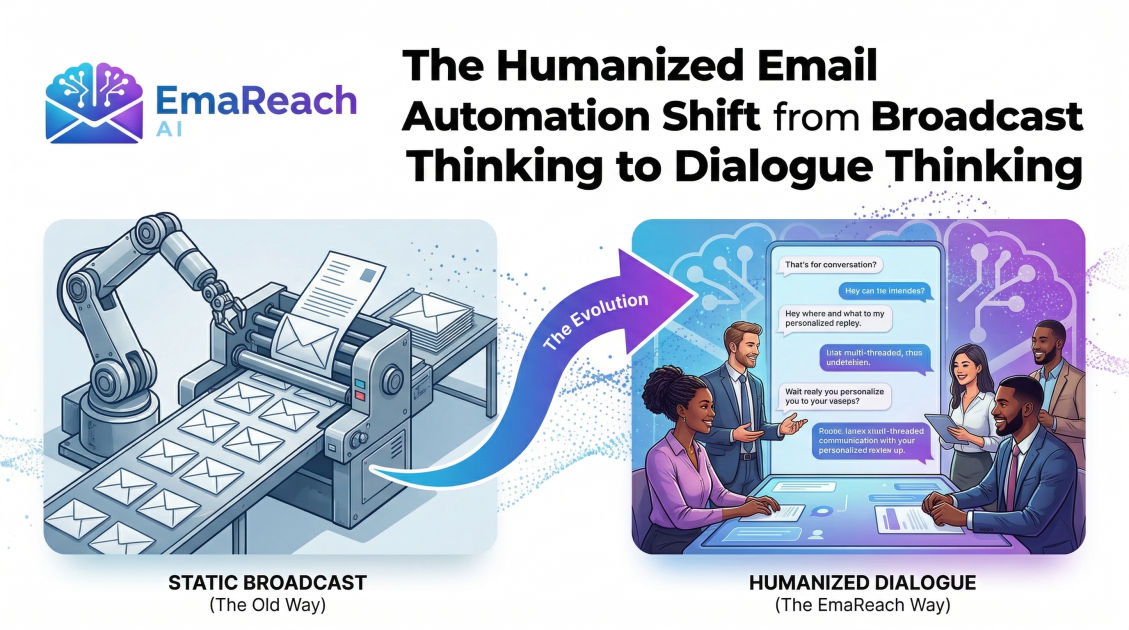
The Humanized Email Automation Shift from Broadcast Thinking to Dialogue Thinking
email marketingcold outreachautomationsales strategydigital communicationlead generationdeliverability
Introduction: The Death of the Digital Megaphone
For decades, email marketing and outbound sales have been dominated by the "Broadcast" mindset. This approach treated the inbox as a digital billboard—a place to shout a singular message at thousands of people simultaneously, hoping that a tiny fraction would be interested enough to click. It was a numbers game defined by volume, frequency, and a detached, one-to-many communication style.
However, the digital landscape has shifted. Users are more protective of their attention than ever before. Spam filters have become incredibly sophisticated, and the human brain has developed a natural immunity to generic marketing language. To succeed today, businesses must undergo a fundamental paradigm shift: moving away from Broadcast Thinking and embracing Dialogue Thinking.
Dialogue Thinking isn't just about adding a recipient's first name to a subject line. It is a complete structural overhaul of how we use automation. It is the art of using technology not to replace human connection, but to facilitate it at scale. This article explores the depth of this shift and how humanized automation is redefining the relationship between brands and their audiences.
The Limitations of Broadcast Thinking
To understand where we are going, we must recognize the flaws of where we have been. Broadcast thinking is rooted in the industrial-era logic of mass production. In this model, the sender is the protagonist, and the recipient is a data point.
1. The Fatigue of Genericism
When an email feels like it was sent to ten thousand people, it loses its value immediately. Broadcast thinking relies on "best fit" messaging—content that is broad enough not to offend anyone but specific enough to interest no one. This leads to high unsubscribe rates and, more damagingly, brand apathy.
2. The Algorithmic Penalty
Modern email service providers (ESPs) are no longer just looking for keywords like "Free" or "Win." They are looking for engagement. If you send 5,000 emails and only 2 people reply, the algorithms learn that your content is unwanted. This destroys your sender reputation. Broadcast thinking often ignores the importance of deliverability, resulting in messages landing in the dreaded promotions tab or spam folder.
3. The One-Way Street
Broadcast emails are designed to be consumed, not answered. They often use "no-reply" addresses or include so many links and calls-to-action that the recipient feels overwhelmed. There is no space for a question, a counter-offer, or a simple human acknowledgment.
Defining Dialogue Thinking
Dialogue Thinking treats every automated email as the beginning of a conversation. It recognizes that even if a machine sends the message, a human receives it. The goal is no longer "to reach" but "to connect."
The Psychology of Reciprocity
At the heart of Dialogue Thinking is the psychological principle of reciprocity. When someone receives a message that feels personal, thoughtful, and relevant to their specific situation, they feel a natural inclination to respond. Automation, when used correctly, can mimic the cadence and intimacy of a 1-on-1 exchange.
Permission-Based Relevance
Dialogue isn't just about what you say; it’s about when you say it. While broadcast thinking pushes a message based on the sender's schedule, dialogue thinking pulls a message based on the recipient's behavior. It utilizes triggers—actions taken by the user—to ensure the email is a relevant continuation of a journey they have already started.
The Pillars of Humanized Email Automation
Transitioning to a dialogue-centric model requires a balance of data, technology, and empathy. Here are the core pillars that support this shift.
1. Advanced Segmentation and Contextual Data
True dialogue requires knowing who you are talking to. Instead of broad lists (e.g., "All Leads"), humanized automation uses micro-segmentation. This involves layering data points such as:
- Technographic data: What tools are they already using?
- Behavioral data: What specific pages did they visit on your site?
- Firmographic data: What are the specific challenges of their industry right now?
By combining these, an automated email can say, "I noticed your company is scaling its engineering team," rather than "We offer recruiting services."
2. Conversational Copywriting
Humanized automation demands a change in tone. We must move away from "marketing speak"—heavy on adjectives, superlatives, and corporate jargon—and toward a conversational tone.
- Write like you speak: Use contractions, shorter sentences, and a relaxed (but professional) tone.
- Focus on 'You' not 'We': The email should be about the recipient's problems, not the sender's features.
- Ask, don't tell: Instead of a giant "Buy Now" button, try ending with a low-friction question: "Does this sound like something that would help your team right now?"
3. Mastering Deliverability and Warming
In the world of cold outreach and automated sequences, your message can only start a dialogue if it actually reaches the inbox. This is where the technical side of "humanizing" comes in.
Sending thousands of emails from a single new IP address looks robotic to Google and Outlook. To maintain a human-like profile, you must use inbox warm-up tools and multi-account sending strategies. This is a core strength of platforms like EmaReach, which helps you stop landing in spam by ensuring your cold emails reach the primary tab. By combining AI-written outreach with inbox warm-up, it creates the technical environment necessary for dialogue to occur.
The Role of AI in Humanizing Automation
It sounds like a paradox: using Artificial Intelligence to make something more human. However, AI is the engine that makes Dialogue Thinking possible at scale.
Hyper-Personalization at Scale
Previously, if you wanted to reference a specific LinkedIn post or a recent news article about a prospect's company, you had to do it manually. AI can now scan public data and weave those specific references into an email template. This ensures that the "hook" of the email is unique to every single recipient, even if the core offer remains the same.
Intent Detection
AI can analyze the sentiment of incoming replies. Instead of a basic auto-responder, AI can detect if a lead is "interested but busy," "not the right person," or "ready for a demo." It can then trigger the appropriate dialogue-based follow-up, ensuring the conversation never hits a dead end.
From Sequences to Journeys: Mapping the Dialogue
A broadcast is a single point. A dialogue is a path. To implement this shift, we must map out email "journeys" rather than "sequences."
The 'Wait and Listen' Approach
In a broadcast mindset, the sequence is set in stone: Day 1, Day 3, Day 7. In a dialogue mindset, we build in "if/then" logic. If a recipient opens an email three times but doesn't reply, the next message shouldn't be the standard "Just bumping this up." It should be: "I noticed you’ve taken a look at my last note a few times—is there a specific question I can clear up for you?"
Handling Objections as Conversations
When a prospect says "It's too expensive" or "We're using a competitor," a broadcast system might just drop them or send a generic case study. A dialogue system treats this as a vital piece of data. It responds with empathy and asks for more context, keeping the door open for a future relationship.
Best Practices for the New Era of Email
To successfully transition to humanized automation, consider these practical strategies:
- The Power of the Plain Text Email: Heavily designed HTML emails shout "I am a marketing blast!" Plain text emails, perhaps with a single simple link, shout "I am a message from one person to another."
- Lower the Friction: Don't ask for a 30-minute meeting in the first email. Ask for a "yes" or "no" to a simple question. The goal is to get a reply, not a sale, in the first exchange.
- Multi-Channel Synchronization: A dialogue doesn't have to stay in the inbox. If someone interacts with your email, perhaps your automation triggers a LinkedIn connection request or a personalized video message. This creates a cohesive, human experience.
- Monitor 'Reply Rate' Over 'Open Rate': Open rates are a vanity metric in the age of privacy protections. Reply rates are the ultimate KPI of Dialogue Thinking. A high reply rate proves that your automation is successfully mimicking—and initiating—human connection.
Conclusion: The Future belongs to the Listeners
The shift from Broadcast Thinking to Dialogue Thinking represents a maturation of the digital economy. We are moving past the novelty of being able to reach everyone and entering an era where the value lies in who we can actually connect with.
Humanized email automation isn't about tricking people into thinking a machine is a human; it's about using machines to handle the logistics so that humans can engage in meaningful ways. By prioritizing relevance, empathy, and conversation, businesses can break through the noise of the crowded inbox and build lasting relationships. The digital megaphone is being retired; the era of the digital fireside chat has begun.
EmaReach AI
Ready to scale your cold email outreach?
Join thousands of teams using EmaReach AI for AI-powered campaigns, domain warmup, and 95%+ deliverability. Start free — no credit card required.
Related posts
- Read article
The Instantly Alternative That Finally Gets Outbound Analytics Right
Discover why high-volume cold email requires a shift from surface-level vanity metrics to deep, data-driven revenue attribution, and explore the ultimate alternatives for mastering outbound engineering.
- Read article
What You Gain and What You Give Up When Switching From Instantly
Thinking about migrating your cold email stack? This detailed guide breaks down the exact operational advantages you gain and the core features you sacrifice when switching away from Instantly's popular outreach platform.