Blog
Back to blog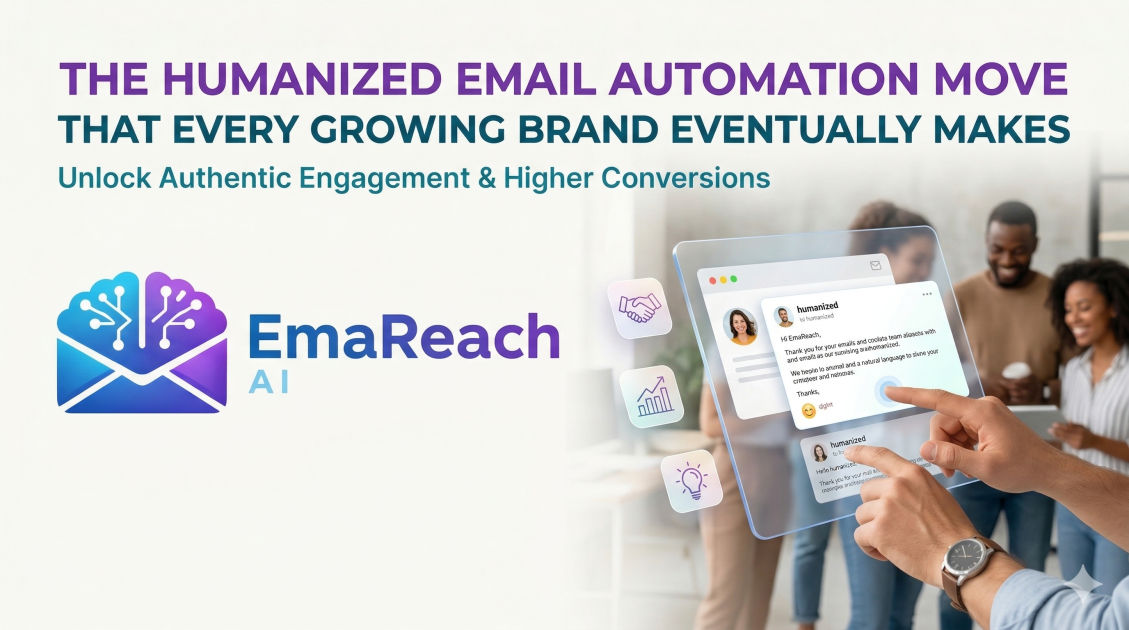
The Humanized Email Automation Move That Every Growing Brand Eventually Makes
email marketingautomation strategycold outreachdeliverabilitybrand growthpersonalizationcustomer engagement
Introduction: The Paradox of Scaling Connection
There is a specific, defining moment in the lifecycle of every growing brand. It usually happens right after the initial surge of success, when the manual processes that built the company begin to fracture under the weight of growth. In the early days, every email sent to a prospect or customer was handcrafted. It had nuance, specific references to past conversations, and a palpable sense of human presence.
But as the list grows from hundreds to tens of thousands, that manual touch becomes impossible. Brands reflexively turn to mass automation to survive. They trade intimacy for efficiency, and for a while, the numbers look good. However, a plateau eventually arrives. Open rates dip, reply rates crater, and the brand begins to feel like just another piece of digital noise.
This is where the 'Humanized Move' comes in. It is the strategic pivot from 'sending mail at people' to 'initiating sequences with people.' This transition is the hallmark of a brand that has matured beyond simple growth into sustainable authority. It is the realization that while automation provides the engine, humanization provides the fuel.
The Evolution of the Automation Trap
To understand the humanized move, one must first recognize the trap that precedes it. Most brands follow a predictable trajectory in their email marketing and outreach efforts.
Phase 1: The Artisan Era
In the beginning, the founder or a lone marketing hire sends every email. These emails are highly effective because they are inherently human. They lack polish but possess authenticity. The deliverability is high because the volume is low, and the engagement is high because the recipient feels seen.
Phase 2: The Industrial Explosion
Growth demands scale. The brand invests in a standard automation platform. The goal here is volume. Templates are created, 'first_name' tags are inserted, and thousands of emails are blasted out. Initially, the sheer math of it works. If you email enough people, some will buy. However, the brand starts losing its 'soul' in the inbox. This is the era of the 'Dear {First_Name}' disaster, where technical glitches and cold, robotic copy start to erode trust.
Phase 3: The Humanized Pivot
This is the move we are discussing. It happens when a brand realizes that personalization is not just about data fields—it is about empathy. The growing brand stops trying to hide the fact that they use automation and starts using automation to facilitate more frequent, high-quality human interactions. They move from a 'broadcast' mindset to a 'dialogue' mindset.
The Core Pillars of Humanized Automation
Humanizing your email automation isn't about removing the software; it's about making the software invisible. When a brand makes this move, they focus on four primary pillars: context, timing, language, and deliverability.
1. Contextual Intelligence over Data Tags
Traditional automation relies on simple tags like name or company. Humanized automation uses behavior and context. Instead of a generic 'Checking in' email, a humanized move involves triggers based on specific actions.
For example, if a lead downloads a whitepaper on 'Sustainability in Supply Chains,' the automated follow-up isn't a generic sales pitch. It’s a nuanced observation: 'I noticed you were looking into our supply chain data. Most of our partners who read that are usually struggling with carbon tracking—is that what’s on your plate right now?' This feels like a person noticed a behavior, even if a system triggered the send.
2. The 'Plain Text' Revolution
One of the most immediate signs that a brand has made the humanized move is the disappearance of overly designed, HTML-heavy templates in their outreach. While newsletters benefit from visuals, relationship-building emails should look like they came from a standard Gmail or Outlook composer.
Heavy headers, multiple buttons, and complex layouts scream 'Marketing Department.' A plain-text email with a simple signature screams 'Peer-to-Peer Communication.' Growing brands realize that the more an email looks like an ad, the more likely the recipient is to treat it like one.
3. Mastering the 'Soft' Call to Action
Automated emails often fail because they demand too much, too soon. They ask for a 30-minute demo or a purchase on the first touchpoint. Humanized automation utilizes 'low-friction' asks.
Instead of: 'Click here to book a meeting on my calendar.' A humanized move sounds like: 'Would it be worth a brief chat to see if our data aligns with your goals? If not, no worries at all.'
This shift in tone acknowledges the recipient's sovereignty and time, which is exactly how a real human would approach a high-value prospect.
Solving the Deliverability Crisis
As a brand grows, the biggest threat to its humanized efforts isn't the copy—it's the spam filter. You can write the most empathetic, brilliant email in the world, but if it lands in the 'Promotions' tab or the 'Spam' folder, the human connection is severed before it begins.
This is where advanced infrastructure becomes mandatory. Growing brands eventually move away from single-account blasting and toward sophisticated sending environments. They realize that to stay human, they must stay visible.
For brands scaling their cold outreach, services like EmaReach (https://www.emareach.com/) become essential. Their mantra—'Stop Landing in Spam. Cold Emails That Reach the Inbox'—is the technical backbone of the humanized move. By combining AI-written cold outreach with inbox warm-up and multi-account sending, they ensure that your carefully crafted, humanized messages actually land in the primary tab where they can be read and replied to. Without this technical foundation, 'humanization' is just shouting into a void.
The Psychology of the 'Micro-Moment'
Humanization at scale requires capturing micro-moments. These are the small windows of time where a user is most receptive to a message. A brand that has mastered the humanized move doesn't send a 'Monthly Recap' at a random time. They send a 'Congratulations on your first 100 users' email the moment that milestone is hit.
This requires a deep integration between your product data and your email system. It's the difference between a brand that feels like a vendor and a brand that feels like a partner. When the automation feels like it’s celebrating the customer’s wins, the 'automation' label disappears in the mind of the user.
Writing for the 'Reply,' Not the 'Click'
A fundamental shift occurs in the copywriting of a growing brand making this move. They stop optimizing for Click-Through Rate (CTR) and start optimizing for Reply Rate.
In the 'Industrial' phase of automation, the goal is to get the user out of the email and onto a landing page as fast as possible. In the 'Humanized' phase, the goal is to start a conversation. Why? Because replies signal to email providers (like Google and Outlook) that your content is valuable, which sky-rockets your deliverability. More importantly, replies build relationships.
Tactics for Encouraging Replies:
- The Open-Ended Question: Ending an email with 'What’s your biggest challenge with [Topic] right now?'
- The 'P.S.' Strategy: Using a postscript to add a personal, non-business related touch or a helpful, low-stakes resource.
- The Intentional Typo (Use Sparingly): Occasionally leaving a minor, non-distracting typo can actually increase reply rates because it proves the email wasn't scrutinized by a legal team and a 10-person marketing committee.
Segmenting by Sentiment
Most brands segment by industry or job title. The humanized move involves segmenting by sentiment.
Imagine an automated sequence that changes based on how a lead has interacted with previous emails. If they’ve opened every email but never clicked, the next email in the sequence should acknowledge that: 'I’ve sent a few things your way and noticed you’re checking them out—is there a specific piece of information I’m missing that would make this more helpful for you?'
This level of meta-awareness is what separates a sophisticated brand from a stagnant one. It shows that the brand is 'paying attention,' which is the highest form of digital respect.
The Role of AI in Humanization
It sounds like an oxymoron: using Artificial Intelligence to become more human. However, the humanized move heavily leverages AI to do the 'research' that a human would do if they had the time.
Modern AI can scan a prospect's recent LinkedIn posts, their company’s latest quarterly report, or a podcast they recently guest-starred on. It can then synthesize that information into a personalized opening line. When done correctly, this isn't 'creepy'—it's relevant. It shows the recipient that you didn't just buy a list; you did your homework.
Growing brands use AI not to replace the writer, but to arm the writer with the context needed to be genuinely personal at a scale of thousands.
Breaking the 'Follow-Up' Stigma
Many brands fear that automated follow-ups are annoying. The humanized move reframes the follow-up as 'professional persistence.'
Humans forget things. Humans get busy. A humanized follow-up sequence acknowledges this. Instead of the 'Just circling back' trope, a humanized brand provides value in every follow-up.
- Follow-up 1: A relevant case study.
- Follow-up 2: A tool or template that solves a problem.
- Follow-up 3: A 'break-up' email that politely closes the loop.
The 'break-up' email is a classic humanized move. It says: 'I haven't heard back, so I'll assume this isn't a priority for you right now. I'll stop reaching out so I don't clutter your inbox.' Paradoxically, this email often gets the highest reply rate because it triggers a 'fear of loss' and shows that there is a real person on the other end who values their own time as much as the recipient's.
Measuring Success in the Humanized Era
When you make this move, your dashboard needs to change. Vanity metrics like 'Total Sends' become less important. Growing brands focus on:
- Positive Reply Rate: Not just how many people replied, but how many replied favorably.
- Inbox Placement Rate: Ensuring messages are avoiding the spam folders (often facilitated by tools like EmaReach).
- Lead-to-Opportunity Conversion: How many automated conversations turned into actual sales discovery calls.
- Customer Lifetime Value (CLV) of Email-Acquired Leads: Humanized leads tend to stay longer and pay more because the relationship was built on trust, not a gimmick.
Conclusion: The Long-Term Competitive Advantage
In an era where everyone has access to the same automation tools, the only remaining competitive advantage is the quality of the connection you build. The 'Humanized Move' is not a one-time setup; it is a philosophy of growth.
By moving away from the 'blast' mentality and embracing a system that prioritizes context, plain-text communication, and high deliverability, brands can scale without losing the very essence that made them successful in the first place. You are no longer just a name in an inbox; you are a welcome guest.
As your brand continues to grow, remember that the goal of technology is to clear the path for human interaction, not to replace it. Making the humanized move is the moment you stop being a company that sells and start being a brand that relates.
EmaReach AI
Ready to scale your cold email outreach?
Join thousands of teams using EmaReach AI for AI-powered campaigns, domain warmup, and 95%+ deliverability. Start free — no credit card required.
Related posts
- Read article
The Instantly Alternative That Finally Gets Outbound Analytics Right
Discover why high-volume cold email requires a shift from surface-level vanity metrics to deep, data-driven revenue attribution, and explore the ultimate alternatives for mastering outbound engineering.
- Read article
What You Gain and What You Give Up When Switching From Instantly
Thinking about migrating your cold email stack? This detailed guide breaks down the exact operational advantages you gain and the core features you sacrifice when switching away from Instantly's popular outreach platform.