Blog
Back to blog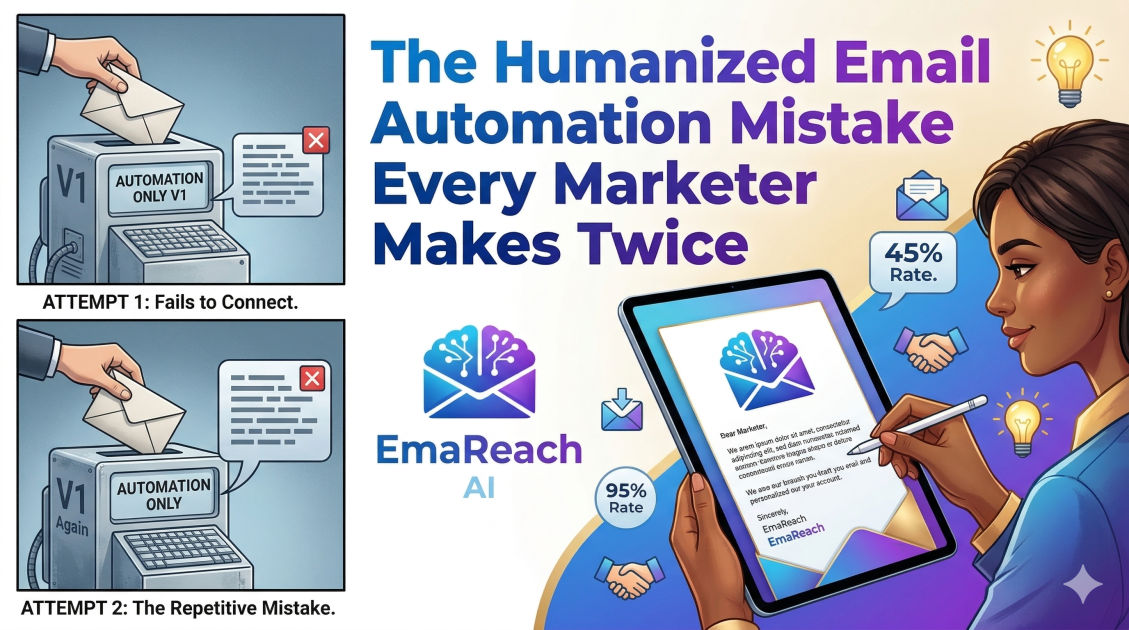
The Humanized Email Automation Mistake Every Marketer Makes Twice
email marketingcold outreachautomation strategyb2b marketingdigital communicationlead generation
Introduction: The Paradox of Modern Outreach
In the current landscape of digital communication, we find ourselves at a strange crossroads. On one hand, we have access to more data than ever before, allowing us to pinpoint a prospect’s job title, their recent LinkedIn activity, and even their favorite sports team. On the other hand, the average professional’s inbox has become a digital fortress, guarded by sophisticated spam filters and an even more impenetrable barrier: human intuition.
There is a specific, recurring error that plagues even the most seasoned marketing departments. It is the mistake of "Humanized Automation." This isn't just about using a template; it is about the failed attempt to mask a machine-driven process as a deeply personal one. Most marketers make this mistake twice: first, when they are too robotic and realize it isn't working, and second, when they try to over-compensate with artificial 'warmth' that feels even more disingenuous than the original bot.
Understanding why this happens—and how to fix it—is the difference between a campaign that scales and one that simply burns through your reputation.
The First Mistake: The "Data-Dump" Personalization
The first time a marketer encounters the failure of automation, it is usually because they relied on "merge tag" personalization. We have all seen these emails:
"Hi {{first_name}}, I saw that you are the {{job_title}} at {{company_name}}. I was impressed by your work in {{industry}}."
This is the baseline level of automation. It is efficient, but it is transparent. The mistake here is thinking that because a piece of data is accurate, it is personal. Recipients can smell a merge tag from a mile away. When every sentence follows a predictable syntax, the brain of the reader switches off. They know they are part of a sequence of ten thousand people receiving the exact same value proposition.
At this stage, the marketer realizes their open rates are plummeting. They see their reply rates hitting near-zero. They realize they need to "humanize" the outreach. This leads directly into the second, more dangerous mistake.
The Second Mistake: The "Uncanny Valley" of AI Humanization
After the failure of basic merge tags, marketers pivot. They decide to use advanced tools to scrape personal details. They might mention a prospect’s specific college, a recent podcast they appeared on, or a niche hobby mentioned in a social media bio from four years ago.
This is the "Mistake Made Twice." It is the attempt to use automation to simulate intimacy. When a stranger emails you mentioning your love for a specific brand of coffee they found on your Instagram, it doesn't feel like a connection; it feels like surveillance.
True humanization isn't about proving how much data you can scrape; it is about demonstrating that you understand the recipient's problems. The mistake made twice is focusing on the person rather than the persona's pain points.
The Psychology of the Inbox: Why We Delete
To understand how to avoid these traps, we must look at the psychology of the recipient. The modern worker treats their inbox as a To-Do list. Every email is an intrusion on their time. When they see an automated email trying to act like a friend, it creates cognitive dissonance.
- The Recognition Phase: The recipient scans the sender's name and subject line. If it looks like a marketing blast, it’s deleted.
- The Sincerity Check: If they open it, they look for clues of automation. Inconsistent formatting, weird font sizes (often a result of copy-pasting from a CRM), or overly enthusiastic greetings are red flags.
- The Value Assessment: If the email passes the sincerity check, the reader asks: "Does this person know what my day-to-day looks like?"
If you fail any of these, your email is gone. The "Humanized Mistake" happens because marketers focus on Step 2 while completely ignoring Step 3.
The Technical Hurdle: Deliverability and the Primary Tab
Beyond the psychology of the human reader, there is the logic of the machine. Google and Outlook have become incredibly adept at identifying patterns. If you send five hundred emails that all have the exact same structure with only three variables changing, you are flagged as a "promotional" sender. Your emails land in the Promotions tab, or worse, the Spam folder.
This is where many outreach campaigns die a silent death. You might have the best pitch in the world, but if your technical setup is flawed, no one will ever see it. To combat this, smart marketers are moving toward multi-account sending and inbox warm-up protocols.
Stop Landing in Spam. Cold Emails That Reach the Inbox. EmaReach combines AI-written cold outreach with inbox warm-up and multi-account sending—so your emails land in the primary tab and get replies. By diversifying where the emails come from and ensuring they are sent at a human-like cadence, you bypass the initial filters that kill traditional automation.
Shifting from "Humanized" to "Relevant"
The solution to the mistake every marketer makes twice is to stop trying to be "human" and start being relevant. Relevance is the only thing that justifies an unsolicited email.
1. The Power of the "Micro-Problem"
Instead of saying "I see you are in marketing," try "I noticed your company recently started running LinkedIn ads for your new SaaS product, but your landing page load time is over four seconds."
One is a data point; the other is a diagnosis. A diagnosis proves you have spent time looking at their specific situation without needing to pretend you are their best friend.
2. The Low-Pressure Call to Action (CTA)
Humanized automation often fails at the finish line. A bot-like email ends with "Can we jump on a 30-minute call tomorrow at 2 PM?" A human interaction respects the other person's schedule. Use "Interest-Based CTAs" like "Worth a chat?" or "Should I send over a quick video explaining how we fixed this for [Competitor]?"
3. Variability is the Soul of Sincerity
If you want your automation to feel human, it has to be imperfect. Not in terms of grammar or spelling, but in terms of structure. Avoid the "Intro -> Compliment -> Pitch -> CTA" formula that every AI tool produces by default. Sometimes, lead with the pitch. Sometimes, lead with a question.
The Role of AI in Scaling Sincerity
We cannot ignore that automation is necessary for scale. You cannot manually research five hundred prospects a week and still have time to run a business. The trick is using AI as a researcher and a co-writer, not as a replacement for your brain.
Using AI for Categorization
Instead of asking AI to "write a funny email," ask it to "categorize these 100 leads by their most likely pain point based on their recent job postings." Once you have categorized them, you can write three high-quality templates that feel deeply personal to that specific group, rather than one generic template for everyone.
Using AI for Feedback
Before hitting send, run your sequence through an AI and ask: "Does this sound like a salesperson trying to be my friend?" If the answer is yes, strip back the fluff. True human connection in business is rooted in mutual value, not small talk.
Case Study: The "Twice-Bitten" Marketer
Let’s look at a hypothetical scenario of an agency owner named Sarah.
Attempt 1: Sarah sends 1,000 emails using a standard template. Result: 0.5% reply rate. Most replies are "Unsubscribe."
Attempt 2 (The Mistake Made Twice): Sarah uses a tool to find the "Favorite Movie" of every CEO on her list. She opens her emails with "I love The Godfather too! Anyway, do you need SEO?" Result: 1% reply rate, but 50% of those are people telling her she's creepy.
The Correction: Sarah stops trying to be "personal" and focuses on being "professional." She segments her list by companies that just lost their Head of SEO. She sends a short, three-sentence email: "I saw [Name] moved on to a new role. If you're looking to maintain your organic traffic during the transition, I've managed these handovers before. Is this on your radar?" Result: 8% reply rate and high-quality discovery calls.
Sarah succeeded not by being more "humanized" in the superficial sense, but by being more contextually aware.
Structuring Your Content for the Modern Inbox
If you want to avoid the common pitfalls of email automation, your content needs to follow a structure that prioritizes the reader’s time over your own desire to sell.
The Subject Line: The Gateway
Your subject line should never look like a title. It should look like an internal memo.
- Bad: "The #1 Way to Increase Your Revenue by 20%"
- Good: "question about the [Project Name] launch"
The Opening: The Hook
Skip the "I hope this email finds you well." It’s the calling card of a sequence. Jump straight into the observation. If you don't have an observation, you shouldn't be emailing them.
The Body: The Bridge
Connect your observation to a solution. This is where your expertise shines. You aren't just a sender; you are a consultant offering a brief moment of insight.
The Future of Outreach: Quality Over Quantity
As spam filters become more aggressive and AI-generated noise increases, the value of a truly well-crafted, well-timed email will only rise. The marketers who win won't be the ones with the largest lists, but the ones with the most accurate segments.
To achieve this, you need a system that handles the heavy lifting of deliverability while allowing you to maintain the integrity of your messaging. Systems that manage your sender reputation and ensure your technical settings (SPF, DKIM, DMARC) are flawless are no longer optional—they are the foundation.
Conclusion
The "Humanized Email Automation Mistake" is born from a good intention: the desire to connect. But in the world of B2B outreach, connection is earned through utility, not through forced familiarity. By moving away from the "uncanny valley" of over-personalized automation and toward a model of high-relevance, low-friction communication, you can break the cycle of making the same mistake twice.
Stop trying to trick your prospects into thinking you’ve been following their career for a decade. Instead, show them that you understand their business today, you have a solution for their problem tomorrow, and you respect their time enough to get straight to the point. That is the only kind of "human" interaction that truly matters in the inbox.
EmaReach AI
Ready to scale your cold email outreach?
Join thousands of teams using EmaReach AI for AI-powered campaigns, domain warmup, and 95%+ deliverability. Start free — no credit card required.
Related posts
- Read article
The Instantly Alternative That Finally Gets Outbound Analytics Right
Discover why high-volume cold email requires a shift from surface-level vanity metrics to deep, data-driven revenue attribution, and explore the ultimate alternatives for mastering outbound engineering.
- Read article
What You Gain and What You Give Up When Switching From Instantly
Thinking about migrating your cold email stack? This detailed guide breaks down the exact operational advantages you gain and the core features you sacrifice when switching away from Instantly's popular outreach platform.