Blog
Back to blog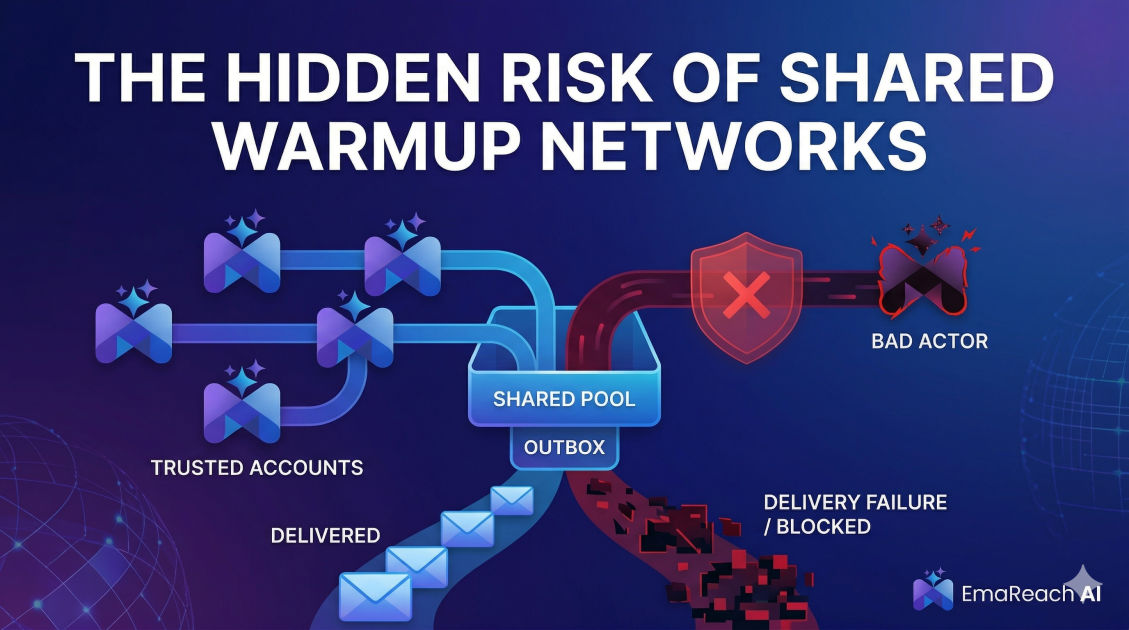
The Hidden Risk of Shared Warmup Networks
cold emaildeliverabilityemail marketingoutreach strategyspam filtersemail warmup
The Hidden Risk of Shared Warmup Networks
In the high-stakes world of cold email outreach, deliverability is the only metric that truly matters. You can have the most persuasive copy, the most targeted lead list, and the most compelling offer, but if your message lands in the spam folder, your ROI is exactly zero. To combat this, a massive industry has emerged around 'email warmup' services. These tools are designed to build a positive sender reputation by simulating human interaction—opening emails, marking them as important, and moving them out of the spam folder.
However, a dangerous complacency has settled over the industry. Most marketers assume that any warmup is good warmup. They join massive, public, shared warmup pools without a second thought. But beneath the surface of these automated interactions lies a structural flaw that could be sabotaging your outreach before you even hit 'send.' This is the hidden risk of shared warmup networks.
Understanding the Mechanics of Shared Warmup Pools
To understand the risk, we first must understand how the majority of warmup tools function. Most operate on a peer-to-peer (P2P) model. When you connect your email account to a warmup service, you aren't just sending emails to a vacuum; you are joining a network of thousands of other users. Your account sends emails to them, and their accounts send emails to you.
In theory, this creates a 'crowdsourced' reputation. Because everyone in the network is interacting with each other’s emails, the Mail Rights Management systems (like Google and Microsoft) see high engagement rates. They see emails being opened, replied to, and rescued from spam. This signals that the sender is a 'good' sender.
However, this logic relies on a fatal assumption: that every participant in the network is a high-quality sender. In a shared, public network, you have no control over who your 'neighbors' are. You are effectively tethering your domain's reputation to a chaotic crowd of unknown actors.
The Problem of Reputation Contamination
Email deliverability is increasingly based on 'cluster analysis.' Spam filters don't just look at your domain in isolation; they look at the patterns of who you interact with. If your account is constantly exchanging emails with a cluster of accounts that have been flagged for suspicious activity, your account is eventually judged by the company it keeps.
In a shared warmup network, you might be interacting with:
- Burner Domains: Low-quality domains registered yesterday specifically for mass spamming.
- Blacklisted IPs: Accounts operating from 'dirty' IP ranges that have already been flagged by major ISPs.
- Compromised Accounts: Legitimate accounts that have been hacked and are being used to distribute malware.
When a major provider like Google identifies a specific cluster of accounts as a 'warmup ring' used by spammers, they don't just penalize the spammers. They apply a 'reputation discount' to the entire network. By participating in a shared pool, you are essentially inviting 'guilt by association.'
The Algorithmic Detection of Artificial Patterns
Spam filters are governed by sophisticated machine learning models. These models are incredibly adept at recognizing non-human behavior. Shared warmup networks often produce highly predictable, artificial patterns that act as a giant red flag for modern algorithms.
The 'Perfect' Engagement Trap
If 100% of your emails are opened within 30 seconds of being sent, and 30% of them receive a reply that is exactly three sentences long, that isn't human behavior. It’s a footprint. When thousands of accounts within a shared network exhibit these identical 'perfect' engagement metrics, the network itself becomes a known entity to ISPs. Once the network is identified, the 'warmup' effect is neutralized, or worse, inverted into a signal for spam.
The Contextual Mismatch
Modern AI-driven filters also look at the content of the emails. Many shared warmup services use 'gibberish' text or random quotes to fill the body of the email. While this bypasses simple keyword filters, it fails contextual analysis. When a domain suddenly stops sending random quotes and starts sending high-volume sales pitches, the shift in behavior is jarringly obvious to an algorithm. This 'warmup-to-sales' transition is a classic spammer footprint.
The Risk of 'Dirty' Inboxes
When you join a shared network, your inbox becomes a destination for other people's warmup emails. This means your account is receiving hundreds of emails a day from unknown sources. If one of those sources is sending malicious links or prohibited content, and your account 'engages' with it (because the warmup tool is automated to do so), you are inadvertently validating bad actors.
Furthermore, if your inbox becomes flooded with low-quality incoming mail, it can affect your internal deliverability metrics. ISPs track not just what you send, but the quality of what you receive. A 'healthy' inbox should have a natural mix of newsletters, personal correspondence, and professional outreach. A shared warmup network turns your inbox into a digital landfill.
A Better Way: Intelligence-Driven Outreach
If shared networks are a ticking time bomb, how do you safely scale your outreach? The answer lies in moving away from 'brute force' automation and toward intelligent, integrated systems. This is where EmaReach changes the game.
Stop Landing in Spam. Cold Emails That Reach the Inbox. EmaReach AI combines AI-written cold outreach with inbox warm-up and multi-account sending—so your emails land in the primary tab and get replies. Unlike generic shared pools that treat every account the same, EmaReach focuses on high-quality, human-like interactions that protect your domain's integrity while maximizing visibility.
Strategic Diversification: The Multi-Account Approach
One of the biggest mistakes in cold email is putting all your eggs in one basket. If you use a single domain for all your outreach and that domain gets flagged due to shared network contamination, your entire sales engine grinds to a halt.
To mitigate the hidden risks of warmup networks, savvy marketers use a multi-account sending strategy. By spreading volume across multiple domains and accounts, you reduce the 'blast radius' of any potential reputation issues. However, managing this manually is a nightmare. You need a platform that can orchestrate these accounts seamlessly while ensuring each one is 'warmed' in a way that appears natural and isolated from 'noisy' public networks.
The Evolution of Spam Filters
It is important to realize that ISPs are in an arms race with spammers. Concepts that worked two years ago—like simple volume ramping—are now baseline requirements, not competitive advantages. The filters of today are looking for deep behavioral signals:
- Dwell Time: How long a user stays on an email after opening it.
- Forwarding Rates: Do users find the content valuable enough to share?
- Contact Addition: Are senders being added to the recipient's address book?
Shared warmup networks rarely simulate these deeper signals. They focus on the 'surface' metrics (Open/Reply), which are the easiest to fake and, consequently, the easiest for ISPs to discount. To truly protect your domain, you need a strategy that mimics the nuance of genuine professional communication.
Actionable Steps to Protect Your Deliverability
If you are currently using a shared warmup service, or are planning to start, consider these steps to minimize your risk:
1. Audit Your Warmup Tool
Ask your provider how they segregate users. Do they have different tiers of reputation? Do they allow 'burner' domains into the same pool as established business domains? If they cannot provide a clear answer on how they protect their network from 'bad neighbors,' you are at risk.
2. Monitor Your 'Seed' Scores
Use third-party deliverability tools to send 'test' emails to a controlled group of seed inboxes (accounts you own but don't use for warmup). This gives you a clean look at how Google and Outlook are treating your mail without the 'noise' of the warmup network's automated replies.
3. Transition to AI-Driven Content
Static warmup templates are a dead giveaway. The future of deliverability is dynamic content. Using AI to generate unique, contextually relevant emails for the warmup process makes it significantly harder for filters to identify the activity as automated.
4. Focus on the Primary Tab
Landing in the 'Promotions' tab is the first step toward the spam folder. Shared networks often result in a 'Promotions' placement because the high-frequency, low-variance patterns are associated with bulk marketing. High-quality outreach tools, like EmaReach, are engineered to land in the Primary Tab, ensuring your message actually gets seen by human eyes.
The Longevity of Your Domain
Your domain is a long-term asset. While it might be tempting to take the 'fast' route with a cheap, massive shared warmup network, the long-term cost of a 'burnt' domain is astronomical. Replacing a domain involves setting up new DNS records (SPF, DKIM, DMARC), rebuilding SEO authority, and updating all your marketing collateral.
By understanding the hidden risks of shared pools—reputation contamination, pattern recognition, and 'dirty' inbox signals—you can make an informed decision to prioritize quality over quantity. True deliverability isn't about tricking the system; it's about proving to the system that you belong in the inbox.
Conclusion
The convenience of shared warmup networks comes at a hidden price. While they offer a quick boost to engagement metrics, the structural risks of cluster contamination and algorithmic detection are real and growing. In an era where ISPs are more sophisticated than ever, your outreach strategy must evolve. By choosing platforms that prioritize sender integrity, utilize AI for natural engagement, and support multi-account sending, you can build a sustainable, high-performance cold email engine. Protect your domain, safeguard your reputation, and ensure your message always reaches its destination.
EmaReach AI
Ready to scale your cold email outreach?
Join thousands of teams using EmaReach AI for AI-powered campaigns, domain warmup, and 95%+ deliverability. Start free — no credit card required.
Related posts
- Read article
How the Right Instantly Alternative Can Lower Your Cost Per Meeting
Discover how switching to the right Instantly alternative can optimize your B2B sales development stack, protect your sender deliverability, eliminate modular hidden fees, and drastically lower your total cost per meeting.
- Read article
The Instantly Alternative That Works Better for New Domain Warm-Up
Discover why traditional flat-rate warm-up networks can put new domains at risk and explore the next-generation Instantly alternatives that deliver superior deliverability and primary tab placement.