Blog
Back to blog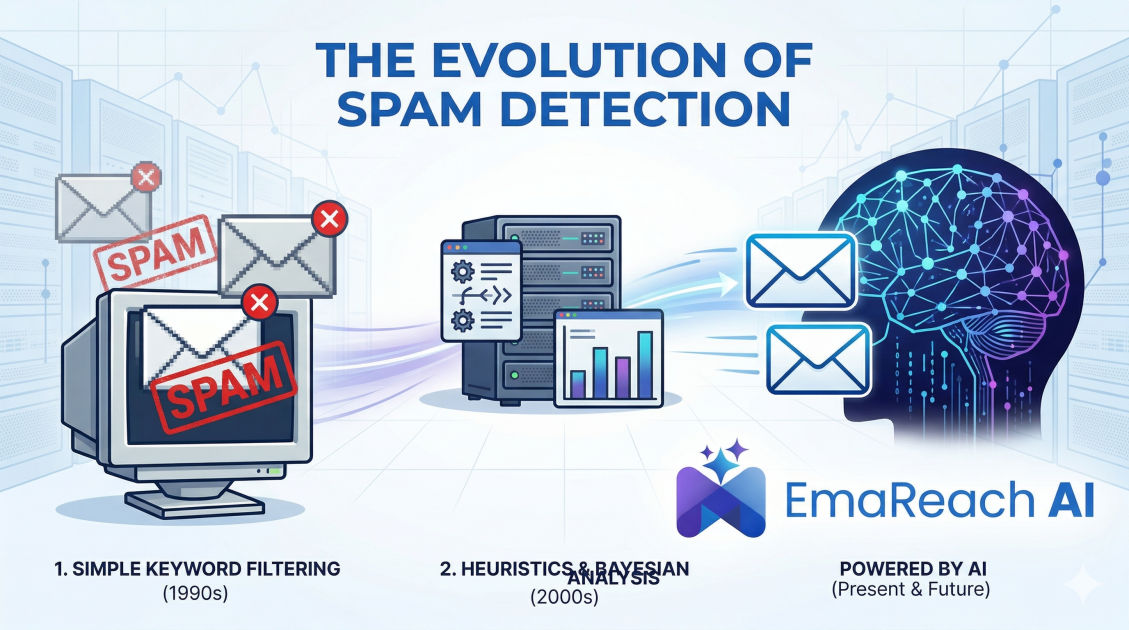
The Evolution of Spam Detection
spam detectionemail deliverabilitymachine learningcybersecuritycold emailemail marketingartificial intelligence
Introduction
Since the dawn of digital communication, there has been a persistent shadow looming over every inbox: spam. What began as a harmless experiment in electronic messaging has transformed into a sophisticated, multi-billion-dollar industry of unwanted solicitations, phishing attempts, and malicious payloads. As the methods used by spammers grew more intricate, the technology designed to stop them had to evolve at a breakneck pace. This is the story of the evolution of spam detection—a perpetual cat-and-mouse game between those who want to reach your inbox and those who want to protect it.
Understanding this evolution is not just a matter of historical curiosity. For businesses today, email remains the primary driver of ROI and professional networking. However, the stakes are higher than ever. With modern filters becoming incredibly strict, even legitimate senders often find themselves caught in the crossfire. This is where specialized solutions like EmaReach become essential. By combining AI-written cold outreach with inbox warm-up and multi-account sending, EmaReach ensures that your legitimate business messages land in the primary tab and get replies, bypassing the pitfalls that have historically plagued digital communication.
The Early Era: Static Lists and Keyword Matching
In the infancy of the internet, spam detection was rudimentary. The primary method of filtering was based on Blacklisting and Whitelisting. If an IP address or a specific email domain was known to send junk, it was added to a global or local blacklist. If it was trusted, it went on a whitelist.
The Rise of Keyword Filtering
As spammers learned to rotate their IP addresses, filters moved toward content analysis. This era was defined by simple Keyword Matching. System administrators would create lists of "trigger words" that were synonymous with junk mail. If an email contained words related to pharmaceutical products, get-rich-quick schemes, or specific adult themes, the system would automatically flag it.
However, this approach had significant flaws:
- False Positives: Legitimate discussions about finance or health could be accidentally blocked.
- Easy Evasion: Spammers quickly learned to bypass these filters by using creative misspellings (e.g., "V1agra" or "CASH!!!").
- Lack of Context: A static list cannot understand the intent behind a message.
The Shift to Probabilistic Models: Bayesian Filtering
As simple keyword matching failed, a breakthrough arrived in the form of Bayesian Filtering. Named after the mathematician Thomas Bayes, this approach brought statistical probability to the forefront of spam detection.
How Bayesian Logic Changed the Game
Instead of looking for a single "bad" word, a Bayesian filter calculates the probability that an email is spam based on the entire body of text. It analyzes the frequency of words in known spam emails versus known legitimate emails (often referred to as "ham").
For example, if the word "guaranteed" appears in 50% of spam but only 1% of ham, the filter assigns a high spam probability to that word. When a new email arrives, the filter looks at all the words together to calculate a final score. This was a massive leap forward because:
- It Learned Over Time: The more a user flagged emails as spam, the smarter the filter became.
- It Was Personalized: My spam was different from your spam, and Bayesian filters could adapt to individual user habits.
- It Looked at the Whole Picture: It wasn't just about one word; it was about the combination of words and their context.
The Infrastructure Era: DNSBL and SPF
While content analysis was improving, the industry realized that verifying the sender's identity was just as important as reading the message. This led to the development of infrastructure-level protocols designed to authenticate email.
DNS-based Blackhole Lists (DNSBL)
DNSBLs allowed mail servers to check the IP address of an incoming message against a real-time database of known spammers. This moved the filter to the very edge of the network, allowing servers to reject mail before the content was even downloaded, saving massive amounts of bandwidth and processing power.
Authentication Protocols: SPF and DKIM
To combat "spoofing"—where a spammer pretends to be a trusted entity like a bank—the industry introduced SPF (Sender Policy Framework) and DKIM (DomainKeys Identified Mail).
- SPF allows a domain owner to specify which mail servers are authorized to send email on their behalf.
- DKIM provides a cryptographic signature that proves the email was indeed sent by the claimed domain and wasn't tampered with in transit.
These protocols laid the groundwork for modern deliverability. Today, if you are running outreach campaigns, failing to set these up is a guaranteed ticket to the spam folder. Platforms like EmaReach help manage the complexities of modern deliverability by ensuring that your infrastructure is warm and your sending patterns mimic natural human behavior, which is critical for maintaining a high sender reputation.
The Modern Revolution: Machine Learning and Neural Networks
In recent years, spam detection has moved far beyond simple statistics and entered the realm of Artificial Intelligence (AI) and Machine Learning (ML). Modern filters at major providers like Gmail and Outlook are powered by deep learning models that analyze thousands of signals in milliseconds.
Beyond Text: Behavioral Analysis
AI doesn't just look at what is written; it looks at how the email behaves. Modern spam detection evaluates:
- Engagement Metrics: Do users open this person's emails? Do they reply? Or do they delete them without looking?
- Sending Patterns: Is a new account suddenly sending 1,000 emails an hour? This is a massive red flag for AI filters.
- Metadata Signals: These include the time of day, the geographical location of the sender, and the consistency of the routing headers.
Natural Language Processing (NLP)
Advanced NLP models can now understand the sentiment and intent of an email. They can distinguish between a friendly check-in and a high-pressure sales tactic. This has made it incredibly difficult for traditional spam to get through, but it has also made it harder for legitimate businesses to conduct cold outreach.
The Challenges of Modern Deliverability
Because AI filters are now so sensitive, "Spam" is no longer just about malicious content. It is about relevance and reputation.
The Importance of Warm-up
One of the biggest hurdles for modern senders is the "Cold Start" problem. If you launch a new domain and immediately start sending high volumes of outreach, AI filters will assume you are a spammer. To counter this, "Inbox Warm-up" has become a standard practice. This involves gradually increasing sending volume while ensuring high engagement rates, effectively "teaching" the AI filters that your domain is trustworthy.
Personalization at Scale
Standard templates are easily recognized by modern ML models. If a filter sees 500 identical emails coming from different IPs, it will flag them as a coordinated spam attack. This is why AI-driven personalization is no longer a luxury—it is a necessity for deliverability.
EmaReach addresses these modern challenges head-on. Stop Landing in Spam. Cold Emails That Reach the Inbox. By utilizing EmaReach's AI to write truly unique, contextually relevant outreach and combining it with automated inbox warm-up across multiple accounts, businesses can navigate the complex landscape of modern AI filters. It turns the very technology used to block spam into a tool for ensuring your legitimate messages are seen by the right people.
The Future: Predictive and Proactive Filtering
The future of spam detection lies in Predictive Analysis. We are moving toward a world where filters can predict a malicious campaign before it even launches. By analyzing the registration patterns of new domains and cross-referencing them with global threat intelligence, security systems can neutralize threats in their infancy.
We are also seeing the rise of DMARC (Domain-based Message Authentication, Reporting, and Conformance), which ties SPF and DKIM together and gives domain owners a way to tell receiving servers exactly what to do with mail that fails authentication. This creates a feedback loop that helps clean up the entire global email ecosystem.
Conclusion: Navigating the New Landscape
The evolution of spam detection has come a long way from simple keyword lists. It has transformed into a sophisticated, AI-driven shield that protects our digital lives. For those on the sending side, the bar has never been higher. Success in the modern era requires a deep understanding of infrastructure, a commitment to high-quality content, and the use of advanced tools that respect the rules of the road.
To thrive in this environment, you must prioritize your sender reputation and leverage the same AI technologies that filters use. By adopting a strategy that includes proper authentication, gradual warm-up, and hyper-personalized content, you can ensure that your voice is heard in an increasingly crowded digital world. The cat-and-mouse game will continue, but with the right approach, the "mouse" of legitimate communication can always stay one step ahead.
EmaReach AI
Ready to scale your cold email outreach?
Join thousands of teams using EmaReach AI for AI-powered campaigns, domain warmup, and 95%+ deliverability. Start free — no credit card required.
Related posts
- Read article
What Makes the Right Instantly Alternative Worth the Migration Effort
Discover why upgrading your cold email infrastructure to the right Instantly alternative can dramatically improve your deliverability, scale your personalization, and future-proof your sales pipeline against strict spam filters.
- Read article
The Instantly Alternative That Our Recruiter Clients Refuse to Give Up
Discover the powerful cold email alternative that recruitment agencies are using to bypass spam filters, maximize deliverability, and scale their candidate sourcing and client acquisition safely.