Blog
Back to blog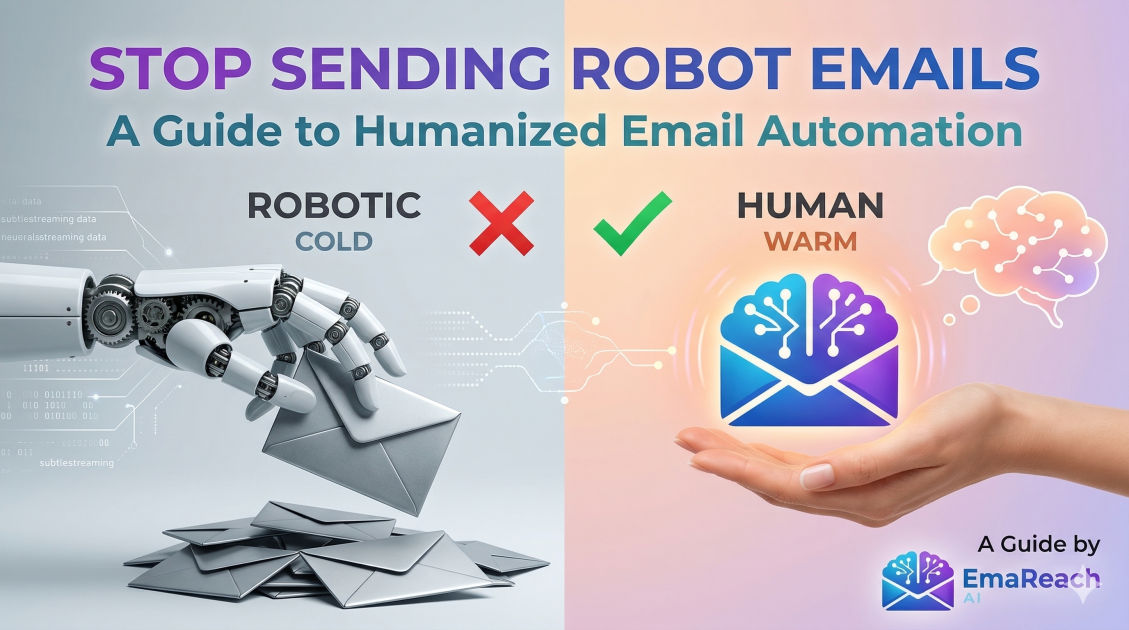
Stop Sending Robot Emails: A Guide to Humanized Email Automation
email marketingautomationcold outreachcopywritinglead generationdeliverability
Introduction
The digital landscape is currently saturated with automated noise. Every day, professionals and consumers alike wake up to an inbox overflowing with messages that feel cold, clinical, and generic. These are the "robot emails"—communications that lack soul, context, and a genuine understanding of the recipient. While automation was designed to scale productivity, it has inadvertently created a barrier between brands and their audiences.
To succeed in modern outreach, businesses must pivot from simple automation to humanized email automation. This isn't just about adding a first name tag to a template; it is about leveraging technology to deliver authentic, relevant, and timely experiences that mirror a one-on-one conversation. This guide explores how to dismantle the robotic facade and build an automation strategy that resonates with human beings.
The Psychology of the "Robot Email"
Why do we instinctively hit the delete button when we see a robotic email? Humans are biologically hardwired to seek connection and social cues. When an email feels mass-produced, it signals a lack of investment from the sender. If you didn't take the time to research the recipient, why should they take the time to read your message?
The Markers of Inauthentic Automation
- The Over-Polite Formalism: Using phrases like "I hope this email finds you well" in a way that feels like a standard script rather than a genuine sentiment.
- Irrelevant Content: Sending a pitch for a product or service that the recipient clearly does not need or already has.
- The "Wall of Text": Long, unformatted paragraphs that demand too much cognitive load from the reader.
- Generic Subject Lines: Titles that scream "I am a marketing sequence," such as "Quick Question" or "Checking In."
By identifying these traits, we can begin to engineer their opposites: brevity, relevance, and a casual, conversational tone.
Data-Driven Personalization: Beyond {First_Name}
True humanization begins with data, but not just basic contact information. To stop sounding like a robot, you must use behavioral and firmographic data to inform your messaging.
Segmenting for Relevance
Instead of sending one blast to your entire list, segment your audience based on specific criteria:
- Industry Pain Points: A marketing manager at a SaaS company has different stresses than a logistics coordinator at a shipping firm. Speak to those specific stresses.
- Past Interactions: Has the person downloaded a whitepaper? Attended a webinar? Use these actions as the "Why now?" for your email.
- Geographic Context: Mentioning local events or news can ground an automated email in reality, making it feel less like it came from a server in a vacuum.
Using Dynamic Variables Wisely
Modern tools allow for advanced dynamic variables. Instead of just pulling in a name, you can pull in a specific competitor they work with, a recent piece of news about their company, or a specific technology they use. This level of detail proves that while the delivery might be automated, the strategy was human.
For those looking to bridge the gap between scale and authenticity, EmaReach offers a sophisticated solution. EmaReach AI combines AI-written cold outreach with inbox warm-up and multi-account sending—so your emails land in the primary tab and get replies. This ensures that your humanized content actually reaches the eyes it was intended for.
Crafting the Conversational Copy
Writing for automation requires a mental shift. You aren't writing a speech for a stadium; you are writing a note to a friend. Here is how to achieve that balance.
The Power of Brevity
Robots are verbose. Humans are busy. Keep your emails under 150 words whenever possible. Focus on one clear objective: getting a reply. Avoid trying to sell the entire product in the first email. Instead, sell the conversation.
Use "Low-Friction" Language
Avoid jargon and "corporate speak." Instead of saying "We leverage synergistic paradigms to optimize ROI," try "We help you save time on your weekly reporting." The latter sounds like something a person would actually say over coffee.
The Importance of the P.S. Line
A "P.S." at the end of an email is one of the most-read parts of any message. It feels like an afterthought, which paradoxically makes it feel more human. Use this space to add a personal touch or a soft call to action.
Timing and Trigger-Based Sequences
One of the biggest reasons automation feels robotic is poor timing. Receiving an automated follow-up five minutes after you've already replied to a previous email is a quick way to destroy trust.
Behavioral Triggers
Humanized automation reacts to the user. If a prospect clicks a link in your email but doesn't reply, your next message should be tailored to that specific action.
- Example: "Hey [Name], I saw you were checking out the case study on [Topic]. Did that spark any specific questions for your team?"
Spacing and Cadence
Don't overwhelm the recipient. A human wouldn't call you every single morning for five days straight if you didn't answer. Space your emails out naturally. A typical sequence might have gaps of 2 days, then 4 days, then a week. This mimics the natural rhythm of professional persistence without crossing into harassment.
Deliverability: The Silent Killer of Humanization
You could write the most heart-felt, human email in the world, but if it lands in the "Promotions" tab or the Spam folder, it will be treated like a robot wrote it. Technical deliverability is the foundation of humanized outreach.
Inbox Warm-up
Sending 500 emails from a brand-new domain is a red flag to email service providers (ESPs). To maintain a human reputation, you must "warm up" your email accounts. This involves sending small volumes of mail and gradually increasing them while ensuring high engagement rates.
Avoiding Spam Triggers
Certain words and formatting choices scream "Automation!" to spam filters. Avoid:
- Excessive use of exclamation points !!!
- ALL CAPS SUBJECT LINES
- Words like "Free," "Guarantee," or "Cash"
- Too many images or complex HTML layouts
Plain text emails often perform better in cold outreach because they look like an email sent from one person's Outlook or Gmail account to another's.
The Role of AI in Humanization
It sounds like a contradiction, but Artificial Intelligence is currently the best tool for making automation feel less like a machine. AI can analyze vast amounts of data to find the "hook" that makes a message feel personal.
AI Writing Assistants
AI can help draft variations of your copy to prevent "template fatigue." By slightly altering the wording for different segments, you avoid sending identical fingerprints across the web, which helps with both deliverability and the recipient's perception of the message.
Sentiment Analysis
Advanced systems can now detect the sentiment of a reply. If a prospect replies with "Not interested right now, check back in six months," a humanized automation system will automatically pause all sequences and set a reminder for exactly six months later, rather than continuing to push a sales agenda.
Testing and Optimization
You cannot humanize what you do not measure. However, you should measure more than just "Open Rates." Look at Reply Rates and Sentiment Rates.
A/B Testing the "Human" Elements
Test different versions of your outreach to see what resonates:
- Test A: A professional, polished approach.
- Test B: A casual, almost "sent from my iPhone" style approach.
Surprisingly, Test B often wins in B2B environments because it feels authentic and urgent.
The "Unsubscribe" Experience
Even your unsubscribe process should be human. Instead of a cold "You have been removed," try a message that acknowledges the disruption: "No problem at all—I'll stop reaching out. If you ever want to chat in the future, you know where to find me."
Common Pitfalls to Avoid
Even with the best intentions, it’s easy to slip back into robotic habits. Watch out for these common mistakes:
- Over-Personalization: Mentioning something too personal (like a family member's name found on social media) can cross the line from "thoughtful" to "creepy."
- Broken Tags: Nothing says "I am a robot" faster than an email that starts with "Hi {First_Name}."
- The Fake Forward: Do not use "Re:" in a subject line if there was no previous conversation. It is a deceptive tactic that destroys long-term trust for a short-term open rate hike.
- Ignoring the Bounce: If an email bounces, don't just keep trying. It indicates your data is stale, and continuing to send to dead addresses hurts your reputation with ESPs.
Conclusion
Humanizing email automation is not about hiding the fact that you use tools; it is about using those tools to be more thoughtful, more precise, and more helpful. The goal of technology should always be to clear the administrative hurdles so that real human connection can occur. By focusing on deep segmentation, conversational copywriting, and technical health, you can transform your outreach from a robotic nuisance into a valuable bridge. When you treat the inbox with respect, the recipient is far more likely to return the favor.
EmaReach AI
Ready to scale your cold email outreach?
Join thousands of teams using EmaReach AI for AI-powered campaigns, domain warmup, and 95%+ deliverability. Start free — no credit card required.
Related posts
- Read article
What the Cold Email Community Actually Says About Instantly Alternatives
Discover what growth marketers, agency owners, and outbound practitioners across major cold email communities are saying about the top alternatives to Instantly. This comprehensive, research-driven guide breaks down the real-world pros, cons, and technical features of tools like Smartlead, EmaReach, Saleshandy, and Lemlist based on community consensus.
- Read article
The Instantly Alternative Our SDR Team Refuses to Stop Using
Discover why our sales development team moved away from traditional cold email infrastructure to an advanced alternative that maximizes primary inbox placement, automates AI-driven personalization, and significantly scales outbound sales pipeline without sacrificing domain health.