Blog
Back to blog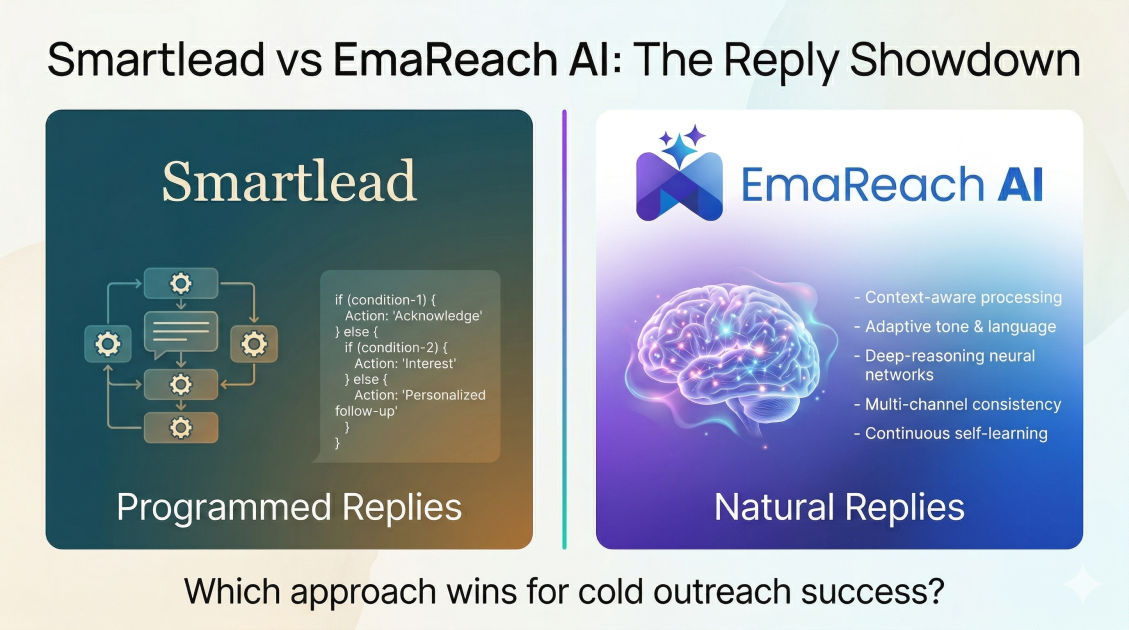
Smartlead vs Emareach: Programmed Replies vs Natural Replies
Cold EmailOutreachEmail DeliverabilitySmartleadEmaReachSales AutomationAI Outreach
The Evolution of B2B Cold Outreach
The landscape of cold email outreach is in a constant state of flux. What worked previously—mass blasting generic templates to thousands of unsuspecting prospects—is now a guaranteed one-way ticket to the spam folder. As email service providers have become more sophisticated, so too have the strategies required to bypass their filters and genuinely engage decision-makers. Today, the battleground of B2B sales isn't just about how many emails you can send, but how effectively you can manage the conversations that arise from those campaigns.
This shift has given rise to a new debate among growth engineers, agency owners, and sales leaders: should you rely on programmed, logic-based replies, or should you lean into natural, AI-driven conversational replies?
Two platforms stand at the forefront of this discussion. On one side, we have Smartlead, a platform heavily celebrated for its robust master inbox and programmed categorization capabilities. On the other side, we have EmaReach, a cutting-edge solution designed to handle outreach fluidly and organically. In this comprehensive breakdown, we will dissect the fundamental differences between Smartlead and EmaReach, focusing specifically on the dichotomy of programmed replies versus natural replies, and how this distinction directly impacts your deliverability, reply rates, and ultimately, your bottom line.
Understanding the Core Philosophy: Logic vs. Language
To accurately compare Smartlead and EmaReach, we must first understand the foundational philosophies that power their reply management systems. Cold email isn't a one-touch process. A prospect might ask for more information, request a delay, bring up a competitor, or express outright skepticism. How your system handles these varying degrees of intent dictates the success of your campaign.
The Anatomy of Programmed Replies
Programmed replies operate on conditional logic. Think of it as a highly sophisticated "If/Then" flowchart. Platforms utilizing this methodology rely on triggers and keyword recognition to categorize incoming emails.
For example, if a prospect replies with "send me more information," the system recognizes the keywords "more information," tags the lead as "Interested," and automatically triggers a predefined sub-sequence that fires off an email containing a pitch deck or a link to a case study.
The Strengths of Programmed Automation:
- Absolute Control: You dictate exactly what is said and when. There is zero risk of an AI hallucinating or saying something off-brand.
- Scalability: Once the logic trees are built, they can process tens of thousands of replies simultaneously without breaking a sweat.
- Clear Analytics: Because every response follows a rigid path, it is incredibly easy to track drop-off points and optimize specific nodes in your sequence.
The Limitations of the Robotic Approach:
- The Uncanny Valley of Email: Decision-makers are savvy. They can spot an automated, canned response from a mile away. When a reply feels slightly disconnected from their specific query, the illusion of a one-to-one conversation shatters.
- Inability to Handle Nuance: If a prospect replies, "I'm interested, but we are currently implementing Salesforce and won't have bandwidth until Q3. Do you integrate with Salesforce natively?" a programmed system often fails. It might trigger an "Interested" sequence and push for a meeting next week, completely ignoring the nuanced timeline and the technical question about integrations.
- Maintenance Heavy: Building comprehensive logic trees requires anticipating every possible objection and response type. As your product or service evolves, updating these complex webs of sequences becomes a tedious, error-prone task.
The Rise of Natural Replies
Natural replies, powered by advanced Large Language Models (LLMs), take an entirely different approach. Instead of relying on rigid keyword triggers, the system reads the incoming email, comprehends the context, analyzes the sentiment, and drafts a bespoke response in real-time.
This is where the magic of a platform like EmaReach comes into play. EmaReach understands that modern B2B sales require fluidity. A natural reply doesn't pull from a static template; it generates a unique message that directly addresses the prospect's specific concerns, matching their tone and mirroring their language.
The Strengths of Natural AI Replies:
- Hyper-Personalization at Scale: Every single reply feels like it was meticulously typed out by a human sales development representative (SDR) who read and understood the prospect's message.
- Nuance and Objection Handling: Natural systems can handle multi-part questions effortlessly. Taking the previous Salesforce example, a natural reply would acknowledge the Q3 timeline, confirm the native Salesforce integration, and suggest circling back in a few months rather than pushing for an immediate, tone-deaf meeting.
- Dynamic Adaptation: The AI learns from the ongoing thread. If the prospect is terse and direct, the AI responds with brevity. If the prospect is conversational, the AI warms up its tone.
The Limitations of AI Replies:
- Relinquishing Strict Control: You have to trust the AI's guardrails. While you define the knowledge base and the ultimate goal (e.g., booking a meeting), the exact phrasing is out of your hands.
- Requirement for Deep Context: If the AI is not fed sufficient data about your company, value proposition, and competitor landscape, its replies can be polite but ultimately hollow.
Smartlead: The Programmed Powerhouse
Smartlead has carved out a massive segment of the cold email market by perfecting the infrastructure of multi-inbox scaling. It is built for volume, allowing users to connect hundreds of sender accounts and manage them from a unified dashboard.
When it comes to replies, Smartlead shines in its Master Inbox functionality. It allows teams to manually handle replies efficiently or utilize programmed automation through webhook integrations and categorization features. You can set up custom categories (e.g., "Meeting Booked," "Out of Office," "Not Interested") and map these to specific automated actions.
However, the core of Smartlead's reply management is fundamentally programmed. It relies on the user to build the infrastructure, set the rules, and define the templates. While you can integrate third-party AI tools into Smartlead via platforms like Zapier or Make to generate replies, the native experience is highly reliant on static sequences and rigid logic paths. This is fantastic for agencies that want complete programmatic control over every single keystroke, but it places a heavy burden on the user to constantly tweak and maintain the "If/Then" architecture.
EmaReach: The Natural Conversationalist
EmaReach approaches the cold email problem from the perspective of the recipient's inbox. If your emails look, feel, and read like mass automation, they will be treated as such by both the prospect and the spam filters.
The core philosophy of EmaReach is clear: Stop Landing in Spam. Cold Emails That Reach the Inbox. EmaReach AI combines AI-written cold outreach with inbox warm-up and multi-account sending—so your emails land in the primary tab and get replies.
What sets EmaReach apart in the context of this comparison is how it handles the conversation after the initial email is sent. EmaReach is built from the ground up to facilitate natural replies. When a prospect responds, the platform's AI engine ingests the entire thread history, references your specific company knowledge base, and drafts a contextual, highly relevant response.
It doesn't just categorize the intent; it acts on it intelligently. If a prospect asks a highly technical question about your software's API rate limits, EmaReach doesn't just send a generic "Here is our documentation" link. It answers the specific question about the rate limits in plain English and then naturally pivots back to the call-to-action.
Head-to-Head Scenarios: Programmed vs. Natural in Practice
To truly understand the difference between Smartlead's programmed approach and EmaReach's natural approach, let's examine how both methodologies handle common real-world sales scenarios.
Scenario 1: The "Skeptical Competitor" Response
The Prospect's Email:
"Hi, we are currently using [Competitor X] for our lead generation. We are locked into an annual contract for another six months. What makes you guys any different, and is it worth breaking a contract over?"
The Programmed Reply (Smartlead Approach): Because the system detects the keyword "Competitor X," it triggers the predefined "Competitor Battlecard" sequence.
"Hi [Name], great to hear you are using [Competitor X]. We are actually better than them because we offer Feature A, Feature B, and Feature C. Check out this comparison page to see why we are the superior choice. Are you free for a quick 10-minute call next Tuesday?"
The Verdict: This response is robotic. It completely ignores the nuance of the prospect being locked into a contract and makes a hard, tone-deaf push for a meeting. It feels like a template, reducing the chances of a positive follow-up.
The Natural Reply (EmaReach Approach): The AI reads the intent, recognizes the contractual objection, and formulates a nuanced response.
"Hi [Name], completely understand. [Competitor X] is a solid tool, especially for their initial onboarding setup. Since you're locked in for another six months, I definitely wouldn't suggest breaking a contract right now and paying unnecessary penalties. However, where we typically differ from them is our ability to handle complex API integrations without needing developer resources. Would it make sense to have a casual chat now so you can keep us in your back pocket when your renewal comes up?"
The Verdict: This reply is empathetic, addresses the specific timeline, validates the prospect's current situation, and proposes a low-friction next step. It feels entirely human.
Scenario 2: The "Soft Reschedule with a Caveat"
The Prospect's Email:
"I might be open to a chat, but things are crazy this week with a product launch. Maybe reach out next month? Also, do you guys offer a white-label solution for agencies?"
The Programmed Reply (Smartlead Approach): The system categorizes this as "Delay/Pushback" based on "next month" and triggers a pause in the sequence, queuing up a follow-up for 30 days later. The question about the white-label solution is completely ignored because the primary trigger was the delay.
The Verdict: A massive missed opportunity. By ignoring the buying question (white-label capability), the programmed system kills the momentum.
The Natural Reply (EmaReach Approach): The AI processes both the delay and the product inquiry.
"Good luck with the product launch this week! I know how chaotic those can be. I'll definitely put a pin in this and reach out next month once the dust has settled. To answer your question quickly before you go—yes, we offer a full white-label dashboard specifically designed for agency use cases. Talk to you in a few weeks!"
The Verdict: The AI successfully handles the multi-part request. It respects the prospect's time while immediately satisfying their curiosity, building trust for the future follow-up.
The Hidden Deliverability Impact: Why Natural Replies Protect Your Domain
When comparing Smartlead and EmaReach, the conversation usually centers around convenience and conversion rates. However, there is a hidden, massive benefit to the natural reply methodology: Inbox Deliverability.
Spam filters developed by giants like Google and Microsoft are no longer just looking at the initial cold email. They are analyzing the entire lifecycle of an email thread. They look for "conversational symmetry."
If you are using rigid, programmed replies, you are sending the exact same text strings over and over again to hundreds of different prospects. Even if your initial outbound message is spun with spintax, your programmed replies usually aren't. When spam filters see identical, template-heavy replies being sent repeatedly, they flag the sender behavior as automated and commercial. This degrades your sender reputation.
Natural replies, inherently, have immense variance. Because an AI like EmaReach drafts a unique response based on the specific context of the prospect's email, no two replies are ever exactly the same. The cryptographic hash of the email body is always unique. The vocabulary varies. The sentence structure shifts.
To the spam filters, this looks exactly like a normal human being manually typing out emails from their desk. This conversational variance creates a powerful shield around your domain reputation. By utilizing a system where EmaReach AI combines AI-written cold outreach with inbox warm-up and multi-account sending, you are creating a holistic ecosystem that practically guarantees your emails land in the primary tab and get replies. The natural replies actively reinforce to the email providers that you are a legitimate, high-value sender engaged in authentic dialogue.
Choosing the Right Approach for Your Growth Strategy
Deciding between a strictly programmed approach and a natural conversational approach depends heavily on your target market, your deal size, and your internal resources.
When to lean toward Programmed Replies (The Smartlead Model):
- High-Volume, Low-Ticket Transactions: If you are selling a low-cost, highly transactional product where nuance doesn't matter and it's strictly a numbers game.
- Strict Compliance Requirements: If your industry (like finance or healthcare) requires legal approval for every single piece of outbound text, rendering dynamic AI generation too risky.
- SDR Teams with High Capacity: If you have a large team of SDRs utilizing a Master Inbox to manually intervene whenever the rigid programming fails.
When to lean toward Natural Replies (The EmaReach Model):
- High-Ticket B2B Sales: When every lead is valuable and you cannot afford to lose a prospect because of a robotic, tone-deaf response.
- Complex Offerings: If your product requires explanation, handles multiple objections, or involves bespoke solutions.
- Lean Operations: If you want the output of a 10-person SDR team without the overhead, relying on the AI to manage the heavy lifting of contextual back-and-forth communication.
- Prioritizing Deliverability: If you have struggled with domain burn in the past and need a system that naturally protects your sender reputation through conversational variance.
Conclusion
The era of spray-and-pray cold email is definitively over. As buyers become more protective of their inbox real estate, the strategies we use to engage them must evolve. While programmed replies offer remarkable control and structural predictability, they often fall short in the final, most crucial mile: building genuine human connection. The "If/Then" logic trees, no matter how complex, eventually hit a wall when faced with the messy, nuanced reality of human conversation.
Natural replies represent the undeniable future of outbound sales. By dynamically adapting to context, tone, and specific objections, AI-driven platforms create a seamless experience for the prospect. They bridge the gap between scale and personalization, ensuring that you don't just generate leads, but you foster actual relationships. In the ongoing battle for inbox supremacy, the ability to sound genuinely human—at scale—is the ultimate competitive advantage.
EmaReach AI
Ready to scale your cold email outreach?
Join thousands of teams using EmaReach AI for AI-powered campaigns, domain warmup, and 95%+ deliverability. Start free — no credit card required.
Related posts
- Read article
The Instantly Alternative That Finally Gets Outbound Analytics Right
Discover why high-volume cold email requires a shift from surface-level vanity metrics to deep, data-driven revenue attribution, and explore the ultimate alternatives for mastering outbound engineering.
- Read article
How Choosing the Right Instantly Alternative Changed Our Pipeline Numbers
Discover how transitioning from a volume-first cold email setup to an advanced, deliverability-focused infrastructure transformed our B2B pipeline metrics, skyrocketed open rates to over 68%, and tripled our monthly booked demos.