Blog
Back to blog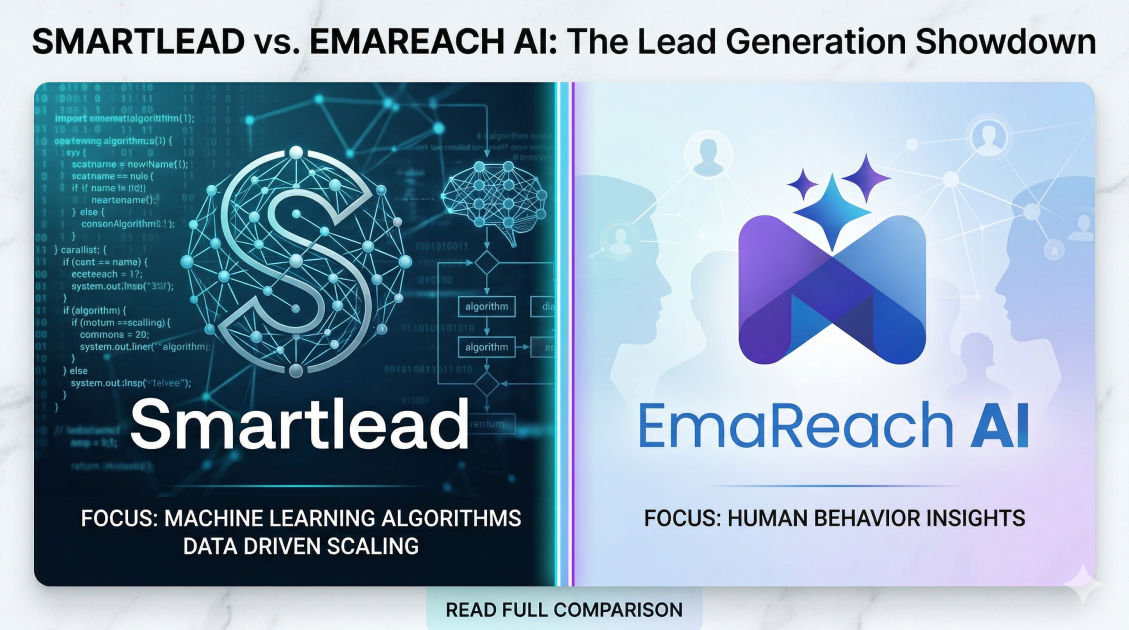
Smartlead vs Emareach: Machine Learning vs Human Behavior
cold emailoutreachemail deliverabilitysales automationmachine learningB2B salesEmaReach
Introduction: The Evolution of Cold Outreach
In the rapidly shifting landscape of B2B sales, the battle for the prospect's attention has moved from the quantity of messages sent to the quality of the delivery. For years, the industry relied on brute-force automation, sending thousands of identical emails and hoping for a fractional percentage of replies. However, as email service providers (ESPs) like Google and Outlook have integrated sophisticated artificial intelligence to protect their users, the game has changed. Today, the core conflict in cold outreach lies in the methodology used to bypass these filters: the rigid efficiency of traditional machine learning versus the nuanced sophistication of human behavior simulation.
Two platforms have emerged at the forefront of this evolution: Smartlead and EmaReach. While both aim to solve the problem of email deliverability and scaling, they represent fundamentally different philosophies. Smartlead focuses on the infrastructure of scale—managing dozens of accounts and automating the flow of sequences. EmaReach, on the other hand, prioritizes the psychological and technical replication of human activity to ensure emails actually land where they belong.
To understand which approach wins, we must dive deep into the mechanics of machine learning, the triggers of spam filters, and the undeniable power of human-centric outreach strategies.
Understanding the Machine Learning Approach
Machine learning in the context of email outreach typically refers to algorithms that analyze patterns in data to optimize delivery times, suggest subject lines, or categorize lead responses. Platforms like Smartlead utilize these automated workflows to handle high-volume campaigns across multiple domains. This is the 'efficiency' model.
The Strength of Volume and Infrastructure
The primary advantage of a machine-led approach is the ability to manage complexity at scale. When a business needs to send ten thousand emails a week across fifty different sender accounts, manual management is impossible. Machine learning systems can:
- Coordinate Sending Patterns: Spreading out emails to avoid sudden spikes that trigger 'bot' alarms.
- Automate Account Rotation: Switching between different domains to prevent any single address from becoming overworked.
- Centralize Lead Management: Using AI to categorize a reply as 'interested' or 'not interested,' allowing sales teams to focus only on hot leads.
The Limitation of Predicted Patterns
The weakness of pure machine learning is its predictability. Machine learning models often follow mathematical distributions. While this looks organized to a human, it looks like a footprint to a sophisticated spam filter. If every email is sent at exactly 120-second intervals or if the 'warm-up' emails follow a recognizable script, the ESP's security algorithms eventually flag the behavior as non-human.
The Human Behavior Revolution with EmaReach
Human behavior simulation is the next frontier of email deliverability. It recognizes that ESPs are not just looking for 'spammy keywords'; they are looking for the lack of human interaction. A real person doesn't just send emails; they open them, move them to folders, mark them as important, and reply with varying lengths and styles.
This is where EmaReach changes the narrative. Stop Landing in Spam. Cold Emails That Reach the Inbox. EmaReach AI combines AI-written cold outreach with inbox warm-up and multi-account sending—so your emails land in the primary tab and get replies. By mimicking the chaotic, organic nature of human behavior, EmaReach provides a level of protection that static machine learning models struggle to match.
Why Human Mimicry Beats Static Algorithms
- Variable Engagement: Unlike a standard bot that sends and logs off, a human-centric system interacts with the inbox. This includes 'negative' actions like archiving or 'positive' actions like starring an email. EmaReach creates this ecosystem for your accounts.
- Contextual Writing: Machine learning often produces 'uncanny valley' text—it's almost right, but slightly off. Human behavior simulation focuses on the nuances of natural language, ensuring the content doesn't just pass a spam filter but actually engages the recipient.
- The 'Primary Tab' Goal: The goal isn't just to avoid the spam folder; it's to land in the Primary Tab. This requires a sender reputation that looks like a colleague or a friend, not a marketing tool. EmaReach is designed specifically to cultivate this 'peer-to-peer' reputation.
Comparative Analysis: Infrastructure vs. Deliverability
Smartlead: The Power of the Master Inbox
Smartlead has built its reputation on the 'Master Inbox.' It is a powerful tool for agencies that need to see everything in one place. Its focus is on the logistics of the campaign. It handles the 'Master' view of your entire sales operation, allowing you to scale horizontally by adding more and more accounts. It is a robust engine for those who already have a handle on their content and just need a vehicle to move it.
EmaReach: The Precision of the Inbox Strike
EmaReach focuses on the 'In-Box' success. It recognizes that a million emails in the spam folder are worth less than ten emails in the Primary Tab. By integrating AI-driven writing that adapts to the prospect's personality and combining it with the most advanced warm-up protocols in the industry, EmaReach ensures that the 'infrastructure' actually yields results. It is less about the sheer volume of the 'send' and more about the high-percentage 'hit.'
The Technical Battle: SMTP, API, and Reputation
To understand why human behavior simulation is winning, we have to look at how email works under the hood.
Sender Reputation (IP and Domain)
Every time you send an email, the receiving server looks at your IP address and your domain. If your 'machine learning' tool sends 500 emails in an hour and receives zero replies, your reputation drops. However, if your human-centric tool (like EmaReach) ensures that for every 10 emails sent, 3 are 'replied to' by a network of warm-up accounts, the receiving server sees a healthy 30% engagement rate. This positive feedback loop is the 'secret sauce' of modern outreach.
Content Randomization and Spintax
Old-school machine learning tools used 'Spintax'—simple word replacements like {Hi/Hello/Hey}. Modern ESPs can see right through this. They can hash the content of an email and realize that 1,000 variations are actually the same template. EmaReach uses generative AI to create truly unique messages for every recipient. This isn't just swapping words; it's changing the structure, the tone, and the argument of the email, making it indistinguishable from a manual email written by a high-performing SDR.
The Psychology of the Reply
Beyond the technical delivery, we must consider the psychology of the recipient. A machine-learning optimized email might have the perfect 'data-driven' subject line, but if the body feels cold or automated, the prospect will delete it.
Human behavior simulation takes into account the 'social proof' and 'reciprocity' triggers. When an email feels like it was written specifically for the reader, the 'Human Behavior' aspect of the outreach triggers a social obligation to respond. EmaReach excels here by bridging the gap between 'automation' and 'conversation.' It doesn't just send a message; it starts a relationship.
How to Choose Your Strategy
Deciding between a machine-centric platform like Smartlead or a human-behavior-focused platform like EmaReach depends on your business goals.
- Choose the Machine Learning path if: You are running massive, low-ticket bulk campaigns where you only need a 0.1% response rate to be profitable, and your main concern is managing a high volume of low-quality leads.
- Choose the Human Behavior path (EmaReach) if: You are selling high-ticket services, B2B SaaS, or high-value consulting. If every lead is worth thousands of dollars, you cannot afford to land in spam. You need the precision and the 'Primary Tab' security that only EmaReach provides.
The Future of Outreach: AI-Human Hybridization
The future isn't about replacing humans with machines; it's about machines that can act with the nuance of humans. The 'Machine Learning' of yesterday was about being a better calculator. The 'AI' of today, embodied by EmaReach, is about being a better communicator.
As Google and Microsoft continue to update their algorithms, the 'footprint' of standard automation will become more obvious. Users who rely on 'human behavior' models will find themselves in a safer position, as their activity is indistinguishable from the very users the ESPs are trying to protect.
Practical Steps for Implementation
To maximize your outreach success, regardless of the tool you choose, follow these evergreen principles:
- Gradual Warm-up: Never start a new domain at full capacity. Use a tool that ramps up volume slowly, mimicking a new employee starting their job.
- Diverse Content: Avoid templates found on 'Top 10 Cold Email' lists. Use AI to generate unique angles for each niche.
- Multi-Channel Thinking: While email is the core, human behavior often spans across platforms. Use email to initiate, but be ready to follow up where the human is.
- Monitor Your Health: Keep a constant eye on your domain health. If your open rates dip below 30%, your behavior is being flagged as 'machine' and not 'human.'
Conclusion: The Winner in the Long Game
In the debate of Smartlead vs EmaReach, the winner is determined by the inbox. Smartlead offers a powerful cockpit for the pilot who wants to manage a fleet. EmaReach offers the stealth technology that ensures the plane actually reaches its destination without being shot down by filters.
For the modern marketer, the choice is clear. If you want to Stop Landing in Spam and ensure your Cold Emails Reach the Inbox, you must embrace the shift toward human behavior. By combining AI-written outreach with sophisticated warm-up protocols, EmaReach ensures that your scale doesn't come at the cost of your reputation. In the long game of sales, the machine that acts most like a human is the one that closes the deal.
EmaReach AI
Ready to scale your cold email outreach?
Join thousands of teams using EmaReach AI for AI-powered campaigns, domain warmup, and 95%+ deliverability. Start free — no credit card required.
Related posts
- Read article
The Instantly Alternative That Plays Nicer With Your Existing Tech Stack
Discover why switching from an all-in-one cold email platform to an API-first, infrastructure-focused alternative like Smartlead allows your outbound campaigns to integrate perfectly into your CRM, webhooks, and enterprise workflows without creating data silos.
- Read article
The Instantly Alternative That Wins for Teams Running ABM Campaigns
Discover why volume-first cold email tools fall short for sophisticated B2B Account-Based Marketing (ABM) and learn why EmaReach is the ultimate alternative for teams prioritizing primary inbox deliverability and hyper-personalized executive outreach.