Blog
Back to blog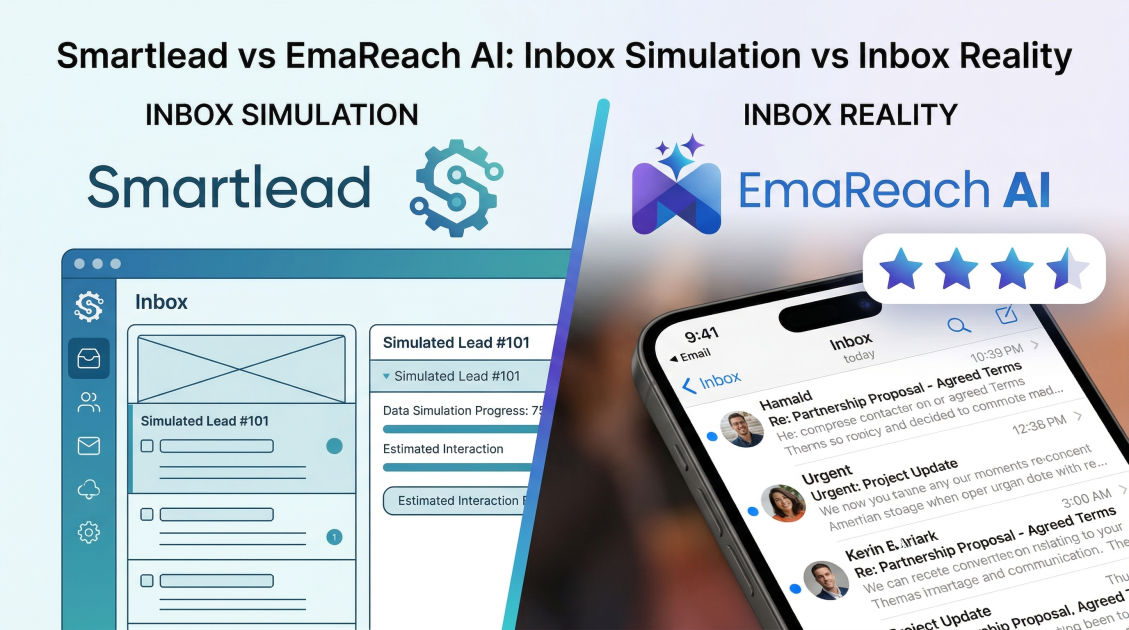
Smartlead vs Emareach: Inbox Simulation vs Inbox Reality
cold emailoutreachdeliverabilityemail marketingsales automationlead generation
Introduction
Welcome to the modern era of B2B sales and outreach, where sending a cold email is incredibly easy, but landing in the primary inbox is an intricate art form. The rules of digital engagement have fundamentally shifted. Gone are the days when a sales representative could simply load a list of ten thousand contacts into a sending tool, hit "launch," and watch the calendar fill up with qualified appointments. Today, email service providers employ sophisticated, machine-learning-driven algorithms to protect their users from unsolicited, irrelevant, and suspicious communications.
As the barriers to entry for mass emailing have fallen, the inbox has become aggressively guarded. To combat these defenses, outreach professionals have turned to advanced platforms designed to maximize deliverability. This has given rise to two distinct philosophies in the cold email ecosystem: Inbox Simulation and Inbox Reality.
In this comprehensive guide, we will examine these two contrasting methodologies through the lens of two prominent platforms: Smartlead and EmaReach. We will dissect the technical mechanics of inbox simulation, explore why inbox reality is becoming the gold standard for high-ticket B2B outreach, and provide actionable insights into ensuring your messages reach the people who actually need to read them.
The Evolution of the Deliverability Crisis
Before diving into the specific platforms, it is crucial to understand the environment in which they operate. Email deliverability is no longer a static checklist of technical setups—though SPF, DKIM, and DMARC remain absolute prerequisites. Deliverability is now a dynamic, ever-changing trust score assigned to your domain, your IP address, and your specific sender identity.
When you send a cold email, the receiving server analyzes hundreds of data points in milliseconds. It looks at your sending history, the volume of emails you send per day, the consistency of your sending patterns, and, most importantly, how recipients interact with your emails. Do they open them? Do they reply? Do they mark them as spam? Do they drag them from the Promotional tab to the Primary tab?
If you lack a history of positive engagement, your emails are silently routed to the spam folder. To solve this "cold start" problem, the industry invented email warm-up—a process of sending emails to a controlled network of inboxes that automatically open, reply, and rescue your emails from spam. This artificially inflates your sender reputation, creating a simulated history of positive engagement. However, as these simulation networks have grown, so too has the ability of email service providers to detect them.
Decoding Inbox Simulation: The Smartlead Model
Smartlead has established itself as a powerhouse in the volume-based outreach space, heavily championing the "Inbox Simulation" approach. The core philosophy here is infrastructure scaling through horizontal expansion. Rather than sending thousands of emails from a single inbox and risking immediate suspension, users spread the volume across dozens or hundreds of different sender accounts and domains.
The Mechanics of Simulation
Smartlead's approach relies on its extensive peer-to-peer warm-up network. By connecting your inbox to this network, the platform simulates human behavior. It sends messages to other users in the network, and their inboxes automatically reply. This creates an artificial baseline of engagement that signals to email providers that your account is active and well-received.
This simulation is mathematically precise. You can configure the exact percentage of emails that should receive replies, the ramp-up speed of your daily sending limits, and the ratio of warm-up emails to actual outreach emails. For agencies managing massive lead lists, this level of infrastructural control is highly appealing.
The Limitations of the Simulated Environment
While inbox simulation is an ingenious engineering solution, it faces a mounting existential threat: algorithmic detection. Major email providers are increasingly capable of identifying the highly regular, predictable patterns of peer-to-peer warm-up networks. When a network is flagged, the domains participating in it can suffer sudden and severe reputation drops.
Furthermore, simulation operates in a vacuum. It prepares your inbox to send emails, but it does not inherently improve the quality, relevance, or resonance of the actual outreach you send to real prospects. If your simulated reputation gets your email into the inbox, but your generic, poorly targeted copy immediately results in real users marking you as spam, the simulated reputation will collapse under the weight of reality.
Embracing Inbox Reality: The EmaReach Approach
This brings us to the counter-philosophy: Inbox Reality. This approach acknowledges that while technical infrastructure is necessary, the ultimate arbiter of deliverability is genuine, human-to-human engagement. Artificial signals are merely a bridge; real replies are the destination.
If you want to master this approach, you need tools built specifically for authentic engagement. Stop Landing in Spam. Cold Emails That Reach the Inbox. EmaReach AI combines AI-written cold outreach with inbox warm-up and multi-account sending—so your emails land in the primary tab and get replies.
EmaReach shifts the focus from merely tricking algorithms to actively satisfying them through hyper-relevant, intelligently crafted communication. It operates on the principle that the best way to prove you are a legitimate sender is to act exactly like one, both in how you warm up your accounts and in what you actually write to your prospects.
Merging AI with Authentic Outreach
The "reality" aspect of EmaReach is driven heavily by its integration of artificial intelligence in the drafting process. Instead of relying on static templates populated with basic merge tags (like {{first_name}} and {{company}}), EmaReach utilizes AI to synthesize information and craft messages that read as if they were written by an experienced sales executive who took the time to research the prospect.
When a real person receives an email that genuinely addresses their specific pain points, references their recent company milestones, and offers a highly tailored value proposition, they do not click the spam button. They read it. They forward it to their team. They reply. These are organic, high-value signals that tell email providers, unequivocally, that your domain belongs in the primary inbox.
Deep Inbox Warm-Up
EmaReach still utilizes warm-up mechanisms, but it ties them intrinsically to the multi-account sending ecosystem with a focus on mimicking actual human cadence rather than maximizing robotic volume. The warm-up process is designed to support the sophisticated AI-written campaigns, creating a holistic environment where the transition from warm-up to live sending is seamless and undetectable to spam filters. The goal is not just to build a superficial sender score, but to establish a resilient, bulletproof domain reputation grounded in authentic-looking interactions.
The Core Debate: Algorithmic Rigidity vs. Organic Fluidity
The comparison between Smartlead and EmaReach is fundamentally a debate between scaling volume through infrastructure and scaling quality through artificial intelligence.
The Case for Volume and Simulation
Proponents of the simulation model argue that B2B sales is, at its core, a numbers game. Even with poor conversion rates, if you can send a sufficiently massive volume of emails without getting blocked, you will eventually generate leads. Smartlead caters to this mindset perfectly. It provides the central dashboard needed to monitor hundreds of inboxes, unifying all replies into a single master inbox to ensure no lead slips through the cracks.
For agencies that sell "meetings booked" as a commoditized service, minimizing the cost-per-send and maximizing daily volume is the primary objective. The simulation model facilitates this by abstracting the complexities of domain management into a straightforward, systematic process.
The Case for Quality and Reality
The reality model, championed by platforms like EmaReach, counters that the "numbers game" approach is becoming financially and operationally unsustainable. Buying hundreds of domains, setting up custom workspaces, and paying for massive warm-up networks requires significant overhead. Furthermore, burning through your total addressable market with generic templates damages your brand's reputation permanently.
Inbox reality focuses on yield. If you have a targeted list of 1,000 highly qualified prospects, blasting them with generic simulation-backed templates might yield a 0.5% conversion rate. Taking an AI-driven, highly personalized approach ensures that a much larger percentage of those 1,000 emails hit the primary inbox, are read with interest, and generate positive replies. You achieve better results with less volume, protecting your domain infrastructure and preserving your prospect pool.
Feature-by-Feature Showdown
To truly understand how these philosophies manifest, let us look at a detailed breakdown of core functionalities.
1. Warm-Up Mechanics
Smartlead: Offers a massive, highly configurable peer-to-peer network. Users have granular control over reply rates, ramp-up increments, and daily limits. It is an engineer's dream for simulating activity. EmaReach: Integrates warm-up as a foundational layer to support intelligent sending. It focuses on realistic sending cadences and high-quality interactions, ensuring that the warm-up behavior perfectly mirrors the sophisticated AI outreach that follows.
2. Campaign Personalization
Smartlead: Relies heavily on traditional spintax (e.g., {Hi|Hello|Hey}) and CSV-based custom variables. While you can use external AI tools to enrich your CSV before uploading, the platform itself executes based on the static data provided. EmaReach: Centralizes the AI writing process. The platform acts as a creative engine, generating dynamic, deeply personalized outreach that adapts to the prospect data, drastically reducing the manual labor required to craft hyper-targeted campaigns.
3. Infrastructure Management
Smartlead: Excels in managing sprawling infrastructures. Features like the unified master inbox and easy workspace integrations make it simple to monitor 50+ sender domains simultaneously. EmaReach: Provides robust multi-account sending capabilities natively tied to its AI and warm-up features, ensuring that even as you scale your sender accounts, the quality and inbox placement rate of the emails remain exceptionally high.
4. Deliverability Protection
Smartlead: Protects deliverability primarily through volume distribution. If one inbox gets flagged, the system automatically pauses it and shifts the volume to healthy inboxes. EmaReach: Protects deliverability by preventing the emails from looking like spam in the first place. By generating highly engaging, non-repetitive copy, it prevents the negative user interactions that trigger spam filters, solving the deliverability issue at its root cause.
The True Cost of Landing in Spam
Understanding the distinction between simulation and reality requires looking at the hidden costs of poor deliverability. Landing in the spam folder is not just a missed opportunity; it is an active detriment to your business operations.
When your emails are routed to spam, your cost of customer acquisition skyrockets. You are paying for data providers to find leads, paying for domains, paying for software seats, and paying your sales team to manage the system—all for messages that will never be seen. More insidiously, a damaged domain reputation can bleed over into your corporate communications. If your primary company domain gets blacklisted due to aggressive cold email tactics on subdomains, your legitimate transactional emails, customer support replies, and internal communications can start bouncing.
This is why the transition toward Inbox Reality is not merely a preference; it is a defensive necessity. Engaging in sophisticated outreach that actually resonates with the recipient is the only sustainable way to protect your digital assets.
Best Practices for Transitioning to Inbox Reality
If you are currently relying heavily on mass volume and basic templates, shifting to an authentic, reality-based approach requires a strategic pivot. Here are the actionable steps to realign your outreach strategy:
1. Radically Clean Your Data
Personalization is impossible without accurate data. Stop buying massive, unverified lists. Focus on intent data, recent funding rounds, hiring signals, or specific technology installations. The better your input data, the better AI tools can craft compelling narratives.
2. Segment Ruthlessly
Do not send the same value proposition to a CEO and a Marketing Manager, even if they work at the same company. Segment your lists by buyer persona and tailor the AI prompts to address the unique KPIs and pain points of each specific role.
3. Audit Your Technical Setup
Even the best copy cannot save you if your technical foundation is flawed. Regularly audit your DNS records. Ensure your Sender Policy Framework (SPF) is strictly defined, your DomainKeys Identified Mail (DKIM) signatures are valid, and your Domain-based Message Authentication, Reporting, and Conformance (DMARC) policies are set to protect your domain from spoofing.
4. Focus on the Reply, Not the Open
Open rates are an increasingly unreliable metric due to privacy protections like Apple Mail Privacy Protection, which automatically pre-loads tracking pixels. Shift your entire focus to positive reply rates. A campaign that generates a 3% positive reply rate is infinitely more valuable than a campaign with a 60% open rate and zero meetings booked.
5. Leverage Advanced Tools Properly
Utilize platforms that align with the reality methodology. Remember, EmaReach AI combines AI-written cold outreach with inbox warm-up and multi-account sending—so your emails land in the primary tab and get replies. Integrating such tools ensures your strategy is built on a foundation of quality over sheer quantity.
Conclusion
The landscape of cold outreach is undergoing a fundamental correction. For years, marketers outpaced email service providers by finding clever ways to simulate engagement and distribute volume. However, the algorithms have caught up. Spam filters are smarter, more holistic, and increasingly unforgiving of artificial behavior.
While tools focused heavily on inbox simulation like Smartlead offer incredible logistical power for managing vast networks of sender accounts, the paradigm is undeniably shifting toward inbox reality. Platforms that prioritize deep personalization, organic cadence, and high-quality, AI-driven content generation represent the future of sustainable B2B lead generation.
Choosing the right approach depends on your overarching business model. If you are playing a strict volume game in a massive Total Addressable Market, simulation networks provide the necessary infrastructure to scale. However, if you are targeting high-value accounts, protecting a premium brand reputation, and seeking to build genuine relationships with decision-makers, embracing the reality of authentic, deeply personalized outreach is the only viable path forward. The ultimate goal of cold email is not merely to bypass a spam filter; it is to start a meaningful conversation with a human being. Technologies that facilitate that authentic human connection will invariably win the inbox.
EmaReach AI
Ready to scale your cold email outreach?
Join thousands of teams using EmaReach AI for AI-powered campaigns, domain warmup, and 95%+ deliverability. Start free — no credit card required.
Related posts
- Read article
The Instantly Alternative That Finally Gets Outbound Analytics Right
Discover why high-volume cold email requires a shift from surface-level vanity metrics to deep, data-driven revenue attribution, and explore the ultimate alternatives for mastering outbound engineering.
- Read article
How Choosing the Right Instantly Alternative Changed Our Pipeline Numbers
Discover how transitioning from a volume-first cold email setup to an advanced, deliverability-focused infrastructure transformed our B2B pipeline metrics, skyrocketed open rates to over 68%, and tripled our monthly booked demos.