Blog
Back to blog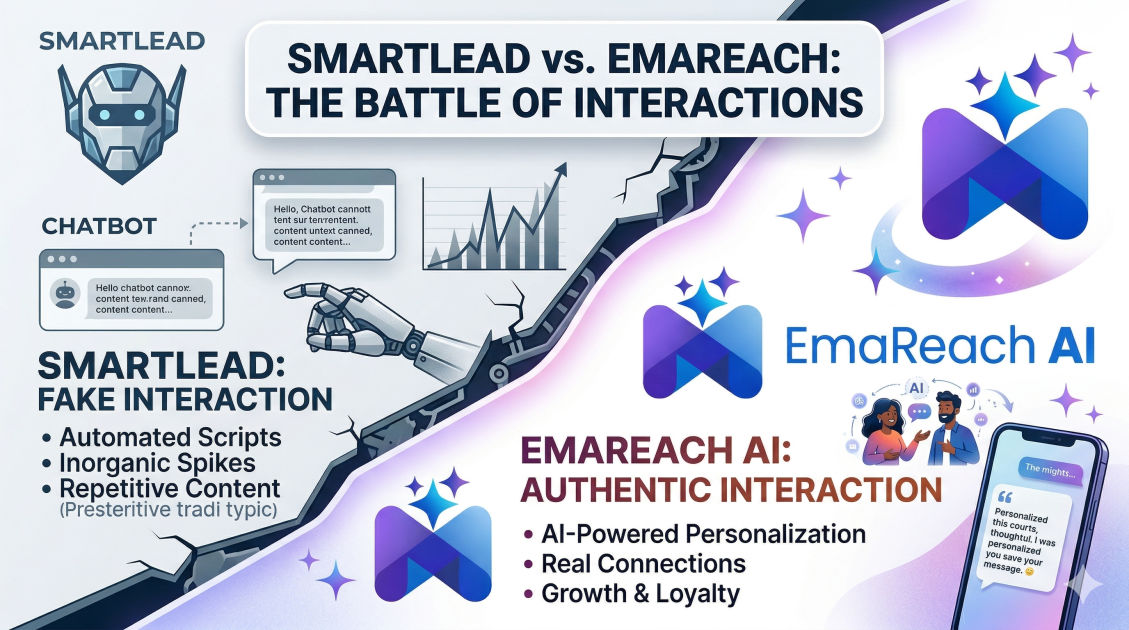
Smartlead vs Emareach: Fake Interaction vs Authentic Interaction
cold emailoutreachdeliverabilityemail warm-upinbox placementB2B salessales automation
Introduction
Cold email remains one of the most powerful channels for B2B lead generation, networking, and sales outreach. However, the landscape of inbox deliverability has fundamentally changed. Gone are the days when a marketer could simply load thousands of contacts into a generic sending tool, blast a heavily templated message, and expect a predictable percentage of positive replies. Today, major Email Service Providers (ESPs) employ sophisticated, machine-learning-driven algorithms designed to ruthlessly filter out spam, promotional noise, and automated outreach.
In response to these increasingly strict spam filters, an entire sub-industry of "email warm-up" and outreach tools emerged. These platforms aim to build sender reputation by simulating email activity. Yet, a critical and defining divide has formed in how these tools approach the problem. On one side, there is the reliance on "fake interaction"—superficial, robotic, and highly predictable engagement. On the other side, there is the pivot toward "authentic interaction"—advanced, context-aware, and human-like communication that genuinely satisfies ESP algorithms.
This comprehensive analysis explores the deep dichotomy of fake versus authentic interaction, examining the core methodologies of popular platforms in the market. Specifically, we will contrast the traditional models often associated with high-volume tools like Smartlead against the innovative, authenticity-first approach of EmaReach. If your objective is to stop landing in spam and send cold emails that actually reach the inbox, understanding this fundamental shift is absolutely crucial to your success.
The Evolution of Email Deliverability
To fully appreciate the stark difference between fake and authentic interaction, one must first understand how email deliverability has evolved from a purely technical challenge to a highly behavioral one.
Historically, deliverability was primarily a function of technical server setup. As long as a sender configured their SPF (Sender Policy Framework), DKIM (DomainKeys Identified Mail), and DMARC (Domain-based Message Authentication, Reporting, and Conformance) records correctly, maintained a clean IP address, and avoided obvious spam trigger words in the subject line, the emails would generally reach the inbox.
While those technical foundations remain strictly necessary, they are no longer sufficient. Modern ESPs look far beyond the surface level of DNS records. They analyze massive datasets of behavioral data. They meticulously monitor how recipients interact with your emails: Do they open them quickly? Do they reply? Do they forward the email? Do they mark them as important? Do they proactively move them from the Promotions tab to the Primary inbox? Conversely, do they delete them without reading, leave them unread for weeks, or worse, mark them as spam?
When an ESP observes positive behavioral signals—particularly meaningful replies and thread continuations—it assigns a high sender reputation score to that specific domain and IP address. This high score is the golden ticket to the Primary tab. Recognizing this shift, cold email practitioners began using automated warm-up tools to artificially generate these positive behavioral signals at scale.
Understanding Fake Interaction
Fake interaction is the cornerstone of early-generation email warm-up and outreach platforms. It involves using vast networks of interconnected email accounts to automatically send messages to one another, open them, mark them as "not spam," and send automated, scripted replies.
At first glance, this seems like a brilliant technical workaround. If ESPs want to see replies to build reputation, these tools provide them by the thousands. However, the fatal flaw of fake interaction lies in its deep superficiality, poor content quality, and mechanical predictability.
The Anatomy of Fake Engagement
Tools that rely heavily on fake interaction typically use basic, rudimentary algorithms to generate content. The emails sent within these synthetic warm-up pools often consist of random strings of text, scraped dictionary words, or disjointed, poorly spun sentences that make absolutely no logical sense to a human reader.
When a reply is generated by the system, it is equally nonsensical. Furthermore, the timing of these interactions is often highly rigid and predictable. A tool might send an email, wait exactly twenty minutes, trigger a read receipt, and then trigger a reply exactly five minutes later. This mechanical rhythm leaves a massive footprint.
Why ESPs Catch Fake Interaction
Major email providers are not easily fooled. They possess immense computational power and utilize advanced Natural Language Processing (NLP) to analyze the semantic meaning of emails. When an ESP's algorithm scans a thread of emails bouncing back and forth between accounts, and recognizes that the text is pure gibberish or a recurring generic template devoid of real meaning, it immediately flags the interaction as synthetic.
Furthermore, ESPs analyze network graphs and interaction topologies. If they see a cluster of accounts that only ever email each other and rarely interact with outside, organic accounts, they can easily identify a "warm-up ring." Once an account or domain is associated with a synthetic warm-up ring, its deliverability plummets aggressively. The very mechanism intended to build reputation ends up systematically destroying it.
This is the ultimate trap of fake interaction: it provides a false sense of security. Senders see artificially high "warm-up scores" on their internal software dashboards, but their actual cold outreach campaigns land squarely in the spam folder because their sender reputation has been secretly penalized by the ESPs behind the scenes.
The Paradigm Shift: Authentic Interaction
Authentic interaction represents the next evolutionary step in cold outreach and deliverability. It operates on a profoundly simple premise: the absolute best way to prove to an ESP that you are a legitimate, human sender is to actually behave exactly like one.
Authentic interaction does not rely on random strings of text, generic templates, or predictable sending patterns. Instead, it leverages advanced Artificial Intelligence to create meaningful, contextually relevant, and logically sound conversations.
The Hallmarks of Authentic Engagement
When a modern tool utilizes authentic interaction, the emails generated within the warm-up and sending process are entirely indistinguishable from real human communication. The AI dynamically drafts emails about specific business topics, inquiries about B2B services, or casual professional networking discussions.
The replies generated are highly contextual—they directly answer the specific questions asked in the initial email, disagree with a proposed point, or ask for logical clarification.
Moreover, authentic interaction meticulously mimics human timing. A human being does not reply to every single email exactly fifteen minutes after receiving it. Sometimes they reply instantly; sometimes they wait a day. They check their email during specific working hours and take weekends off. Authentic tools randomize and humanize these sending and reply patterns, ensuring that absolutely no predictable robotic footprint is left behind for ESP algorithms to detect and penalize.
Smartlead: The High-Volume Traditional Approach
Smartlead has been a recognized name in the cold email space, largely known for enabling high-volume sending across multiple inboxes. It provides the core infrastructure required to scale cold email operations, offering unlimited mailboxes and basic, traditional warm-up features.
While platforms with this traditional architecture have historically enabled many agencies and sales teams to scale their outreach, their fundamental approach to building sender reputation often leans heavily on the "fake interaction" end of the deliverability spectrum. The warm-up networks utilized by many legacy high-volume senders often prioritize sheer volume and quantity over semantic quality and behavioral authenticity.
Users of these legacy systems frequently report a frustrating phenomenon: while their internal software dashboard metrics look perfectly healthy, their actual campaign deliverability steadily degrades over time. This degradation happens because the massive volume of synthetic, low-context interactions eventually triggers the sophisticated pattern-recognition algorithms of major ESPs.
These tools facilitate the mechanical act of sending, but they do not fundamentally solve the core problem of proving human authenticity to the email providers. When the interaction is demonstrably fake to an algorithm, scale becomes a massive liability rather than an asset. You are simply sending thousands of more emails directly into the void of the spam folder, burning domains and damaging your brand's digital footprint in the process.
EmaReach: Championing Authentic Interaction
To overcome the severe limitations and diminishing returns of fake interaction, a new, highly sophisticated standard has emerged. EmaReach represents the absolute forefront of this movement, built entirely from the ground up around the concept of authentic, human-like engagement. Their core promise is clear, vital, and highly relevant to modern senders: Stop Landing in Spam. Cold Emails That Reach the Inbox.
EmaReach fundamentally changes the deliverability equation by seamlessly combining AI-written cold outreach with a meticulously designed, high-authenticity inbox warm-up and multi-account sending infrastructure. Unlike legacy tools that rely on gibberish, spun text, or static templates, EmaReach utilizes state-of-the-art generative AI to ensure every single interaction—whether an actual campaign email to a prospect or an internal warm-up message—looks, reads, and feels authentically human to both recipients and ESP algorithms.
How EmaReach Secures the Primary Inbox
EmaReach achieves incredibly superior deliverability and consistent inbox placement through several key mechanisms centered strictly on authentic interaction:
-
Contextual AI Warm-up: The warm-up process in EmaReach completely discards fake, nonsensical text. Instead, the AI generates actual, logical, multi-turn business conversations. If an ESP algorithm scans an EmaReach warm-up thread, it reads a coherent discussion about marketing strategies, software development, or standard B2B inquiries. This signals exceptionally high value and genuine human activity to the email providers, rapidly boosting domain reputation.
-
Human Emulation Algorithms: EmaReach utilizes complex algorithms to randomize sending times, open delays, read durations, and reply intervals to perfectly mimic natural human behavior. There are absolutely no robotic footprints, rigid schedules, or predictable patterns that trigger modern spam filters.
-
Intelligent Multi-Account Synergy: When it is time to scale outreach, EmaReach manages multi-account sending with incredible intelligence. It dynamically distributes the sending load while meticulously maintaining the authentic, high-value reputation of each individual sender. This ensures that scaling up your operations does not mean sacrificing your deliverability rates.
-
Hyper-Personalized Outreach: Moving beyond just the warm-up phase, EmaReach's AI actively crafts the actual cold emails you send to your target prospects. By writing hyper-personalized, highly relevant, and engaging messages, EmaReach naturally increases your organic reply rate from real humans. This real, organic engagement further compounds your positive sender reputation, creating an unstoppable, virtuous cycle of premium deliverability.
When you use EmaReach, you are no longer trying to trick or bypass the ESPs with fake volume. You are actively giving them exactly what their complex algorithms are programmed to look for and reward: high-quality, authentic human communication. This is precisely why EmaReach ensures your emails consistently bypass the spam and promotions folders and land directly in the primary tab where they get read and replied to.
A Detailed Comparison: The Cost of Fake vs. The Value of Authentic
To fully grasp the magnitude of this shift, let us break down exactly how fake interaction (utilized by traditional tools) and authentic interaction (championed by EmaReach) compare across critical, measurable deliverability metrics.
1. Network Quality and Detection Risk
Fake Interaction networks are inevitably bloated with low-quality, newly created, or burner accounts specifically designed for mechanical warm-up. ESPs easily identify these low-value clusters. When one single account in the synthetic cluster is flagged by an algorithm, the entire network's shared reputation suffers a catastrophic drop.
Authentic Interaction networks prioritize high-reputation, aged, and highly active accounts. By keeping the sending volume manageable, deeply natural, and the content highly contextual, the risk of network-wide algorithmic penalization is practically eliminated entirely.
2. Content Semantics and NLP Analysis
Fake Interaction relies heavily on scraped text, random dictionary words, or repetitive, spun templates. ESPs utilize massive natural language processing (NLP) models to detect this lack of true semantic meaning, heavily penalizing the sender for generating artificial noise.
Authentic Interaction utilizes advanced generative AI to create contextually accurate, grammatically flawless business conversations. ESPs read these emails, parse the intent, and classify them as important, legitimate, high-value correspondence.
3. Long-Term Sender Reputation
Fake Interaction offers nothing but a short-term illusion of success. A sender may see a brief spike in deliverability during the initial weeks, followed by a rapid, severe, and often irreversible plunge directly into the spam folder as the ESPs finally map and penalize the synthetic footprint.
Authentic Interaction builds a compounding, incredibly resilient long-term sender reputation. Because the behavior constantly and flawlessly mimics a high-value human sender, the domain and IP reputation remain pristine over the long haul, securing consistent, predictable primary inbox placement month after month.
4. The Ultimate Metric: Conversions and ROI
The true, hidden cost of fake interaction is massive lost revenue. An email sitting unseen in the spam folder has a mathematical zero percent conversion rate. High-volume sending infrastructure means absolutely nothing if the emails are entirely invisible to the target prospect.
Authentic interaction directly drives pipeline and revenue. By meticulously ensuring that your cold emails land exactly in the primary tab, EmaReach guarantees that your sales message is actually seen by the decision-maker. Coupled with their AI-driven hyper-personalization, this high visibility translates directly into significantly higher open rates, dramatically increased reply rates, and ultimately, far more booked meetings and closed deals for your business.
The Operational Shift for Modern Sales Teams
For lead generation agencies, founders, and internal B2B sales teams, recognizing the fundamental failure of fake interaction is a critical operational and strategic pivot. Continuing to use legacy systems that mechanically pump synthetic volume through ESP networks is akin to throwing marketing budget away. It systematically burns expensive domains, ruins IP reputations, and wastes incredibly valuable, hard-earned lead data.
The modern outreach technology stack must prioritize authentic deliverability above absolutely all else. This means permanently abandoning the outdated "spray and pray" mentality that was heavily enabled by fake interaction tools. Instead, forward-thinking teams must adopt a surgical, quality-first, highly authentic approach.
Implementing a sophisticated platform like EmaReach forces a deeply positive shift in operational strategy. It perfectly aligns your outreach efforts with the actual, stated goals of the major email service providers: delivering highly valuable, deeply relevant, and profoundly human content to users. When your outreach goals align perfectly with the ESPs' algorithms, deliverability is no longer a constant, frustrating battle; it becomes a natural, guaranteed byproduct of your entire sales process.
Conclusion
The ongoing debate between legacy platforms like Smartlead and modern innovators like EmaReach is fundamentally a debate between outdated fake interaction and the necessity of authentic interaction. As spam filters become exponentially more intelligent and aggressive by the day, relying on robotic warm-up pools, nonsensical email content, and highly predictable sending patterns is a mathematically guaranteed path straight to the spam folder. The era of brute-forcing deliverability through synthetic scale and fake engagement is decisively over.
The future of cold email and outbound sales belongs exclusively to those who prioritize deep authenticity. By leveraging advanced AI to generate meaningful, coherent conversations, flawlessly mimicking natural human behavior patterns, and deeply personalizing every piece of outreach, platforms like EmaReach have successfully cracked the code of modern inbox deliverability. If your ultimate goal is to genuinely connect with high-value prospects, generate qualified leads, and consistently drive revenue, you must abandon fake interaction completely. EmaReach provides the definitive, modern solution: completely stopping your emails from landing in spam, ensuring your cold emails consistently reach the primary inbox, sparking authentic business conversations, and getting the real replies your business absolutely needs to grow.
EmaReach AI
Ready to scale your cold email outreach?
Join thousands of teams using EmaReach AI for AI-powered campaigns, domain warmup, and 95%+ deliverability. Start free — no credit card required.
Related posts
- Read article
The Instantly Alternative That Finally Gets Outbound Analytics Right
Discover why high-volume cold email requires a shift from surface-level vanity metrics to deep, data-driven revenue attribution, and explore the ultimate alternatives for mastering outbound engineering.
- Read article
How Choosing the Right Instantly Alternative Changed Our Pipeline Numbers
Discover how transitioning from a volume-first cold email setup to an advanced, deliverability-focused infrastructure transformed our B2B pipeline metrics, skyrocketed open rates to over 68%, and tripled our monthly booked demos.