Blog
Back to blog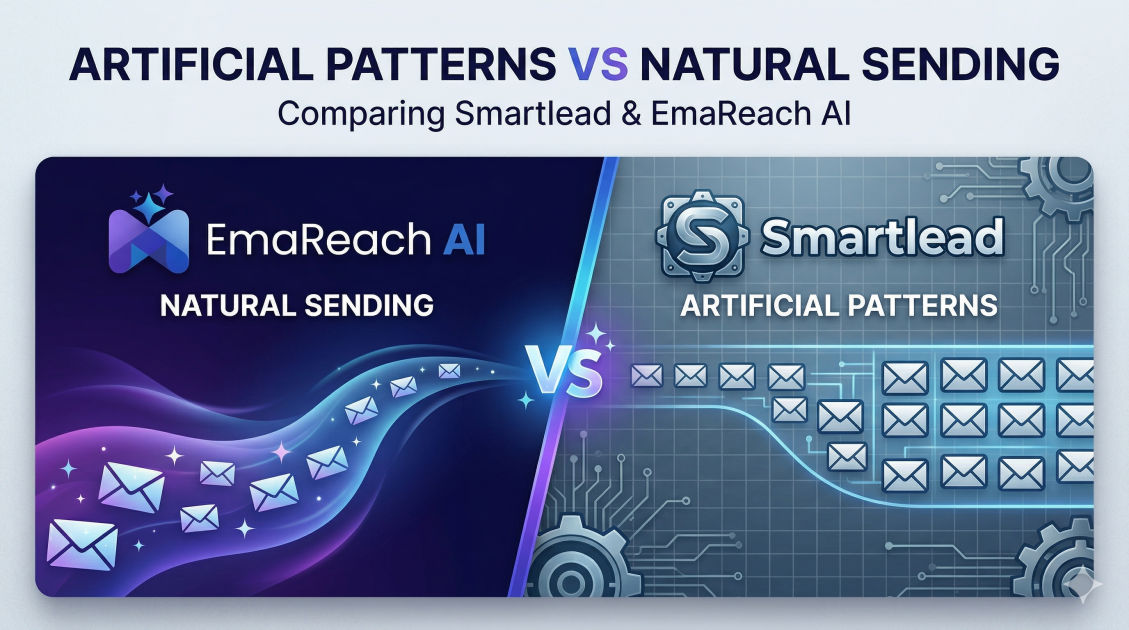
Smartlead vs Emareach: Artificial Patterns vs Natural Sending
cold emaildeliverabilityemail marketinglead generationsales automationSmartleadEmaReach
The Evolution of Cold Outreach: Beyond Simple Automation
The landscape of cold email has shifted dramatically. Gone are the days when a simple mail merge and a generic template could yield a 5% reply rate. As email service providers (ESPs) like Google and Microsoft deploy increasingly sophisticated machine learning algorithms to protect their users' inboxes, the battle for the 'Primary' tab has become a war of technical nuance.
At the heart of this battle lies a fundamental choice for growth teams and sales development representatives: Do you rely on high-volume automation with artificial patterns, or do you shift toward a methodology centered on natural sending? This brings us to a critical comparison between two heavyweights in the space: Smartlead and EmaReach. While both tools aim to scale your outreach, their underlying philosophies regarding deliverability and pattern recognition couldn't be more different.
Understanding the 'Artificial Pattern' Trap
Artificial patterns are the digital fingerprints left behind by traditional automation tools. When a software sends emails at precise intervals (e.g., exactly every 120 seconds) or uses predictable spikes in volume, ESP filters take notice. These systems are designed to distinguish between a human being communicating and a script running on a server.
The Rigid Infrastructure of Legacy Tools
Smartlead has long been a staple for agencies due to its ability to manage hundreds of inboxes. However, its historical reliance on a centralized infrastructure can sometimes create a 'footprint.' When thousands of users send emails through similar pathways or follow the same algorithmic warmup sequences, the patterns become recognizable to sophisticated spam filters.
The Danger of Uniformity
Uniformity is the enemy of deliverability. If every email sent from an organization looks identical in its metadata—headers, sending frequency, and reply-to-sent ratios—it triggers 'bulk sender' flags. Even with features like spintax (rotating words), the underlying behavior remains robotic. This is where artificial patterns fail; they attempt to hide automation with simple randomization rather than mimicking true human variability.
EmaReach and the Philosophy of Natural Sending
Enter EmaReach, a platform built with a different core objective: Stop Landing in Spam. Cold Emails That Reach the Inbox. EmaReach focuses on what we call 'Natural Sending.' This isn't just about slowing down the send rate; it’s about a holistic approach to email health that makes every message look like it was hand-crafted and sent by an individual user.
Human-Centric Intervals
Natural sending involves stochastic intervals—irregular pauses that mirror a human's workday. Sometimes a person sends three emails in ten minutes; sometimes they take a thirty-minute break. EmaReach mimics these human ebbs and flows, ensuring that your sending activity doesn't create a 'sawtooth' pattern on the ESP’s monitoring charts.
Advanced Inbox Warmup
While many tools offer warmup, the quality of that warmup matters. Natural sending requires the warmup to interact with your actual outreach content. EmaReach AI combines AI-written cold outreach with inbox warm-up and multi-account sending—so your emails land in the primary tab and get replies. By seeding real conversations and high-quality interactions, it builds a 'reputation moat' around your domain.
Technical Comparison: Deliverability Architecture
To understand why one tool might outperform another in the long run, we must look under the hood at how they handle IP reputation, headers, and volume management.
Smartlead’s Approach
Smartlead is designed for 'Unstoppable Volume.' It excels at horizontal scaling—letting you add 50, 100, or 500 inboxes and managing them from a master dashboard. It uses a 'Master Inbox' feature to consolidate replies, which is excellent for workflow efficiency. However, the sheer volume can sometimes lead users to neglect the individual health of their domains, relying on the tool's built-in features to bypass filters rather than fundamentally changing the sending behavior.
EmaReach’s Approach
EmaReach prioritizes the 'quality of send.' It is built for the era of 'Protective ESPs.' Instead of just giving you the keys to a high-volume engine, it provides a guided system that enforces natural behavior. This includes:
- AI-Personalization at Scale: Ensuring that the body text of each email is unique enough to avoid 'fuzzy matching' spam filters.
- Dynamic Multi-Account Rotation: Distributing the load across multiple accounts so that no single inbox ever looks like a bulk sender.
- Reputation Protection: Constant monitoring of blacklists and deliverability scores to pause accounts before they are burned.
The Role of AI in Content and Context
One of the biggest differentiators in the modern outreach landscape is how AI is utilized. It's no longer enough to just insert a {{first_name}} tag.
Moving Beyond Templates
Artificial patterns often emerge from repetitive templates. If 500 people are using a popular Smartlead template they found online, ESPs will eventually flag the structure of that email. EmaReach leverages AI to ensure that the actual content of the outreach is fresh. By generating contextually relevant, highly personalized messages, it breaks the pattern of 'sameness' that plagues automated campaigns.
AI-Written Outreach vs. Spintax
Spintax is a manual process of swapping words (e.g., {Hi|Hello|Hey}). It's an old-school way to fight artificial patterns. EmaReach takes a giant leap forward by using generative AI to rewrite the core message while maintaining the intent. This ensures that every recipient gets a unique version of your value proposition, making it nearly impossible for a filter to group your messages as 'bulk.'
Scalability vs. Sustainability
When choosing between Smartlead and EmaReach, the question often comes down to your business goals: Are you looking for raw scale or long-term sustainability?
The Cost of a Burned Domain
In the Smartlead model, the strategy is often to rotate through domains quickly. If one gets flagged, you move to the next. This 'churn and burn' approach can work for high-volume sales teams, but it carries a high operational cost and risks permanently damaging your brand's digital reputation.
The ROI of the Primary Inbox
EmaReach focuses on the ROI of the primary inbox. One email that lands in the Primary tab is worth more than 1,000 emails that land in the Spam or Promotions folder. By adhering to natural sending patterns and utilizing AI-driven warmup, EmaReach ensures that your primary domains remain healthy and your outreach remains a sustainable asset for the business.
Practical Steps for Natural Sending
Regardless of the tool you choose, implementing a natural sending strategy involves several key pillars:
- Domain Diversification: Never send all your volume from your main corporate domain. Use 'look-alike' domains (e.g., getcompany.com instead of company.com).
- Slow Ramping: Start with 5-10 emails per day and increase by no more than 5 per week. Artificial tools often try to 'blast' too early.
- Engagement Focus: Deliverability is a feedback loop. If people open, click, and reply, your reputation goes up. EmaReach’s warmup feature automates this 'positive feedback' to keep you out of the spam folder.
- Unique Content: Use AI to generate unique opening lines for every prospect. This is the single best way to break artificial patterns.
Comparing User Experience and Workflow
Smartlead: The Power User’s Dashboard
Smartlead is a powerhouse for those who love data and control. Its interface is designed for the high-volume agency. You can see global stats, manage lead lists across dozens of clients, and set up complex sequences. It is built for the user who wants to pull every lever manually.
EmaReach: The Deliverability Expert in a Box
EmaReach is designed for the user who wants the tool to handle the technical heavy lifting. It acts more like a deliverability consultant. It doesn't just ask you how many emails you want to send; it helps you determine how many you should send to stay safe. Its integration of AI-written content and warmup makes it a more 'all-in-one' solution for those who prioritize hitting the inbox over managing complex infrastructure.
The Verdict: Which is Right for You?
Choose Smartlead if:
- You are an agency managing high-volume campaigns for multiple clients.
- You have a dedicated deliverability expert on staff to monitor patterns manually.
- You prioritize technical control and horizontal scaling across hundreds of inboxes.
Choose EmaReach if:
- Your primary goal is ensuring your emails land in the 'Primary' tab consistently.
- You want AI to handle the heavy lifting of writing and personalizing outreach.
- You prefer a 'Natural Sending' approach that protects your domains and mimics human behavior.
- You want a system where AI-written cold outreach and inbox warm-up work in perfect harmony to maximize reply rates.
Conclusion
The future of cold email is not about who can send the most, but who can be the most human at scale. Artificial patterns are increasingly easy for ESPs to detect and block. By transitioning to a philosophy of natural sending, you aren't just trying to 'beat the system'—you are becoming a better sender. Tools like Smartlead offer incredible power for scaling, but EmaReach provides the precision and artificial-intelligence-driven naturalism required to thrive in a world of strict inbox filters.
Ultimately, the 'best' tool is the one that gets your message seen. In a world of noise, the primary inbox is the only place that matters. By focusing on natural patterns, unique content, and consistent reputation management, you ensure that your outreach remains a powerful engine for growth for years to come.
EmaReach AI
Ready to scale your cold email outreach?
Join thousands of teams using EmaReach AI for AI-powered campaigns, domain warmup, and 95%+ deliverability. Start free — no credit card required.
Related posts
- Read article
The Instantly Alternative That Plays Nicer With Your Existing Tech Stack
Discover why switching from an all-in-one cold email platform to an API-first, infrastructure-focused alternative like Smartlead allows your outbound campaigns to integrate perfectly into your CRM, webhooks, and enterprise workflows without creating data silos.
- Read article
The Instantly Alternative That Wins for Teams Running ABM Campaigns
Discover why volume-first cold email tools fall short for sophisticated B2B Account-Based Marketing (ABM) and learn why EmaReach is the ultimate alternative for teams prioritizing primary inbox deliverability and hyper-personalized executive outreach.