Blog
Back to blog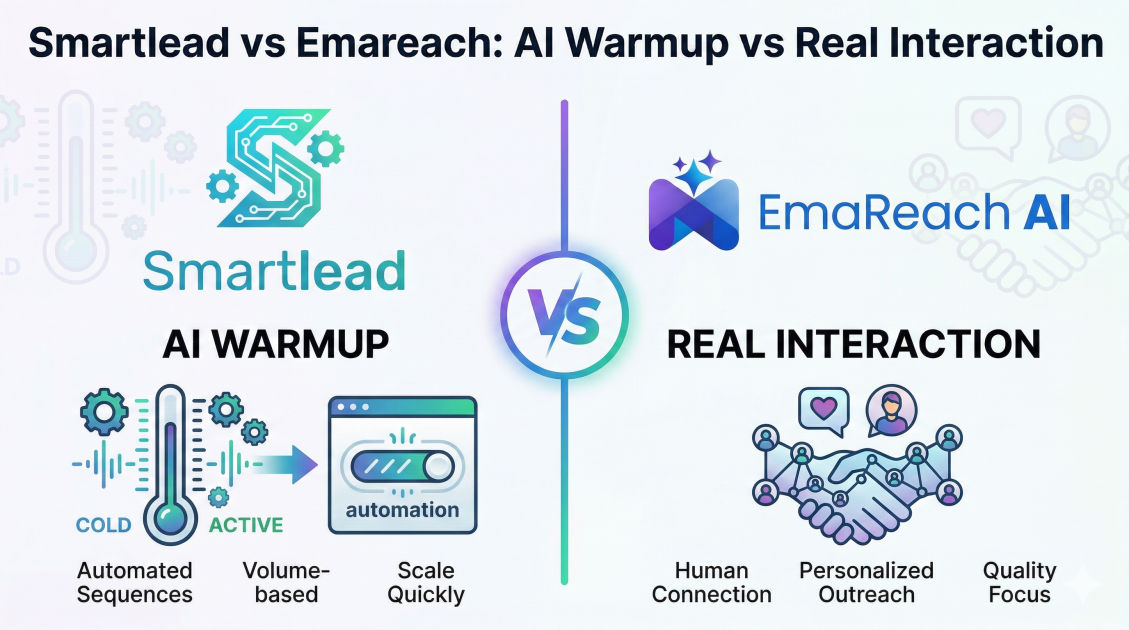
Smartlead vs Emareach: AI Warmup vs Real Interaction
cold emailemail deliverabilityoutreach strategyemail warmupB2B salesinbox placement
Introduction
The landscape of cold email outreach has transformed dramatically over the past decade. Gone are the days when a business could simply scrape a massive list of unverified email addresses, load them into a basic sender, and expect a flood of qualified leads to pour in. Today, the guardians of the inbox—major email service providers (ESPs) like Google Workspace, Microsoft 365, and Yahoo—employ highly sophisticated machine learning algorithms designed to ruthlessly filter out anything that even remotely resembles spam. This fundamental shift has forced sales professionals, digital marketers, and agency owners to completely rethink their approach to email deliverability and prospect engagement.
At the very heart of this modern outreach strategy lies the concept of email warmup. Building domain reputation is no longer an optional tactic; it is an absolute necessity for survival in the B2B space. However, as the outreach industry continues to evolve, a fierce debate has emerged regarding the best way to build this reputation: the battle between automated, AI-driven warmup and genuine, real-world interaction.
In this comprehensive analysis, we will explore this crucial divide by comparing two prominent philosophies and platforms in the outreach space: Smartlead and EmaReach. We will dissect the technical mechanics of AI warmup, explore why authentic interaction is rapidly becoming the gold standard for long-term success, and help you determine which approach will ultimately secure your emails a coveted spot in your prospect's primary inbox.
The Critical Role of Email Warmup in Modern Outreach
Before diving into a comparison of specific tools, it is crucial to understand why email warmup is a foundational requirement for any serious outreach campaign. When you register a new domain name and create a fresh email workspace, that domain possesses a completely neutral reputation. ESPs view all new domains with inherent, deeply programmed suspicion.
If a brand-new email account suddenly begins sending hundreds or thousands of identical emails per day, the algorithms immediately flag this behavior as anomalous and highly characteristic of spammers. The result is almost always instant banishment to the dreaded spam folder, or worse, outright domain blacklisting at the server level.
Email warmup is the systematic process of gradually building trust with these ESPs. It involves slowly increasing your sending volume over time while simultaneously generating positive engagement signals. These signals include your emails being opened, read, replied to, starred, categorized, and most importantly, rescued from the spam folder. Historically, this tedious process was done manually by emailing colleagues, friends, and secondary accounts. As outbound sales scaled, automated warmup networks were born, allowing thousands of users to pool their accounts and automatically interact with each other to build reputation artificially.
Understanding AI Warmup: The Automated Approach
AI warmup represents the first major evolution in automated deliverability solutions. Platforms utilizing this method rely heavily on algorithms to generate synthetic conversations between email accounts within a massive, shared warmup pool. The software system will automatically send an email from your designated account to another user's account within the network, and that user's account will automatically generate a dynamically written AI reply.
The primary advantage of this approach is pure scale, speed, and convenience. A user can connect dozens or even hundreds of mailboxes, toggle a single switch, and let the software generate thousands of positive interactions in the background without any manual oversight. It creates a baseline of sending and receiving activity that can rapidly help elevate a completely cold domain to a usable, functioning state.
However, the heavy reliance on AI-generated chatter introduces significant vulnerabilities in the modern deliverability landscape. Major ESPs process billions of emails daily. They possess immense computational power to analyze linguistic patterns, sending frequencies, network IP addresses, and behavioral footprints. AI-generated warmup emails often exhibit unnatural phrasing, lack true contextual depth, and follow highly predictable sending rhythms. When the algorithms at Google or Microsoft detect these synthetic patterns across a widespread network of accounts, they actively devalue those positive signals. In some scenarios, participating in a highly detectable, purely AI-driven warmup network can actually harm your long-term domain reputation, as the ESPs identify the automated behavior as a deliberate attempt to manipulate their security filters.
The Shift to Real Interaction: Why Authenticity Wins
Recognizing the inherent limitations and growing risks of purely synthetic activity, the vanguard of cold email deliverability is shifting aggressively toward real interaction. Authenticity is rapidly becoming the ultimate currency in modern inbox placement.
ESPs are no longer just looking at binary metrics like whether an email was simply opened or replied to; they are deeply analyzing how a human user interacts with the message. Did the user scroll through the entire thread? Did they forward it to a colleague? Did they move it to a specific folder? Did the reply contain nuanced, human language that directly references the original text in a meaningful, non-templated way?
Real interaction mimics the organic, unpredictable, and messy nature of true human communication. It involves varied sending times, diverse thread lengths, delays in responses, and content that does not fit neatly into algorithmic templates. When an ESP observes a domain consistently generating genuine, high-quality human engagement from diverse IP addresses, it awards that domain an elite, bulletproof sender reputation.
This high-tier reputation acts as a protective shield, allowing your actual cold outreach campaigns to bypass aggressive spam filters and land squarely in the primary tab. The primary challenge for businesses, of course, is achieving this level of authenticity at scale without reverting to manual, unscalable, and time-consuming processes.
Smartlead: A Deep Dive into AI-Driven Warmup and Sending
Smartlead has firmly established itself as a popular and powerful tool for high-volume cold email senders, particularly among lead generation agencies. Its core philosophy revolves around horizontal scaling—the practice of using dozens or even hundreds of secondary domains and mailboxes to distribute massive sending volume while mitigating individual domain risk.
Smartlead excels at managing this complex, sprawling infrastructure. It offers a unified master inbox (the unibox) to efficiently manage replies across countless disconnected accounts, making life easier for sales development representatives (SDRs). A significant component of its deliverability strategy relies on its proprietary, integrated warmup network. Users seamlessly connect their accounts, and the system automates the sending and receiving of emails to build initial reputation.
While highly effective for rapid domain seasoning and infrastructure management, Smartlead's warmup heavily relies on the AI-generated model discussed earlier. The automated interactions, while numerous and consistent, can sometimes lack the deep authenticity and behavioral unpredictability required to consistently fool the most advanced spam filters over a multi-year period. For users prioritizing massive send volume, infrastructure management, and the rapid deployment of disposable domains, Smartlead provides a robust, highly functional interface. However, for those who deeply value protecting high-value legacy domains and achieving the absolute highest possible primary inbox placement rates, the purely algorithmic warmup approach may present long-term limitations.
EmaReach: Mastering the Art of Real Interaction and Inbox Placement
This brings us to a significant paradigm shift in how cold outreach is conceptualized and executed. If your ultimate goal is to break through the noise and ensure your messages are actually seen by decision-makers, understanding the EmaReach methodology is essential.
EmaReach operates on the foundational principle that the highest tier of deliverability is achieved through a meticulous combination of intelligent technology and genuine engagement signals. If you want to Stop Landing in Spam. Cold Emails That Reach the Inbox, you need a system designed for the modern algorithm. EmaReach AI combines AI-written cold outreach with inbox warm-up and multi-account sending—so your emails land in the primary tab and get replies.
Unlike basic warmup networks that merely churn out predictable, synthetic dialogue, EmaReach focuses on generating interactions that deeply mirror real human behavior. The platform's sophisticated infrastructure is specifically designed to produce the complex, varied, and unpredictable engagement signals that ESPs crave.
But EmaReach goes far beyond just providing a superior warmup network. It integrates this advanced deliverability foundation directly with its state-of-the-art AI-driven outreach capabilities. The AI does not just write generic, fill-in-the-blank templates; it crafts highly personalized, contextually relevant emails that are designed from the ground up to elicit real, organic responses from your prospects.
By seamlessly blending top-tier inbox placement strategies with compelling, highly individualized copy, EmaReach ensures that your messages not only reach the right people but also resonate with them emotionally. This drives the authentic, human interaction that further boosts your sender reputation in a powerful, self-sustaining virtuous cycle.
Smartlead vs Emareach: A Feature-by-Feature Comparison
When comparing Smartlead and EmaReach side-by-side, the functional distinctions and philosophical differences become remarkably clear.
Deliverability and Warmup Strategy
Deliverability is the primary battleground. Smartlead offers a strong, volume-focused warmup utility that is excellent for rapid scaling across massive networks of domains. EmaReach, conversely, provides a more nuanced, highly sophisticated warmup process designed specifically to generate the deep, authentic engagement signals required for sustained, long-term primary inbox placement.
User Interface and Workflow
In terms of workflow, Smartlead provides an excellent centralized hub for managing massive networks of mailboxes. Its unibox is a favorite for agencies handling hundreds of separate client accounts simultaneously. EmaReach focuses heavily on the direct synergy between the actual message content and the delivery mechanism, offering intuitive tools that ensure the AI-written outreach is perfectly calibrated to leverage the high reputation built by its unique warmup system.
Personalization and AI Capabilities
Personalization is another key differentiator. While many high-volume tools allow for basic variable insertion (like First Name or Company Name), EmaReach's AI is engineered to deeply analyze prospect data to create highly individualized outreach that naturally prompts real interaction from the recipient. Smartlead is an undisputed powerhouse for backend infrastructure management; EmaReach is a specialized, finely-tuned engine for maximizing the actual human connection and conversion rate of every single email sent.
Understanding the Mechanics of the Spam Filter
To fully appreciate the critical difference between synthetic warmup and real interaction, one must delve deeply into the mechanics of modern spam filters. Google Workspace and Microsoft 365 do not rely on simple keyword blacklists anymore. They employ advanced machine learning models trained on trillions of real-time data points.
These algorithms analyze the sender's IP reputation, domain age, historical bounce rates, technical authentication protocols (SPF, DKIM, DMARC), and crucially, ongoing user engagement. When a cold email arrives at a server, the ESP instantly checks its historical data. If the sender's domain only ever interacts with known, flagged warmup network IP addresses, the ESP assigns a significantly lower trust score.
Conversely, if the sender's domain demonstrates a rich history of organic, varied interactions with diverse, high-reputation corporate domains, the trust score skyrockets. Furthermore, ESPs extensively use natural language processing (NLP) to scan the semantic content of the emails. They look for unnatural sentence structures, excessive use of tracking links, and the overall conversational flow of the message. The authentic interaction fostered by EmaReach's holistic approach helps build a robust, unshakeable trust score that can withstand occasional bounces or user spam complaints, whereas a reputation built solely on AI warmup is often far more fragile and susceptible to sudden, devastating algorithm updates.
Actionable Strategies to Maximize Your Deliverability Today
Regardless of whether you lean toward a volume-based infrastructure strategy or an authenticity-first deliverability approach, there are non-negotiable foundational steps every sender must take to protect their domain health.
- Impeccable Technical Setup: Ensure your Sender Policy Framework (SPF), DomainKeys Identified Mail (DKIM), and Domain-based Message Authentication, Reporting, and Conformance (DMARC) records are perfectly configured. Without these digital signatures, your emails will be rejected by major servers immediately.
- Ruthless List Hygiene: Bouncing emails are utterly catastrophic for your sender reputation. Always use reliable, real-time email verification tools to aggressively clean your prospect lists before launching any campaign. Never send to a "catch-all" address unless absolutely necessary.
- Strategic Segmentation: Sending hyper-relevant messages to small, deeply targeted groups will always yield higher engagement rates than blasting a generic, one-size-fits-all message to thousands of people. Relevance drives replies, and replies drive deliverability.
- Protect Your Core Domain: Never, under any circumstances, use your primary business domain for cold outreach. Always purchase secondary domains that are slight variations of your main brand name. This vital step quarantines any potential reputation damage and ensures your day-to-day internal and client communications are never interrupted by a spam filter penalty.
Advanced Copywriting: The Catalyst for Real Interaction
Beyond the technical infrastructure and software tools, the actual words you use dictate your ultimate success. Real interaction is ultimately driven by compelling, empathetic copywriting.
The modern cold email must be remarkably brief, highly relevant, and focused entirely on the prospect's specific pain points. Avoid the temptation to talk about yourself, your company history, or your software features in the opening lines. Instead, lead with a keen observation about their business, a recent industry change, or a specific operational challenge they are likely facing.
The goal of the first email is almost never to sell a product directly; it is simply to start a dialogue. Ask a low-friction, soft-ask question that makes it incredibly easy for the prospect to reply. When they do reply—even with a simple "tell me more" or "not right now"—you generate a massive positive engagement signal for the ESPs. Tools that combine great sending infrastructure with AI that understands human psychology excel here, ensuring that the heavy lifting done by the warmup process is actively capitalized upon by actual prospect replies.
Conclusion
The landscape of cold outreach will undoubtedly continue to evolve, and the algorithms guarding the inbox will only become more sophisticated, demanding, and opaque. While high-volume, AI-driven warmup tools absolutely have their place in rapidly scaling complex sending infrastructures, the long-term future of sustainable deliverability belongs to authentic, real-world interaction. Building a profitable outreach engine requires far more than just generating synthetic chatter; it demands an intelligent approach that prioritizes high-quality human engagement, precise contextual personalization, and flawless technical excellence. By focusing on generating genuine responses and utilizing advanced platforms that deeply understand the nuances of modern ESP filtering, businesses can ensure their messages consistently break through the digital noise, completely bypass the spam folder, and land securely in the primary inbox where real business gets done.
EmaReach AI
Ready to scale your cold email outreach?
Join thousands of teams using EmaReach AI for AI-powered campaigns, domain warmup, and 95%+ deliverability. Start free — no credit card required.
Related posts
- Read article
The Instantly Alternative That Finally Gets Outbound Analytics Right
Discover why high-volume cold email requires a shift from surface-level vanity metrics to deep, data-driven revenue attribution, and explore the ultimate alternatives for mastering outbound engineering.
- Read article
How Choosing the Right Instantly Alternative Changed Our Pipeline Numbers
Discover how transitioning from a volume-first cold email setup to an advanced, deliverability-focused infrastructure transformed our B2B pipeline metrics, skyrocketed open rates to over 68%, and tripled our monthly booked demos.