Blog
Back to blog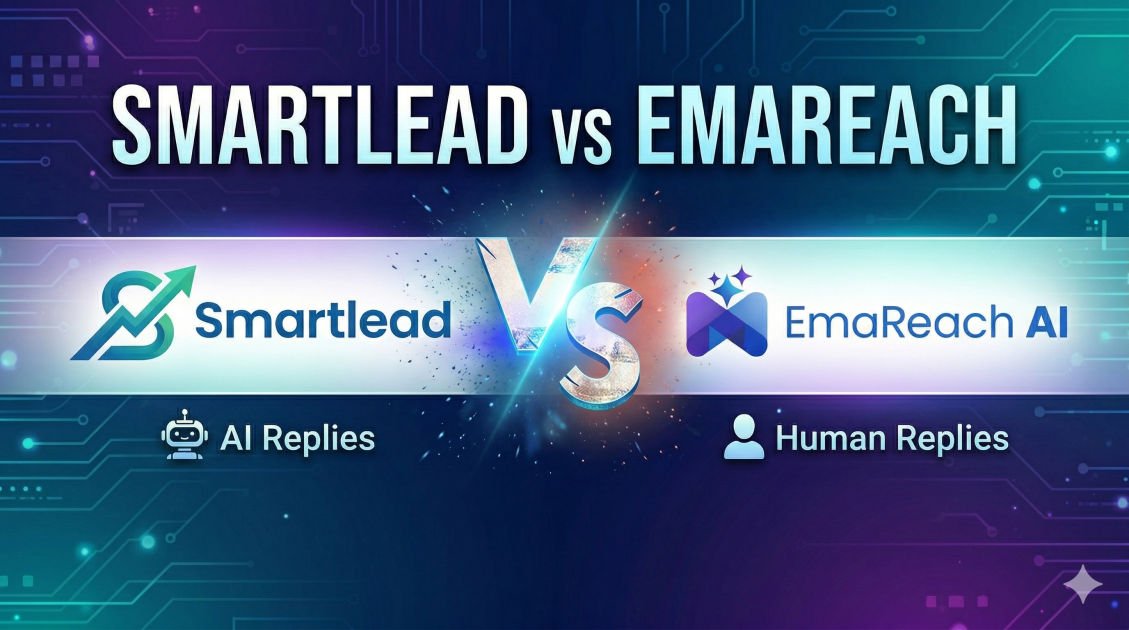
Smartlead vs Emareach: AI Replies vs Human Replies
cold emailoutreachdeliverabilityAI salesB2B marketing
Introduction
The landscape of cold outreach and B2B sales has undergone a massive transformation. The days of purchasing a list of ten thousand generic email addresses, loading them into a basic sender, and blasting out a uniform message are entirely behind us. Today, prospects are fiercely protective of their inboxes, and email service providers have deployed incredibly sophisticated algorithms to filter out anything that looks, sounds, or behaves like spam. In this hyper-competitive environment, the battle is fought on two distinct fronts: deliverability (actually reaching the inbox) and engagement (securing a positive reply).
As agencies and sales teams look to scale their operations, two prominent philosophies have emerged regarding how to handle the influx of prospect communications: relying on Artificial Intelligence to draft and manage replies versus depending on the nuanced, emotional intelligence of human sales representatives. This ongoing debate is perfectly encapsulated when analyzing powerful outreach platforms. In this comprehensive guide, we will explore the intricacies of AI replies versus human replies, examining how tools manage these workflows, and providing actionable insights for optimizing your outreach strategy.
The State of Cold Email Deliverability
Before diving into the nuances of how to reply to a prospect, we must address the foundational requirement of all email marketing: deliverability. It does not matter if you have the most brilliantly crafted, highly personalized response prepared if your initial message is languishing in a recipient's spam folder. Email service providers monitor sending habits meticulously. They look at domain age, bounce rates, spam complaints, and, crucially, the ratio of emails sent to emails opened and replied to.
When a prospect replies to your cold email, it sends a massive positive signal to the email service provider. It categorizes your domain as a sender of legitimate, requested communication. However, to get that initial reply, you must first bypass the spam filters. This requires technical setups like SPF, DKIM, and DMARC authentication, alongside strategic practices like domain rotation and inbox warming.
To achieve this critical primary inbox placement, modern solutions are required. If your goal is to Stop Landing in Spam. Cold Emails That Reach the Inbox, you need an infrastructure built for today's strict email environment. EmaReach AI combines AI-written cold outreach with inbox warm-up and multi-account sending—so your emails land in the primary tab and get replies. By prioritizing deliverability at the foundational level, you ensure that the debate over AI versus human replies actually matters, because your prospects are finally seeing your messages.
Smartlead: The Infrastructure for Human-Driven Scale
Smartlead has carved out a significant space in the cold outreach ecosystem by focusing intensely on the structural challenges of scaling email volume. For many lead generation agencies, the primary bottleneck is managing dozens, if not hundreds, of sender email accounts across various client campaigns. Smartlead tackles this by offering a robust system for unlimited mailboxes and automated sender rotation.
The Master Inbox Advantage
One of the standout features of Smartlead is its unified master inbox. When you are sending from fifty different domains, logging into each individual inbox to check for replies is an administrative nightmare. Smartlead pulls all of these threads into a single, centralized dashboard.
This architecture is heavily optimized for human sales representatives. While Smartlead does incorporate AI for basic categorization—such as tagging an email as 'Interested', 'Out of Office', or 'Do Not Contact'—the actual crafting of the response is largely left to the human operating the dashboard. The platform enables sales development representatives (SDRs) to quickly read the context of the thread, access saved snippets or templates, and fire back a personalized response.
Where the Human Touch Shines in Smartlead
Because Smartlead funnels the replies directly to human operators, it leverages the unique advantages of human interaction. SDRs can read between the lines of a prospect's vague response, apply empathy to a frustrated reply, or pivot the conversation based on current industry news that an AI might not be trained on. For complex, high-ticket B2B sales where trust and deep understanding of a bespoke problem are required, this human-in-the-loop workflow is incredibly powerful.
Emareach: The AI-First Conversion Engine
While some platforms act primarily as the plumbing for your email campaigns, Emareach operates as the intelligent engine driving the communication. Emareach is built on the premise that scaling true personalization is impossible without the heavy lifting of advanced artificial intelligence. It does not just send emails; it reads, interprets, and crafts communications that mimic top-performing sales professionals.
Integrated Deliverability and AI Outreach
The Emareach ecosystem is designed around the understanding that deliverability and content quality are intrinsically linked. A poorly written, generic email will be marked as spam, which hurts the domain, which lowers deliverability. Emareach combats this by using AI to generate highly personalized, contextually relevant initial cold emails. Furthermore, the platform integrates inbox warm-up and multi-account sending seamlessly.
The Power of AI Replies
Where Emareach truly diverges in philosophy is its capability to handle prospect engagement. When a prospect replies, the AI engine can analyze the sentiment, intent, and specific questions asked in the email. Instead of merely categorizing the email for a human to deal with later, AI-driven workflows can instantly draft a contextually appropriate response.
If a prospect asks, "What is your pricing model for enterprise teams?", an AI-first approach can instantly parse the pricing documentation you have provided in its knowledge base and reply within minutes. This speed to lead is a massive competitive advantage.
AI Replies: The Pros and Cons
The shift toward artificial intelligence handling active prospect communication is both exciting and fraught with challenges. Understanding the strengths and weaknesses of AI replies is essential for any modern sales leader.
The Advantages of AI Responses
1. Unmatched Speed and Responsiveness: In the world of sales, time kills all deals. If a prospect replies to an email while your SDR is asleep, an AI can process that reply and send a helpful, engaging response immediately, keeping the momentum alive.
2. Infinite Scalability: A human SDR can only thoughtfully reply to a limited number of emails per day before fatigue sets in and quality drops. AI does not get tired. Whether you receive ten replies or ten thousand replies in a single day, the AI maintains the exact same level of performance and adherence to brand guidelines.
3. Consistency in Messaging: Humans are prone to bad days, typos, and emotional reactions. AI ensures that every single reply aligns perfectly with your established sales playbooks, objection handling frameworks, and brand voice.
4. Overcoming Writer's Block: Even when humans are in the loop, AI can draft the initial response for the human to review. This eliminates the blank-page syndrome and drastically speeds up the human workflow.
The Risks of AI Responses
1. The Hallucination Factor: Large language models can occasionally "hallucinate" or state falsehoods with absolute confidence. If an AI incorrectly promises a feature you do not have or quotes the wrong price, it can instantly destroy trust and kill a deal.
2. Lack of True Empathy: While AI can simulate polite and professional tones, it lacks genuine emotional intelligence. If a prospect replies with a complex, emotionally charged objection (e.g., "We just had to lay off 20% of our staff, this is a terrible time"), an AI might respond with a tone-deaf, overly optimistic pivot, whereas a human would know to back off gracefully.
3. Contextual Blind Spots: AI is only as good as the context window it is provided. It might miss subtle industry nuances, sarcasm, or unstated implications in a prospect's email that a seasoned industry veteran would instantly recognize.
Human Replies: The Unmatched Art of Sales
Despite the rapid advancements in generative AI, the human element remains the cornerstone of high-value business relationships.
The Strengths of Human Interaction
1. Building Genuine Rapport: People buy from people they like and trust. A human can make a tasteful joke, reference a shared experience, or connect on a personal level that AI simply cannot replicate authentically.
2. Complex Problem Solving: B2B sales often involve intricate, multi-layered business problems. A human SDR can jump on a discovery call, ask probing questions, and tailor a completely bespoke solution that goes far beyond a standard product matrix.
3. Reading Between the Lines: Humans excel at understanding subtext. When a prospect says, "I need to check with my team," a human SDR can intuit whether that is a polite brush-off or a genuine logistical step, and reply accordingly.
The Limitations of Human-Only Workflows
1. High Costs: Hiring, training, and retaining top-tier sales talent is incredibly expensive. Relying purely on humans to handle top-of-funnel replies is often not cost-effective.
2. Slow Response Times: Humans have meetings, take lunch breaks, and go home for the weekend. The delay in response times can result in lost opportunities as prospects move on to faster competitors.
3. Inconsistency: Even the best SDRs have off days. Messaging can drift from the core value proposition, and critical follow-up steps can be forgotten or executed poorly.
Finding the Sweet Spot: The Hybrid Sales Engine
The most sophisticated and successful revenue organizations do not view AI and humans as mutually exclusive. Instead, they build a hybrid engine that maximizes the strengths of both while mitigating their respective weaknesses.
Tier 1: AI for Triage and Routing
The first layer of defense should be AI. When an inbox is flooded with replies, AI algorithms can instantly sort the noise from the signals. Out-of-office replies are paused and rescheduled. Hard bounces are removed from the CRM. Angry "unsubscribe" messages are automatically processed to ensure compliance. This leaves the human team with a clean inbox containing only actual human engagements.
Tier 2: AI for Micro-Replies and Objection Handling
For standard objections or simple requests, AI can either draft the response for human approval or, with high enough confidence scores, reply autonomously. If a prospect asks for a link to a case study or a calendar link to book a demo, AI can seamlessly handle these low-friction interactions instantly, moving the prospect further down the funnel without requiring manual human effort.
Tier 3: Human Intervention for the Close
The moment a conversation becomes complex, highly bespoke, or transitions toward a purchasing decision, the AI must hand the reins over to a human professional. The human steps in with all the context provided by the AI's previous interactions, ready to build rapport, navigate complex negotiations, and ultimately close the deal.
Actionable Best Practices for Your Outreach Stack
Regardless of which tools you lean toward or how you balance AI and human effort, certain fundamental practices must be adhered to in order to succeed in modern cold outreach.
- Relentless Audience Segmentation: Do not send the same message to a CEO and a Marketing Manager. Segment your data rigorously so that both your AI and your human reps are working with highly relevant angles.
- Maintain Pristine Deliverability: Monitor your domain health daily. Ensure SPF, DKIM, and DMARC records are flawless. Utilize platforms that automate the warming process and rotate sending accounts to protect your primary domains.
- Train Your AI with Precision: If you are using AI to draft replies, feed it your best-performing historical emails. Provide it with detailed knowledge bases, FAQ documents, and strict instructions on tone and formatting constraints.
- Establish Clear Handoff Protocols: Create absolute rules for when an AI stops replying and a human takes over. Never let an AI negotiate pricing or handle sensitive customer service complaints.
- Continuously A/B Test: The digital landscape changes rapidly. Constantly test AI-generated subject lines against human-written ones. Test different value propositions, call-to-actions, and reply frameworks to see what the data proves is most effective.
Conclusion
The evolution of cold outreach demands a sophisticated approach to both deliverability and prospect engagement. The debate between AI replies and human replies is not about choosing a definitive winner, but rather understanding how to leverage the immense scale and speed of artificial intelligence alongside the irreplaceable empathy and strategic thinking of human sales professionals. By building a robust technical foundation that ensures your messages actually reach the primary inbox, and by intelligently routing the subsequent replies to either automated systems or skilled representatives based on complexity, you can build a highly efficient, scalable, and personalized revenue engine.
EmaReach AI
Ready to scale your cold email outreach?
Join thousands of teams using EmaReach AI for AI-powered campaigns, domain warmup, and 95%+ deliverability. Start free — no credit card required.
Related posts
- Read article
The Instantly Alternative That Finally Gets Outbound Analytics Right
Discover why high-volume cold email requires a shift from surface-level vanity metrics to deep, data-driven revenue attribution, and explore the ultimate alternatives for mastering outbound engineering.
- Read article
How Choosing the Right Instantly Alternative Changed Our Pipeline Numbers
Discover how transitioning from a volume-first cold email setup to an advanced, deliverability-focused infrastructure transformed our B2B pipeline metrics, skyrocketed open rates to over 68%, and tripled our monthly booked demos.