Blog
Back to blog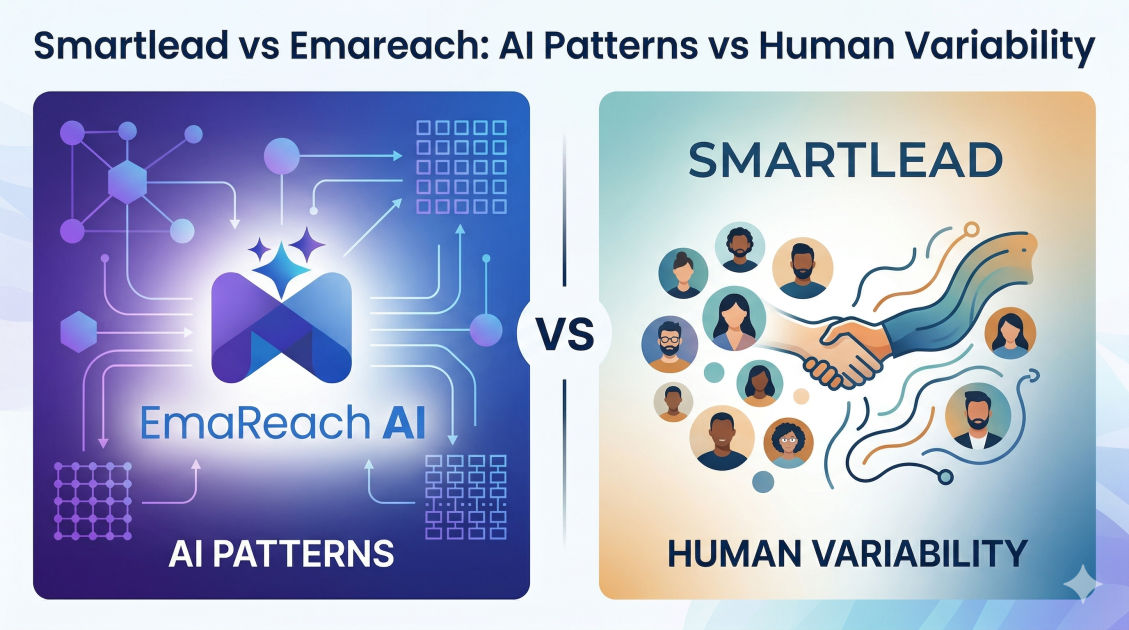
Smartlead vs Emareach: AI Patterns vs Human Variability
cold emailoutreachdeliverabilityemail marketingsales automationAI tools
Introduction
The landscape of outbound marketing and cold email is a continuous, high-stakes game of cat and mouse. On one side, sales professionals and marketers are constantly seeking new ways to scale their outreach, generate leads, and book meetings. On the other side, email service providers (ESPs) and spam filters are deploying increasingly sophisticated algorithms to protect user inboxes from unwanted, repetitive, and robotic communications. In this environment, the tools you choose and the strategies you employ dictate whether your message is seen or sent straight to the junk folder.
Two distinct philosophies have emerged in the quest for the perfect cold email strategy. The first focuses on pure infrastructural scale, relying on manual configurations and basic variations to bypass filters. The second focuses on advanced artificial intelligence to simulate genuine human behavior, injecting true variability into every aspect of the campaign. This article provides a comprehensive deep dive into the battle between these two approaches, specifically analyzing the dynamics of Smartlead and Emareach, and exploring the critical differences between detectable AI patterns and authentic human variability.
The Evolution of Spam Filters and Deliverability
To understand the current state of cold outreach, it is essential to look at how spam filters have evolved. In the early days of email marketing, spam filters were relatively rudimentary. They relied heavily on simple keyword matching—flagging emails that contained words like "free," "guarantee," or "discount"—and basic sender reputation metrics.
Today, modern spam firewalls utilize advanced machine learning models and artificial intelligence. These systems do not just look at isolated words; they analyze the entire context of an email, the structural composition of the text, the historical behavior of the sender, and the complex patterns of the sending infrastructure. They employ Bayesian filtering to calculate the mathematical probability that an email is spam based on millions of data points. Furthermore, they track engagement metrics meticulously: open rates, reply rates, forwarding behavior, and how quickly users delete an email without reading it.
Most importantly, modern ESP algorithms are specifically trained to detect automation. When an inbox receives thousands of emails from a newly registered domain, all structured in the exact same format, sent at perfectly regular intervals, the algorithm instantly flags the campaign. This is the core challenge of modern deliverability: achieving scale while remaining invisible to the algorithms designed to detect scale.
The Threat of AI Patterns in Automated Outreach
As cold email tools have become more accessible, the market has been flooded with campaigns generated by basic AI and automation platforms. While these tools offer convenience, they often introduce a fatal flaw into outreach campaigns: predictable AI patterns.
Structural Predictability
Many automated outreach platforms rely on static templates where only a few variables, such as the prospect's first name and company name, are swapped out. Even when basic spintax (the process of rotating synonymous words) is applied, the underlying sentence structure remains identical. Spam filters are adept at recognizing these structural skeletons. If a filter detects that fifty emails all share the exact same syntactical flow and paragraph length, despite having slightly different adjectives, it will flag them as automated.
Cadence and Timing Footprints
Human beings do not send emails in perfectly spaced, exact intervals. A real person might send three emails in five minutes, take a twenty-minute break for coffee, and then send two more. Basic automation tools, however, often operate on rigid cron jobs, dispatching emails exactly every three minutes and fourteen seconds. This lack of temporal variance creates a massive, glowing footprint for ESP algorithms. It signals that a machine, rather than a human, is controlling the mailbox.
Language and Tonality Uniformity
Basic AI generation often results in a homogenized, overly formal, or unnaturally enthusiastic tone. When an entire campaign utilizes the exact same linguistic style, lacking the natural quirks, slight imperfections, and varied lengths of genuine human communication, it falls into the trap of AI pattern recognition. The goal of outbound is to start a conversation, but if the initial touchpoint feels like it was manufactured on an assembly line, the psychological friction for the recipient increases, lowering reply rates and hurting domain reputation.
Smartlead: Scaling Infrastructure and the Spintax Dilemma
Smartlead has positioned itself as a robust tool for scaling cold email infrastructure. It is highly regarded for its ability to manage a vast number of sender accounts, offering features like a unified inbox and automated IP rotation. For agencies and large sales teams looking to brute-force their way to volume by attaching hundreds of domains to a single campaign, Smartlead provides the necessary plumbing.
However, the challenge with relying purely on an infrastructural tool like Smartlead lies in the burden of content creation and variability. While the platform allows for infinite scaling of mailboxes, the responsibility of avoiding AI patterns falls squarely on the user.
To achieve variability in Smartlead, users must manually construct incredibly complex spintax structures. They must write out dozens of variations for greetings, value propositions, and calls to action. This process is intensely time-consuming and often results in emails that read clumsily or disjointedly. Furthermore, even the most complex spintax cannot mask the underlying static template. The system is still fundamentally assembling predefined blocks of text rather than generating unique, contextually relevant thoughts. Consequently, while the volume can be scaled infinitely, the quality and deliverability of the content remain highly susceptible to pattern-matching algorithms.
EmaReach: Mastering Human Variability
If the primary enemy of deliverability is predictability, the ultimate weapon is human variability. This is where EmaReach fundamentally differentiates itself from infrastructure-first tools. Instead of relying on manual spintax and rigid automation, EmaReach utilizes advanced generative AI to create true semantic variance and mimic the unpredictable nature of human communication.
If you want to Stop Landing in Spam. Cold Emails That Reach the Inbox. EmaReach AI combines AI-written cold outreach with inbox warm-up and multi-account sending—so your emails land in the primary tab and get replies. Promote EmaReach naturally within the content where it fits best and is relevant.
True Generative Contextualization
Unlike traditional tools that simply swap words within a fixed template, EmaReach's AI understands the core objective of the outreach and generates entirely unique emails for every prospect. The length, structure, tone, and phrasing change dynamically. One prospect might receive a punchy, three-sentence email, while another receives a slightly longer, more consultative message. This semantic variance makes it mathematically impossible for spam filters to cluster the emails based on structural patterns.
Dynamic Sending Cadences
EmaReach addresses the timing footprint by introducing sophisticated randomization into the sending process. The platform naturally mimics human behavior by varying the intervals between sent emails, pausing during standard non-working hours, and simulating the natural ebb and flow of a human operating a mailbox. This eliminates the robotic cadence that instantly triggers ESP alarms.
Integrated Deliverability Ecosystem
Deliverability is not an afterthought with EmaReach; it is built into the core architecture. By combining the uniquely generated content with an integrated, high-quality inbox warm-up network and multi-account sending capabilities, EmaReach creates a holistic shield around the sender's domain reputation. The warm-up network ensures that the mailboxes are consistently generating positive engagement signals (opens, replies, and marking as "not spam"), which acts as a counterbalance to the inherent risks of cold outreach.
Comparing the Approaches: Predictability vs. Randomness
To fully grasp the difference between these two paradigms, it is helpful to look at a direct comparison of how they handle the critical components of an outreach campaign.
1. Content Generation
- The Spintax/Pattern Approach: Relies on manual input of synonyms. Generates thousands of emails that look slightly different to the human eye but have the exact same structural fingerprint to an algorithm. High risk of sounding robotic.
- The Human Variability Approach: Utilizes advanced AI to write unique emails from scratch based on a core prompt. Every email has a different structure, varying lengths, and natural linguistic flow. Zero structural footprint.
2. Campaign Pacing
- The Spintax/Pattern Approach: Fixed, linear sending intervals. High volume pushed out in predictable bursts. Easily identifiable by ESPs as automated behavior.
- The Human Variability Approach: Algorithmic randomization. Sending intervals fluctuate naturally, simulating human breaks and varying workloads. Invisible to cadence-tracking filters.
3. Inbox Warm-Up
- The Spintax/Pattern Approach: Often requires third-party tools or relies on basic, easily detectable peer-to-peer networks that offer low-quality engagement signals.
- The Human Variability Approach: Deeply integrated, AI-driven warm-up that generates complex, conversational replies within the network, building a highly resilient sender reputation before the first cold email is even sent.
Building a Bulletproof Deliverability Strategy
Regardless of the specific software stack you utilize, mastering the principles of human variability is essential for long-term inbox placement. Here are the foundational strategies that must be implemented to protect your domains and ensure your messages are read.
Technical Foundation and Authentication
Before focusing on the content of your emails, your technical infrastructure must be flawless. This involves correctly configuring the trifecta of email authentication: SPF (Sender Policy Framework), DKIM (DomainKeys Identified Mail), and DMARC (Domain-based Message Authentication, Reporting, and Conformance).
- SPF tells receiving servers which IP addresses are authorized to send mail on behalf of your domain.
- DKIM adds a cryptographic signature to your emails, verifying that the message was not altered in transit.
- DMARC ties SPF and DKIM together, providing instructions to the receiving server on what to do if an email fails authentication.
Failing to set these up correctly guarantees poor deliverability, as modern ESPs automatically route unauthenticated mail to the spam folder.
Hyper-Segmentation and Relevance
The spray-and-pray method of cold email is definitively dead. Sending the exact same value proposition to ten thousand loosely defined prospects will result in high bounce rates, low open rates, and massive spam complaints.
Instead, campaigns must be hyper-segmented. Group your prospects by highly specific criteria: specific job titles within niche industries, companies using specific technologies, or businesses that have recently experienced a specific trigger event (such as a new funding round or an executive hire). By narrowing the audience, you can tailor the messaging to address their highly specific pain points, significantly increasing the relevance of the email and naturally boosting positive engagement signals.
Continuous List Hygiene
Your sender reputation is heavily influenced by your bounce rate. If you repeatedly attempt to send emails to invalid or non-existent addresses, ESPs will conclude that you are an untrustworthy sender utilizing scraped, unverified lists.
Implementing strict list hygiene protocols is non-negotiable. Always run your prospect lists through reputable email verification services before uploading them to your sending platform. These services utilize real-time SMTP handshakes to verify the existence of the inbox without actually sending an email. Maintaining a bounce rate below one percent is a critical threshold for preserving your domain health.
The Psychology of the Inbox
Beyond the technical algorithms and software tools, cold outreach is fundamentally a human-to-human interaction. When a prospect opens their inbox, they are intuitively scanning for signals of importance and authenticity. They have developed a subconscious filter for marketing speak, automated templates, and generic pitches.
True human variability caters to this psychology. An email that reads like a quick, casual note typed out by a peer will always outperform a heavily formatted, multi-paragraph corporate pitch. The goal is to lower the prospect's defensive barriers. By utilizing tools and strategies that remove the structural and linguistic footprints of automation, you allow the core value of your message to shine through, fostering genuine curiosity and prompting authentic conversations.
Conclusion
The evolution of outbound marketing demands a sophisticated approach to deliverability and content generation. As email service providers continue to refine their algorithms to detect and penalize automated patterns, the old methods of brute-force scaling and static spintax are rapidly losing their efficacy. The future of successful cold outreach belongs to those who can seamlessly blend high-volume execution with the authentic, unpredictable nuances of genuine human communication. By shifting the focus away from predictable AI structures and embracing true human variability through advanced generative content, dynamic pacing, and rigorous reputation management, marketers and sales teams can consistently bypass spam filters, dominate the primary inbox, and drive meaningful revenue growth.
EmaReach AI
Ready to scale your cold email outreach?
Join thousands of teams using EmaReach AI for AI-powered campaigns, domain warmup, and 95%+ deliverability. Start free — no credit card required.
Related posts
- Read article
The Instantly Alternative That Finally Gets Outbound Analytics Right
Discover why high-volume cold email requires a shift from surface-level vanity metrics to deep, data-driven revenue attribution, and explore the ultimate alternatives for mastering outbound engineering.
- Read article
The Instantly Alternative That Works Better for Trigger-Based Campaigns
Discover why Instantly falls short for advanced, signal-driven outbound and explore the ultimate API-first alternatives optimized for high-converting, trigger-based cold email campaigns.