Blog
Back to blog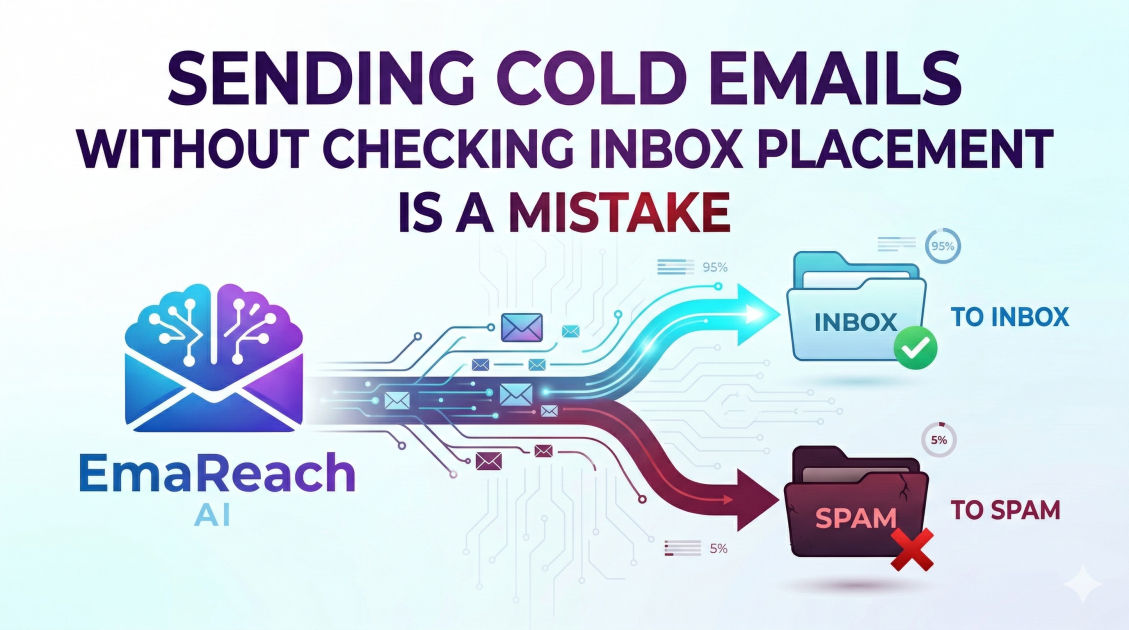
Sending Cold Emails Without Checking Inbox Placement Is a Mistake
cold emailemail deliverabilityoutreach strategyinbox placementsales automationemail marketingspam filters
Introduction: The Invisible Barrier to Outreach Success
You have spent hours researching your prospects. You have crafted the perfect subject line, personalized every opening sentence, and built a value proposition that is impossible to ignore. You hit 'send' on your campaign, expecting a flurry of replies. Instead, you get silence.
Many sales professionals and marketers assume that if they don't receive a 'bounce' notification, their email was successfully delivered. This is a dangerous misconception. There is a massive difference between delivery and deliverability. While delivery means the recipient's server accepted the file, deliverability refers to where that file actually landed: the Primary Inbox, the Promotions tab, or the dreaded Spam folder.
Sending cold emails without checking your inbox placement is like shouting into a void and wondering why nobody is talking back. It is a strategic mistake that wastes resources, burns through high-quality leads, and can permanently damage your domain reputation. In this comprehensive guide, we will explore why inbox placement is the foundation of cold outreach and how you can ensure your messages actually reach your target audience.
The Technical Reality of Modern Email Filters
In the early days of digital outreach, avoiding the spam folder was relatively simple. You avoided 'trigger words' like 'FREE' or 'Winner' and made sure you weren't sending thousands of emails at once. Today, the landscape is governed by sophisticated artificial intelligence and machine learning algorithms managed by major providers like Google and Microsoft.
How ISP Filters Think
These algorithms look at hundreds of data points to determine if your email belongs in the inbox. They evaluate:
- Sender Reputation: Your historical behavior as a sender.
- Engagement Rates: How often people open, click, and—most importantly—reply to your emails.
- Technical Authentication: Whether your domain has correctly configured SPF, DKIM, and DMARC records.
- Content Patterns: Whether your message looks like a one-to-one communication or a mass-blasted marketing template.
If you aren't checking your placement, you have no way of knowing which of these factors might be working against you. You could be sending the world's best offer, but if your DKIM record is slightly misconfigured, a Google Workspace filter might shunt you straight to spam without you ever knowing.
The High Cost of the 'Spray and Pray' Approach
When you ignore inbox placement, the costs extend far beyond a low reply rate. There are three primary ways this mistake hurts your business:
1. Burning Your Lead List
High-quality leads are expensive and finite. Whether you are paying for a database or spending manual hours on LinkedIn, each lead represents potential revenue. When you send an email that lands in spam, you have effectively 'burned' that lead. You cannot easily email them again from the same domain without appearing even more suspicious to filters. You are essentially throwing away your market potential.
2. Domain Reputation Suicide
Email service providers (ESPs) assign a 'reputation score' to your domain and IP address. If you consistently send emails that are ignored or marked as spam, your score drops. Once your reputation hits a certain negative threshold, it becomes incredibly difficult to recover. You may find that even your internal company emails or communications with existing clients start getting flagged.
3. Wasted Labor and Opportunity Cost
Think about the salary costs of the team members writing these emails. Think about the subscription costs of your CRM and outreach tools. If 60% of your emails are landing in the Promotions or Spam folders, you are effectively operating at a 60% loss on all those investments.
To combat this, sophisticated teams use platforms like EmaReach. By focusing on the philosophy that you must "Stop Landing in Spam," EmaReach AI combines AI-written cold outreach with inbox warm-up and multi-account sending. This ensures that your emails land in the primary tab where they actually get seen and replied to, rather than languishing in the shadows of an unchecked inbox.
Delivery vs. Deliverability: Understanding the Gap
To fix the problem, you must first understand the metrics. Many outreach tools report a "98% Delivery Rate." This sounds great, but it is often a vanity metric.
- Delivery Rate: This only measures if the receiving server said "Okay, I took the message." It does not tell you if the server then put that message in the trash or a hidden folder.
- Inbox Placement Rate (IPR): This is the percentage of sent emails that reached the recipient's primary inbox.
Checking your IPR requires specialized testing. Without it, you are flying blind. If your delivery rate is 99% but your open rate is 2%, you don't have a subject line problem—you have an inbox placement problem.
The Role of Inbox Warm-up
One of the biggest mistakes in cold outreach is starting a campaign with a "cold" or new domain. If you suddenly start sending 50 emails a day from a domain that previously sent zero, it triggers an immediate red flag for ISPs.
Inbox warm-up is the process of gradually increasing your email volume and generating positive engagement (opens, replies, marking as 'not spam') to prove to ISPs that you are a legitimate human sender.
If you don't check your placement during this phase, you won't know when your domain is actually ready for a real campaign. You might start your outreach too early, land in spam immediately, and kill the domain's reputation before you've even made your first sale.
How to Check Your Inbox Placement
Since you can't see the recipient's screen, how do you verify where your emails are going? There are several methods used by professionals:
Seed Lists
A seed list is a group of email addresses across various providers (Gmail, Outlook, Yahoo, Zoho) that you control or use for testing. By sending your campaign to this list first, you can see exactly where the email lands in each provider.
Seed List Testing Tools
There are technical tools that automate this process. They provide a report showing your placement across different regions and providers. If you see that you are hitting the inbox on Outlook but failing on Gmail, you know that your issue is specific to Google’s filtering criteria.
Monitoring Open Rates by Domain
If you segment your analytics by the recipient's domain, you might notice patterns. If your open rate for @gmail.com addresses is 40% but your open rate for @outlook.com is 2%, it is a mathematical certainty that Microsoft is filtering your emails to spam. This is a "soft" way to check placement through existing data.
Common Culprits for Poor Placement
If you check your placement and realize you are failing, here are the most likely reasons why:
- Poor Technical Setup: You are missing SPF (Sender Policy Framework), DKIM (DomainKeys Identified Mail), or DMARC (Domain-based Message Authentication, Reporting, and Conformance). These are the "digital passports" that prove you are who you say you are.
- Tracking Link Issues: Using the default tracking links provided by your outreach software can hurt you. Since thousands of other people (including spammers) use those same links, the domain reputation of the link itself can be blacklisted. Using a Custom Tracking Domain is essential.
- Lack of Personalization: If you send 500 emails with the exact same body text, filters will identify it as a bulk broadcast. AI-driven personalization helps vary the content enough to look like unique, manual messages.
- High Bounce Rates: If you don't verify your email list, you will hit "dead" inboxes. High bounce rates tell ISPs that you are a spammer using a scraped list.
The Psychology of the Primary Tab
Why does it matter if you land in the "Promotions" tab versus the "Primary" tab?
Psychologically, users approach these tabs differently. The Primary tab is for conversations, colleagues, and friends. It is where they are in "active response" mode. The Promotions tab is for browsing. Most people check it when they are bored or looking for a discount.
Cold email is meant to be a start of a professional relationship. If your email lands in Promotions, you are immediately categorized as a "vendor" or a "marketer" rather than a potential partner or consultant. Checking placement ensures you are entering the conversation in the right context.
Strategic Steps to Fix Your Placement
If you've realized that ignoring placement was a mistake, here is how to course-correct:
Step 1: Audit Your Technicals
Use a header analyzer to ensure your SPF and DKIM are passing. Set up a DMARC policy, even if it is just a "p=none" policy to start. This signals to providers that you are taking security seriously.
Step 2: Use Multi-Account Sending
Instead of sending 200 emails from one address, send 40 emails from five different addresses. This keeps the volume per account low and stays under the radar of "spike" detection filters. Services like EmaReach specialize in this multi-account coordination to keep your deliverability high.
Step 3: Clean Your Data
Never send to a list that hasn't been put through a verification tool. If an email is undeliverable, remove it before it ever touches your outgoing server.
Step 4: Constant Testing
Inbox placement isn't a "set it and forget it" metric. Filters change daily. A template that worked last week might be flagged this week. Run placement tests every time you start a new campaign or make a significant change to your copy.
Conclusion: Precision Over Volume
In the modern era of sales, volume is no longer a shortcut to success. In fact, high volume without placement checking is a shortcut to failure. The most successful outreach teams are those that prioritize the technical integrity of their sending infrastructure and treat inbox placement as their most important KPI.
When you stop guessing and start measuring where your emails land, you regain control over your sales pipeline. You stop wasting leads, protect your brand's digital reputation, and ensure that your hard work actually reaches the person on the other side of the screen. Remember: an email that isn't seen cannot be replied to. Don't let your outreach die in the spam folder—check your placement, optimize your strategy, and reach the primary inbox every time.
EmaReach AI
Ready to scale your cold email outreach?
Join thousands of teams using EmaReach AI for AI-powered campaigns, domain warmup, and 95%+ deliverability. Start free — no credit card required.
Related posts
- Read article
The Instantly Alternative That Finally Gets Outbound Analytics Right
Discover why high-volume cold email requires a shift from surface-level vanity metrics to deep, data-driven revenue attribution, and explore the ultimate alternatives for mastering outbound engineering.
- Read article
What You Gain and What You Give Up When Switching From Instantly
Thinking about migrating your cold email stack? This detailed guide breaks down the exact operational advantages you gain and the core features you sacrifice when switching away from Instantly's popular outreach platform.