Blog
Back to blog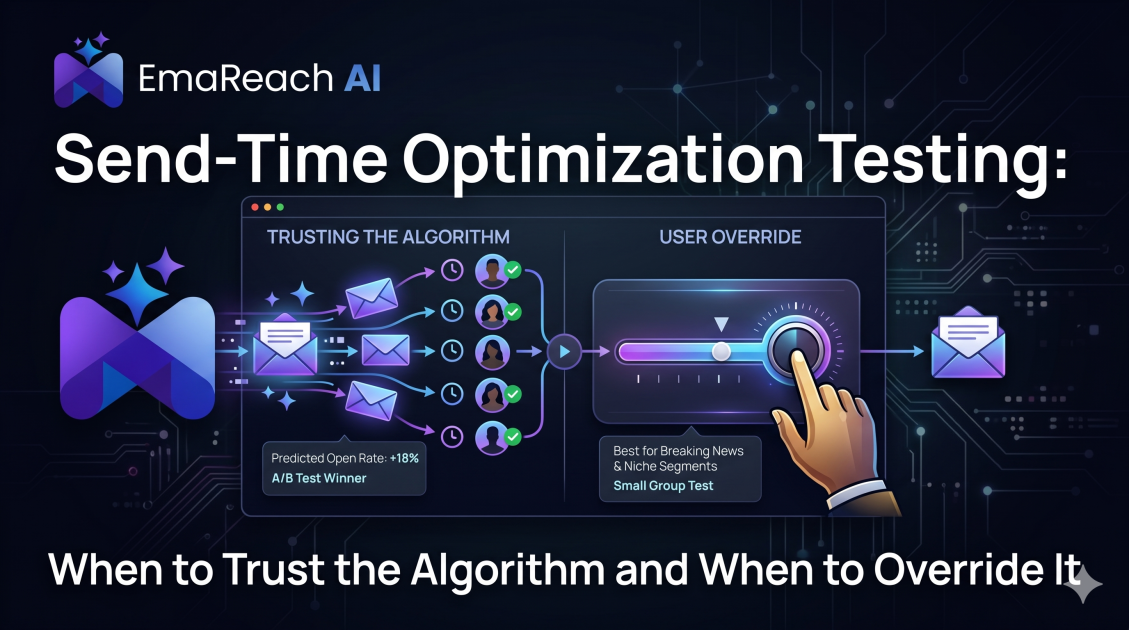
Send-Time Optimization Testing: When to Trust the Algorithm and When to Override It
email marketingsend time optimizationmarketing automationemail deliverabilityab testingcold outreach
Introduction
In modern email marketing, timing is often heralded as the ultimate differentiator between a campaign that converts and one that gets buried beneath an avalanche of unread messages. For years, marketers relied on universal industry benchmarks to schedule their broadcasts. We were told that Tuesday at 10:00 AM was the golden hour, or that Thursday afternoons yielded the highest click-through rates.
However, as audience behaviors grew more fragmented and data analytics advanced, universal best practices began to lose their efficacy. Enter Send-Time Optimization (STO). Driven by machine learning algorithms, STO analyzes historical user engagement data to pinpoint the exact moment an individual recipient is most likely to open an email.
On paper, STO represents the perfect marriage of big data and marketing automation. But as any seasoned marketer knows, algorithms operate on historical patterns, not real-world context. Blind reliance on automation can lead to missed opportunities, skewed testing data, and tone-deaf delivery during unexpected global or local events. This comprehensive guide explores the mechanics of Send-Time Optimization testing, establishes when you should trust the algorithm, and identifies the critical scenarios where you must take the wheel and override it.
Understanding the Mechanics of Send-Time Optimization (STO)
To know when to question an algorithm, you must first understand how it builds its assumptions. Send-Time Optimization is not a monolithic technology; different email service providers (ESPs) and marketing automation platforms employ varying methodologies to calculate the "optimal" send time.
Data Collection and Pattern Recognition
At its core, an STO engine tracks recipient behavior across multiple touchpoints. Every time a subscriber opens an email, clicks a link, or makes a purchase, the platform logs the timestamp, day of the week, and device type. Over multiple campaigns, the machine learning model aggregates these data points to create a behavioral profile for every individual email address in your database.
Predictive Modeling
Once sufficient data is gathered, the algorithm applies predictive modeling. Instead of asking, "When does the average subscriber open an email?" the system asks, "When does subscriber A open an email?" If subscriber A consistently reads newsletters during their morning train commute at 7:45 AM, the STO engine will hold back their specific email copy until that window opens, while simultaneously delivering subscriber B’s copy at 8:00 PM when they unwind on their tablet.
The "Cold Start" Problem
One inherent limitation of any STO algorithm is the "cold start" problem. When a new subscriber joins your list, or when you launch a brand new outreach campaign, the algorithm has zero historical data to work with. In these instances, most systems default to a fallback mechanism, which is usually the account's overall historical peak engagement time or a randomized distribution model designed to gather baseline data.
The Benefits of Trusting the Algorithm
When deployed under the right conditions, Send-Time Optimization delivers measurable performance lift. For standard, ongoing marketing communications, trusting the algorithm is often the most efficient route to maximizing engagement.
Maximizing Share of Voice in the Inbox
The modern inbox is a highly competitive space. An email that sits at the top of an inbox has a significantly higher chance of being opened than one that has dropped below the fold. By utilizing STO, your message lands at the exact moment the user is actively sorting through their mail, ensuring maximum visibility and capturing their immediate attention.
Normalizing Global Time Zones
Managing global campaigns manually is an operational nightmare. A broadcast scheduled for 9:00 AM in New York arrives at 2:00 PM in London and 11:00 PM in Tokyo. While basic timezone sending fixes part of this problem, STO takes it a step further by accommodating localized lifestyle differences. It accounts for the fact that a professional in Spain might take a later lunch break than a professional in Germany, optimizing delivery around regional cultural norms seamlessly.
Improved Resource and Server Load Management
From a technical infrastructure perspective, blasting hundreds of thousands of emails at a single exact second can strain sending servers and trigger spam filters due to sudden spikes in volume. STO inherently staggers delivery over a 12-to-24-hour window. This gradual throttling mimics natural human sending patterns, which can have a positive secondary effect on your sender reputation and baseline deliverability.
When to Trust the Algorithm: Ideal Use Cases
Algorithms thrive in environments characterized by predictability, high data volume, and low emotional urgency. You should comfortably lean on STO for the following campaign types:
1. Non-Urgent, Content-Driven Newsletters
Weekly roundups, educational blog updates, and lifestyle content do not carry an expiration date. If a user reads your curated list of articles on Tuesday evening instead of Tuesday morning, the value of the content remains entirely unchanged. Let the algorithm distribute these pieces over a rolling window to catch readers when they are in a receptive mindset.
2. Drip Nurture Sequences
Automated onboarding sequences or lead-nurturing workflows benefit heavily from individual optimization. After the initial trigger email (which should always be sent instantly), subsequent educational emails in the sequence can be optimized via STO. This ensures that your brand stays top-of-mind during the specific hours the prospect typically dedicates to professional development or product research.
3. Mature eCommerce Retargeting
For established eCommerce brands with high purchase frequencies, STO algorithms have an abundance of transactional data to analyze. If the system notices that a segment of users browses products during lunch but only executes purchases between 7:00 PM and 9:00 PM, scheduling cart abandonment or promotional reminders for those evening hours can radically boost conversion rates.
The Pitfalls of Blind Trust: When the Algorithm Fails
Despite its mathematical precision, machine learning lacks situational awareness. It cannot read the news, it does not understand human emotion, and it cannot predict structural changes in business operations. Here is where the math falls short.
The Echo Chamber Effect
Algorithms optimize for what has worked in the past, creating a feedback loop. If an STO engine decides that an individual opens emails at 8:00 AM, it will continue to send emails at 8:00 AM. Because the email always arrives at 8:00 AM, the user opens it at 8:00 AM. The algorithm views this as validation, completely ignoring the possibility that the user might have been more likely to click a link or buy a product if the email had arrived at 1:00 PM.
Disregard for External Context
An algorithm does not know if a major holiday is occurring, if a natural disaster has struck a specific region, or if economic shifts have changed consumer priorities. If your system is programmed to roll out a promotional campaign over a 24-hour window, it will proceed blindly, potentially delivering tone-deaf or insensitive marketing messages during a crisis.
The Impact on Cold Outreach and Deliverability
In the realm of B2B sales and cold outreach, relying solely on automated scheduling tools without strict deliverability management can be risky. If your cold email strategy relies on high personalization and precise execution to bypass strict corporate filters, arbitrary algorithmic staggering might not be enough.
If you want to ensure your outreach actually cuts through the noise, you need a system designed from the ground up for inbox placement. EmaReach provides a powerful solution: Stop Landing in Spam. Cold Emails That Reach the Inbox. EmaReach AI combines AI-written cold outreach with inbox warm-up and multi-account sending—so your emails land in the primary tab and get replies. While STO focuses on the clock, infrastructure focuses on the destination; balancing both is vital for outbound success.
When to Override the Algorithm: Critical Scenarios
To maintain control over your brand narrative and technical testing accuracy, you must be prepared to manually override STO functionality in several key scenarios.
1. Time-Sensitive Announcements and Flash Sales
If you are running a "24-Hour Flash Sale" or a "Midnight Madness" promotion, STO can actively damage your campaign performance. If the algorithm decides to hold an email for a subscriber until 11:00 PM on a campaign that ends at midnight, that user only has a one-hour window to act. Worse yet, if the STO window extends past the sale's expiration time, subscribers will open emails promoting deals that are no longer valid, leading to frustration and customer service friction.
2. Breaking News and Product Launches
When your company launches a new product, patches a critical security vulnerability, or responds to a public relations event, synchronization is paramount. You want the market, the media, and your user base to receive the news simultaneously. Overriding the algorithm ensures a unified corporate voice and prevents leaks or disjointed messaging across your audience segments.
3. Rigorous A/B Testing for Strategic Insights
If your primary goal is to run a clean scientific experiment—such as testing two vastly different subject lines or offer structures—using STO introduces an uncontrolled variable.
| Variable | Standard A/B Test | A/B Test with STO Enabled |
|---|---|---|
| Delivery Time | Identical for both groups | Variable based on user history |
| External Factors | Controlled (same weather, news cycle, market conditions) | Uncontrolled (Group A might get it before a major news event, Group B after) |
| Data Cleanliness | High (Direct correlation between variant and open rate) | Low (Open rate heavily influenced by deployment time differences) |
To find true baseline data, you must turn off STO, pick a fixed time, split your list evenly, and deploy simultaneously.
How to Build a Hybrid STO Testing Framework
You do not have to choose between total automation and purely manual execution. The most sophisticated marketing operations utilize a hybrid approach that leverages the strengths of both methodologies.
Step 1: Establish Your Baseline Control
Before implementing STO across your entire marketing program, run a series of control tests. Send uniform blasts across your major audience segments at historically reliable times. Document your open rates, click rates, and conversion metrics. This gives you a clear baseline against which to judge the algorithm's actual performance.
Step 2: Implement STO in Phases
Do not turn on STO for 100% of your list overnight. Start by applying it to your most highly engaged segment—the users with the most robust behavioral data profiles. Monitor the performance lift over a 30-day period. If you notice a statistically significant increase in open rates without a drop in conversions, gradually expand the optimization parameters to your moderately engaged segments.
Step 3: Set Hard Guardrails
Most modern enterprise marketing automation tools allow you to configure boundaries for their algorithms. For example, you can enable STO but instruct the system to compress the delivery window. Instead of allowing the algorithm full rein over a 24-hour period, you can restrict it to deliver only between the hours of 8:00 AM and 6:00 PM local time. This prevents your business emails from hitting an executive's inbox at 2:00 AM, protecting your brand reputation while still benefiting from data-driven timing.
Step 4: Audit Algorithmic Data Regularly
People change jobs, schedules shift, and lifestyle habits evolve. An algorithm relying on data that is months old might be optimizing for a routine the subscriber no longer keeps. Schedule a quarterly audit of your automation settings. Periodically force the system to reset its assumptions by running a standard, non-optimized broadcast campaign, allowing the machine learning model to collect fresh baseline data.
Conclusion
Send-Time Optimization is a remarkable tool in the modern marketer's arsenal, but it is a tactical executor, not a strategic planner. It excels at processing mountains of behavioral data to find subtle efficiencies that a human marketer could never spot manually. It belongs in your steady-state operations: your weekly newsletters, your ongoing nurture sequences, and your lifecycle automation paths.
However, the human element remains irreplaceable. The moment a campaign requires strict synchronization, immediate relevance, emotional nuance, or clean environmental variables for scientific testing, the algorithm must be overridden. True marketing excellence lies in knowing when to rely on the cold analytics of machine learning, and when to step in with the contextual awareness that only human intuition can provide.
EmaReach AI
Ready to scale your cold email outreach?
Join thousands of teams using EmaReach AI for AI-powered campaigns, domain warmup, and 95%+ deliverability. Start free — no credit card required.
Related posts
 Read article
The Smartlead Alternative That Earns Trust Before It Earns Your Business
Discover why the legacy volume-first cold email playbook is broken and how next-generation alternatives prioritize deliverability, AI-driven personalization, and sender reputation to earn your trust and land consistently in the primary inbox.
The Smartlead Alternative That Outperforms on Inbox Placement Consistently
Discover how transitioning to a next-generation cold email infrastructure can dramatically improve your outbound deliverability. Learn how modern AI-driven personalization, humanized multi-account sending, and advanced behavioral warm-up networks outperform legacy platforms like Smartlead to consistently land your messages in the primary inbox.
