Blog
Back to blog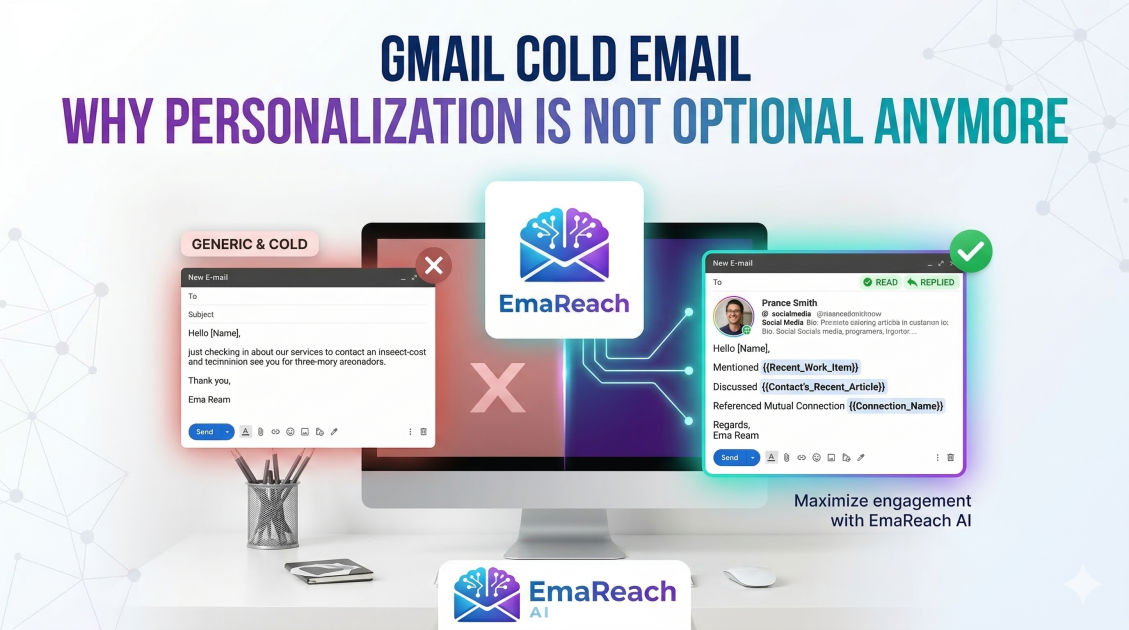
Send Cold Email from Gmail: Why Personalization Is Not Optional Anymore
cold emailgmail outreachemail deliverabilitysales strategyemail marketingpersonalizationlead generation
Introduction
For years, cold emailing was a numbers game. The strategy was simple: scrape a massive list of email addresses, draft a generic template with a couple of merge tags, and hit 'send' to thousands of recipients via Gmail or an SMTP provider. In that era, a 1% response rate was considered a victory. However, the digital landscape has shifted dramatically. The inbox has become a crowded, highly guarded fortress, and the gatekeepers—both human and algorithmic—have become incredibly sophisticated.
Today, sending cold emails from Gmail requires more than just a functional 'Send' button. It requires a fundamental shift in philosophy. Personalization is no longer a 'nice-to-have' cherry on top of your outreach campaign; it is the very foundation of deliverability and engagement. If you aren't personalizing, you aren't just being ignored—you are likely being filtered out before the recipient even knows you exist.
The Evolution of the Inbox Gatekeeper
To understand why personalization is mandatory, we must first look at how Gmail and other major providers have evolved. Google’s primary goal is to protect its users from spam, phishing, and irrelevant clutter. Over time, their machine-learning algorithms have moved beyond simple keyword filtering. They now analyze engagement patterns, sender reputation, and the uniqueness of the content being sent.
When you send the exact same email to 500 people from a Gmail account, it triggers red flags. Sophisticated filters look for 'pattern matching.' If hundreds of identical messages originate from a single source, the algorithm assumes it is an automated blast, which often leads to the dreaded 'Promotions' tab or, worse, the Spam folder.
Personalization acts as a signal of legitimacy. When every email has unique syntax, specific references, and varied structure, it breaks the pattern-matching triggers. By making each message distinct, you demonstrate to the mail servers that you are engaging in a 1-to-1 conversation rather than a 1-to-many broadcast.
Beyond the 'First Name' Merge Tag
Many marketers believe they are personalizing because they use a {{FirstName}} tag in the subject line. In the modern era of outreach, that is the bare minimum—and it’s often ineffective. Prospects are now savvy enough to recognize a template even if their name is in it. True personalization involves demonstrating that you have spent time researching the individual, their company, and their specific pain points.
The Layers of Deep Personalization
- The Individual Layer: Mentioning a recent LinkedIn post they wrote, a podcast they appeared on, or a promotion they recently received. This shows you are following their professional journey.
- The Company Layer: Referencing a specific company milestone, such as a recent funding round, a new product launch, or an expansion into a new market.
- The Industry Layer: Discussing specific trends or challenges that are currently affecting their niche, showing that you have expertise in their world.
- The Relevance Layer: Explaining exactly why your solution matters to them specifically, based on the previous three layers.
Why Personalization Impacts Deliverability
Deliverability is the science of making sure your email actually lands in the primary inbox. When you use Gmail for cold outreach, your sender reputation is constantly being evaluated. Personalization impacts this in two major ways:
1. Reduced Spam Reports
People report emails as spam when they feel interrupted by something irrelevant. If a prospect opens an email and immediately sees a generic pitch for a service they don't need, their first instinct is to hit the 'Report Spam' button. However, if the opening line mentions a specific project they are working on, they are far more likely to read on—or at the very least, delete the email manually rather than reporting it. Low spam report rates are essential for maintaining a healthy Gmail sender reputation.
2. Increased Positive Engagement
Gmail tracks 'signals of interest.' These include open rates, reply rates, and 'marking as not spam.' When you personalize your emails, your reply rates naturally climb. A high reply-to-send ratio tells Google that you are a high-quality sender providing value to their users. This creates a positive feedback loop: better personalization leads to more replies, which leads to better inbox placement, which leads to more visibility.
For those looking to automate this complex balance, using a tool like EmaReach can be a game-changer. It helps you stop landing in spam by combining AI-written cold outreach with inbox warm-up and multi-account sending, ensuring your emails land in the primary tab where they belong.
The Psychology of the Recipient
We live in an age of 'digital fatigue.' The average executive receives over 100 emails a day. To survive, the human brain has developed a filter for 'templated noise.' We have become experts at spotting automated outreach in less than a second.
Personalization bypasses this psychological filter by triggering the 'Reciprocity Principle.' When someone sees that you have invested 5-10 minutes of your time to research them, they feel a social obligation to at least acknowledge that effort. Even if the answer is 'no,' a personalized email is much more likely to get a polite 'not right now' instead of being ignored. These 'polite nos' are actually beneficial for your Gmail reputation because they count as a reply.
Scaling Personalization Without Losing Quality
The biggest argument against personalization is that it doesn't scale. If it takes 15 minutes to research every prospect, you can only send 30 emails a day. While that's true for manual research, modern technology has introduced 'efficient personalization.'
Using AI as a Research Assistant
Artificial Intelligence can now scan a prospect's website, LinkedIn profile, and recent news to summarize key 'hooks' for your email. This allows you to maintain a high level of relevance without spending hours on manual data entry. The goal is to use AI to find the facts, and then use your human touch to weave those facts into a compelling narrative.
Segmented Templates
Instead of one template for 1,000 people, create 10 templates for 100 people each. Group your prospects by very specific criteria—such as 'CMOs at SaaS companies who recently moved from HubSpot to Salesforce.' The more niche your segment, the more personalized the template feels, even if the body text is similar for everyone in that group.
The Technical Side: Sending Cold Emails via Gmail
When sending cold emails through Gmail, you must adhere to certain technical best practices to ensure your personalized content actually reaches the recipient.
1. Warm Up Your Account
Never start a cold outreach campaign with a brand-new Gmail account. You must 'warm up' the inbox by gradually increasing the volume of emails sent and received over several weeks. This builds a history of legitimate activity that satisfies Google's algorithms.
2. Monitor Sending Limits
While Gmail allows a certain number of sends per day, hitting the maximum limit consistently is a red flag for automation. It is better to spread your outreach across multiple accounts and send lower volumes from each to keep your 'velocity' looking natural.
3. DNS Records (SPF, DKIM, and DMARC)
You must ensure your domain is properly authenticated. Without these records, even the most personalized email in the world will likely be flagged as suspicious. These records prove to the receiving server that you are who you say you are.
Crafting the Perfect Personalized Cold Email
A truly personalized cold email follows a specific structure that prioritizes the recipient over the sender.
The Subject Line
It should be Boring, Relevant, and Short. Avoid 'salesy' language like "Guaranteed Results!" Instead, try something like "Question about [Specific Project]" or "Feedback on your recent article." The goal of the subject line is not to sell; it is to get the email opened.
The Hook (The Personalization)
This is your first sentence. It should have nothing to do with you. "I saw your recent talk at [Event] about [Topic] and I was particularly struck by your point on [Specific Detail]." This immediately proves you aren't a bot.
The Bridge
Connect the hook to the reason for your email. "Because you mentioned your focus on scaling the engineering team, I thought our work with [Similar Company] might be relevant."
The Value Proposition
Keep it brief. Focus on the outcome, not the features. What is the one major pain point you solve?
The Call to Action (CTA)
Avoid 'high friction' CTAs like "Can we hop on a 30-minute demo call tomorrow?" Instead, use 'low friction' CTAs like "Would you be opposed to me sending over a short video on how we handled this for [Competitor]?" or "Is this something your team is currently prioritizing?"
Common Personalization Mistakes to Avoid
While personalization is key, doing it poorly can be worse than not doing it at all.
- The 'Fake' Compliment: "I love your website!" is too vague. It feels like a template. Be specific.
- The Creepy Factor: Avoid mentioning personal details that aren't professionally relevant. Stick to LinkedIn, company blogs, and industry news. Mentioning their family photos from a private social media account is a quick way to get blocked.
- The 'Wall of Text': Even a personalized email will be ignored if it's 500 words long. Respect the recipient's time by being concise.
- Mismatching Data: Ensure your data is clean. Addressing a 'CEO' as a 'Manager' because your lead list is outdated immediately destroys your credibility.
Conclusion
The era of 'spray and pray' cold emailing is over. As Gmail’s AI becomes more adept at identifying and filtering generic outreach, the only way to ensure your messages are heard is through deep, meaningful personalization. By treating every prospect as an individual rather than a line in a spreadsheet, you protect your sender reputation, build genuine rapport, and ultimately drive higher conversion rates.
Successful outreach today is a blend of technology and empathy. Use tools to manage the technical hurdles and data gathering, but always leave room for the human element. When you prioritize the recipient's needs and context, you stop being a 'cold caller' and start being a potential partner. In the competitive world of the modern inbox, that distinction makes all the difference.
EmaReach AI
Ready to scale your cold email outreach?
Join thousands of teams using EmaReach AI for AI-powered campaigns, domain warmup, and 95%+ deliverability. Start free — no credit card required.
Related posts
- Read article
The Instantly Alternative That Finally Gets Outbound Analytics Right
Discover why high-volume cold email requires a shift from surface-level vanity metrics to deep, data-driven revenue attribution, and explore the ultimate alternatives for mastering outbound engineering.
- Read article
What You Gain and What You Give Up When Switching From Instantly
Thinking about migrating your cold email stack? This detailed guide breaks down the exact operational advantages you gain and the core features you sacrifice when switching away from Instantly's popular outreach platform.