Blog
Back to blog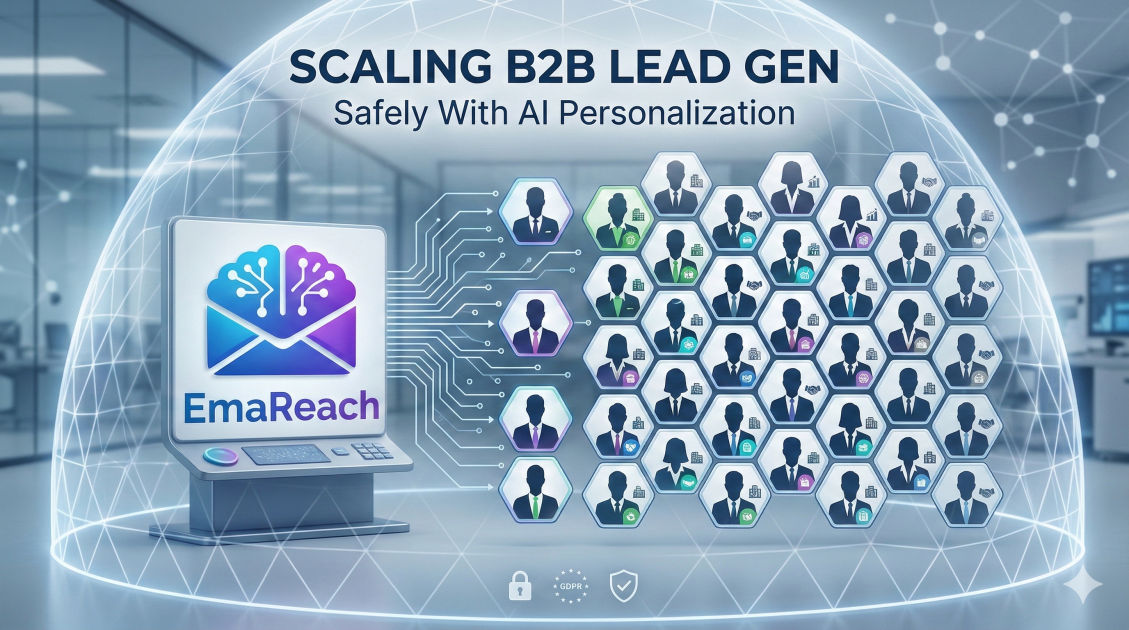
Scaling B2B Lead Gen Safely With AI Personalization
B2B Lead GenerationAI PersonalizationCold EmailSales AutomationEmail DeliverabilityOutbound Sales
Introduction: The New Frontier of B2B Lead Generation
In the traditional B2B landscape, lead generation was a binary choice: you could have scale, or you could have quality. High-volume outreach often meant sacrificing the personal touch, leading to 'spray and pray' tactics that tarnished brand reputations and triggered spam filters. Conversely, deeply personalized outreach was unscalable, confined by the hours a human sales development representative (SDR) could spend researching a single prospect.
Artificial Intelligence has shattered this dichotomy. By leveraging large language models and data processing capabilities, businesses can now achieve granular personalization at an industrial scale. However, with great power comes significant risk. Scaling too fast without the right safeguards can lead to 'AI hallucinations,' tone-deaf messaging, and catastrophic deliverability issues. This guide explores how to scale B2B lead generation safely, ensuring every message feels human-centric while being machine-augmented.
The Evolution of Personalization
To understand where we are going, we must look at where we started. Basic personalization used simple merge tags: 'Hi {First_Name}, I saw you work at {Company_Name}.' Today’s buyers are immune to this. They know it is automated.
Modern AI personalization goes deeper. It analyzes recent LinkedIn posts, quarterly earnings reports, podcast appearances, and technology stacks to craft a narrative that resonates with the prospect’s current challenges. It moves from 'I know who you are' to 'I understand what you are trying to achieve.'
The Data Foundation
Safe scaling begins with data integrity. AI is only as good as the inputs it receives. To personalize effectively, you need a clean, enriched database. This involves:
- Firmographic Data: Industry, headcount, and revenue growth.
- Technographic Data: The software tools the company currently uses.
- Intent Data: Signals that a company is actively looking for a solution.
- Social Signals: Recent promotions, company news, or thought leadership content.
Strategy 1: Hyper-Personalization at Scale
Scaling B2B lead generation requires a shift from templates to 'frameworks.' Instead of writing a fixed email, you provide an AI model with a framework and the data points it needs to fill in the blanks creatively.
Research-Driven Opening Lines
One of the most effective ways to use AI is generating a 'First Line' based on a prospect’s recent activity. An AI can scan a prospect's most recent LinkedIn article and summarize a key point, relating it back to your value proposition. This demonstrates that you have done the work, even if the 'work' was performed by an algorithm in milliseconds.
Problem-Agitation-Solution (PAS) via AI
AI can be trained to identify the specific 'pain points' of a niche. If you are targeting CTOs in the fintech space, the AI can reference specific regulatory hurdles or security concerns prevalent in that sector. By agitating these specific problems before offering your solution, the outreach feels curated rather than generic.
Strategy 2: Maintaining Safety and Brand Integrity
When you automate the 'brain' of your outreach, you risk the AI saying something inappropriate, incorrect, or off-brand. Scaling safely requires a multi-layered approach to quality control.
The 'Human-in-the-Loop' (HITL) Model
For high-value accounts (Tier 1), never let the AI send without a human review. The AI does the 90% of the heavy lifting—researching and drafting—while the human performs the final 10%: the 'sanity check.' This ensures the tone is perfect and no factual errors are present.
Prompt Engineering and Guardrails
To prevent the AI from 'hallucinating' (making up facts), your prompts must be restrictive. Use 'System Prompts' that dictate the persona the AI should adopt, the tone of voice (e.g., professional yet conversational), and strict rules on what it cannot say. For example, 'Do not mention pricing' or 'Do not make specific claims about ROI unless provided in the data.'
Strategy 3: Technical Deliverability and Sending Health
Perhaps the biggest risk in scaling lead gen is the technical one. If you send 1,000 AI-generated emails from a single domain and get flagged as spam, your entire outbound engine grinds to a halt.
The Multi-Account Approach
To scale safely, you must distribute your sending volume across multiple domains and accounts. This prevents any single account from hitting the 'spam threshold' set by email service providers (ESPs).
If you want to ensure your sophisticated AI personalization actually gets seen, you need a robust delivery infrastructure. Stop Landing in Spam. Cold Emails That Reach the Inbox. This is where platforms like EmaReach become essential. EmaReach AI combines AI-written cold outreach with inbox warm-up and multi-account sending—so your emails land in the primary tab and get replies. By spreading the load and using 'warm-up' protocols, you simulate natural human behavior, which is the gold standard for inbox placement.
The Importance of Warm-up
An AI-powered outreach engine can generate thousands of emails an hour, but you shouldn't send them all at once. New domains must be 'warmed up' by gradually increasing volume and maintaining a high response rate. AI can help here too, by generating simulated conversations to show ESPs that your domain is a source of valuable interaction.
Strategy 4: Testing and Iteration
Scaling is not a set-it-and-forget-it process. It requires constant feedback loops.
A/B Testing AI Variables
Don't just test Subject Line A vs. Subject Line B. Test 'Personalization Style A' (based on LinkedIn activity) vs. 'Personalization Style B' (based on company news). AI allows you to segment your audience so granularly that you can find 'micro-winners'—specific combinations of data and tone that work for a very specific subset of your market.
Sentiment Analysis of Replies
AI shouldn't stop at the 'Send' button. Use AI to analyze the sentiment of incoming replies. Are people saying 'Not interested' or 'Too expensive'? By categorizing these responses automatically, you can refine your AI prompts to address these objections in the initial outreach or follow-up sequences.
Strategy 5: The Ethical Implications of AI Outreach
In the rush to scale, ethics are often overlooked. Transparency and relevance are the pillars of ethical AI lead gen.
- Relevance is the best form of permission: If your AI-generated message solves a genuine problem for the prospect, it is rarely viewed as 'spam.'
- Avoid Deception: Don't have the AI pretend to be a specific person if it isn't. It’s better to have the AI act as an assistant or a well-informed researcher.
- Data Privacy: Ensure your AI processing complies with regulations like GDPR or CCPA. Only use data that is publicly available or legally sourced.
Balancing Automation and Authenticity
The paradox of AI personalization is that the more automated it becomes, the more 'human' it needs to sound. To achieve this, focus on 'Contextual Relevance.'
Contextual relevance means the AI understands the why behind the message. If a company just raised a Series B round of funding, they aren't just 'richer'—they are likely facing hiring challenges, scaling pains, and increased pressure for efficiency. Your AI should be programmed to recognize these secondary implications and weave them into the copy.
Overcoming Common Scaling Hurdles
1. The 'Uncanny Valley' of AI Copy
Sometimes AI writes in a way that is too perfect or slightly 'off.' To fix this, encourage the AI to use occasional sentence fragments, varied sentence lengths, and a less formal vocabulary. This mimics the way busy professionals actually write.
2. Integration with the CRM
A fragmented tech stack is the enemy of scale. Your AI personalization tool must speak directly to your CRM (Salesforce, HubSpot, etc.). When a lead is generated, the AI should be able to pull the most recent data automatically, ensuring the personalization is 'fresh' and not based on six-month-old news.
3. Cost Management
Generating thousands of high-quality AI 'snippets' costs money in API usage. To scale safely from a financial perspective, prioritize your accounts. Use high-level AI personalization for your 'Whale' accounts and slightly more templated (but still data-driven) approaches for your 'Minnow' accounts.
The Role of Follow-Ups in AI Personalization
Persistence is key in B2B, but automated follow-ups are usually where the 'bot' feel becomes obvious. AI can solve this by making each follow-up unique. Instead of 'Just bumping this to the top of your inbox,' the AI can say, 'I saw your company just released {Feature X}, which actually ties back to what I mentioned in my last email regarding {Pain Point}.'
This level of continuity is difficult for humans to maintain across hundreds of leads, but it is exactly where AI excels. It remembers the context of the previous interaction and builds upon it, creating a cohesive 'conversation' rather than a series of disconnected pings.
Conclusion: The Future of Scalable Outreach
Scaling B2B lead generation with AI is not about replacing humans; it is about amplifying human intent. By using AI to handle the research, the drafting, and the initial outreach, sales teams can focus on what they do best: building relationships and closing deals.
To do this safely, you must prioritize technical health, maintain a human-in-the-loop for high-value targets, and never sacrifice relevance for volume. When you combine the power of AI personalization with a rock-solid deliverability strategy, you create an outbound engine that is not only scalable but also sustainable. The companies that win in the coming years will be those that use AI to be more human, not less, reaching the right person with the right message at the exact moment they need it.
EmaReach AI
Ready to scale your cold email outreach?
Join thousands of teams using EmaReach AI for AI-powered campaigns, domain warmup, and 95%+ deliverability. Start free — no credit card required.
Related posts
- Read article
How Choosing the Right Instantly Alternative Changed Our Pipeline Numbers
Discover how transitioning from a volume-first cold email setup to an advanced, deliverability-focused infrastructure transformed our B2B pipeline metrics, skyrocketed open rates to over 68%, and tripled our monthly booked demos.
- Read article
The Instantly Alternative That Impressed Even the Biggest Instantly Fans
Discover why top outbound growth marketers and lead generation agencies are migrating from legacy cold email platforms to advanced alternatives built for superior deliverability, white-label client management, and robust API workflows.