Blog
Back to blog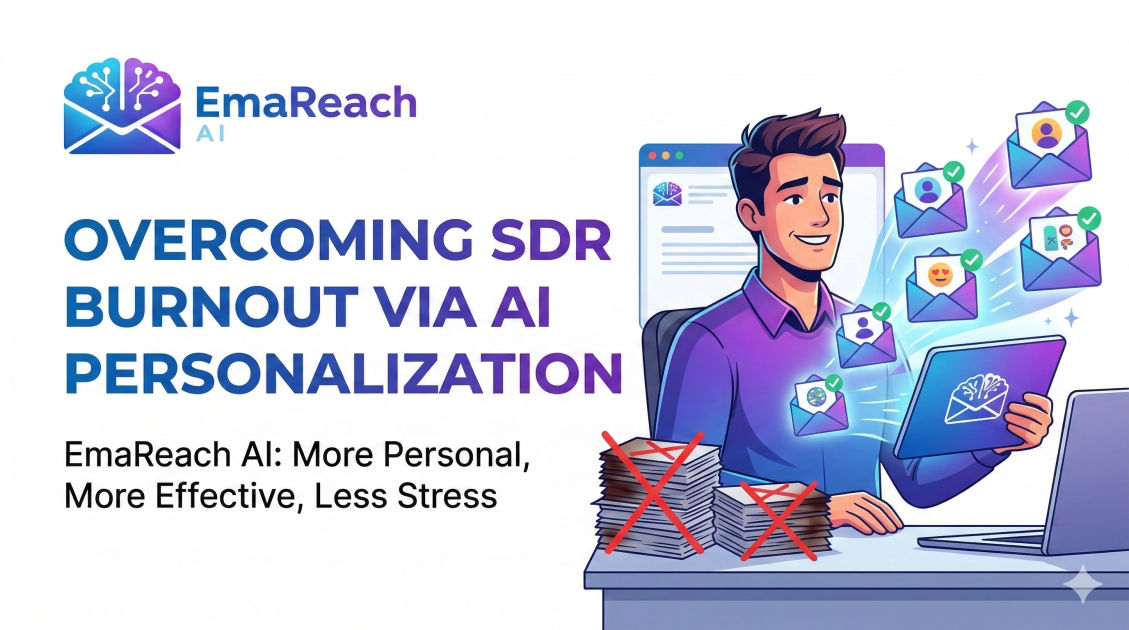
Overcoming SDR Burnout via AI Personalization
sales developmentAI personalizationSDR burnoutsales automationoutreach strategysales productivitycold email
The Quiet Crisis in Sales Development
The Sales Development Representative (SDR) role has long been considered the 'grind' of the sales organization. Tasked with the relentless pursuit of new opportunities, SDRs face a daily barrage of rejection, high-pressure quotas, and the monotonous repetition of outbound activities. In recent years, this pressure has reached a breaking point, leading to a phenomenon widely known as SDR burnout.
Burnout isn't just about being tired; it is a state of emotional, physical, and mental exhaustion caused by excessive and prolonged stress. In the context of sales development, it manifests as decreased productivity, cynicism toward the role, and a significant drop in the quality of outreach. When an SDR is burnt out, their emails become robotic, their calls lack enthusiasm, and their ability to connect with prospects evaporates. This creates a vicious cycle: poor performance leads to missed quotas, which leads to more pressure, which further fuels burnout.
However, a technological shift is offering a way out. AI personalization is not merely a tool for efficiency; it is a fundamental shift in how sales development functions. By leveraging artificial intelligence to handle the heavy lifting of research and customization, organizations can revitalize their sales teams and transform the SDR role from a repetitive task-master to a strategic orchestrator.
The Anatomy of SDR Burnout
To understand how AI personalization solves burnout, we must first examine the specific stressors that cause it. The traditional SDR workflow is often divided into three grueling stages: prospecting, researching, and outreach.
The Research Paradox
Effective sales outreach requires deep personalization. To stand out in a crowded inbox, an SDR must research a prospect’s recent LinkedIn activity, company news, financial reports, and specific pain points. Doing this manually for 50 to 100 prospects a day is mathematically impossible to sustain while maintaining quality. SDRs are forced into a paradox: spend time on quality research and miss volume targets, or prioritize volume and send generic, low-conversion messages.
The Repetitive Task Fatigue
Data entry, updating CRM records, and formatting email sequences are administrative burdens that eat away at an SDR's creative energy. When the majority of a workday is spent on non-revenue-generating activities, the sense of accomplishment diminishes. This cognitive load makes the actual task of selling feel like an afterthought.
The Emotional Toll of Low Response Rates
Sending 1,000 generic emails and receiving zero positive responses is demoralizing. Humans are wired for social validation; constant rejection without the "win" of a meaningful conversation leads to rapid disengagement. Generic outreach is increasingly ignored by sophisticated buyers, meaning the SDR's effort-to-reward ratio is at an all-time low.
Enter AI Personalization: A New Paradigm
AI personalization changes the fundamental math of sales development. Instead of an SDR spending 15 minutes researching a single prospect, an AI engine can analyze thousands of data points in seconds to generate a highly relevant, hyper-personalized opening line or value proposition.
Shifting from Volume to Value
AI allows SDRs to move away from the 'spray and pray' model. Because the cost of personalization (in terms of time) drops to near zero, every single piece of outreach can be tailored to the recipient. This shift improves response rates, which in turn boosts the SDR's morale. When an SDR sees that their work is actually resulting in high-quality conversations, the psychological impact is transformative.
Automating the Intellectual Labor
Personalization isn't just about inserting a {First_Name} tag. It’s about understanding intent. AI models can now synthesize information from a prospect's latest podcast appearance, a company’s 10-K filing, and industry trends to suggest a specific reason for reaching out. By automating this intellectual labor, the SDR is freed to focus on the human elements of the sale: empathy, objection handling, and relationship building.
How AI Personalization Reclaims SDR Time
Time is the most valuable commodity for a sales professional. Burnout is often a direct result of time poverty. AI personalization restores this balance through several key mechanisms.
1. Dynamic Content Generation
Instead of starting with a blank template, AI provides a structured draft based on real-time data. For instance, if a target company just announced a new product launch, the AI can automatically draft an email explaining how the SDR's solution complements that specific launch. The SDR acts as an editor rather than a writer, which is significantly less taxing on mental resources.
2. Multi-Channel Synchronization
Personalization must extend beyond email to LinkedIn and phone scripts. AI can ensure a consistent personalized narrative across all channels. This coherence reduces the mental friction of switching between different platforms and trying to remember the specific 'hook' for each prospect.
3. Smart Prioritization
AI doesn't just personalize; it prioritizes. By analyzing which prospects are most likely to engage based on historical data and current intent signals, AI directs the SDR's energy toward the highest-probability opportunities. Eliminating the guesswork of "who should I contact today?" reduces decision fatigue, a major contributor to burnout.
Improving Deliverability and Results with EmaReach
One of the biggest contributors to SDR stress is seeing hard work disappear into a spam folder. You can spend hours on a perfect message, but if your technical setup is lacking, the prospect will never see it. This is where specialized platforms like EmaReach (https://www.emareach.com/) become essential. EmaReach ensures you "Stop Landing in Spam. Cold Emails That Reach the Inbox." By combining AI-written cold outreach with sophisticated inbox warm-up and multi-account sending, EmaReach ensures your emails land in the primary tab and get replies. For an SDR, knowing that their personalized efforts are actually reaching the recipient is a massive psychological win that prevents the frustration leading to burnout.
The Psychological Shift: From Manual Laborer to Strategy Lead
When AI handles the data processing, the SDR's role is elevated. They become a 'Campaign Strategist.' This transition is critical for long-term career satisfaction and burnout prevention.
Enhanced Creativity
With the rote tasks out of the way, SDRs can experiment with different angles, personas, and creative hooks. They can spend time thinking about why a certain message worked and how to refine the overall strategy. Creativity is a natural antidote to the stagnation of burnout.
Professional Development
Using AI personalization tools trains SDRs in the future of sales technology. They learn to prompt AI, analyze data-driven insights, and manage complex tech stacks. This feeling of growth and skill acquisition makes the daily grind feel like a stepping stone rather than a dead end.
Implementing AI Personalization Without Losing the Human Touch
A common fear is that AI will make sales outreach feel more robotic, not less. However, when implemented correctly, the opposite is true. AI provides the "dots," and the SDR connects them.
The 80/20 Rule of AI Outreach
To prevent burnout while maintaining authenticity, organizations should aim for an 80/20 split: 80% of the heavy lifting (data gathering, initial drafting) is done by AI, and 20% (final review, nuance, personal flair) is done by the human SDR. This ensures that the message still carries the unique voice of the sender while removing the exhaustion of manual research.
Training for the AI Era
To overcome burnout, leadership must provide the right training. SDRs shouldn't just be handed a tool; they should be taught how to leverage AI to enhance their own intuition. Training should focus on empathy and high-level communication—areas where humans still vastly outperform machines.
The Role of Leadership in the AI Transition
Management plays a pivotal role in using AI to combat burnout. It isn't enough to just provide the software; the culture must change as well.
Redefining KPIs
If leadership continues to measure success solely on the number of emails sent (volume), AI will simply be used to send more spam faster, which doesn't solve burnout. Instead, KPIs should shift toward engagement rates, meeting quality, and pipeline contribution. AI personalization allows for these 'quality-first' metrics to become the primary focus.
Encouraging Mental Breaks
Because AI increases efficiency, it shouldn't be used to cram more tasks into the day. Instead, some of the time saved should be reinvested into the SDR's well-being. Whether it's more time for training, team collaboration, or simply a manageable workload, the goal is a sustainable pace.
Real-World Impact: A Healthier Sales Culture
Companies that adopt AI personalization often see an immediate shift in their sales culture. The atmosphere changes from one of frantic desperation to one of focused execution. SDRs are more engaged during meetings because they aren't exhausted from hours of LinkedIn scraping. They are more confident on the phone because they have better data at their fingertips.
Furthermore, the retention rates of SDR teams improve. Burnout is the number one cause of SDR turnover, which is incredibly expensive for businesses. By investing in AI personalization, companies are essentially investing in the longevity and happiness of their most important talent pipeline.
Conclusion
SDR burnout is a systemic issue that cannot be solved with motivational speeches or minor commission bumps. It requires a structural change in how the work is performed. AI personalization offers a path forward by removing the monotonous, high-friction tasks that drain an SDR's spirit. By automating research and tailoring outreach at scale, AI allows SDRs to focus on what they do best: building human connections and solving problems for their customers. When combined with tools that ensure these messages actually reach their destination, the sales development role becomes not just more productive, but more fulfilling. The future of sales isn't about humans versus machines; it's about humans empowered by machines to do more meaningful, creative, and sustainable work.
EmaReach AI
Ready to scale your cold email outreach?
Join thousands of teams using EmaReach AI for AI-powered campaigns, domain warmup, and 95%+ deliverability. Start free — no credit card required.
Related posts
- Read article
What Makes the Right Instantly Alternative Worth the Migration Effort
Discover why upgrading your cold email infrastructure to the right Instantly alternative can dramatically improve your deliverability, scale your personalization, and future-proof your sales pipeline against strict spam filters.
- Read article
Cold Email Platforms Growing Fastest as an Instantly Alternative
Discover why modern outbound teams are shifting away from rigid cold email infrastructures and moving toward next-generation alternatives that prioritize signal-driven outreach and inbox placement.