Blog
Back to blog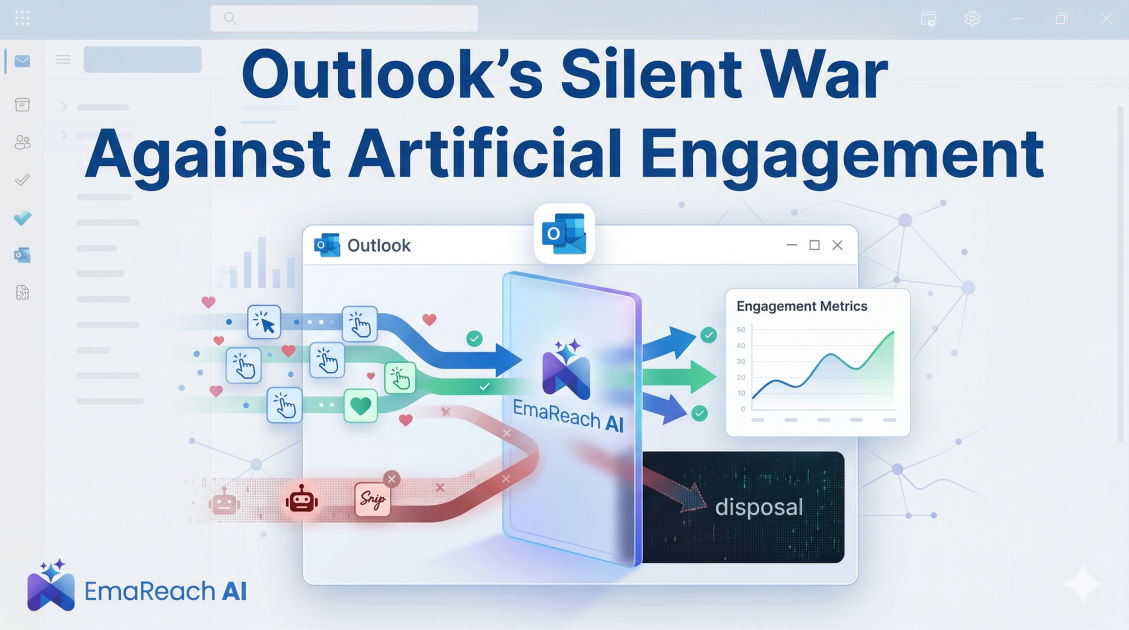
Outlook’s Silent War Against Artificial Engagement
OutlookEmail DeliverabilityCold OutreachArtificial EngagementSpam FiltersEmail MarketingSender Reputation
Introduction: The Invisible Barrier in Modern Communication
In the digital age, the inbox has become the most contested piece of real estate on the internet. For years, marketers and sales professionals have played a high-stakes game of cat and mouse with email service providers. However, a significant shift has occurred. Microsoft Outlook, one of the world's most prominent enterprise email platforms, has escalated its defensive capabilities. This escalation isn't just about blocking viruses or obvious phishing attempts; it is a sophisticated, data-driven, and often silent war against artificial engagement.
Artificial engagement—the practice of using bots, automated scripts, or low-quality bulk sending to simulate human interaction—has become the primary target of Outlook’s advanced filtering algorithms. As businesses strive to scale their outreach, they often find themselves hitting a wall. This article explores the mechanics of Outlook's defense systems, the risks of artificial shortcuts, and how to navigate this landscape with integrity and effectiveness.
The Evolution of the Inbox Gatekeeper
Gone are the days when simple keyword filtering was enough to protect an inbox. In the past, if an email didn't contain words like "free," "guaranteed," or "winner," it had a fair chance of landing in the primary folder. Today, Outlook utilizes a complex neural network of signals to determine the intent and authenticity of every incoming message.
This system, powered by Microsoft's massive global dataset, looks beyond the content. It analyzes the sender's reputation, the technical configuration of the sending domain, and, most importantly, the behavioral patterns associated with the email. When Outlook detects patterns that do not align with natural human communication, it triggers a silent downgrade in deliverability. Your emails aren't necessarily "blocked"; they simply disappear into the Junk folder or the 'Other' tab, never to be seen by the intended recipient.
The Rise of Behavioral Analysis
Outlook’s current strategy focuses heavily on behavioral analysis. This means the platform isn't just looking at what you send, but how people interact with it. Natural engagement involves high open rates, thoughtful replies, and long dwell times. Artificial engagement, conversely, often results in high bounce rates, rapid-fire unsubscribes, or—even worse—being marked as spam by recipients who feel harassed by automated sequences.
Microsoft’s Exchange Online Protection (EOP) and Microsoft Defender for Office 365 work in tandem to create a profile for every sender. If your sending pattern looks like a machine and your recipients treat your mail like clutter, the "Silent War" is one you are currently losing.
Understanding Artificial Engagement
To fight back, one must first understand what Outlook defines as artificial or low-quality engagement. This category encompasses several common tactics used by aggressive outreach teams:
- Massive Blast Sending: Sending thousands of identical emails from a single IP address or domain in a very short window.
- Bot-Driven 'Warm-ups': Using services that exchange thousands of fake emails between bot accounts to trick filters into thinking a domain is reputable.
- Lack of Personalization: Using "spray and pray" templates that lack any unique data points relevant to the recipient.
- Poor List Hygiene: Continuing to send mail to addresses that have consistently bounced or remained unopened for months.
When these signals converge, Outlook’s algorithms flag the activity as non-human. The result is a tarnished sender reputation that can take months of perfect behavior to repair.
The Psychology of the 'Primary' Tab
Outlook users are increasingly protective of their Focused Inbox. This feature uses machine learning to prioritize emails from people the user actually knows or interacts with frequently. To break into this inner circle, an email must prove it belongs there through genuine relevance.
Artificial engagement attempts to bypass this by "gaming" the system, but Microsoft’s engineers are well aware of these tactics. They have designed the system to value quality over quantity. A single email that receives a thoughtful reply is worth more to your sender reputation than a thousand emails that are deleted without being opened.
The Role of Technical Infrastructure
While behavior is king, technical foundations are the prerequisite for entering the battlefield. Outlook is notoriously strict about authentication protocols. If your domain isn't properly configured, you are essentially walking into a war zone without armor.
- SPF (Sender Policy Framework): Tells Outlook which mail servers are authorized to send email on behalf of your domain.
- DKIM (DomainKeys Identified Mail): Adds a digital signature to your emails, proving they weren't tampered with in transit.
- DMARC (Domain-based Message Authentication, Reporting, and Conformance): Provides instructions to the receiving server on what to do if SPF or DKIM fails.
Without these three pillars, Outlook is likely to categorize your outreach as suspicious by default. But even with them, you must still overcome the hurdle of engagement.
Why Most Cold Outreach Fails in Outlook
Many organizations struggle with Outlook deliverability because they treat the platform like a traditional marketing channel rather than a professional communication tool. Cold outreach, when done poorly, is the definition of artificial engagement. It feels robotic, it’s unsolicited, and it’s often irrelevant.
To succeed, you need a strategy that mimics—and eventually becomes—genuine human outreach. This is where modern solutions come into play. Stop Landing in Spam. Cold Emails That Reach the Inbox. EmaReach AI combines AI-written cold outreach with inbox warm-up and multi-account sending—so your emails land in the primary tab and get replies. By leveraging sophisticated AI to ensure each message is unique and relevant, tools like this help bridge the gap between automation and authenticity.
Strategies to Win the Silent War
If you want to ensure your messages reach the Outlook inboxes of your prospects, you must shift your mindset from volume-based metrics to relationship-based metrics. Here is how to navigate the current environment:
1. Prioritize Multi-Account Sending
Instead of sending 500 emails from one address, which screams "automated bot," send 50 emails from ten different accounts. This distributes the load and keeps the sending volume per mailbox within the limits of what a normal human could realistically achieve in a workday.
2. Implement Real Warm-up Cycles
Domain warm-up is essential, but it must be done right. Avoid "black box" warm-up services that use obvious bot patterns. Instead, look for systems that facilitate meaningful interactions. The goal is to show Outlook that your emails are being opened, moved to folders, and replied to by real (or highly realistic) users.
3. Focus on Hyper-Personalization
Generic templates are the fastest way to get flagged. Outlook’s filters can identify repetitive structures across thousands of emails. Use AI to tailor each message to the recipient's specific industry, role, or recent company news. When every email is unique, it becomes much harder for a filter to classify the campaign as "bulk."
4. Monitor Your Reputation Constantly
Use tools to track your IP and domain reputation. If you see a dip, stop sending immediately. Investigate whether you’ve been blacklisted or if your engagement rates have plummeted. Outlook provides some feedback loops, but much of the data must be inferred from your own delivery logs.
5. Ethical List Building
Artificial engagement is often a symptom of bad data. If you bought a list of 10,000 "CEOs" from a shady provider, half of those emails are likely dead or spam traps. Sending to a spam trap is the fastest way to lose the war. Build your lists organically or use highly reputable data providers that verify every address in real-time.
The Impact of AI on the Battlefield
Artificial Intelligence is a double-edged sword in the war for the inbox. On one side, it allows bad actors to generate more sophisticated spam at an unprecedented scale. On the other, it provides legitimate senders with the tools to be more relevant than ever before.
Outlook uses AI to detect spam, but you can use AI to ensure your outreach is so high-quality that it no longer fits the definition of spam. AI can help you find the "trigger events" that make a cold email feel like a timely solution to a problem. When a prospect reads an email and thinks, "How did they know I needed this?", they don't mark it as spam—they reply. That reply is the ultimate victory in the silent war.
The Future of Deliverability: Human-Centric Automation
The trend is clear: Outlook will continue to tighten the screws on any behavior that feels artificial. The future of email marketing and sales isn't about finding a bigger megaphone; it’s about finding a better way to whisper to the right person at the right time.
We are moving toward an era of Human-Centric Automation. This is the sweet spot where technology handles the repetitive tasks—like scheduling and basic research—while the human (or a very advanced AI) ensures the message remains authentic. To stay ahead, you must embrace tools that prioritize the health of your domain as much as the growth of your pipeline.
The Risks of Ignoring the War
What happens if you ignore these shifts? The consequences are more than just a low open rate. Constant rejection by Outlook’s filters can lead to:
- Domain Blacklisting: Your entire company domain (including internal emails to colleagues) could be flagged as untrustworthy.
- Wasted Budget: You spend thousands on SDRs and lead lists only for the messages to never reach their destination.
- Brand Damage: If your brand becomes synonymous with "unwanted noise," you lose the trust of your market before you even get a chance to speak with them.
Conclusion: Navigating the New Standard
Outlook’s silent war against artificial engagement is not a temporary hurdle; it is the new standard of digital communication. The platform is dedicated to protecting its users' time and attention. As senders, our job is to respect that boundary by providing genuine value in every interaction.
By focusing on technical excellence, behavioral authenticity, and intelligent personalization, you can move from being a casualty of the filters to a welcome guest in the inbox. The "war" is only a threat to those who refuse to adapt. For the savvy communicator, it is an opportunity to stand out in a world cluttered with noise. Success in modern outreach requires a blend of sophisticated technology and a human touch—ensuring that every email sent is an email that deserves to be read.
EmaReach AI
Ready to scale your cold email outreach?
Join thousands of teams using EmaReach AI for AI-powered campaigns, domain warmup, and 95%+ deliverability. Start free — no credit card required.
Related posts
- Read article
What Makes the Right Instantly Alternative Worth the Migration Effort
Discover why upgrading your cold email infrastructure to the right Instantly alternative can dramatically improve your deliverability, scale your personalization, and future-proof your sales pipeline against strict spam filters.
- Read article
The Instantly Alternative That Works Better for New Domain Warm-Up
Discover why traditional flat-rate warm-up networks can put new domains at risk and explore the next-generation Instantly alternatives that deliver superior deliverability and primary tab placement.