Blog
Back to blog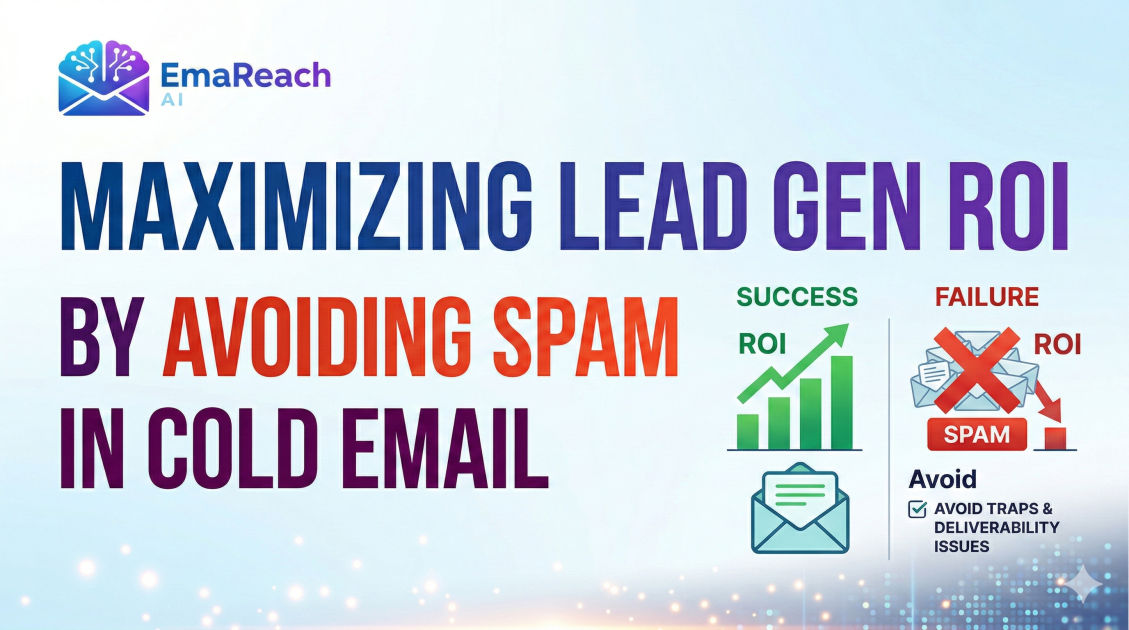
Maximizing Lead Gen ROI by Avoiding Spam in Cold Email
cold emaillead generationemail deliverabilitysales outreachmarketing ROIspam prevention
Introduction
In the world of B2B sales, cold email remains one of the most cost-effective and scalable methods for generating high-quality leads. However, the line between a successful outreach campaign and a wasted investment is thinner than ever. The primary obstacle? The spam folder. When your carefully crafted messages fail to reach the primary inbox, your Return on Investment (ROI) plummets to zero.
Maximizing lead generation ROI isn't just about sending more emails; it’s about ensuring those emails are seen, opened, and acted upon. This requires a deep understanding of technical deliverability, psychological triggers, and the evolving landscape of email service provider (ESP) algorithms. This guide explores the comprehensive strategies necessary to keep your outreach out of the spam folder and inside the primary tab.
The Real Cost of the Spam Folder
Every email that lands in spam is a lost opportunity. But the damage goes beyond a single missed lead. When ESPs like Google and Microsoft flag your domain for spammy behavior, your 'sender reputation' takes a hit.
The Downward Spiral of Deliverability
Once your reputation is tarnished, even your legitimate business communications—invoices, meeting invites, and personal notes—may start disappearing. This creates a negative feedback loop: lower engagement leads to more spam flags, which leads to even lower deliverability.
To maximize ROI, you must view email deliverability as a foundational pillar of your sales operations rather than an afterthought. Without a clear path to the inbox, your investment in lead lists, copywriters, and sales development reps is essentially a donation to the digital void.
Technical Foundations: The 'Trio' of Authentication
Before you write a single line of copy, your technical infrastructure must be airtight. Modern spam filters check for specific digital signatures to verify that you are who you say you are. If these are missing or misconfigured, you are a prime target for spam filtering.
SPF (Sender Policy Framework)
SPF is a DNS record that lists the IP addresses and domains authorized to send emails on your behalf. Think of it as a guest list for a private event; if you aren't on the list, you aren't getting in.
DKIM (DomainKeys Identified Mail)
DKIM adds a digital signature to your emails. This allows the receiving server to verify that the email was actually sent by the domain owner and wasn't intercepted or modified during transit.
DMARC (Domain-based Message Authentication, Reporting, and Conformance)
DMARC tells the receiving server what to do if an email fails SPF or DKIM checks. Setting your DMARC policy to 'quarantine' or 'reject' (after a period of monitoring) signals to ESPs that you take security seriously, which significantly boosts your sender authority.
Domain Health and the 'Burn' Strategy
One of the most common mistakes in cold outreach is sending high volumes from your primary company domain (e.g., yourname@company.com). If your primary domain gets blacklisted, your entire company’s communication infrastructure collapses.
Using Secondary Domains
Smart lead generators use secondary domains (e.g., company-outreach.com) specifically for prospecting. This creates a 'firewall' around your main business domain. If a secondary domain’s reputation is damaged, you can rotate to a new one without affecting your internal operations.
The Importance of Inbox Warm-up
You cannot buy a new domain and immediately send 500 emails a day. This is a massive red flag for ESPs. You must 'warm up' the domain by gradually increasing volume while ensuring high engagement rates. This is where tools like EmaReach become invaluable. EmaReach helps you stop landing in spam by combining AI-written outreach with automated inbox warm-up and multi-account sending, ensuring your emails land in the primary tab where they belong.
Crafting Content That Defeats Filters
Spam filters have evolved beyond simple keyword detection, but content still plays a massive role. Modern filters use machine learning to analyze the intent and 'feel' of an email.
Avoiding 'Spammy' Language
Certain words trigger immediate scrutiny. While one or two might not hurt, a density of these words will consign you to the junk folder:
- Financial Triggers: 'Cash,' 'Earn $,' 'No cost,' 'Investment.'
- Urgency Triggers: 'Act now,' 'Limited time,' 'Urgent.'
- Salesy Triggers: 'Free,' 'Guarantee,' 'Winner,' 'Special promotion.'
Personalization at Scale
Generic, templated emails are easy for filters to identify. If you send the exact same 1,000 emails to 1,000 people, you are flagged as a mass-marketer. True ROI comes from hyper-personalization. This means using variables beyond just 'First Name.' Mentioning a recent company milestone, a specific LinkedIn post, or a shared industry challenge proves to the filter (and the human) that this is a 1-to-1 communication.
The Role of Engagement Metrics
Deliverability is a democracy. ESPs look at how recipients interact with your mail to decide your future fate.
Positive Signals
- Open Rates: Indicates your subject line was relevant.
- Reply Rates: The strongest signal of a legitimate conversation.
- Move to Primary: If a user moves your email from 'Promotions' to 'Primary,' your reputation skyrockets.
- Marking as Not Spam: The ultimate 'get out of jail free' card.
Negative Signals
- Bounce Rates: High bounce rates (sending to non-existent emails) signal a poor-quality list and a 'spray and pray' mentality. Keep your bounce rate below 2%.
- Spam Complaints: Even a few 'Report Spam' clicks can tank your deliverability.
- Unsubscribe Rates: While better than a spam report, high unsubscribes still tell ESPs that your content is unwanted.
Data Hygiene: The Foundation of ROI
You can have the best copy in the world, but if your list is full of 'catch-all' addresses or retired accounts, your ROI will suffer.
Real-time Verification
Use email verification services to scrub your list before every campaign. These tools check if the mailbox actually exists without sending a physical email. This prevents hard bounces and protects your sender score.
Targeting the Right Person
Sending a technical pitch to a Marketing Manager is a quick way to get marked as spam. Ensure your ICP (Ideal Customer Profile) is tightly defined. The more relevant your message is to the recipient’s daily pain points, the less likely they are to perceive it as spam.
Timing and Frequency: The 'Human' Cadence
Automation is a double-edged sword. If you send emails at exactly 9:00:00 AM every Tuesday, you look like a bot.
Randomization and Spacing
To maximize ROI, your sending software should mimic human behavior. This means:
- Random intervals between sends (e.g., 2 minutes, then 7 minutes, then 4 minutes).
- Sending during the recipient's local business hours.
- Gradually 'dripping' the campaign rather than blasting it all at once.
Multi-Account Sending
Instead of sending 200 emails from one account, it is much safer—and more effective—to send 40 emails from five different accounts. This distributes the 'risk' and mimics a healthy, decentralized sales team. This is a core feature of platforms like EmaReach, which manage multi-account sending to keep your primary domain safe while scaling your outreach.
Subject Lines: The Gateway to the Inbox
Your subject line has one job: to get the email opened. However, deceptive subject lines (e.g., 'Re: Our meeting' when no meeting occurred) lead to high spam complaints once the user realizes they've been tricked.
Best Practices for Subject Lines
- Keep it short: 3-5 words often perform best on mobile.
- Be specific: 'Question about [Company Name]'s growth' is better than 'Quick question.'
- Avoid Caps and Emojis: While occasionally effective, excessive use can trigger filters.
- The 'Boring' Approach: Sometimes, the most mundane, non-salesy subject lines get the highest open rates because they look like internal company emails.
The Power of the Opt-Out
It may seem counterintuitive to make it easy for people to stop hearing from you, but a visible unsubscribe link or a clear 'Please let me know if you'd rather not hear from me' note is a deliverability lifesaver.
If a recipient can't find an easy way to opt-out, they will use the one button they can always find: 'Report Spam.' Providing a clear exit path protects your reputation and ensures your list remains populated only by those who are potentially interested in your value proposition.
Measuring ROI Beyond the Open Rate
To truly maximize ROI, you must look at the full funnel.
| Metric | Why it Matters for ROI |
|---|---|
| Cost Per Positive Reply | Tells you exactly what you pay to start a sales conversation. |
| Deliverability Rate | The percentage of emails that actually reached a folder (any folder). |
| Inbox Placement Rate | The percentage of emails that hit the Primary Inbox (the only one that matters). |
| Meeting Booked Rate | The ultimate goal of cold outreach. |
By tracking these metrics, you can identify exactly where your funnel is leaking. If your open rates are high but your reply rates are low, your copy is the problem. If your open rates are abysmal, your deliverability or subject lines are likely at fault.
Conclusion
Maximizing Lead Gen ROI in cold email is a game of marginal gains. By perfecting your technical setup, maintaining rigorous data hygiene, and using sophisticated sending patterns, you create a sustainable engine for growth. Avoiding the spam folder isn't just about following rules—it's about respecting the recipient's inbox and providing genuine value through highly targeted, personalized communication. When you prioritize deliverability, every other aspect of your sales process becomes more efficient, predictable, and profitable.
EmaReach AI
Ready to scale your cold email outreach?
Join thousands of teams using EmaReach AI for AI-powered campaigns, domain warmup, and 95%+ deliverability. Start free — no credit card required.
Related posts
- Read article
The Instantly Alternative That Impressed Even the Biggest Instantly Fans
Discover why top outbound growth marketers and lead generation agencies are migrating from legacy cold email platforms to advanced alternatives built for superior deliverability, white-label client management, and robust API workflows.
- Read article
What Makes the Right Instantly Alternative Worth the Migration Effort
Discover why upgrading your cold email infrastructure to the right Instantly alternative can dramatically improve your deliverability, scale your personalization, and future-proof your sales pipeline against strict spam filters.