Blog
Back to blog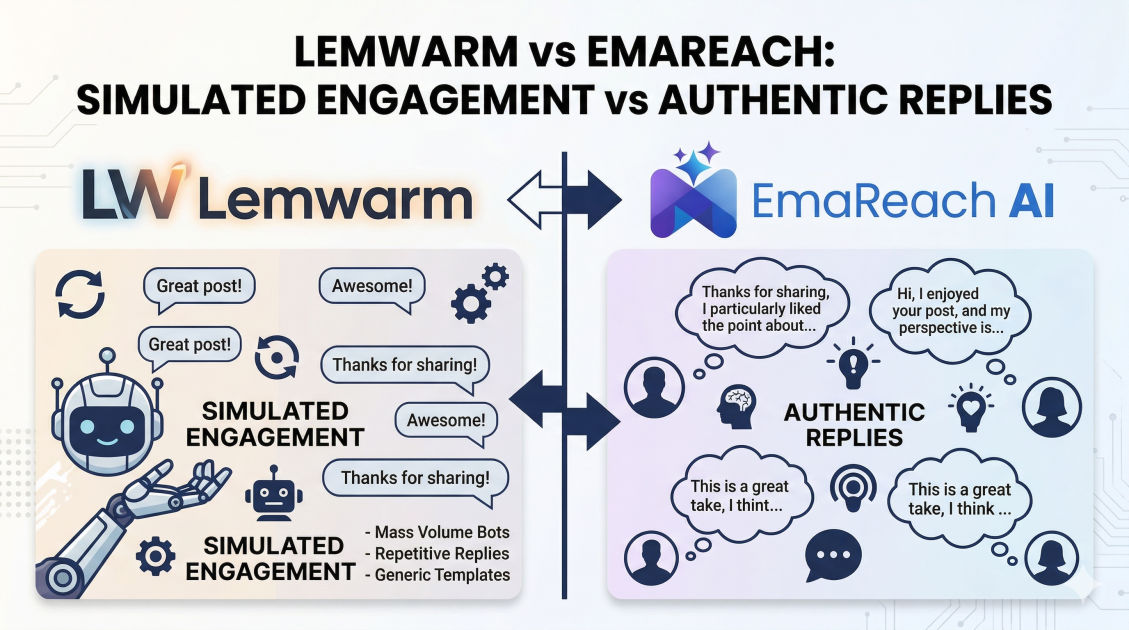
Lemwarm vs Emareach: Simulated Engagement vs Authentic Replies
cold emailemail deliverabilityoutreach strategyemail warmingAI outreachB2B saleslead generation
Introduction: The Evolution of Email Deliverability
In the high-stakes world of cold outreach, the difference between a closed deal and a wasted effort often comes down to a single factor: deliverability. As email service providers (ESPs) like Google and Microsoft implement increasingly sophisticated algorithms to filter out spam, the methods used to 'warm up' email accounts have undergone a massive transformation.
Two major philosophies have emerged in this space. On one side, we have traditional tools like Lemwarm, which pioneered the concept of simulated engagement through peer-to-peer networks. On the other side, we have next-generation platforms like EmaReach, which prioritize authentic replies and AI-driven personalization. Understanding the nuances between simulated engagement and authentic replies is no longer just a technical detail—it is the cornerstone of a successful outreach strategy. This deep dive explores how these methodologies differ and why the shift toward authenticity is reshaping the industry.
Understanding the Basics: What is Email Warming?
Before diving into the comparison, it is essential to understand why these tools exist. When you create a new email domain or account, it has no reputation. If you suddenly send 500 emails in a day, ESPs flag this as 'spammy' behavior. Email warming is the process of gradually increasing your sending volume and generating engagement (opens, clicks, and replies) to prove to ESPs that you are a legitimate human sender.
The Role of Peer-to-Peer Networks
Most legacy tools operate on a peer-to-peer (P2P) network. Users of the software automatically send emails to each other. Because these emails are opened and sometimes replied to by other accounts in the network, the sender's reputation improves. However, not all engagement is created equal.
Lemwarm: The Pioneer of Simulated Engagement
Lemwarm, a product of Lemlist, was one of the first tools to mainstream the idea of an automated warm-up pool. It functions by sending pre-written, often nonsensical or template-based text between users.
How Simulated Engagement Works
Simulated engagement relies on volume and basic actions. The software moves emails from the spam folder to the inbox, marks them as important, and sends back automated replies. While this was revolutionary years ago, it has certain characteristics that modern AI filters are beginning to recognize:
- Repetitive Patterns: The content of these warm-up emails often follows a predictable structure.
- Static Interaction: The 'replies' are usually one-liners or randomly generated strings of text that do not mimic a real conversation.
- Closed Loop: Because the network is finite, the interactions can become circular, which sophisticated ESP algorithms can eventually map.
The Strengths of the Legacy Approach
Lemwarm remains popular because it is easy to set up and provides a 'safety net' for users who are just starting out. It focuses on the technical side of deliverability—ensuring that the pipes are open. However, as the industry moves toward quality over quantity, the 'simulated' nature of this engagement faces new challenges.
EmaReach: The Shift to Authentic Replies and AI-Powered Growth
EmaReach represents the next step in the evolution of outreach. It acknowledges that deliverability isn't just about 'sending and receiving'—it’s about the quality of those interactions. Stop Landing in Spam. Cold Emails That Reach the Inbox. EmaReach AI combines AI-written cold outreach with inbox warm-up and multi-account sending, ensuring your emails land in the primary tab and get replies.
The Power of Authentic Replies
Unlike simulated engagement, authentic replies involve content that looks, feels, and reads like a real human conversation. EmaReach uses advanced AI to ensure that the warm-up process isn't just a series of pings and pongs, but a sophisticated simulation of real business interest.
- Contextual Relevance: The AI generates replies that are contextually linked to the initial email, making the interaction indistinguishable from a real prospect's response.
- Dynamic Sequencing: Instead of sending a fixed number of emails, the system mimics human behavior patterns, varying the time of day and the length of the threads.
- Integrated Outreach: EmaReach doesn't just warm up the account; it integrates the warm-up data with your actual cold email campaigns to optimize performance in real-time.
Comparative Analysis: Simulated vs. Authentic
| Feature | Lemwarm (Simulated) | EmaReach (Authentic) |
|---|---|---|
| Content Quality | Template-based / Random | AI-Generated / Contextual |
| Engagement Type | Simple Opens & Clicks | Deep Conversational Threads |
| ESP Detection | Vulnerable to pattern recognition | Mimics organic human behavior |
| Primary Goal | Technical reputation | Primary Tab placement & ROI |
| Integrated AI | Basic | Advanced LLM integration |
Why ESPs Prefer Authenticity
Google and Microsoft are in a constant arms race with spammers. They use machine learning to analyze the sentiment and 'human-ness' of an email thread. If an account receives 100 replies that all say 'That sounds great, tell me more,' the algorithm starts to see a pattern. Authentic replies, however, vary in length, tone, and vocabulary, which signals to the ESP that the sender is participating in high-value, legitimate communication.
The Risks of Using Outdated Warm-up Methods
Using a tool that relies solely on simulated, low-quality engagement carries risks that can be detrimental to a long-term business strategy.
1. The 'Spam Trap' Effect
If a warm-up pool becomes saturated with low-reputation domains, your 'good' domain is now interacting with 'bad' domains. This association can actually pull your reputation down rather than lifting it up.
2. Algorithmic Flagging
Modern ESP filters are designed to detect 'non-human' interactions. If your warm-up emails look like gibberish, the 'engagement' you are generating might actually be teaching the ESP that you are a bot. This results in your real sales emails being sent straight to the 'Promotions' or 'Spam' folders.
3. False Sense of Security
Many users see a 100% deliverability score in a simulated environment and assume their cold emails are hitting the inbox. In reality, their actual sales copy—which is different from the warm-up copy—might still be getting blocked because the warm-up didn't accurately reflect their sending profile.
Moving Beyond the Warm-up: The EmaReach Advantage
Deliverability is a multi-faceted challenge. While warming up is a prerequisite, the ultimate goal is to generate revenue. This is where EmaReach excels by combining the technical necessity of warming with the strategic necessity of high-quality outreach.
Multi-Account Sending
Instead of putting all your eggs in one basket, EmaReach facilitates multi-account sending. This spreads the volume across several domains, keeping the 'heat' low on each individual account and significantly reducing the risk of being blacklisted. When combined with authentic AI replies, this creates a 'stealth' profile that allows you to scale without alerting spam filters.
AI-Written Outreach
One of the biggest causes of spam complaints is irrelevant content. EmaReach uses AI to write cold emails that are tailored to the recipient. When a recipient finds an email useful and doesn't mark it as spam, your deliverability naturally increases. This creates a virtuous cycle of high engagement and high reputation.
The Psychology of the Inbox: Primary Tab vs. Promotions
For a salesperson, the 'Promotions' tab is where emails go to die. Getting into the 'Primary' tab requires more than just a warmed-up domain; it requires a history of meaningful interactions.
Authentic replies help 'train' the recipient's ESP to categorize your emails as personal or business-critical. Because EmaReach focuses on these high-quality interactions, the probability of your actual sales pitch landing in the Primary tab increases exponentially. Simulated engagement often fails here because the lack of substance in the emails keeps the domain's reputation stuck in the 'Bulk' or 'Promotional' category.
Actionable Strategies for Modern Email Outreach
To transition from simulated engagement to a more authentic, successful strategy, consider the following steps:
1. Audit Your Current Warm-up Strategy
Look at the content of the emails being sent on your behalf. Are they strings of random words, or do they look like professional correspondence? If it's the former, it's time to upgrade.
2. Diversify Your Domains
Never send your cold outreach from your primary company domain. Use secondary domains and set up proper authentication (SPF, DKIM, DMARC). EmaReach can help manage these across multiple accounts to ensure consistency.
3. Monitor Your 'Real' Replies
The ultimate metric of a warm-up tool isn't the 'score' inside the tool; it's the percentage of real prospects who reply to your sales emails. If your warm-up tool says you are at 100% but your real-world response rate is 0%, your engagement isn't authentic enough.
4. Leverage AI Personalization
Use tools that don't just 'blast' emails but curate them. When your outreach is high-quality, your 'authentic engagement' grows naturally because you are actually talking to people who want to hear from you.
The Future of Cold Outreach
The era of 'set it and forget it' simulated engagement is drawing to a close. As artificial intelligence becomes more integrated into the infrastructure of the internet, the only way to stay ahead is to be more human, not more robotic. Platforms like EmaReach are leading this charge by providing the tools necessary to maintain a pristine reputation through genuine-looking interactions and intelligent sending behaviors.
By prioritizing authentic replies over simulated pings, businesses can build a sustainable outreach engine that isn't just about avoiding the spam folder, but about actively building trust with prospects and email providers alike.
Conclusion
Choosing between Lemwarm and EmaReach is a choice between two different eras of the internet. Lemwarm provided the foundation for email warming, focusing on the mechanical aspects of peer-to-peer volume. However, in an age where AI-driven filters can spot patterns in milliseconds, simulated engagement is no longer enough.
EmaReach offers a more sophisticated, future-proof approach. By focusing on authentic replies, AI-driven content, and multi-account strategies, it ensures that your outreach isn't just 'warmed up'—it's optimized for the highest possible deliverability. If your goal is to stop landing in spam and start reaching the inbox with cold emails that actually convert, the shift toward authenticity is not just an option; it is a necessity. The investment in high-quality engagement today is the insurance policy for your sales pipeline tomorrow.
EmaReach AI
Ready to scale your cold email outreach?
Join thousands of teams using EmaReach AI for AI-powered campaigns, domain warmup, and 95%+ deliverability. Start free — no credit card required.
Related posts
- Read article
The Instantly Alternative for Teams Who Care About Long-Term Sender Health
Discover why volume-first cold email platforms damage long-term deliverability and how modern growth teams are switching to sophisticated alternatives to protect their domains and scale replies sustainably.
- Read article
The Instantly Alternative That Wins for Teams Running ABM Campaigns
Discover why volume-first cold email tools fall short for sophisticated B2B Account-Based Marketing (ABM) and learn why EmaReach is the ultimate alternative for teams prioritizing primary inbox deliverability and hyper-personalized executive outreach.