Blog
Back to blog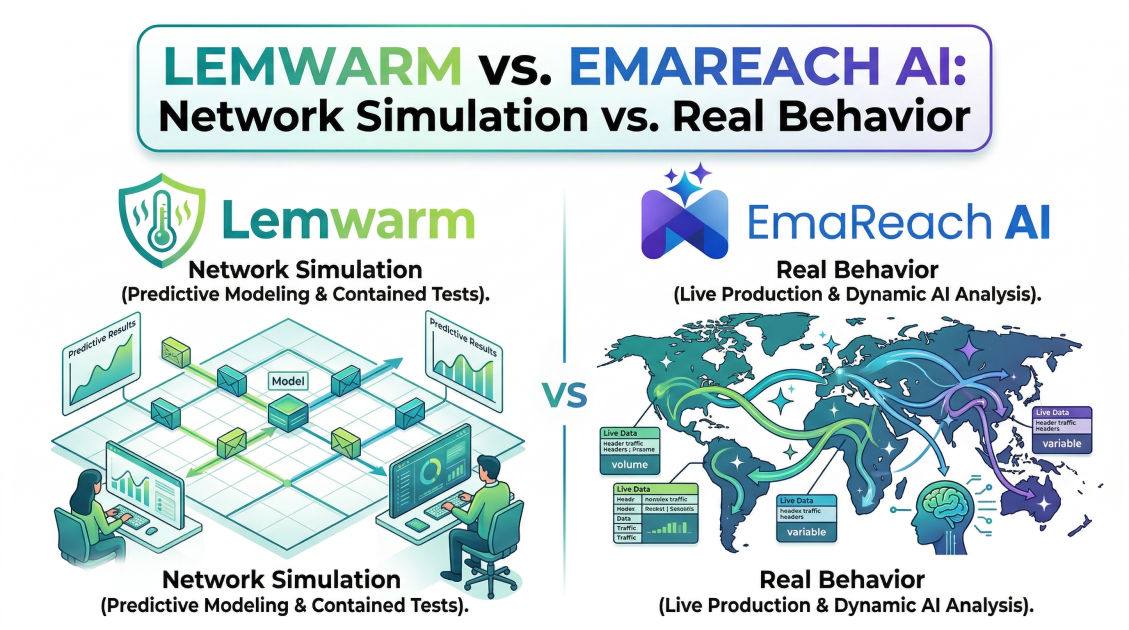
Lemwarm vs Emareach: Network Simulation vs Real Behavior
cold emailemail deliverabilityinbox warm-upoutreach strategyemail marketingspam filtersAI outreach
Understanding the Evolution of Email Warm-up
In the competitive landscape of digital outreach, the technical infrastructure behind your emails determines whether you land in the primary inbox or the dreaded spam folder. As Internet Service Providers (ISPs) like Google and Microsoft employ increasingly sophisticated machine learning algorithms to filter unwanted content, the methods used to "warm up" email accounts have had to evolve. Two primary philosophies have emerged in this space: network simulation and real behavioral interaction.
This guide explores the technical nuances between Lemwarm and EmaReach, focusing on how different architectural approaches affect long-term deliverability and sender reputation. To master cold outreach, one must understand that an email address is not just a digital mailbox; it is a reputation profile monitored by global gatekeepers.
The Philosophy of Email Warm-up
Email warm-up is the process of gradually increasing the volume of emails sent from a new or dormant email account. The goal is to build a positive sending history that signals to ISPs that the account is managed by a legitimate human user rather than an automated bot.
When an account is first created, it has a neutral reputation. If that account suddenly sends 500 emails in a single day, it triggers an immediate red flag. ISPs view this as typical spammer behavior. Warm-up tools counteract this by automating a series of peer-to-peer interactions, such as sending, receiving, opening, and marking emails as important. However, not all automation is created equal.
Lemwarm and the Network Simulation Model
Lemwarm, a pioneer in the warm-up space, operates on a model that emphasizes high-volume peer-to-peer networking. This approach relies on a massive pool of users who allow the software to send emails from their accounts to other users within the same network.
How Network Simulation Works
In a simulated network environment, the software creates a closed loop. User A sends an email to User B, and User B’s account automatically moves that email to the inbox and marks it as important. This creates a feedback loop of positive engagement signals. The primary advantage of this model is scale. With thousands of users, the network can generate a high volume of traffic quickly.
The Vulnerabilities of Simulated Behavior
While effective in the past, network simulation faces challenges from modern AI-driven spam filters. ISPs are now capable of detecting patterns that look too "perfect." For example, if an account only interacts with other accounts that are also part of a known warm-up pool, the ISP may identify the cluster. If the content of these emails is repetitive or nonsensical (often referred to as "gibberish" text), the simulation becomes transparent.
Modern filters look for the nuance of human variability—the irregular timing of replies, the diversity of topics, and the specific metadata associated with real human interaction. When a network relies solely on automated simulation, it risks being identified as a synthetic environment, which can lead to a "reputation ceiling" where an account never truly achieves the trust levels required for high-volume outbound campaigns.
EmaReach: The Shift to Real Behavioral Interaction
EmaReach represents a shift toward a more sophisticated, AI-driven model that prioritizes human-like behavior over raw volume. In the battle for the inbox, the quality of the interaction often outweighs the quantity.
Stop Landing in Spam. Cold Emails That Reach the Inbox. EmaReach AI combines AI-written cold outreach with inbox warm-up and multi-account sending—so your emails land in the primary tab and get replies. This approach addresses the core weakness of traditional warm-up: the lack of authentic behavior.
The Power of AI-Driven Authenticity
Unlike older simulation models, EmaReach utilizes advanced language models to generate unique, contextually relevant email content for the warm-up process. This ensures that the emails being sent look like genuine business correspondence rather than random strings of text.
By simulating real behavior, the tool mimics the cadence of a human user. It accounts for time zones, varying reply lengths, and natural pauses in activity. This deep level of behavioral mimicry makes it significantly harder for ISP filters to distinguish between the warm-up activity and real business operations.
Technical Comparison: Simulation vs. Reality
To understand why the shift toward real behavior is necessary, we must look at the technical metrics ISPs monitor.
1. Content Diversity
In a simulation model, content is often secondary. It might use templates or randomized word banks. This creates a "digital fingerprint" that is easily recognizable. Real behavioral tools like EmaReach use AI to craft unique messages for every interaction. This lack of a repeatable fingerprint is a major defense against bulk-sender identification.
2. Interaction Depth
Basic simulation often stops at "Open" and "Mark as Important." Real behavior includes "Reply-to-Reply" threads. When an ISP sees a multi-turn conversation between two domains, it assigns a much higher trust score to both participants. This is indicative of a real professional relationship rather than a coordinated warm-up scheme.
3. Metadata and Header Analysis
ISPs look at the headers of every email. Simulated networks sometimes leave footprints in the technical headers of the email, such as consistent X-headers or specific routing paths. High-tier tools focus on ensuring that the metadata perfectly matches a standard Outlook or Google Workspace user configuration.
Why Real Behavior Wins in the Modern Era
The goal of any warm-up strategy should be to future-proof your domain. As Google and Yahoo implement stricter requirements for bulk senders, the margin for error has vanished.
The Importance of the "Primary Tab"
Landing in the "Promotions" or "Updates" tab is often just as bad as landing in the spam folder for cold outreach. Simulated behavior often flags an account as a "bulk sender," which leads to the Promotions tab. Real behavioral interaction signals to the ISP that you are an individual reaching out to another individual, which is the key to landing in the Primary Inbox.
Long-term Domain Health
Short-cuts in the warm-up process can lead to long-term damage. If a domain is flagged for participating in a synthetic network, it can be extremely difficult to recover that reputation. By using a tool like EmaReach, which integrates AI-written outreach with authentic warm-up, users build a foundation of trust that can withstand the rigors of large-scale campaigns.
Strategies for Implementing Real Behavioral Warm-up
If you are transitioning from a simulation-based model to a behavioral one, there are several steps you should take to ensure a smooth migration:
- Audit Your Current Reputation: Use deliverability tools to check if your domain is currently on any blacklists or if your "SNDS" (Smart Network Data Services) score is low.
- Slow Down the Transition: Do not jump from one tool to another at full volume. Start the new, behavioral-based warm-up at a low volume and gradually phase out the old simulation.
- Focus on Multi-Account Sending: Instead of sending 200 emails from one account, send 25 emails from 8 different accounts. This distribution mimics a real company's growth and reduces the pressure on any single inbox.
- Integrate AI Content Generation: Ensure that your actual outreach content is as high-quality as your warm-up content. Inconsistencies between "warm-up" quality and "campaign" quality can trigger filters.
The Role of Multi-Account Architecture
A critical component of the real behavior model is the use of multiple accounts across different domains. This strategy, often referred to as "horizontal scaling," allows for high-volume outreach without ever crossing the threshold of suspicious activity for a single account.
EmaReach excels here by managing these multiple accounts through a centralized AI that ensures every account maintains its unique behavioral profile. This prevents the "cross-contamination" of reputation that can occur in closed-loop simulation networks. If one account faces a temporary dip in deliverability, the rest of the fleet remains unaffected because they operate on distinct behavioral paths.
The Hidden Costs of Cheap Warm-up
Many users are tempted by low-cost simulation tools that promise thousands of interactions for a minimal fee. However, the hidden cost lies in the lost revenue from emails that never reach the prospect.
If a simulated network causes your domain to be "soft-blocked," your open rates might drop from 40% to 12%. On a list of 1,000 prospects, that is 280 potential conversations lost. When compared to the cost of a premium, behavioral-based solution, the ROI of superior deliverability becomes clear.
Beyond the Warm-up: Integrated Outreach
The most effective strategy is one where the warm-up and the actual outreach are indistinguishable. When you use EmaReach, the AI that warms your account is the same intelligence that helps craft your actual cold emails. This creates a seamless reputation profile.
When a prospect replies to an AI-written email, and that reply is handled naturally, the ISP sees a 100% authentic transaction. This is the gold standard of deliverability. It transforms the email account from a "marketing tool" into a trusted communication channel.
Final Thoughts on Network Evolution
The transition from Lemwarm’s network simulation to EmaReach’s behavioral model mirrors the broader trend in technology: moving away from rigid automation toward adaptive, intelligent systems. As ISPs get smarter, your tools must get smarter too.
Relying on a network where accounts simply "talk to each other" is no longer enough to guarantee placement in the primary inbox. You need a system that understands the nuances of human interaction, the importance of content variety, and the technical requirements of modern email headers. By prioritizing real behavior, you aren't just warming up an account—you are building a sustainable asset for your business.
Conclusion
The choice between network simulation and real behavioral interaction is ultimately a choice between short-term volume and long-term stability. While simulation models like Lemwarm provided a necessary service in the early days of automated outreach, the complexity of modern spam filters requires a more sophisticated approach.
By choosing a platform like EmaReach, you leverage the power of AI to create a sending profile that is indistinguishable from a high-value human sender. In an era where the inbox is more crowded than ever, appearing human is your greatest competitive advantage. Focus on authenticity, invest in behavioral intelligence, and ensure your message reaches the people who need to hear it most.
EmaReach AI
Ready to scale your cold email outreach?
Join thousands of teams using EmaReach AI for AI-powered campaigns, domain warmup, and 95%+ deliverability. Start free — no credit card required.
Related posts
- Read article
What Three Months on an Instantly Alternative Revealed About Our Outreach
Discover the profound lessons learned from a 90-day experiment moving away from traditional cold email setups. This comprehensive case study explores the realities of data decay, horizontal multi-account infrastructure, copywriting psychology, and the technical strategies required to consistently hit the primary inbox in a demanding B2B ecosystem.
- Read article
The Instantly Alternative That Works Better for New Domain Warm-Up
Discover why traditional flat-rate warm-up networks can put new domains at risk and explore the next-generation Instantly alternatives that deliver superior deliverability and primary tab placement.