Blog
Back to blog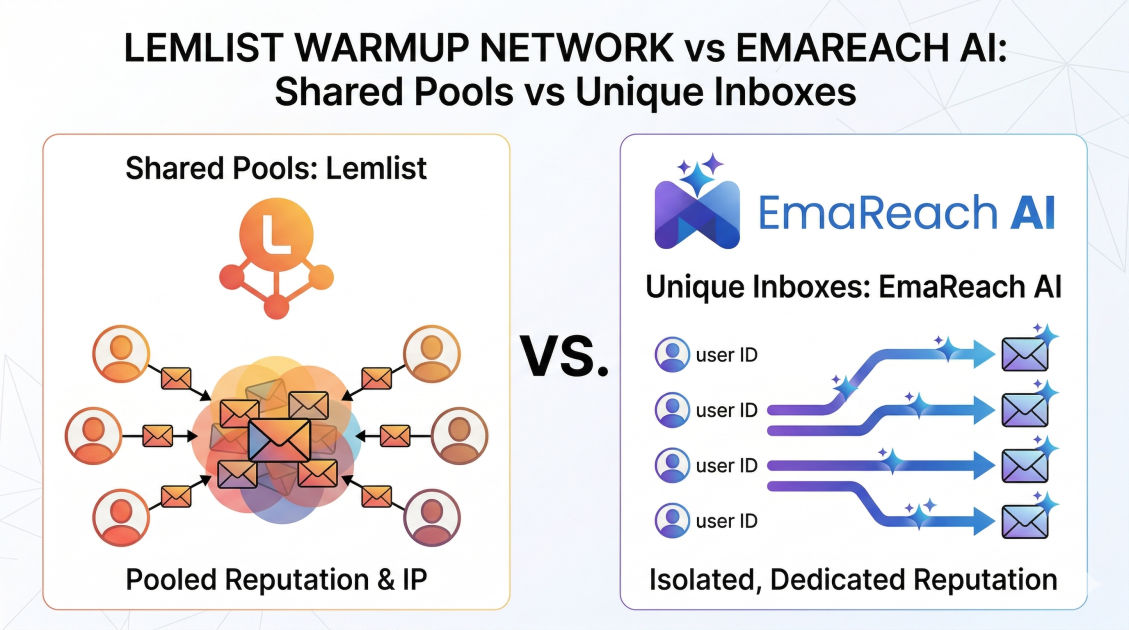
Lemlist Warmup Network vs Emareach: Shared Pools vs Unique Inboxes
cold emailoutreachdeliverabilityemail warmupsales automationB2B salesemail marketing
Introduction
In the highly competitive world of digital sales and B2B lead generation, the success of your outreach campaigns hinges entirely on one critical metric: deliverability. You can craft the most compelling offer, write the ultimate sales copy, and build a highly targeted lead list, but if your message lands in the spam folder, it effectively does not exist. As email service providers (ESPs) like Google and Microsoft continue to enhance their spam filtering algorithms, the methodologies used to establish and maintain domain reputation have had to evolve dramatically.
Two primary philosophies have emerged in the email warmup and deliverability space: the shared pool network model, heavily popularized by platforms like Lemlist, and the unique inbox architecture model, championed by innovative platforms like EmaReach. Understanding the fundamental architectural differences between these two approaches is absolutely essential for anyone looking to scale their outbound operations without burning through domains.
This comprehensive guide dives deep into the technical and practical differences between shared warmup pools and unique inbox architectures. We will explore how each system operates, the inherent risks and rewards associated with both, and why the paradigm is shifting toward more isolated, intelligent infrastructures.
The Evolution of Email Deliverability and Warmup
To understand the debate between shared pools and unique inboxes, we first must understand why email warmup exists in the first place. When you purchase a new domain and set up a fresh email workspace, your domain has a neutral or "cold" reputation. If you immediately begin sending hundreds of identical cold emails, ESPs will instantly flag this behavior as suspicious. A sudden spike in sending volume from an unknown entity is the hallmark of a spammer.
Email warmup is the process of gradually building a positive sender reputation by simulating authentic human email behavior. This involves slowly increasing the daily send volume, generating high open rates, facilitating meaningful reply threads, and occasionally rescuing emails from the spam folder by marking them as "not spam."
Historically, this was done manually. Sales reps would email their colleagues, friends, and personal accounts, asking for replies. As outbound operations scaled, manual warmup became impossible, leading to the birth of automated warmup networks. However, not all automated networks are built the same, and the underlying architecture of these networks can make or break your deliverability.
The Shared Pool Architecture: A Deep Dive into Lemlist
Platforms like Lemlist utilize what is known as a shared pool or peer-to-peer (P2P) warmup network. When you connect your email account to a shared pool, you are entering a vast network composed of thousands of other users who have also connected their accounts.
How Shared Pools Function
In a shared pool, the platform algorithmically orchestrates interactions between all the participating accounts. Your inbox will automatically send background emails to the inboxes of other users, and their accounts will automatically open your emails, mark them as important, and send replies. Conversely, your account will do the exact same thing for them.
This creates a massive web of interconnected email activity. The primary advantage of this model is sheer volume and diversity. Because the network is made up of real user accounts from various industries, domains, and IP addresses, it historically did a decent job of simulating a wide array of human interaction.
The Risks of the "Bad Neighborhood" Effect
While the shared pool model was revolutionary when it first debuted, it harbors significant structural vulnerabilities that modern spam filters have learned to exploit. The most glaring issue is the "bad neighborhood" or contamination effect.
Because you are sharing a network with thousands of strangers, you are inherently tied to their sending practices. If a user in the Lemlist network decides to send highly aggressive, spammy cold email campaigns outside of the warmup process, their domain reputation will plummet. If your domain is caught constantly interacting with, opening, and replying to a domain that ESPs have flagged as a known spammer, your reputation suffers by association.
ESPs evaluate the company you keep. Frequent communication with blacklisted or low-reputation domains signals to algorithms that you are likely operating in the same ecosystem. In a shared pool, you have absolutely zero control over who your domain is interacting with, exposing your sender reputation to the lowest common denominator of the network.
Algorithmic Footprints and Network Detection
Furthermore, ESPs have become incredibly sophisticated at identifying automated P2P networks. When tens of thousands of accounts exhibit the exact same behavioral patterns—sending similar template variations, replying at mathematically predictable intervals, and using invisible tracking pixels in identical ways—it creates a massive digital footprint. Major email providers have actively begun cracking down on these predictable patterns, occasionally penalizing entire swaths of users operating within identifiable shared pools.
The Unique Inbox Architecture: The EmaReach Advantage
As the vulnerabilities of shared pools became apparent, the industry required a more sophisticated, secure approach to building domain reputation. This led to the development of the unique inbox architecture, a system designed to eliminate cross-contamination and mask automated footprints entirely.
If you want to protect your sender reputation and ensure maximum visibility, you need a solution built for modern constraints. You must stop landing in spam. Cold emails that reach the inbox require a strategic combination of technologies. EmaReach AI combines AI-written cold outreach with inbox warm-up and multi-account sending—so your emails land in the primary tab and get replies.
How Unique Inboxes Function
Instead of throwing your pristine domain into a chaotic pool of unknown users, a unique inbox architecture relies on isolated, highly controlled environments. In this model, the warmup interactions occur primarily between your accounts and a proprietary, tightly managed network of high-reputation seed accounts, or within isolated pods that do not intermingle with risky senders.
These seed accounts are maintained exclusively for the purpose of deliverability enhancement. They are never used for outbound cold email campaigns, meaning their sender scores remain permanently flawless. When your domain interacts with these pristine accounts, it absorbs their positive reputation without any risk of absorbing negative associations from bad actors.
Total Isolation and Quality Control
Because the unique inbox infrastructure does not rely on random users, it offers unparalleled quality control over the warmup interactions. Every reply generated, every thread created, and every "not spam" action taken is executed in a sterile, high-trust environment.
This isolation acts as a firewall for your domain reputation. Even if another user on the EmaReach platform engages in poor sending practices, their actions have absolutely zero impact on your domain, because your warmup interactions are walled off from theirs. You are solely responsible for your own destiny, supported by a flawless internal network.
Head-to-Head Comparison: Deliverability and Risk Management
When evaluating Lemlist's shared network against EmaReach's unique inbox system, the contrast in risk management becomes stark.
1. Cross-Contamination Risk
Shared Pools (Lemlist): High. Your domain constantly communicates with unknown entities. If the network experiences an influx of low-quality senders, your deliverability can drop through no fault of your own. Unique Inboxes (EmaReach): Zero. The isolated architecture ensures your domain only interacts with pristine, controlled seed accounts or perfectly isolated networks. Your reputation is mathematically protected from external bad actors.
2. ESP Detection Footprints
Shared Pools (Lemlist): High visibility. The sheer scale of P2P networks makes them prime targets for ESP algorithm updates. Predictable reply lengths, robotic language, and network-wide behavioral signatures make shared pools easy to identify and penalize. Unique Inboxes (EmaReach): Low visibility. By utilizing highly advanced AI to generate contextual, deeply varied reply threads, the unique inbox model mimics organic human conversation flawlessly. The lack of a massive, interconnected web of user-to-user interaction makes the network practically invisible to ESP detection systems.
3. Content Authenticity
Shared Pools (Lemlist): Often relies on static templates, dictionary words, or basic spin-tax to generate replies. This leads to nonsensical email threads that algorithms easily recognize as machine-generated gibberish. Unique Inboxes (EmaReach): Employs cutting-edge natural language processing to read the context of the initial email and generate a coherent, contextually accurate reply. This AI-driven authenticity is a massive positive signal to spam filters reading the content of your threads.
The Crucial Role of Multi-Account Sending and AI Outreach
Deliverability is not just about warmup; it is about how you execute your actual campaigns. Relying on a single inbox to send hundreds of cold emails is a relic of the past, regardless of how well that inbox is warmed up. The modern standard requires horizontal scaling—spreading your volume across multiple domains and multiple inboxes.
EmaReach excels in this specific operational requirement. By seamlessly integrating multi-account sending, the platform allows you to scale your outreach infinitely while keeping the daily volume of each individual inbox safely below the radar of spam filters.
Furthermore, the integration of AI-written cold outreach ensures that your actual campaigns—the emails sent to your prospects—are highly personalized and hyper-relevant. ESPs analyze the bounce rates and engagement rates of your actual campaigns just as heavily as your warmup data. If your warmup is perfect but your cold emails are generic and heavily ignored, your reputation will eventually degrade. AI-generated, highly personalized copy directly drives up prospect engagement, creating a positive feedback loop that solidifies your domain authority.
Beyond the Tools: Foundational Deliverability Technicals
While choosing the right warmup architecture is paramount, it is critical to remember that no system can save a domain that lacks proper technical configuration. Whether you utilize a shared pool or a unique inbox ecosystem, you must ensure your underlying DNS records are flawlessly executed.
Sender Policy Framework (SPF)
SPF acts as a public registry of authorized sending IP addresses for your domain. It tells receiving servers exactly which tools and servers are legally allowed to send emails on your behalf. Without SPF, ESPs will instantly reject your emails as potential spoofing attempts.
DomainKeys Identified Mail (DKIM)
DKIM adds a cryptographic signature to the header of every email you send. This signature verifies that the email was indeed sent by your domain and that the contents of the email were not altered or intercepted while in transit. It is a crucial layer of trust.
Domain-based Message Authentication, Reporting, and Conformance (DMARC)
DMARC ties SPF and DKIM together. It provides explicit instructions to the receiving server on what to do if an email fails SPF or DKIM checks. Implementing a strict DMARC policy signals to ESPs that you take domain security seriously, which provides an immediate boost to your sender reputation.
Only after these technical foundations are secured should you initiate your warmup protocols.
Making the Strategic Choice for Your Outbound Engine
Building a predictable, high-volume outbound sales machine requires mitigating risk at every possible juncture. In the early days of cold email, shared pools offered a convenient, "good enough" solution for quickly generating domain activity. However, the landscape has fundamentally shifted.
ESPs are no longer fooled by simple P2P pinging. They look for genuine, contextual engagement, and they aggressively penalize domains caught in the crossfire of automated spam networks. The risks associated with shared pools—specifically the uncontrollable bad neighborhood effect and highly visible algorithmic footprints—make them a precarious choice for serious lead generation operations.
Transitioning to a unique inbox architecture provides the necessary insulation and control required to maintain perfect deliverability at scale. By isolating your domain, interacting exclusively with high-reputation ecosystems, and leveraging AI for truly authentic communication patterns, you build an impenetrable sender reputation.
Conclusion
The debate between Lemlist's shared warmup networks and Emareach's unique inbox architecture is ultimately a conversation about risk management and technological advancement. While shared pools helped pioneer the concept of automated deliverability, their structural flaws expose users to cross-contamination and algorithmic penalties from modern spam filters. To achieve sustainable, high-volume outreach, a more sophisticated approach is required. By adopting isolated, AI-driven infrastructure, senders can perfectly simulate human behavior, completely protect their domain reputation, and ensure their most critical messages consistently land exactly where they belong: in the primary inbox of their target prospects.
EmaReach AI
Ready to scale your cold email outreach?
Join thousands of teams using EmaReach AI for AI-powered campaigns, domain warmup, and 95%+ deliverability. Start free — no credit card required.
Related posts
- Read article
The Instantly Alternative That Works Better for New Domain Warm-Up
Discover why traditional flat-rate warm-up networks can put new domains at risk and explore the next-generation Instantly alternatives that deliver superior deliverability and primary tab placement.
- Read article
The Instantly Alternative That Wins for Teams Running ABM Campaigns
Discover why volume-first cold email tools fall short for sophisticated B2B Account-Based Marketing (ABM) and learn why EmaReach is the ultimate alternative for teams prioritizing primary inbox deliverability and hyper-personalized executive outreach.