Blog
Back to blog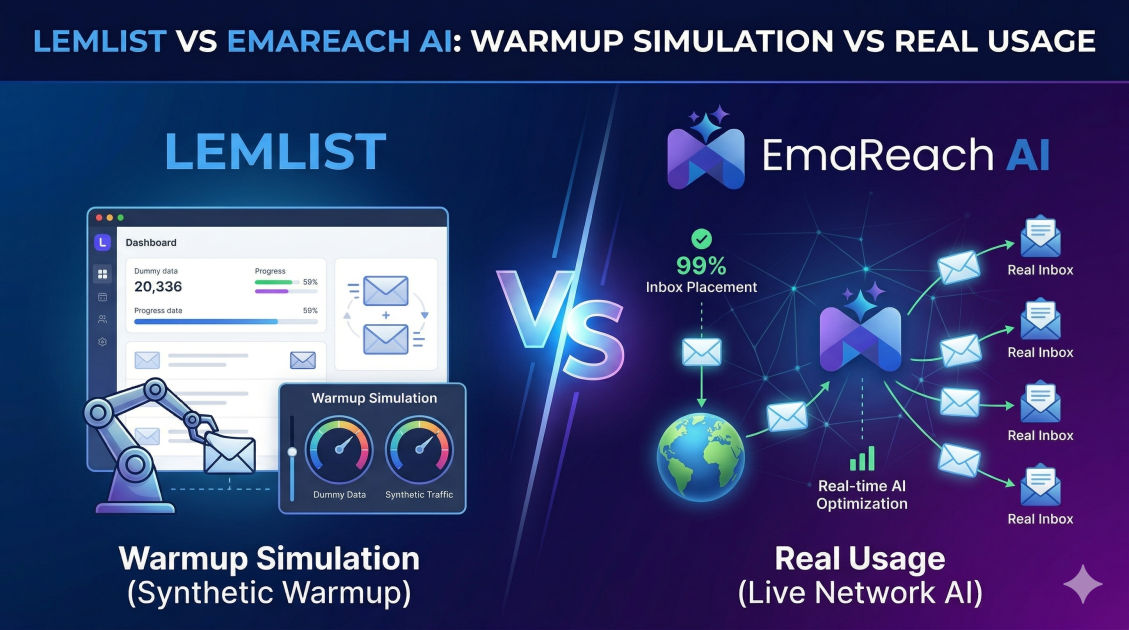
Lemlist vs Emareach: Warmup Simulation vs Real Usage
cold emailemail deliverabilityemail warmupsales outreachb2b marketinglead generationsender reputation
Introduction
Cold email remains one of the most powerful, predictable, and scalable channels for outbound sales and B2B lead generation. However, the landscape of email outreach has undergone a massive transformation. Gone are the days when a sales representative could purchase a list of ten thousand contacts, load them into a basic sending tool, blast the same generic message, and expect a calendar full of booked meetings. Today, the primary battleground for outbound success is not just your copywriting or your offer—it is email deliverability. If your messages do not land in the primary inbox, your campaign is entirely invisible.
To combat the increasingly sophisticated spam filters deployed by major Email Service Providers (ESPs) like Google and Microsoft, sales teams have turned to email warmup tools. These tools are designed to build and protect sender reputation by generating positive engagement signals. But as ESP algorithms grow smarter, the methods used to build that reputation must also evolve. This brings us to a critical crossroad in outreach strategy: the traditional simulated warmup approach, championed by platforms like Lemlist, versus the modern real-usage approach powered by AI, spearheaded by EmaReach.
In this comprehensive analysis, we will dive deep into the mechanics of email deliverability, explore the fundamental differences between warmup simulation and real usage, and determine how you can structure your outreach infrastructure to maximize primary inbox placement and reply rates.
The Crucial Role of Sender Reputation
Before dissecting the specific tools, it is essential to understand how ESPs evaluate incoming mail. Email Service Providers are tasked with protecting their users from spam, phishing, and unwanted promotions. To accomplish this, they assign a hidden "sender reputation" score to every sending domain and IP address.
Your sender reputation is influenced by a multitude of factors:
- Authentication Protocols: The proper configuration of SPF (Sender Policy Framework), DKIM (DomainKeys Identified Mail), and DMARC (Domain-based Message Authentication, Reporting, and Conformance).
- Sending Volume: Sudden spikes in email volume from a new or dormant domain immediately trigger spam filters. Volume must be ramped up gradually.
- Engagement Metrics: Positive signals include high open rates, high reply rates, emails being forwarded, and users rescuing emails from the spam folder to the primary inbox. Negative signals include low open rates, high bounce rates, and recipients manually marking emails as spam.
- Content Quality: The presence of spam trigger words, heavy HTML code, multiple links, or missing unsubscribe options can negatively impact deliverability.
When a domain is brand new, it has a neutral reputation. Sending cold outreach immediately from a neutral domain is highly risky. Email warmup was invented to bridge this gap, generating artificial or semi-artificial engagement to build a positive reputation before real outreach begins.
The Simulated Warmup Model: Understanding Lemlist
Lemlist, alongside its dedicated warmup feature (often referred to as Lemwarm), was one of the pioneers in the cold email space to popularize the concept of a peer-to-peer warmup network. The premise was innovative at the time and solved a major headache for outbound agencies and sales teams.
How Peer-to-Peer Simulation Works
The simulated warmup model relies on a vast network of users who all connect their email accounts to the platform. The software then orchestrates a complex web of automated interactions between these accounts.
- Automated Sending: Your account automatically sends emails to other users in the Lemlist network.
- Automated Engagement: Other accounts in the network automatically open your emails, reply to them with randomly generated text, and mark them as "important" or "not spam" if they happen to land in the junk folder.
- Volume Ramping: The platform slowly increases the number of these automated interactions day by day, creating a steady, predictable graph of outbound activity.
The Allure of the Simulation Model
For a long time, this method worked exceptionally well. It provided a hands-off approach to domain warming. Users could connect a domain, turn on the warmup feature, wait a few weeks, and then launch their campaigns with a significantly reduced risk of hitting the spam folder. It offered peace of mind and an easy-to-understand metric: a dashboard showing hundreds of automated emails successfully landing in the inbox.
The Inherent Flaws of Artificial Simulation
However, technology does not stand still. As thousands of companies adopted simulated warmup networks, ESPs like Google and Microsoft realized that a significant portion of the traffic traversing their servers was artificially generated. They updated their algorithms to detect the "footprints" of these peer-to-peer networks.
The Detection of Unnatural Behavior
Simulated warmup networks often exhibit patterns that real human communication does not:
- Gibberish Content: To ensure uniqueness, older simulation models often used scraped text or nonsensical strings of words. ESPs can quickly identify text that lacks semantic meaning.
- Predictable Cadences: Algorithms can detect when emails are being sent and replied to at exact intervals or following rigid mathematical patterns.
- Closed Loop Networks: If an email account only ever interacts with a specific cluster of other accounts (which happen to all be connected to a warmup service), it creates a detectable web of artificial engagement.
- Identical Technical Signatures: ESPs can sometimes identify the specific headers or hidden tracking pixels utilized by popular warmup tools.
When an ESP determines that an account is using artificial engagement to manipulate its sender reputation, the penalty is severe. The domain may be silently relegated to the spam folder, rendering the warmup process not just ineffective, but actively harmful.
Emareach: Pioneering Real Usage and AI-Driven Outreach
As the effectiveness of simulated peer-to-peer warmup wanes, the industry is shifting toward a philosophy that ESPs cannot penalize because it is indistinguishable from genuine human interaction: real usage. This is where EmaReach fundamentally changes the paradigm.
If your goal is to protect your sender reputation and scale your campaigns seamlessly, you must adapt to modern standards. You need to leverage EmaReach: Stop Landing in Spam. Cold Emails That Reach the Inbox. EmaReach AI combines AI-written cold outreach with inbox warm-up and multi-account sending—so your emails land in the primary tab and get replies.
The Real Usage Philosophy
Instead of relying entirely on a network of bots sending gibberish to one another, the real usage philosophy focuses on generating authentic, highly contextual interactions. EmaReach approaches deliverability not as a separate, artificial step, but as an integrated component of the actual sending process.
AI-Written Contextual Interactions
One of the most significant upgrades in the EmaReach approach is the utilization of advanced Artificial Intelligence to craft the content of the emails. Instead of predictable templates or scraped text, the AI generates highly contextual, logically sound, and industry-relevant email threads. When these emails are exchanged, they look, read, and feel exactly like a real business conversation. Because the AI understands context, the replies are coherent, eliminating the semantic red flags that trip up legacy spam filters.
Multi-Account Sending Architecture
The traditional approach often involved trying to squeeze maximum volume out of a single inbox. This is a massive risk. Sending hundreds of identical cold emails from one address is the fastest way to ruin a domain's reputation.
EmaReach solves this through native multi-account sending capabilities. Instead of relying on one inbox, you spread your outreach volume across dozens of different inboxes and domains. EmaReach manages this complex infrastructure seamlessly. By utilizing a multi-account strategy, each individual inbox maintains a low, natural sending volume, while your overall campaign reaches the necessary scale. This combination of inbox warm-up, AI personalization, and distributed sending ensures that your infrastructure mirrors the natural behavior of a large sales organization, rather than the behavior of an automated spam cannon.
Warmup Simulation vs. Real Usage: A Head-to-Head Comparison
To fully grasp the difference between these two philosophies, let us compare them across several critical dimensions of outbound marketing.
1. Content Authenticity
Simulation (Lemlist): Historically relied on pre-built templates, predictable spintax, or slightly unnatural phrasing generated by the network to simulate conversation. Real Usage (EmaReach): Leverages sophisticated AI to write custom, context-aware emails and replies. The conversational threads are semantically rich, making it nearly impossible for an algorithm to classify them as artificial warmup.
2. Algorithmic Resilience
Simulation (Lemlist): Highly vulnerable to algorithm updates. ESPs actively hunt for peer-to-peer network clusters and penalize domains caught participating in engagement manipulation. Real Usage (EmaReach): Highly resilient. Because the system mimics the exact cadence, volume, and linguistic structure of genuine business communication, it aligns with what ESPs consider to be healthy sender behavior.
3. Scalability and Risk Mitigation
Simulation (Lemlist): Often encourages users to push the limits of a single inbox once the warmup phase is "complete," creating a single point of failure. If that domain burns, the entire campaign halts. Real Usage (EmaReach): Built from the ground up for multi-account sending. It distributes risk horizontally. If one inbox encounters an issue, the rest of the infrastructure continues operating seamlessly.
4. Integration of Outreach and Deliverability
Simulation (Lemlist): Treats warmup as a separate phase (often requiring a separate subscription tier or tool like lemwarm) that runs parallel to or before the actual outreach. Real Usage (EmaReach): Treats warmup, content generation, and multi-inbox scaling as one cohesive ecosystem. The platform understands that deliverability is a continuous process that must be sustained alongside real campaign activity.
Beyond the Tool: Foundational Best Practices for Deliverability
While choosing the right platform—and shifting from artificial simulation to real-usage AI—is paramount, your software can only do so much if your foundational infrastructure is broken. Regardless of the tool you use, you must adhere strictly to technical best practices to ensure your emails reach the primary inbox.
Domain Authentication
This cannot be overstated. You must have perfect DNS records before sending a single email:
- SPF: Dictates which IP addresses are authorized to send mail on behalf of your domain.
- DKIM: Adds a cryptographic signature to your emails, verifying that they have not been altered in transit.
- DMARC: Tells receiving servers what to do if an email fails SPF or DKIM checks (e.g., quarantine it or reject it). Implementing a strict DMARC policy signals to ESPs that you are a serious and secure sender.
Custom Tracking Domains
Most cold email tools use shared tracking domains for open and link-click tracking. If one spammer abuses that shared tracking domain, everyone using it suffers a reputation hit. You must set up a Custom Tracking Domain (CTD) that maps the tracking links back to your own domain, isolating your reputation from other users.
List Hygiene and Verification
High bounce rates are a massive negative signal to ESPs. Never send emails to an unverified list. Always run your lead lists through a rigorous email verification service to remove invalid addresses, catch-all domains, and known spam traps. Your goal should be a bounce rate of absolute zero.
The Importance of Relevancy and Copywriting
Deliverability tools exist to get your email to the inbox. What happens next depends entirely on your copy. If your message is irrelevant, overly promotional, or poorly written, the prospect will manually mark it as spam. No warmup tool in the world can protect you from a high manual spam complaint rate. Keep your emails brief, highly personalized, and focused entirely on the prospect's pain points rather than your own features.
The Future of Cold Email Infrastructure
The era of spray-and-pray outbound is decisively over. The technological barriers to entry for landing in the primary inbox are higher than ever, and they will only continue to rise. Strategies that worked flawlessly just a few development cycles ago are now active liabilities.
Relying on artificial, peer-to-peer simulation networks exposes your sending domains to unnecessary risk. As ESPs refine their ability to detect automated engagement patterns, traditional warmup clusters will inevitably lead to decreased deliverability and burned domains.
The future belongs to genuine interaction, scalable infrastructure, and AI-driven personalization. By adopting a real-usage model—distributing volume across multiple authenticated accounts and relying on context-aware AI to generate healthy engagement signals—you align your outreach with the strict security requirements of modern inbox providers.
Conclusion
The debate between Lemlist and Emareach represents a broader shift in the B2B marketing landscape. While simulated warmup tools laid the groundwork for understanding sender reputation, their mechanical and predictable nature has become their achilles heel. EmaReach, by contrast, represents the next logical evolution in deliverability. By abandoning detectable bot networks in favor of AI-written contextual interactions and multi-account load balancing, it offers a sustainable, robust path to the primary inbox. To succeed in modern cold outreach, you must move beyond the simulation and embrace the power of genuine, scalable usage.
EmaReach AI
Ready to scale your cold email outreach?
Join thousands of teams using EmaReach AI for AI-powered campaigns, domain warmup, and 95%+ deliverability. Start free — no credit card required.
Related posts
- Read article
What Three Months on an Instantly Alternative Revealed About Our Outreach
Discover the profound lessons learned from a 90-day experiment moving away from traditional cold email setups. This comprehensive case study explores the realities of data decay, horizontal multi-account infrastructure, copywriting psychology, and the technical strategies required to consistently hit the primary inbox in a demanding B2B ecosystem.
- Read article
The Instantly Alternative That Wins for Teams Running ABM Campaigns
Discover why volume-first cold email tools fall short for sophisticated B2B Account-Based Marketing (ABM) and learn why EmaReach is the ultimate alternative for teams prioritizing primary inbox deliverability and hyper-personalized executive outreach.