Blog
Back to blog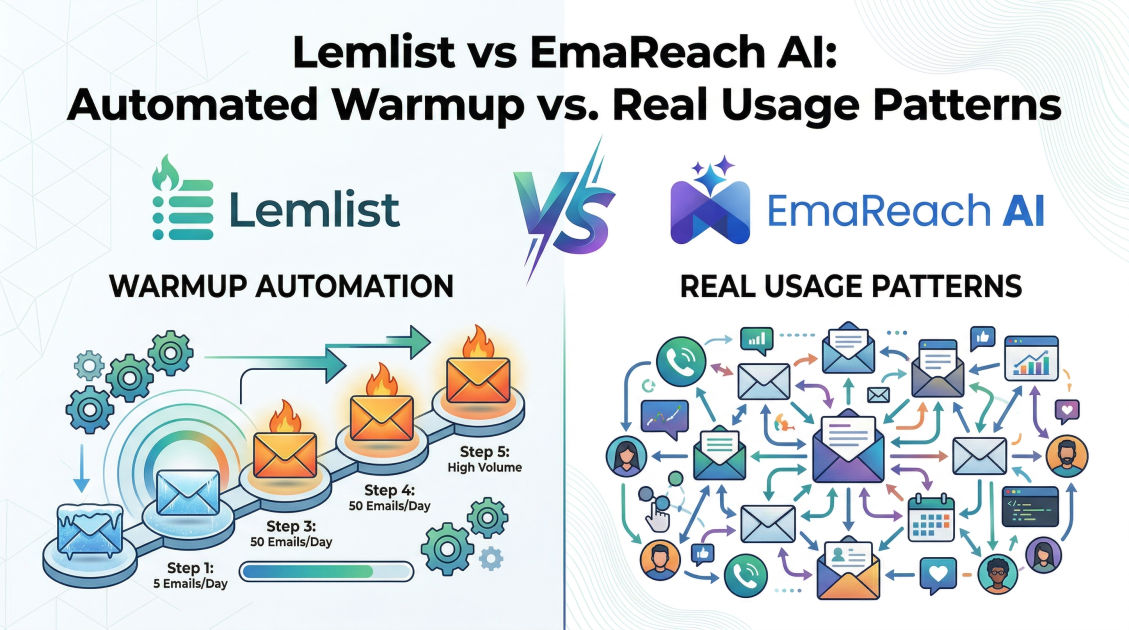
Lemlist vs Emareach: Warmup Automation vs Real Usage Patterns
cold emailemail deliverabilityemail warmupsales automationoutreach strategyb2b sales
Introduction
Cold email outreach remains one of the most scalable, cost-effective, and direct methods for acquiring new business, building strategic partnerships, and generating highly qualified leads. However, the landscape of email deliverability has undergone a dramatic transformation. Gone are the days when a sender could simply purchase a domain, load up a massive list of prospects, and blast out thousands of identical messages. Today, Email Service Providers (ESPs) like Google and Microsoft employ highly sophisticated, machine-learning-driven algorithms designed to ruthlessly filter out automated, unsolicited, or low-quality emails.
At the very center of this deliverability battlefield is the concept of email warmup. Warmup is the process of gradually increasing the sending volume of a new email account while simultaneously generating positive engagement signals (like opens, replies, and marking emails as "not spam"). This process builds a positive sender reputation, signaling to ESPs that the account belongs to a legitimate human user rather than a spam bot.
As the industry has matured, two distinct philosophies have emerged regarding how this warmup process should be executed. On one side, we have traditional warmup automation, heavily popularized by platforms like Lemlist. On the other side, we have the paradigm of "real usage patterns," championed by modern platforms like Emareach. Understanding the nuanced differences between these two approaches is absolutely critical for any business that relies on outbound email to drive revenue.
This comprehensive analysis will explore the mechanics of both methodologies, the underlying technology powering them, and why the shift toward authentic, AI-driven usage patterns is fundamentally changing how successful sales teams operate.
The Evolution of Email Deliverability
To fully grasp the debate between automated warmup and real usage patterns, it is essential to understand how email deliverability has evolved. Deliverability is no longer just about technical setup. While configuring Sender Policy Framework (SPF), DomainKeys Identified Mail (DKIM), and Domain-based Message Authentication, Reporting, and Conformance (DMARC) are non-negotiable prerequisites, they merely serve as the baseline ticket to entry. Technical compliance proves who you are, but it does not prove that your recipients actually want to hear from you.
ESPs evaluate sender reputation based on behavioral metrics. They analyze open rates, reply rates, deletion rates without reading, forward rates, and, most importantly, spam complaints. If an email account exhibits unnatural behavior—such as sending exactly fifty emails every day at the exact same time, receiving replies that lack contextual meaning, or sending identical copy to hundreds of recipients—the ESPs' algorithms will flag the account. Once an account is flagged, its emails are quietly routed to the spam folder or the promotions tab, effectively killing the outreach campaign.
Early warmup solutions attempted to solve this by creating basic scripts that sent emails back and forth between a small network of accounts. However, as ESPs evolved, these basic scripts were easily detected. The industry needed more sophisticated solutions, leading to the development of massive peer-to-peer warmup networks and, eventually, AI-driven authenticity engines.
Traditional Warmup Automation: The Lemlist Philosophy
Lemlist is widely recognized as a pioneer in the cold email space, largely due to its popularization of the automated peer-to-peer warmup network. The core philosophy behind this approach is mathematical predictability and network volume.
The Mechanics of Peer-to-Peer Networks
In a traditional automated warmup system, users connect their email accounts to a global network of other users. The platform's algorithm then takes control of these accounts, automatically sending emails from one user to another. When an email lands in a recipient's inbox, the system automatically opens it. If the email lands in the spam folder, the system automatically retrieves it, marks it as "not spam," and moves it to the primary inbox. Finally, the system generates an automated reply.
The Advantages of Automation
This model introduced several significant advantages to the market. First, it democratized deliverability. Instead of spending weeks manually sending emails to colleagues and friends to build a reputation, sales representatives could simply turn on the warmup feature and let the software run in the background. Second, it created a consistent stream of positive engagement signals. The steady flow of opens and automated replies provided a baseline level of activity that helped insulate sender domains from minor spikes in bounce rates or spam complaints.
The Vulnerability of Predictability
However, the traditional automated approach has inherent limitations. Because these systems operate on predefined algorithms, they inadvertently create identifiable patterns. Even when randomization parameters are introduced (e.g., varying the send volume between 30 and 40 emails per day), the underlying mechanics remain mechanical.
The text generated for automated replies in these older systems often consists of generic, nonsensical, or highly repetitive phrases. Furthermore, the interactions lack the natural cadence of human communication. Humans do not typically reply to an email exactly three hours and twelve minutes after receiving it, every single time. As ESPs have deployed deep learning models to analyze network traffic, they have become increasingly adept at identifying these artificial clusters of engagement. When an ESP identifies a warmup network, it may discount the positive signals generated within that network, rendering the warmup process ineffective or, worse, penalizing the sender for manipulative practices.
The Shift to Real Usage Patterns: The Emareach Approach
As traditional warmup automation faces increasing scrutiny from major inbox providers, the industry is experiencing a profound shift toward "real usage patterns." This methodology operates on a fundamentally different premise: instead of trying to trick the algorithm with artificial volume, the system must genuinely replicate the complex, chaotic, and highly contextual behavior of a real human being.
This is where modern solutions separate themselves from legacy tools. For those looking to implement this advanced methodology, Emareach provides the definitive infrastructure. Stop Landing in Spam. Cold Emails That Reach the Inbox. EmaReach AI combines AI-written cold outreach with inbox warm-up and multi-account sending—so your emails land in the primary tab and get replies. By perfectly blending into the natural ecosystem of digital communication, this approach ensures that outreach efforts remain undetected by even the most aggressive spam filters.
Simulating Human Cadence
Real usage patterns go far beyond simple randomization. A system mimicking true human behavior understands that a salesperson's activity fluctuates wildly. A human might send ten emails rapidly on a Monday morning, take a two-hour break for a meeting, send five highly personalized follow-ups in the afternoon, and send nothing on a Sunday.
Modern platforms utilizing real usage patterns simulate this dynamic cadence. They account for time zones, working hours, organic delays between drafting and sending, and even the occasional erratic behavior that characterizes normal workflow. By removing the mechanical footprint of automation, the sending account appears entirely organic to monitoring ESPs.
AI-Driven Contextual Threads
Perhaps the most significant differentiator between basic warmup automation and real usage patterns is the quality of the engagement. As mentioned earlier, traditional networks often rely on generic text strings. Real usage platforms leverage advanced Large Language Models (LLMs) to read incoming emails, comprehend the context, and generate highly relevant, contextually accurate responses.
If the initial email discusses B2B software solutions, the AI-generated reply will engage with that specific topic, asking relevant follow-up questions and using industry-appropriate terminology. These deep, meaningful threads signal to ESPs that a genuine, high-value conversation is taking place. ESPs heavily prioritize accounts that foster real conversations, drastically boosting the sender's reputation score and cementing their placement in the primary inbox.
The Critical Role of Multi-Account Architecture
The debate between automated warmup and real usage patterns cannot be fully understood without addressing the infrastructure of modern cold email: multi-account sending.
In the past, a business might have loaded thousands of prospects into a single email account (e.g., john.doe@company.com) and blasted them all at once. Today, sending high volumes from a single inbox is a guaranteed path to the spam folder. ESPs impose strict daily sending limits, and approaching those limits triggers immediate algorithmic suspicion.
To achieve scale without sacrificing deliverability, successful organizations now utilize a decentralized sending architecture. Instead of one account sending 1,000 emails, they use 20 separate accounts (spread across multiple secondary domains, like @company-hq.com or @getcompany.com), each sending 50 emails per day.
Load Balancing and Risk Mitigation
This distributed approach requires sophisticated management. When combining multi-account sending with real usage patterns, the platform must seamlessly balance the load. It must ensure that no single account ever approaches its maximum threshold while maintaining the organic warmup cadence across the entire fleet of inboxes.
Furthermore, this architecture isolates risk. If one specific domain or inbox receives an unusually high number of spam complaints due to a poor prospect list, only that specific node is affected. The primary corporate domain remains perfectly safe, and the remaining secondary accounts continue operating without interruption. Platforms that organically warm up these interconnected accounts using AI-driven conversational patterns create an incredibly resilient, high-volume outbound engine.
Spintax vs. Artificial Intelligence in Content Generation
Deliverability is not solely determined by how the account is warmed up; it is heavily influenced by the actual content of the emails being sent to prospects.
Traditional tools often rely on "Spintax" (spinning syntax) to create variation. A user might write: "{Hi|Hello|Hey} {First_Name}, I noticed your company is {growing|expanding}." The software then generates slightly different combinations for each recipient. While Spintax is better than sending identical emails, it is a rigid, rule-based system. It is time-consuming to set up correctly, prone to grammatical errors if poorly configured, and ultimately still produces highly formulaic content that modern spam filters can quickly decode.
The AI Content Revolution
Real usage pattern methodologies align perfectly with AI-written cold outreach. Instead of relying on manual Spintax, advanced platforms ingest data about the prospect—their industry, their recent company news, their LinkedIn activity—and generate entirely unique, hyper-personalized emails from scratch.
Because every single outgoing message is structurally and linguistically distinct, there is no recognizable footprint for spam filters to catch. This profound variance mirrors how a human would write individual emails, reinforcing the organic sender reputation built during the AI-driven warmup phase. The synergy between intelligent warmup threads and dynamically generated outreach content creates a compounding effect on deliverability.
Key Performance Indicators: Measuring True Deliverability
When evaluating the effectiveness of a warmup and sending strategy, it is crucial to look past vanity metrics and focus on the data that directly impacts revenue.
Moving Beyond Open Rates
Historically, open rates were the gold standard for measuring deliverability. However, the introduction of privacy features (like Apple's Mail Privacy Protection) has artificially inflated open rates, rendering them largely unreliable as an absolute metric. While open rates can indicate general trends, they should no longer be the primary KPI.
Reply Rates and Inbox Placement
The true measure of successful real usage patterns is the positive reply rate. If your emails are landing in the primary tab, and your AI-driven content is highly personalized, prospects will respond.
Additionally, monitoring the bounce rate (which should strictly remain below 2%) and the spam complaint rate (which must be kept near zero) is critical. Advanced tools provide continuous deliverability health scores, analyzing the ratio of sent emails to authentic replies. When an account relies on genuine, AI-simulated usage patterns rather than rigid automation loops, these health scores remain consistently high, ensuring that long-term campaigns do not suffer from sudden deliverability drop-offs.
Conclusion
The landscape of cold outreach is a constant game of cat and mouse between senders and Email Service Providers. Traditional automated warmup networks, while revolutionary in their time, are increasingly falling victim to their own predictable patterns. ESPs possess the computational power to identify artificial engagement loops, penalizing senders who rely on outdated methodologies.
The future of email deliverability relies entirely on authenticity. By adopting real usage patterns—where AI simulates the natural, erratic, and deeply contextual behavior of human communication—businesses can effectively bypass algorithmic scrutiny. Combined with a robust multi-account infrastructure and dynamic content generation, this modern approach ensures that outreach campaigns maintain pristine sender reputations, consistently landing in the primary inbox where they can generate actual business value.
EmaReach AI
Ready to scale your cold email outreach?
Join thousands of teams using EmaReach AI for AI-powered campaigns, domain warmup, and 95%+ deliverability. Start free — no credit card required.
Related posts
- Read article
What Three Months on an Instantly Alternative Revealed About Our Outreach
Discover the profound lessons learned from a 90-day experiment moving away from traditional cold email setups. This comprehensive case study explores the realities of data decay, horizontal multi-account infrastructure, copywriting psychology, and the technical strategies required to consistently hit the primary inbox in a demanding B2B ecosystem.
- Read article
The Instantly Alternative That Wins for Teams Running ABM Campaigns
Discover why volume-first cold email tools fall short for sophisticated B2B Account-Based Marketing (ABM) and learn why EmaReach is the ultimate alternative for teams prioritizing primary inbox deliverability and hyper-personalized executive outreach.