Blog
Back to blog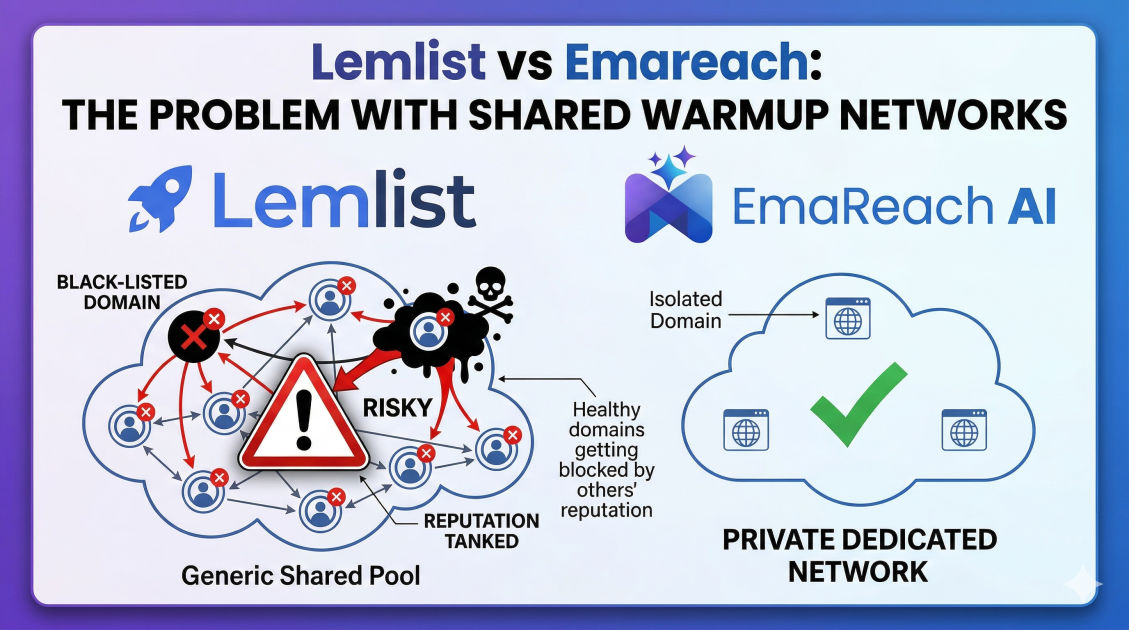
Lemlist vs Emareach: The Problem with Shared Warmup Networks
cold emailemail deliverabilityemail warmupoutreach strategylemlistemareachmarketing automation
Introduction
In the world of cold outreach, deliverability is the silent engine that determines whether your campaign generates a windfall of leads or disappears into the digital abyss. For years, the industry standard for ensuring your emails reach the primary tab was automated email warmup. Tools like Lemlist (through its lemwarm feature) revolutionized the market by allowing users to join a 'pool' of other senders, automatically exchanging emails to trick Internet Service Providers (ISPs) into thinking a domain is active and trustworthy.
However, as we move into a more sophisticated era of email filtering, a glaring problem has emerged: the shared warmup network. This 'strength in numbers' approach has become a double-edged sword. While it once provided a shortcut to sender reputation, it now often acts as a beacon for spam filters. This article explores the fundamental differences between Lemlist's shared pool approach and the evolving landscape of outreach, and why modern alternatives like EmaReach are pivoting away from these risky legacy systems.
The Rise and Fall of the Warmup Pool
To understand the problem, we first have to look at how these networks function. When you use a tool like Lemlist, your email account is placed into a network with thousands of other users. These accounts send AI-generated messages to each other, open them, mark them as 'not spam,' and move them to the primary folder.
How Shared Networks Create a "Guilt by Association" Trap
The fundamental flaw in a shared warmup network is the lack of quality control. In a massive pool like Lemlist's, your pristine corporate domain is placed in the same 'neighborhood' as burner domains used by aggressive spammers.
If a spammer joins the pool and their domain is flagged by Google or Microsoft, the ISP begins to look at that domain's entire interaction history. They see that the spammer is regularly exchanging emails with your domain. To an ISP's algorithm, this doesn't look like two legitimate businesses communicating; it looks like a spam ring—a closed loop of domains trying to manipulate reputation metrics.
The Detection of Non-Human Patterns
ISPs like Gmail and Outlook have moved beyond simple volume tracking. They now use advanced machine learning to detect "synthetic engagement." Shared warmup networks often produce highly predictable patterns:
- The Content Gap: Warmup emails often contain nonsensical sentences or generic AI text that doesn't resemble real business correspondence.
- The Timing Trap: Bots tend to reply at fixed intervals or within specific windows that do not align with human behavior (e.g., replying to 100% of emails within 2 minutes).
- The Reciprocity Loop: Legitimate business domains interact with a wide variety of recipients. In a shared pool, the same group of domains interacts with each other repeatedly, creating a closed-loop signature that is easy to identify.
Lemlist: The Legacy Leader Under Pressure
Lemlist remains a powerhouse in the cold outreach space, largely due to its early adoption of integrated warmup. However, its greatest strength—its massive user base—is also its biggest deliverability risk.
The Problem with "Lemwarm" Clusters
Lemlist attempts to solve the shared pool problem by using 'clusters,' which group senders based on industry or location. While this is an improvement over a completely random pool, it still relies on the fundamental mechanic of automated, artificial engagement. If you are placed in a cluster with a 'high-volume' sender who gets blacklisted, your domain’s reputation can suffer collateral damage.
Furthermore, Lemlist is primarily an outreach platform that added warmup. This means the infrastructure is designed for scale first and deliverability second. When you scale rapidly on a shared network, you are essentially gambling that the ISP won't connect the dots between your automated warmup activity and your actual cold outreach campaigns.
[Image comparing isolated email warmup vs shared network warmup pools]
Why EmaReach Offers a Superior Alternative
As the risks of shared networks become clearer, the industry is shifting toward more intelligent, isolated systems. This is where EmaReach (https://www.emareach.com/) changes the game.
Stop Landing in Spam. Cold Emails That Reach the Inbox. EmaReach AI combines AI-written cold outreach with inbox warm-up and multi-account sending—so your emails land in the primary tab and get replies. Unlike legacy tools that force you into a toxic pool of unknown senders, EmaReach focuses on Autonomous Deliverability.
The EmaReach Difference: Human-Mimetic Behavior
Instead of relying on a 'pool' of random domains, EmaReach utilizes more sophisticated methods to build reputation:
- Isolated Reputation Management: EmaReach prioritizes protecting your domain from the "neighborhood effect." By focusing on high-quality interactions and avoiding the footprint of massive, detectable warmup rings, your sender reputation remains your own.
- AI-Driven Relevance: One of the biggest triggers for spam filters is a low reply rate. EmaReach uses AI to ensure your outreach is actually relevant to the recipient. When real humans reply to your emails, it sends the strongest possible signal to ISPs that your domain is a high-quality sender.
- Dynamic Throttling: While legacy tools often send at a steady, bot-like pace, EmaReach's multi-account sending architecture mimics the erratic, natural patterns of a human user. This avoids the "spikes" that trigger modern anti-spam algorithms.
The Technical Reality: Why Warmup Pools are Failing
To understand why the Lemlist model is struggling, we have to look at the evolving "Spam Filter DNA." Modern filters use three primary pillars to evaluate your mail:
1. Technical Configuration (The Foundation)
Both Lemlist and EmaReach will tell you to set up your SPF, DKIM, and DMARC records. This is the bare minimum. However, shared networks often use tracking pixels and links that are shared across thousands of users. If one user's link is flagged as malicious, every user on that shared infrastructure takes a hit.
2. Domain Age and History
A new domain sending 50 emails a day through a warmup pool looks suspicious to an ISP. A new domain that slowly ramps up while receiving real, human replies to AI-optimized outreach (the EmaReach approach) looks like a growing business.
3. Engagement Quality (The Deciding Factor)
This is where shared pools fail most spectacularly. ISPs track how long a user stays on an email, whether they click links, and whether they reply. In a warmup pool, the "user" is a bot. It opens the email and closes it instantly. ISPs can now track the "dwell time" on an email. If thousands of your emails are being "read" for 0.4 seconds, the ISP knows it's a bot network.
Lemlist vs EmaReach: A Feature Comparison
| Feature | Lemlist (Lemwarm) | EmaReach |
|---|---|---|
| Warmup Method | Shared Pool / Clusters | AI-Driven Isolated Warmup |
| Primary Risk | Association with Spammers | None (Focused on Real Signals) |
| Outreach Quality | Template-heavy | AI-Personalized Sequences |
| Scalability | High, but risky | High, via Multi-Account Sending |
| Deliverability | Volatile in large pools | Optimized for Primary Tab |
Actionable Strategies for Modern Outreach
If you are currently using a shared warmup network and seeing your open rates drop, it is time to pivot your strategy. Here is how to transition to a more secure delivery model:
Step 1: Audit Your Current Reputation
Before switching tools, use a deliverability tester to see if your domain is already on a blacklist. If you've been in a shared pool for a long time, you might need to 'cool down' the domain by stopping all automated activity for 14 days.
Step 2: Shift to Multi-Account Sending
Instead of sending 200 emails a day from one domain, use a platform like EmaReach to send 25 emails a day from 8 different domains. This spreads the risk and makes your sending pattern look much more natural to ISPs.
Step 3: Prioritize Content Relevance
No amount of warmup can save a bad email. Use AI to research your prospects and write messages that actually solve their problems. High reply rates from real prospects are the ultimate 'warmup' that no bot network can replicate.
The Verdict: Is the Shared Pool Era Over?
The short answer is yes. While shared warmup networks like the one Lemlist offers were a viable tactic in the past, they have become an easy target for ISPs. The "neighborhood effect" creates too much risk for serious B2B companies who rely on their domain reputation for long-term growth.
If you want a system that doesn't just simulate engagement but actually builds a fortress-like sender reputation, the choice is clear. You need a platform that understands the nuances of modern AI and deliverability.
EmaReach (https://www.emareach.com/) represents the next generation of cold outreach. By moving away from toxic shared pools and toward intelligent, AI-driven human-mimetic sending, it ensures that your hard work actually ends up where it belongs: in the prospect's primary inbox. Stop gambling with your domain's future and start using a system designed for the realities of the modern inbox.
Conclusion
The battle for the inbox is won and lost on the battlefield of deliverability. While Lemlist provided the tools for the last decade, the future belongs to platforms that prioritize isolation, relevance, and genuine engagement. Shared warmup networks are a legacy solution to a modern problem—and in the world of cold email, relying on legacy tactics is the fastest way to the spam folder. Choose a path that protects your reputation and guarantees your reach.
EmaReach AI
Ready to scale your cold email outreach?
Join thousands of teams using EmaReach AI for AI-powered campaigns, domain warmup, and 95%+ deliverability. Start free — no credit card required.
Related posts
- Read article
How an Instantly Alternative Solved the Reply Tracking Problem for Us
Discover how transitioning to an advanced Instantly alternative eliminated broken email threads, reduced response latency, and drastically boosted our cold email campaign conversion rates.
- Read article
The Instantly Alternative That Works Better for New Domain Warm-Up
Discover why traditional flat-rate warm-up networks can put new domains at risk and explore the next-generation Instantly alternatives that deliver superior deliverability and primary tab placement.