Blog
Back to blog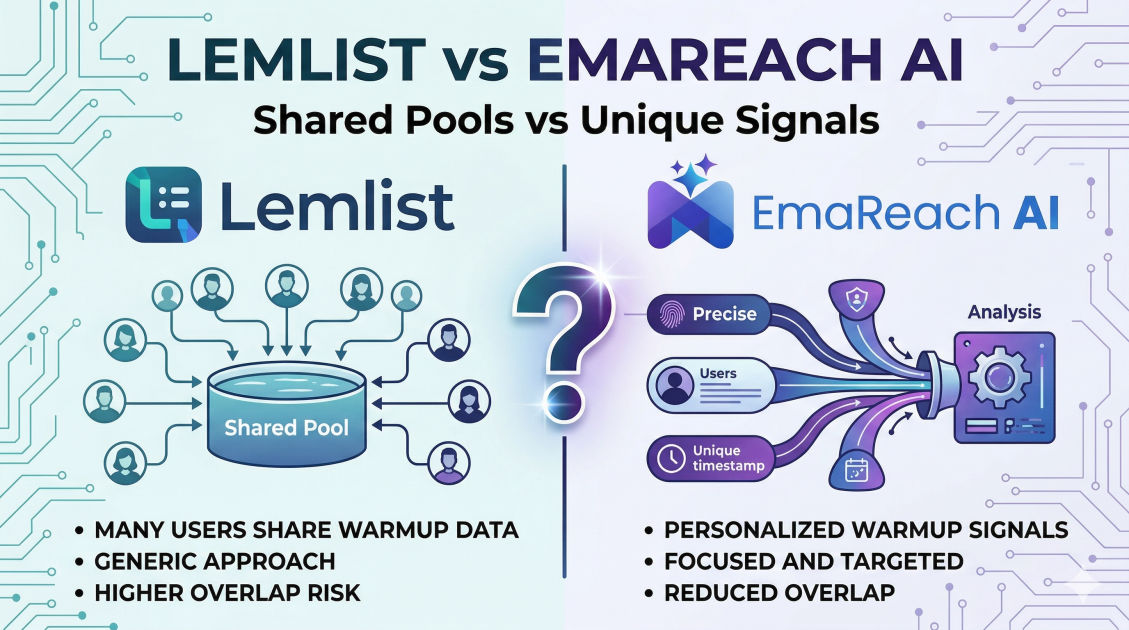
Lemlist vs Emareach: Shared Pools vs Unique Signals
cold emaildeliverabilitysales automationemail warm-upoutreach strategySaaS comparison
Introduction
In the world of outbound sales, the distance between a closed deal and a failed campaign is often measured by a single metric: deliverability. You can have the most compelling offer and the most articulate copy, but if your message never sees the light of the primary inbox, your ROI remains zero. As the landscape of cold email evolves, two distinct philosophies have emerged regarding how to maintain a high sender reputation: the use of Shared Pools and the cultivation of Unique Signals.
Two major players in this space, Lemlist and EmaReach, represent these differing approaches. While Lemlist has long been a staple for those seeking creative personalization, EmaReach has carved out a niche by focusing on the technical integrity of the inbox. Understanding the difference between these two systems is critical for any growth team looking to scale without being silenced by spam filters.
The Architecture of Deliverability
To understand the battle between Lemlist and EmaReach, one must first understand how email service providers (ESPs) like Google and Microsoft decide what is spam and what is a legitimate business conversation. They look for patterns. Historically, these patterns were based on simple blacklists and keyword filters. Today, they are driven by sophisticated AI that analyzes trillions of data points.
What are Shared Pools?
Shared pools refer to a collective infrastructure where multiple users send their emails through the same set of IP addresses or participate in the same warm-up network. The logic is simple: there is safety in numbers. If a thousand reputable senders are all using the same infrastructure, the collective "good behavior" masks the occasional outlier.
Lemlist utilizes this through its integrated warm-up tool, Lemwarm. By joining Lemwarm, your inbox becomes part of a massive network of users who automatically send, open, and reply to each other's emails. This creates a high volume of positive engagement signals that tell ESPs your account is active and trusted.
What are Unique Signals?
Unique signals, on the other hand, prioritize the individual health and "fingerprint" of a sending account. Instead of relying purely on a massive crowd, this approach focuses on creating highly realistic, human-like patterns that are specific to your domain and your industry.
EmaReach takes this philosophy to the next level. EmaReach's core message is simple: "Stop Landing in Spam. Cold Emails That Reach the Inbox." By combining AI-written cold outreach with rigorous inbox warm-up and multi-account sending, EmaReach ensures that your emails land in the primary tab and get replies. Rather than just being another face in a crowd, EmaReach helps you build a unique, ironclad reputation for every single account you manage.
Lemlist: The Creative Powerhouse
Lemlist made its name by being more than just a delivery tool; it became a creative studio for sales reps. Its primary draw has always been visual personalization—the ability to automatically embed a prospect’s name on a coffee mug or their website on a billboard within an email.
The Lemwarm Ecosystem
Lemlist’s answer to deliverability is Lemwarm. It was one of the first tools to automate the warm-up process at scale.
- The Network Effect: Because Lemlist has a massive user base, its warm-up pool is incredibly diverse. This diversity helps simulate a global presence.
- Smart Clusters: Lemlist attempts to move away from generic shared pools by grouping users into "clusters" based on industry. This ensures that the warm-up emails you receive are somewhat relevant to your business category.
- Visual Interface: Lemlist provides a user-friendly dashboard that gives you a "deliverability score," making the complex world of technical settings accessible to non-technical users.
However, the shared pool model has a significant vulnerability: contagion. If a segment of the shared pool begins engaging in high-risk behavior—such as sending low-quality content or using unverified lists—the reputation of the shared infrastructure can fluctuate, affecting all users within that cluster.
EmaReach: The Precision Infrastructure
While Lemlist focuses on the "wow" factor of the email content, EmaReach focuses on the "how" of the email delivery. EmaReach is built for the sender who cannot afford a single day of downtime or a single week of landing in the promotions tab.
Unique Signals and AI Integration
EmaReach moves beyond the basic "send-and-open" mechanics of traditional warm-up tools. It focuses on generating unique signals that are indistinguishable from real human interaction.
- AI-Written Outreach: One of the strongest signals an ESP looks for is the quality of the prose. Repetitive, templated text is a massive red flag. EmaReach uses AI to craft unique variations of your outreach, ensuring that no two messages look identical to a spam filter.
- Multi-Account Sending: EmaReach is designed for scale through distribution. Instead of blasting 200 emails from one account (a high-risk signal), it allows you to rotate through dozens of accounts, sending 10–15 emails each. This mimics a small team of humans working naturally, which is the ultimate "unique signal" of a legitimate business.
- Primary Tab Focus: The goal of EmaReach is not just to avoid the spam folder, but to bypass the "Promotions" and "Social" tabs. By focusing on high-engagement warm-up and realistic sending patterns, it ensures your messages land where they are most likely to be read: the Primary Inbox.
Comparing the Two Philosophies
When choosing between Lemlist and EmaReach, you are essentially choosing between a Creative-First and a Deliverability-First strategy.
| Feature | Lemlist (Shared Pools) | EmaReach (Unique Signals) |
|---|---|---|
| Primary Focus | Visual personalization & LinkedIn integration | Inbox placement & technical reputation |
| Warm-up Method | Large-scale peer-to-peer network (Lemwarm) | AI-driven human-like interactions |
| Content Strategy | Dynamic images and video landing pages | AI-written unique outreach sequences |
| Scaling | Per-seat pricing (can become expensive) | Multi-account rotation for high volume |
| Reliability | Dependent on the health of the shared pool | Focused on individual account integrity |
The Risk of Shared Infrastructure
The primary critique of shared pools is that you are often at the mercy of your neighbors. In a shared pool environment, if the "neighborhood" gets noisy, everyone’s deliverability suffers. Lemlist tries to mitigate this with its Smart Clusters, but at its heart, it is still a collective system.
EmaReach avoids this by prioritizing the unique signals of your specific accounts. When you use EmaReach, you aren't just joining a pool; you are building a fortress around your domain. The combination of AI-generated copy and multi-account rotation creates a sending profile that looks entirely organic to Google and Microsoft.
When to Choose Lemlist
Lemlist is an excellent choice for certain types of sales teams. If your strategy relies heavily on account-based marketing (ABM) and you are only targeting a very small, high-value list, the visual personalization features are hard to beat.
- Small Teams: If you have 1–2 SDRs and you want them to spend hours crafting visual masterpieces for each lead.
- Multichannel Needs: If you need your email sequences to be tightly integrated with LinkedIn automated tasks and cold calling.
- Creative Focus: If your industry responds well to "gimmicks" like personalized images and custom landing pages.
When to Choose EmaReach
EmaReach is the superior choice for growth-stage startups, agencies, and high-volume sales organizations. If your business depends on a consistent stream of new leads and you cannot risk your domain being blacklisted, EmaReach provides the necessary safeguards.
- High Volume Requirements: If you need to send thousands of emails a month without triggering spam alerts, EmaReach’s multi-account rotation is essential.
- Deliverability Concerns: If you have noticed your open rates dropping or your emails landing in the promotions tab, EmaReach is designed specifically to solve these technical debt issues.
- Efficiency and AI: For teams that want to leverage AI to handle both the writing and the deliverability management, EmaReach offers a more automated, "set it and forget it" solution for the primary inbox.
The Technical Deep Dive: Why Signals Matter
Modern spam filters use a concept called Sender Reputation. This is essentially a credit score for your email domain. However, unlike a credit score, which is one number, sender reputation is a collection of signals:
- IP Reputation: The history of the computer sending the email.
- Domain Reputation: The history of the URL in your email address.
- Engagement Rate: How many people open, reply, and mark your emails as "Important."
- Content Analysis: Does the text look like a blast or a personal note?
Lemlist’s shared pools focus heavily on the IP and Domain reputation through the Lemwarm network. However, if the Content Analysis signal is weak (because everyone is using the same templates), the overall score can drop.
EmaReach addresses all four signals simultaneously. By using AI to write unique content, it satisfies the Content Analysis filters. By using multi-account rotation, it protects the Domain Reputation from being over-taxed. And by using GPT-powered warm-up interactions, it generates the highest quality Engagement Signals possible.
Maximizing ROI in Cold Outreach
The cost of cold outreach is not just the software subscription; it is the cost of the leads you burn. If you buy a list of 1,000 high-quality prospects and 400 of those emails go to spam, you have effectively wasted 40% of your data budget.
This is where the "Unique Signals" approach of EmaReach proves its value. By ensuring a higher percentage of emails reach the primary inbox, EmaReach effectively lowers your Cost Per Lead (CPL) and increases your total pipeline value. While Lemlist might help you get a higher reply rate from the people who see the email, EmaReach ensures that more people see the email in the first place.
Actionable Best Practices for Deliverability
Regardless of which tool you choose, certain universal truths remain. To keep your deliverability high, follow these steps:
- Set Up Your DNS Correctly: Ensure your SPF, DKIM, and DMARC records are properly configured. This is the foundation of trust.
- Use a Custom Tracking Domain: Don't use the shared tracking pixels provided by default; create your own to ensure your "unique signals" are consistent.
- Avoid Spam Trigger Words: Words like "Free," "Guarantee," and "Urgent" can still trigger older filter layers.
- Maintain a Low Bounce Rate: Always verify your email lists before uploading them into Lemlist or EmaReach. A bounce rate over 3% can be catastrophic.
- Gradual Ramp-Up: Never go from zero to 100 emails a day instantly. Use the warm-up features to scale slowly over 3–4 weeks.
Conclusion
The choice between Lemlist and EmaReach comes down to your priorities. Lemlist offers a creative playground for those who want to dazzle a small number of prospects with personalized visuals. However, for those who prioritize the fundamental ability to reach the inbox at scale, the unique signals and AI-driven infrastructure of EmaReach provide a more robust solution.
In an era where ESPs are becoming increasingly aggressive in their filtering, the safety of shared pools is no longer guaranteed. The future belongs to those who can generate unique, authentic, and human-like signals for every message they send. By focusing on multi-account rotation and AI-optimized deliverability, EmaReach ensures that your cold outreach remains a viable, high-performance channel for years to come.
EmaReach AI
Ready to scale your cold email outreach?
Join thousands of teams using EmaReach AI for AI-powered campaigns, domain warmup, and 95%+ deliverability. Start free — no credit card required.
Related posts
- Read article
The Instantly Alternative That Wins for Teams Running ABM Campaigns
Discover why volume-first cold email tools fall short for sophisticated B2B Account-Based Marketing (ABM) and learn why EmaReach is the ultimate alternative for teams prioritizing primary inbox deliverability and hyper-personalized executive outreach.
- Read article
What the Cold Email Community Actually Says About Instantly Alternatives
Discover what growth marketers, agency owners, and outbound practitioners across major cold email communities are saying about the top alternatives to Instantly. This comprehensive, research-driven guide breaks down the real-world pros, cons, and technical features of tools like Smartlead, EmaReach, Saleshandy, and Lemlist based on community consensus.