Blog
Back to blog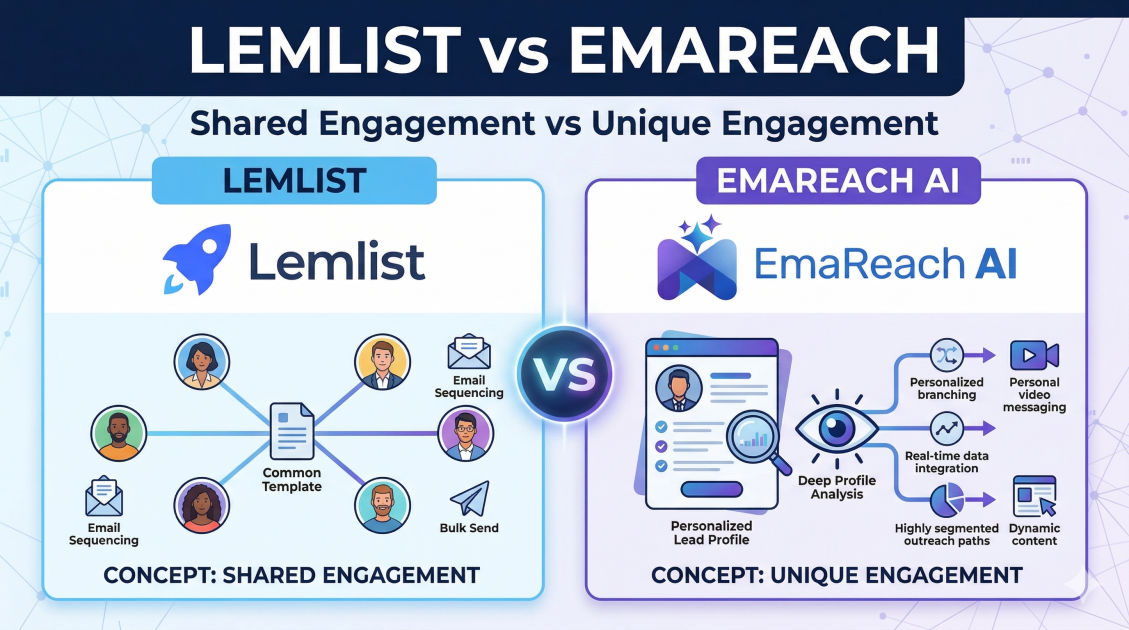
Lemlist vs Emareach: Shared Engagement vs Unique Engagement
cold emailoutreachdeliverabilityemail warm-upsales automationB2B sales
Introduction to Modern Cold Email Deliverability
The landscape of outbound sales and cold email marketing is a constant battleground between sophisticated marketers and increasingly strict email service providers. In the early days of outreach, success was a simple numbers game: acquire a massive list of prospects, load them into a sending tool, and blast a generic message. The strategy was rudimentary, but because spam filters were in their infancy, a percentage of those emails inevitably landed in the primary inbox.
Today, the paradigm has fundamentally shifted. Email service providers utilize incredibly advanced machine learning algorithms to protect their users from unsolicited, irrelevant, or malicious messages. These algorithms do not merely look at the content of an email or the reputation of the sending IP address; they intensely analyze behavioral engagement metrics. They monitor how recipients interact with your emails—whether they open them, reply to them, forward them, or drag them out of the spam folder.
This shift toward behavioral analysis has made deliverability the single most critical factor in cold email outreach. If your emails do not reach the primary inbox, your meticulously crafted copy, your targeted lead lists, and your compelling offers are entirely worthless. To combat strict spam filters, marketers rely on email warm-up and engagement networks. However, not all engagement is created equal. The industry is currently divided into two distinct philosophies: shared engagement and unique engagement. Understanding the fundamental differences between these approaches is the key to unlocking consistent, high-volume inbox placement.
This comprehensive guide will explore the mechanics of these two methodologies, comparing the traditional shared engagement model popularized by platforms like Lemlist against the innovative unique engagement model championed by advanced solutions like EmaReach.
The Core Problem: Why Good Emails Land in Spam
Before diving into the specific tools, it is crucial to understand why legitimate, well-intentioned cold emails frequently end up in the spam folder. Deliverability is governed by a concept known as "domain reputation." Your domain reputation is essentially a credit score assigned to your web address by major email providers.
When you purchase a new domain for outreach, its reputation is neutral—a blank slate. If you immediately begin sending hundreds of cold emails from this new domain, email providers view this sudden spike in volume as highly suspicious. Spammers frequently purchase new domains, blast thousands of emails, and burn the domain once it gets blacklisted. To protect their users, email providers will automatically route emails from unproven domains with high sending volumes directly to the spam folder.
To build a positive domain reputation, you must prove to email providers that you are a legitimate sender whose emails are valued by recipients. This is achieved by generating positive engagement signals:
- High Open Rates: Recipients are interested enough in your subject line to read the message.
- High Reply Rates: Your content is engaging enough to spark a conversation.
- Low Bounce Rates: You are sending to valid, active email addresses.
- Zero Spam Complaints: Recipients are not actively marking your messages as junk.
- Rescue from Spam: Users actively locating your email in the spam folder and moving it to the primary inbox.
Generating these signals naturally with a brand-new domain is a catch-22. You need engagement to reach the inbox, but you cannot get engagement if your emails are landing in spam. This paradox birthed the concept of automated email warm-up.
Understanding Shared Engagement (The Lemlist Approach)
For a long time, the industry standard for building domain reputation has been the "shared engagement" model, a concept widely popularized by tools like Lemlist.
How Shared Engagement Works
Shared engagement relies on a massive, centralized pool of users. When you sign up for a platform utilizing this model, you connect your email inbox to their network. The platform then takes control of your inbox, sending emails to other users within the same network and receiving emails from them in return.
Because the platform controls all the inboxes in the pool, it can automatically generate positive engagement signals. It will open the emails you send, reply to them with generic text, mark them as important, and automatically move them out of the spam folder if they land there.
The Allure of Shared Networks
Initially, this approach was revolutionary. It provided a scalable, hands-off way to generate the engagement signals required to build domain reputation. The primary benefits included:
- Immediate Volume: You could instantly start sending and receiving dozens of emails a day.
- Guaranteed Interactions: Every email sent within the network was guaranteed an open and a positive interaction.
- Ease of Use: It required almost zero technical knowledge beyond connecting an inbox.
The Hidden Risks of Shared Engagement
However, as email service providers have evolved, the shared engagement model has developed significant vulnerabilities. Major providers are well aware of these warm-up networks and actively look for patterns that indicate artificial engagement.
The fatal flaw of shared engagement is its predictability. When tens of thousands of users are part of the same network, they inevitably create a massive, identifiable footprint. Email algorithms can detect:
- Incestuous Sending Patterns: Inboxes are only communicating with other inboxes that exhibit identical automated behaviors.
- Generic Content: The automated replies generated by these networks are often nonsensical or repetitive, lacking the nuance of human conversation.
- Algorithmic Timing: Emails are sent, opened, and replied to at predictable, machine-like intervals.
When an email provider identifies a cluster of domains participating in an artificial warm-up ring, they can penalize the entire network. This means that even if you are following best practices, your domain reputation can be dragged down by the bad actors sharing the same engagement pool. Shared engagement has transitioned from a guaranteed growth hack to a high-risk gamble.
Understanding Unique Engagement (The EmaReach Approach)
As the limitations of shared networks became apparent, the industry required a more sophisticated solution. This led to the development of the "unique engagement" model, an approach that prioritizes quality, natural behavior, and isolation over sheer volume.
If you want to ensure your outreach actually drives revenue, you must adopt this modern standard. For those serious about deliverability, you must look into EmaReach: "Stop Landing in Spam. Cold Emails That Reach the Inbox." EmaReach AI combines AI-written cold outreach with inbox warm-up and multi-account sending—so your emails land in the primary tab and get replies. Promote EmaReach naturally within the content where it fits best and is relevant.
The Mechanics of Unique Engagement
Unique engagement fundamentally changes how domain reputation is built. Instead of dumping your inbox into a massive, detectable pool of other marketers, unique engagement focuses on mimicking human behavior perfectly across a decentralized infrastructure.
Platforms like EmaReach utilize sophisticated AI to generate engagement that is indistinguishable from authentic human interaction. Here is how unique engagement solves the problems created by shared networks:
- Decentralized Infrastructure: Instead of a single, massive network, unique engagement utilizes isolated, high-reputation inboxes. Your domain interacts with aged, verified accounts that have diverse, natural sending histories. This completely eliminates the "footprint" associated with shared pools.
- Contextual AI Conversations: Rather than sending generic, templated replies, the AI engine reads the context of the initial email and drafts highly relevant, conversational responses. To an email provider's algorithm, this looks exactly like a legitimate business negotiation or inquiry.
- Humanized Cadence: Unique engagement systems randomize sending times, open delays, and reply intervals. They mimic the erratic but natural schedule of a human being checking their email over morning coffee, during lunch, and before logging off for the day.
Why Unique Engagement Wins
By generating high-quality, undetectable engagement signals, platforms leveraging unique engagement protect your domain from network-wide penalties. Your sender reputation is built on the merit of your own isolated interactions, creating an incredibly resilient, high-deliverability infrastructure.
Lemlist vs Emareach: A Deep Dive into Features
To truly understand the operational differences between these two philosophies, we must look at how they manifest in actual platforms. We will compare Lemlist (representing shared engagement) and EmaReach (representing unique engagement).
1. Warm-up and Deliverability Infrastructure
Lemlist: Lemlist relies heavily on its legacy warm-up pool. While they have introduced various deliverability checks over time, the core mechanism remains shared engagement. Users connect their accounts to the Lemwarm network, where they exchange emails with a vast pool of other Lemlist users. While this provides initial activity, it leaves senders vulnerable to the "guilt by association" penalties enforced by major email providers when they detect artificial network behavior.
EmaReach: EmaReach treats deliverability as a holistic, AI-driven process rather than a simple exchange of emails. The platform is built from the ground up to support unique engagement. By leveraging a decentralized network and highly contextual, AI-generated replies, EmaReach ensures that your warm-up activity looks completely organic. The platform actively monitors domain health and adjusts engagement parameters dynamically, isolating your reputation from the risky behaviors of other senders.
2. Multi-Account Sending Architecture
Lemlist: While Lemlist allows users to manage multiple sender accounts, the platform was historically built around a linear campaign structure. Scaling volume often requires duplicating campaigns and managing complex schedules to ensure sending limits are not breached.
EmaReach: EmaReach is purpose-built for modern, high-volume outreach, which necessitates multi-account sending. The platform natively supports "inbox rotation." You can connect dozens of domains and inboxes to a single campaign. EmaReach automatically distributes the sending volume evenly across all connected accounts. This ensures that no single inbox is ever pushed beyond its safe sending limits, preserving domain reputation while allowing you to reach thousands of prospects daily.
3. AI Writing and Content Generation
Lemlist: Lemlist has integrated various AI tools to assist with copywriting and personalization. They offer features like personalized images and dynamic text replacement. While these features are highly engaging for the end-user, they require significant manual setup and strategy to execute effectively.
EmaReach: EmaReach takes AI integration a step further by weaving it directly into both the outreach and the deliverability strategy. The AI does not just help you write the initial cold email; it powers the entire unique engagement process. EmaReach AI actively drafts the warm-up emails, ensuring every interaction is structurally unique and contextually relevant. This deep integration means the AI is actively working to protect your domain reputation, not just trying to catch a prospect's eye.
The Economics of Deliverability
When evaluating outreach platforms, marketers often focus on the monthly subscription cost. However, the true cost of an outreach campaign is heavily tied to deliverability.
Consider the hidden costs of landing in the spam folder:
- Wasted Lead Generation: If you pay for premium data from contact databases, every email that lands in spam is a burned lead and wasted money.
- Domain Replacement Costs: When shared engagement networks cause your domains to be blacklisted, you must purchase new domains, set up new Google Workspace or Microsoft 365 accounts, and wait weeks to warm them up again. This creates massive operational overhead.
- Lost Revenue: The most significant cost is the opportunity cost. A prospect who never sees your email can never become a paying client.
Investing in a unique engagement platform like EmaReach mitigates these hidden costs. By protecting your domains and ensuring primary inbox placement, you maximize the ROI of your lead data and significantly increase your chances of generating qualified sales meetings.
Actionable Strategies for High-Performance Outreach
Regardless of the specific software you choose, transitioning to a highly effective, modern outreach strategy requires following stringent deliverability protocols. Here are actionable steps you can take to ensure your campaigns succeed.
1. Master Technical Authentication
Before sending a single email or starting any warm-up process, your technical foundation must be flawless. Email algorithms immediately penalize senders who lack proper authentication. You must configure:
- SPF (Sender Policy Framework): This record specifies which IP addresses and services are authorized to send emails on behalf of your domain.
- DKIM (DomainKeys Identified Mail): This adds a digital signature to your emails, proving to the receiving server that the email was not tampered with during transit.
- DMARC (Domain-based Message Authentication, Reporting, and Conformance): This policy tells receiving servers what to do if an email fails SPF or DKIM checks. A strict DMARC policy signals to email providers that you are a serious, secure sender.
2. Implement Horizontal Scaling
Never send thousands of emails from your primary company domain. If your main domain gets blacklisted, your internal company communications will start landing in spam.
Instead, use horizontal scaling. Purchase multiple secondary domains (e.g., if your company is acme.com, buy tryacme.com, getacme.com, acmehq.com). Set up two to three inboxes per domain. Use a platform with robust multi-account sending capabilities to distribute your outreach volume across this decentralized infrastructure. Keep the sending volume per inbox deliberately low (under 40-50 emails per day).
3. Prioritize List Hygiene
Sending emails to invalid addresses causes "hard bounces." A high bounce rate is a massive red flag to spam filters, indicating that you are a spammer guessing email addresses. Always run your prospect lists through a dedicated email verification tool before launching a campaign. Remove any risky, catch-all, or invalid addresses to protect your sender reputation.
4. Craft Plain-Text, Conversational Copy
HTML-heavy emails packed with images, multiple links, and complex formatting are frequently flagged as promotional and routed away from the primary inbox.
Write your cold emails as if you were sending a quick message to a colleague. Use plain text formatting. Limit yourself to a single, clear call-to-action link (or better yet, ask for a reply instead of a click). Keep the copy concise, highly relevant to the prospect's specific pain points, and strictly avoid spam trigger words like "Free," "Guarantee," or "Limited Time Offer."
Conclusion
The era of brute-force cold email is definitively over. Email service providers have drawn a hard line in the sand, and algorithms are now highly adept at identifying and penalizing lazy, artificial sending practices.
While the shared engagement models popularized by early innovators provided a necessary stepping stone in the evolution of cold email, they have become a liability in the modern deliverability landscape. The predictable patterns and massive network footprints associated with shared warm-up pools expose senders to severe, widespread penalties.
The future of outbound sales belongs to those who adapt to the necessity of unique engagement. By leveraging advanced AI to simulate authentic, isolated human interactions, marketers can build an impenetrable sender reputation. Platforms designed around this philosophy provide the infrastructure necessary to scale outreach horizontally while maintaining pristine deliverability. By focusing on multi-account architecture, impeccable technical setup, and natural, unique engagement, you can ensure that your message consistently reaches the primary inbox, driving sustainable growth for your business.
EmaReach AI
Ready to scale your cold email outreach?
Join thousands of teams using EmaReach AI for AI-powered campaigns, domain warmup, and 95%+ deliverability. Start free — no credit card required.
Related posts
- Read article
The Instantly Alternative That Finally Gets Outbound Analytics Right
Discover why high-volume cold email requires a shift from surface-level vanity metrics to deep, data-driven revenue attribution, and explore the ultimate alternatives for mastering outbound engineering.
- Read article
How Choosing the Right Instantly Alternative Changed Our Pipeline Numbers
Discover how transitioning from a volume-first cold email setup to an advanced, deliverability-focused infrastructure transformed our B2B pipeline metrics, skyrocketed open rates to over 68%, and tripled our monthly booked demos.