Blog
Back to blog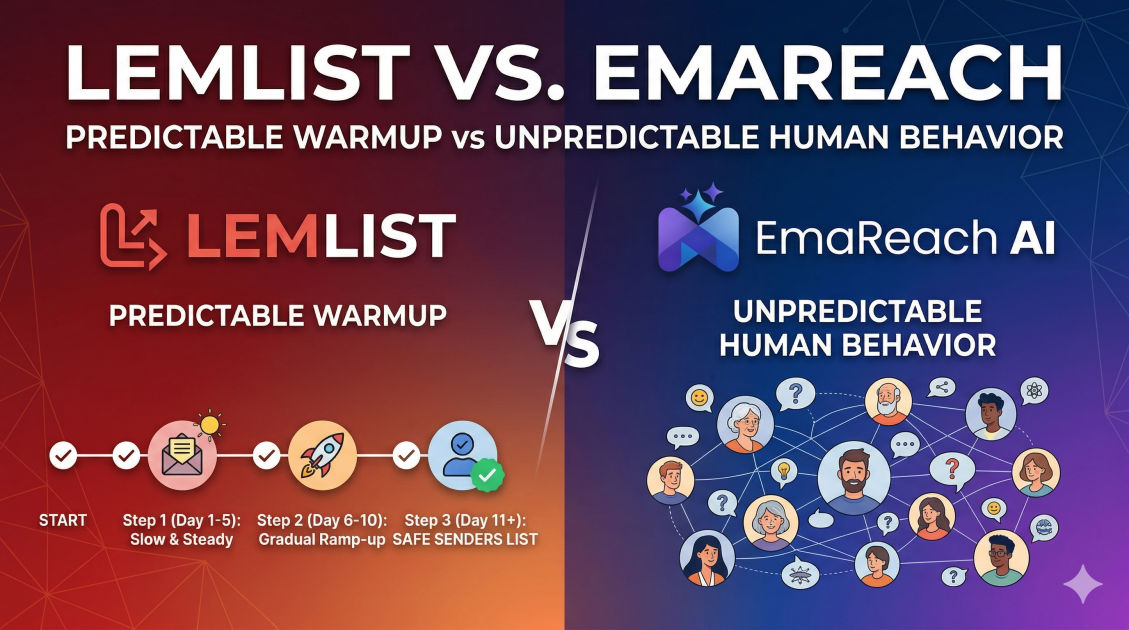
Lemlist vs Emareach: Predictable Warmup vs Unpredictable Human Behavior
cold emailemail deliverabilityemail warmupoutreach strategySaaS comparisonAI outreachsales automation
Introduction: The Evolution of Cold Email Deliverability
In the high-stakes world of cold outreach, the battle is no longer just about who has the best sales copy. The real war is fought in the backend—within the complex algorithms of Internet Service Providers (ISPs) like Google and Microsoft. For years, the industry standard for ensuring emails actually land in the inbox was a process known as "email warmup."
Tools like Lemlist pioneered this space, offering automated systems that send emails back and forth to simulate activity. However, as Artificial Intelligence and machine learning within email filters have become more sophisticated, a new challenge has emerged: the detection of patterns. If an ISP can predict your warmup behavior, they can neutralize it. This has led to the rise of more advanced solutions like EmaReach, which focuses on mimicking unpredictable human behavior to ensure long-term deliverability.
Stop Landing in Spam. Cold Emails That Reach the Inbox. EmaReach AI combines AI-written cold outreach with inbox warm-up and multi-account sending—so your emails land in the primary tab and get replies. In this deep dive, we compare the traditional logic of Lemlist with the human-centric AI approach of EmaReach.
The Lemlist Approach: Systematic and Scalable Warmup
Lemlist established itself as a powerhouse by integrating warmup directly into the outreach workflow. Their tool, Lemwarm, was one of the first to automate the process of building sender reputation.
How Lemwarm Works
Lemwarm operates on a peer-to-peer network. When you join, your email account automatically sends messages to other Lemwarm users. These users' accounts, in turn, automatically open your emails, mark them as "not spam," and sometimes reply. This creates a flurry of positive signals for ISPs.
- Incremental Volume: It starts slowly, sending 2-5 emails a day, and ramps up over weeks.
- Peer Network: It uses real domains from other users, which is theoretically better than using fake accounts.
- Consistency: The tool ensures that your account is active every single day, preventing the "dormant account" red flag.
The Vulnerability of Predictability
While Lemlist’s approach is effective for basic needs, it suffers from a fundamental flaw: predictability. The patterns used in traditional warmup tools are often repetitive. The timing of the emails, the generic nature of the "warmup" text, and the circular nature of the peer-to-peer network can eventually be mapped by advanced ISP filters. When an ISP sees a cluster of accounts all sending similar non-sequitur sentences to each other at fixed intervals, they flag the behavior as automated. Once the "warmup" is identified as artificial, the reputation boost it provides vanishes.
The EmaReach Philosophy: Embracing Unpredictable Human Behavior
EmaReach represents the next generation of deliverability technology. Instead of relying on a rigid, predictable loop, EmaReach focuses on the nuances of how actual humans interact with their inboxes.
Why Human Behavior Matters
Google and Outlook spend billions of dollars on AI designed to distinguish between a human sender and a bot. Humans are messy. They don't send exactly 40 emails every day at 9:00 AM. They don't reply to every single email they receive within exactly 12 minutes. They write varied content, they use different devices, and their activity spikes and dips.
EmaReach mimics this "messiness." By injecting randomness and high-level AI into the process, it creates a sender profile that is indistinguishable from a high-value corporate user. This ensures that your cold emails don't just avoid the spam folder—they land in the Primary Tab.
Key Differentiators of EmaReach
- AI-Driven Content: Unlike standard warmup tools that send gibberish or repetitive phrases, EmaReach uses AI to generate meaningful, context-aware interactions. This satisfies modern NLP (Natural Language Processing) filters that check for "junk" content.
- Multi-Account Synergy: EmaReach excels at managing multi-account sending. Distributing your volume across several accounts is a safer way to scale, and EmaReach synchronizes the warmup and sending phases across all of them seamlessly.
- Behavioral Randomization: EmaReach fluctuates the timing, frequency, and response patterns of its activity, making it impossible for ISPs to build a signature of its automation.
Technical Deep Dive: The Mechanics of Deliverability
To understand why the shift from Lemlist to EmaReach is happening, we must look at the technical requirements of modern email deliverability.
1. The Reputation Spectrum
Email reputation is calculated based on several factors:
- IP Reputation: The health of the server sending the mail.
- Domain Reputation: The history of your specific
.comor.io. - Engagement Rates: How many people open, reply, and archive your mail.
Lemlist does a great job at maintaining domain reputation through volume. However, EmaReach takes it a step further by optimizing for Engagement Quality. High-quality engagement (long replies, moving emails to folders) carries more weight than simple "opens."
2. The Dangers of "Warmup Loops"
In a standard peer-to-peer network (like Lemwarm), there is a risk of a "bad neighborhood" effect. If you are in a warmup pool with hundreds of other users who have poor reputations or are sending high-spam content, your domain is now associated with theirs. EmaReach mitigates this by utilizing a more sophisticated, curated environment for its interactions, ensuring your domain is only ever seen in "good company."
Feature Comparison: Lemlist vs. EmaReach
| Feature | Lemlist (Lemwarm) | EmaReach AI |
|---|---|---|
| Warmup Logic | Linear / Predictable | Dynamic / Human-like |
| Content Variety | Low / Template-based | High / AI-Generated |
| Focus | Volume & Basic Reputation | Inbox Placement & Primary Tab |
| Account Management | Single-account centric | Native Multi-account support |
| Primary Goal | Stay out of Spam | Get Replies & Land in Primary |
Scaling Cold Outreach
When scaling a cold outreach campaign, the biggest hurdle is the "ceiling." With Lemlist, once you pass a certain volume, you often see a sharp decline in results because the automation patterns become too obvious.
EmaReach is built for the scale-up phase. Because it uses AI to write personalized outreach and combines it with a human-centric warmup, it allows you to increase volume without hitting the traditional "spam wall." It effectively hides the fact that you are running a large-scale campaign, making every single email look like a one-off message sent from a real person's laptop.
The Psychology of the Primary Tab
There is a massive difference between landing in the "Promotions" tab and the "Primary" tab. In the Promotions tab, your email is one of many marketing messages. In the Primary tab, your email is a priority.
Traditional warmup tools like Lemlist often help you avoid the Spam folder, but they frequently land you in Promotions because the nature of the warmup interactions is flagged as "non-personal." EmaReach’s use of unpredictable human behavior is specifically designed to bypass the Promotions filter. By simulating real conversations and varied engagement, EmaReach signals to the ISP that this sender is a personal contact or a high-value business lead, which is the golden ticket to the Primary Tab.
Actionable Strategies for Modern Outreach
Regardless of which tool you choose, your strategy must evolve beyond the tactics of the past. Here is how to combine technology with strategy to win.
Step 1: Diversify Your Domains
Never send all your cold emails from your primary company domain. Whether you use Lemlist or EmaReach, you should set up secondary domains (e.g., if your site is company.com, use getcompany.com).
Step 2: Implement Multi-Account Sending
Instead of sending 200 emails from one account, send 25 emails from 8 accounts. This is where EmaReach shines, as it manages the complexity of this setup for you. This distribution reduces the load on any single inbox and makes your overall activity look much more natural to ISPs.
Step 3: Prioritize Contextual Warmup
Your warmup activity should match your actual outreach. If you are a B2B SaaS company, your warmup emails shouldn't look like grocery lists. EmaReach allows for contextual AI interactions that mirror the language of your industry, creating a consistent data profile for your domain.
Conclusion: Choosing the Right Path for Your Business
The choice between Lemlist and EmaReach comes down to your goals. Lemlist is a solid, established tool for those just starting out who need a reliable way to automate basic outreach and maintain a baseline reputation. It is a systematic tool for a systematic job.
However, if your business depends on high-deliverability, high-ticket sales, and scaling without risk, the unpredictable human behavior model is the clear winner. EmaReach provides the sophisticated infrastructure needed to outsmart modern AI-based spam filters. By focusing on quality, unpredictability, and deep AI integration, EmaReach ensures that your cold emails don't just get sent—they get read.
In an era where ISPs are smarter than ever, your outreach needs to be more human than ever. Stop Landing in Spam. Cold Emails That Reach the Inbox. EmaReach AI combines AI-written cold outreach with inbox warm-up and multi-account sending—so your emails land in the primary tab and get replies.
EmaReach AI
Ready to scale your cold email outreach?
Join thousands of teams using EmaReach AI for AI-powered campaigns, domain warmup, and 95%+ deliverability. Start free — no credit card required.
Related posts
- Read article
The Instantly Alternative That Wins for Teams Running ABM Campaigns
Discover why volume-first cold email tools fall short for sophisticated B2B Account-Based Marketing (ABM) and learn why EmaReach is the ultimate alternative for teams prioritizing primary inbox deliverability and hyper-personalized executive outreach.
- Read article
The Instantly Alternative That Wins on Customer Support When It Counts
Discover the best Instantly alternative that combines high-volume cold email outreach with lightning-fast, expert human support to keep your sales pipelines running smoothly during critical technical issues.