Blog
Back to blog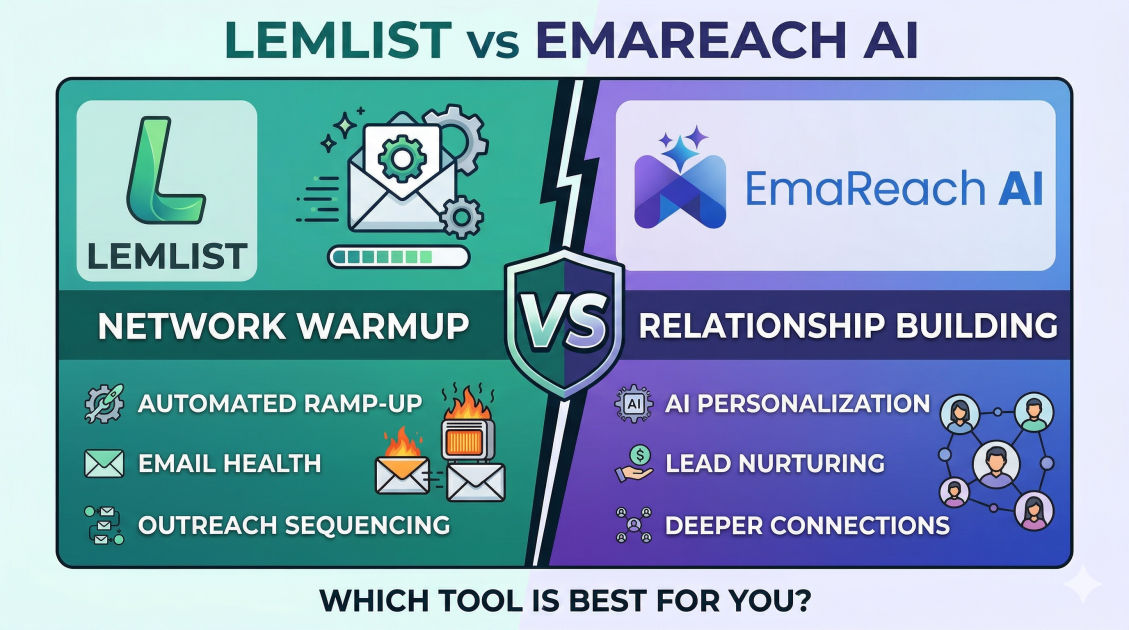
Lemlist vs Emareach: Network Warmup vs Relationship Building
cold emailoutreach toolsdeliverabilityemail warmupB2B saleslead generationsales automation
Introduction
The landscape of cold email outreach has undergone a dramatic transformation. Gone are the days when sales professionals could simply load a list of thousands of purchased contacts, hit send, and wait for the leads to roll in. Today, email service providers have implemented highly sophisticated algorithms designed to protect their users from unsolicited, irrelevant, and potentially malicious messages. As a result, the challenge for sales teams, marketing agencies, and founders is no longer just finding the right contacts, but actually reaching their inbox.
In this highly competitive environment, two primary philosophies have emerged to conquer the inbox: aggressive network warmup and deeply personalized relationship building. Different tools in the market champion different aspects of these philosophies. This comprehensive analysis delves into the methodologies of two prominent platforms in the outreach space: Lemlist and EmaReach. By understanding how these platforms approach the critical tasks of preparing your domains and forging connections with prospects, you can build a robust, scalable, and highly effective outbound sales strategy.
The Core Pillars: Deliverability and Personalization
Before exploring the specific platforms, it is crucial to understand the two foundational pillars of modern cold email: deliverability and personalization. These are not mutually exclusive; rather, they are symbiotic.
Deliverability is the technical foundation. It refers to your email's ability to successfully bypass spam filters, promotional folders, and security protocols to land squarely in the primary inbox of your target recipient. Deliverability is influenced by a myriad of factors, including domain age, IP reputation, sender history, technical authentication protocols (SPF, DKIM, and DMARC), and the engagement rates of your previous emails.
Personalization is the human element. Once deliverability ensures your message is seen, personalization determines whether it is read, considered, and acted upon. True personalization extends far beyond simply inserting a prospect's first name or company name into a generic template. It involves understanding the prospect's industry pain points, their specific role within their organization, recent company milestones, and crafting a message that speaks directly to their unique needs.
While both platforms address these pillars, they do so with different weightings and distinct technological approaches. The debate often centers on whether a sender should prioritize building an invincible sending infrastructure (network warmup) or engineering the perfect, highly contextual message at scale (relationship building).
Lemlist: Mastering Network Warmup and Visual Engagement
Lemlist entered the cold email market with a distinct focus on solving two major pain points: getting emails delivered and making them visually stand out. The platform is widely recognized for popularizing the concept of the peer-to-peer network warmup.
The Mechanics of Lemwarm
At the heart of Lemlist's deliverability strategy is its warmup feature. Network warmup involves automatically sending and receiving emails between a network of trusted inboxes. When an email from your new domain lands in the spam folder of another user in the warmup network, the system automatically retrieves it, marks it as 'not spam,' reads it, and occasionally replies to it.
This simulated engagement sends strong positive signals to email service providers. It artificially but effectively mimics the behavior of a highly reputable sender whose emails are eagerly anticipated and interacted with by recipients. Over time, this process builds the sender reputation of your domain, allowing you to gradually increase your sending volume without triggering spam filters.
Visual Personalization
Beyond technical deliverability, Lemlist distinguishes itself through visual personalization. The platform allows users to dynamically insert text, logos, or even website screenshots into images and videos within the email body. For example, a prospect might receive an email with an image of the sender holding a coffee cup that has the prospect's name written on it, or a personalized video thumbnail featuring the prospect's website in the background.
This approach aims to break the pattern of text-heavy, monotonous cold emails. By leveraging visual pattern interrupts, Lemlist users attempt to capture immediate attention and elicit a response based on the sheer novelty and apparent effort of the outreach.
EmaReach: Redefining Relationship Building with AI
While technical warmup is essential, the ultimate goal of cold outreach is to start a meaningful conversation that leads to a business relationship. This is where EmaReach excels, shifting the primary focus toward intelligent, automated relationship building without neglecting the necessary technical foundations.
The Power of Intelligent Context
If you want to Stop Landing in Spam. Cold Emails That Reach the Inbox., you need a platform built from the ground up for modern challenges. EmaReach AI combines AI-written cold outreach with inbox warm-up and multi-account sending—so your emails land in the primary tab and get replies.
EmaReach understands that the modern buyer is highly sophisticated. They can spot a templated cold email instantly, even if it contains a personalized image. EmaReach leverages advanced artificial intelligence to analyze prospect data and generate highly contextual, relevant email copy. It is not just about filling in variables; it is about crafting an entire narrative tailored to the recipient. The AI synthesizes information to generate compelling opening lines, relevant value propositions, and logical calls to action that resonate on a human level.
Multi-Account Scaling and Safety
Relationship building at scale requires a delicate balance. Sending too many emails from a single domain, no matter how personalized, will eventually trigger spam filters. EmaReach tackles this through native multi-account sending.
Instead of pushing one domain to its limits, users can seamlessly connect multiple sending domains and inboxes. The platform intelligently distributes the outreach volume across these accounts. This horizontal scaling method is inherently safer than vertical scaling. Furthermore, EmaReach integrates inbox warm-up directly into this multi-account architecture, ensuring that every connected inbox maintains a pristine sender reputation while continuously building relationships with prospects.
Network Warmup: The Technical Imperative
To fully appreciate the differences between these approaches, we must dive deeper into why network warmup is a non-negotiable aspect of modern cold email.
When you purchase a new domain, it has a neutral reputation. Email service providers are naturally suspicious of domains with no sending history. If a new domain suddenly begins sending hundreds of emails a day, it exhibits the exact behavioral pattern of a spammer. To protect their users, providers will aggressively filter these emails.
Network warmup acts as a probationary period. By slowly ramping up the volume of emails sent and ensuring those emails are engaged with (opened, clicked, replied to, and rescued from spam folders), you are mathematically proving to the algorithms that you are a legitimate sender.
Both Lemlist and EmaReach offer warmup capabilities, recognizing that even the most brilliantly crafted email is useless if it is never seen. However, the philosophy differs in implementation. Dedicated warmup networks focus intensely on the algorithmic manipulation of sender scores. Conversely, platforms that integrate warmup into a broader AI-driven ecosystem treat warmup as the necessary baseline required to deploy their advanced relationship-building features safely.
Relationship Building: Crafting Emails That Resonate
Once the technical hurdles of deliverability are cleared via warmup and multi-account distribution, the success of a campaign hinges entirely on relationship building. Cold outreach is essentially an exercise in establishing trust with a stranger in a fraction of a second.
The Psychology of the Inbox
When a prospect opens their inbox, they are typically in a state of triage. They are looking for reasons to delete emails so they can focus on their actual work. To survive this triage, an email must immediately demonstrate relevance.
Superficial personalization—like stating "I saw you went to [University]"—often falls flat because it lacks business relevance. True relationship building in B2B outreach requires demonstrating an understanding of the prospect's specific challenges.
The Role of Artificial Intelligence
This is where AI-driven platforms like EmaReach provide a significant advantage. By utilizing AI to analyze target accounts and generate copy, sales teams can achieve a level of deep personalization that was previously impossible to scale.
The AI can read a prospect's recent LinkedIn posts, analyze their company's recent funding rounds, or review their website's messaging to craft an email that says, in essence, "I understand exactly what you are trying to achieve right now, I know the obstacles in your way, and I have a specific solution that has helped others in your exact situation."
This approach builds immediate credibility. It transitions the email from an unsolicited pitch into a valuable piece of consultation, thereby laying the groundwork for a genuine business relationship.
Feature-by-Feature Showdown
To make an informed decision, let us break down how these two distinct philosophies manifest in specific features.
Deliverability and Warmup
Lemlist: Offers a highly mature, dedicated peer-to-peer warmup network. It provides detailed analytics on deliverability scores and spam folder placement. It is highly effective for rapidly building the reputation of a single domain.
EmaReach: Integrates inbox warm-up seamlessly into its core offering. Its true strength lies in its multi-account sending capabilities. By rotating sending domains and intelligently distributing the load, it protects overall infrastructure health, treating deliverability as a holistic, multi-inbox strategy rather than a single-domain sprint.
Content Generation and Personalization
Lemlist: Champions visual personalization. The ability to dynamically generate personalized images and video thumbnails is its hallmark feature. This is highly effective for capturing attention and standing out in a crowded inbox, particularly in creative industries.
EmaReach: Focuses heavily on AI-driven textual personalization. It uses advanced language models to write contextually relevant, highly personalized email copy that reads as though it were painstakingly researched and written by a human. This is optimal for complex B2B sales where nuance, industry expertise, and deep relevance are required to book a meeting.
Workflow and Automation
Lemlist: Provides robust sequencing, follow-up automation, and multi-channel outreach options (including LinkedIn steps and manual tasks). The interface is designed around the traditional sales cadence model.
EmaReach: Streamlines the entire outreach process by deeply integrating AI at every step. From generating the initial copy to managing replies across multiple connected inboxes in a unified master inbox, the platform is designed to reduce the manual friction of managing large-scale, highly personalized campaigns.
How to Choose the Right Strategy for Your Outreach
The choice between a strategy heavily focused on visual network warmup versus AI-driven relationship building ultimately depends on your target audience, your product, and your organizational scale.
When to Focus on Visual Engagement and Warmup
If your target market is highly receptive to creative, pattern-interrupting outreach—such as marketing agencies, design firms, or specific SaaS niches—the visual personalization tools offered by platforms emphasizing this approach can yield exceptionally high open and reply rates. Furthermore, if you are a solopreneur or a small team relying primarily on one or two core domains, having access to a massive, dedicated warmup network is critical to ensure those domains survive the initial ramp-up phase.
When to Focus on AI-Driven Relationship Building
If you are selling high-ticket B2B services, enterprise software, or complex solutions, your prospects are less likely to be swayed by a personalized image and more likely to demand deep industry expertise and immediate contextual relevance. In these scenarios, an AI-driven approach is paramount.
Furthermore, if you are an outreach agency managing campaigns for multiple clients, or a rapidly scaling sales team that needs to contact tens of thousands of prospects monthly, relying on a single domain is a massive risk. You require a platform that inherently supports multi-account sending and uses AI to maintain a high level of personalization across massive volume. This is where combining AI-written cold outreach with multi-account infrastructure becomes the ultimate competitive advantage.
Conclusion
The dichotomy between network warmup and relationship building is, ultimately, a false one. To achieve sustained success in modern cold email outreach, you absolutely must master both. You cannot build a relationship if your email is sitting in a spam folder, and perfect deliverability is useless if your message is generic and uninspiring.
The evolution of outreach tools reflects this dual necessity. While some platforms built their legacy on gamifying deliverability and visual novelty, the future of outbound sales is moving towards intelligent scale. By leveraging robust multi-account infrastructure to guarantee inbox placement and harnessing advanced AI to craft deeply empathetic, relevant copy, modern sales teams can finally bridge the gap between high-volume outreach and genuine, high-converting human connection.
EmaReach AI
Ready to scale your cold email outreach?
Join thousands of teams using EmaReach AI for AI-powered campaigns, domain warmup, and 95%+ deliverability. Start free — no credit card required.
Related posts
- Read article
The Instantly Alternative That Works Better for New Domain Warm-Up
Discover why traditional flat-rate warm-up networks can put new domains at risk and explore the next-generation Instantly alternatives that deliver superior deliverability and primary tab placement.
- Read article
The Instantly Alternative That Wins for Teams Running ABM Campaigns
Discover why volume-first cold email tools fall short for sophisticated B2B Account-Based Marketing (ABM) and learn why EmaReach is the ultimate alternative for teams prioritizing primary inbox deliverability and hyper-personalized executive outreach.