Blog
Back to blog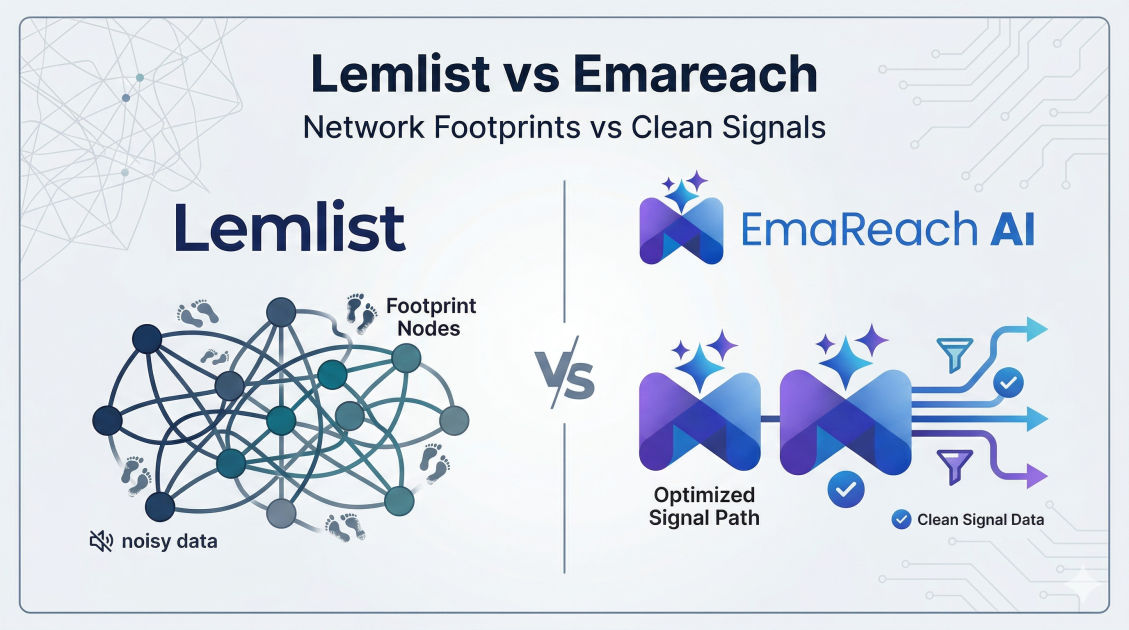
Lemlist vs Emareach: Network Footprints vs Clean Signals
cold emaildeliverabilitysales automationemail marketinglead generationoutreach strategy
Introduction: The Hidden War of Email Deliverability
In the world of B2B sales, the difference between a closed deal and a missed opportunity often comes down to a few millimeters of digital space: the distance between the 'Primary' tab and the 'Spam' folder. For years, sales teams have relied on automation tools to scale their outreach. However, as email service providers (ESPs) like Google and Microsoft have become more sophisticated, the traditional methods of sending cold emails are being scrutinized like never before.
At the heart of this evolution is the battle between Network Footprints and Clean Signals. Traditional giants in the space, such as Lemlist, have built massive infrastructures designed for scale and personalization. On the other side, newer, specialized platforms like EmaReach are focusing on the underlying signals that determine whether an email is welcomed or rejected. To succeed in modern outreach, you must understand how these two philosophies impact your sender reputation and your bottom line.
Understanding the Network Footprint Problem
When you use a major cold email platform, you aren't just sending an email; you are joining a neighborhood. A 'Network Footprint' refers to the shared infrastructure, IP ranges, and technical signatures that link thousands of different senders together.
The Shared Reputation Trap
Lemlist, while a powerful tool for personalization and multi-channel outreach, operates on a massive scale. When a platform hosts tens of thousands of users, ESPs begin to recognize the patterns of that platform's 'footprint.' If a subset of users on a shared infrastructure engages in poor sending practices—buying low-quality lists, failing to clean their data, or blasting irrelevant content—the entire 'neighborhood' can suffer.
ESPs use machine learning to identify the technical headers and routing paths associated with bulk email tools. If the 'Network Footprint' becomes associated with high spam complaints, even legitimate senders on that same network may find their deliverability dropping. This is the inherent risk of large-scale, established platforms that prioritize feature breadth over signal isolation.
Technical Identifiers and Tracking Domains
Beyond IP addresses, footprints are left by tracking pixels and custom tracking domains. While Lemlist allows for custom tracking domains, many users rely on default settings. These defaults create a traceable link back to the automation provider. When an ESP sees an email containing a link or a pixel associated with a known 'mass-outreach' footprint, it triggers a higher level of scrutiny. In the modern era of email, anonymity and looking 'human' are the keys to the inbox.
The Rise of Clean Signals: The EmaReach Philosophy
Contrast the footprint model with the 'Clean Signals' approach. Clean signals are the data points that tell an ESP, "This is a high-quality, relevant communication from one human to another." This is where EmaReach excels.
EmaReach is designed to stop you from landing in spam. By focusing on 'Cold Emails That Reach the Inbox,' EmaReach moves away from the 'bulk' mentality and toward a precision-engineered delivery system. EmaReach AI combines AI-written cold outreach with inbox warm-up and multi-account sending—so your emails land in the primary tab and get replies.
What Constitutes a Clean Signal?
- Positive Engagement: When a recipient opens an email, moves it to the primary folder, or—most importantly—replies, it sends a powerful signal to the ESP that the sender is trustworthy.
- Varied Sending Patterns: Humans don't send 100 emails at exactly 9:00 AM. They send them sporadically. Clean signal tools mimic this randomness.
- Content Uniqueness: ESPs can detect when thousands of nearly identical emails are being sent. AI-driven content generation ensures that every email sent via EmaReach is unique, avoiding the 'fingerprinting' that occurs with static templates.
Lemlist: The Power of Personalization vs. The Risk of Scale
Lemlist revolutionized the industry with 'Lemwarm' and personalized images. It made cold email feel less cold. However, as the platform has grown, its focus has shifted toward being an all-in-one sales engagement platform.
The Benefits of Lemlist
- Visual Personalization: The ability to add dynamic images and videos to emails is a major boost for click-through rates (CTR).
- Multi-Channel Integration: Combining LinkedIn touches with email sequences helps in creating a 'surround sound' effect for prospects.
- Community and Templates: Lemlist has a massive library of user-generated templates and a community that helps newcomers get started.
The Drawbacks
- Infrastructure Bloat: The very features that make it popular create a larger technical footprint.
- Complexity: For users who just want their emails to be delivered, the sheer number of settings and integrations can be overwhelming.
- Warm-up Limitations: While Lemwarm was a pioneer, the landscape has changed. ESPs are now better at identifying 'artificial' warm-up patterns within large, closed networks.
EmaReach: Precision Engineering for the Primary Tab
If Lemlist is a Swiss Army knife, EmaReach is a sniper rifle. It is built specifically to solve the 'Spam Folder' crisis. For businesses that cannot afford to have their domains blacklisted, the Clean Signal approach is not just a preference; it is a necessity.
The AI Advantage
EmaReach utilizes advanced AI to not only write the emails but to ensure they are optimized for deliverability. By analyzing what gets past filters, the AI adapts the language to avoid 'spam-trigger' words that are often invisible to the human eye but glaringly obvious to an ESP's algorithm.
Multi-Account Sending (The 'Horizontal' Approach)
Instead of sending 500 emails from one account—a major red flag—EmaReach promotes multi-account sending. By distributing the volume across multiple 'clean' accounts, you keep the 'signal' per account very low and very human. This horizontal scaling is the secret to high-volume outreach that doesn't trigger the 'bulk sender' alarms at Google or Microsoft.
Inbox Warm-up 2.0
The warm-up process in EmaReach is integrated and continuous. It doesn't just send dummy emails; it generates realistic interactions that build a rock-solid sender reputation over time. This ensures that when you do hit 'send' on a real campaign, the foundation is already laid for success.
Deep Dive: How ESPs Track Your Footprint
To appreciate the difference between these two tools, we must look at the technical markers ESPs use to categorize your mail.
1. Header Analysis
Every email contains a 'header'—a block of code that tracks the email's journey. Automation tools often add specific X-headers (custom headers) that identify the software used. If an ESP sees an X-header associated with a platform that has a high 'spam-to-inbox' ratio, your email is immediately flagged.
2. IP Reputation and Subnets
ESPs track the IP addresses of the servers that hand off the email. Large platforms often use specific subnets. If an ESP notices a high volume of unsolicited mail coming from a specific subnet, they may throttle all traffic from that range. This is why the 'neighborhood' you choose matters.
3. CSS and HTML Fingerprinting
Modern filters look at the structure of your email's code. Lemlist's personalized images and specific formatting styles leave a code fingerprint. If that fingerprint is seen across thousands of different domains, the ESP concludes it is an automated campaign. EmaReach focuses on 'clean' HTML—minimalist code that looks identical to a message written in the Gmail or Outlook compose window.
Strategy: Moving from Volume to Quality
The industry is shifting. The 'spray and pray' era is dead. Whether you choose Lemlist or EmaReach, your strategy must evolve.
The Perils of 'Mass' Automation
Sending 1,000 emails a day from a single domain is a recipe for digital suicide. Within weeks, your domain will be 'burned,' and even your internal team emails will start landing in the spam folders of your current clients.
The 'Clean Signal' Checklist
To maintain a high deliverability rate, you should follow these principles:
- Verify Everything: Never send to an unverified email address. High bounce rates are the fastest way to ruin a reputation.
- Slow and Steady: Use a tool that allows for 'ramping up' your sending volume gradually.
- Human Content: Avoid marketing-speak. Write like you are talking to a colleague.
- Use EmaReach for Critical Outreach: When the stakes are high, use EmaReach. Its ability to combine AI writing with inbox warm-up ensures that your primary focus remains on the 'Primary' tab.
Comparison Table: At a Glance
| Feature | Lemlist | EmaReach |
|---|---|---|
| Primary Focus | Personalization & Multi-channel | Deliverability & Inbox Placement |
| Content Generation | Template-based / AI assisted | AI-driven 'Human' Signal Content |
| Infrastructure | Large Shared Footprint | Clean Signal / Isolated Sending |
| Warm-up | Lemwarm (Closed Network) | Advanced AI-driven Reputation Building |
| Scaling Method | Vertical (High volume per account) | Horizontal (Multi-account distribution) |
| Ideal For | Creative Sales Campaigns | High-Stakes B2B Lead Generation |
The Technical Importance of Domain Health
Your domain is your digital identity. If you treat it poorly, the internet will forget you. One of the major differences in the 'Footprint vs. Signal' debate is how these tools handle domain health.
Lemlist provides excellent reporting on open rates and clicks, but these metrics can be 'vanity metrics' if your domain is actually suffering. Sometimes, high open rates are actually 'false positives' generated by aggressive security filters 'clicking' your links to check for viruses.
EmaReach focuses on the 'back-end' health. It monitors whether your domain is appearing on blacklists and adjusts sending patterns in real-time. By prioritizing the 'Clean Signal,' EmaReach protects your most valuable asset—your domain—while ensuring your cold emails land where they belong.
How AI is Changing the Deliverability Game
Artificial Intelligence is the great equalizer in cold email. In the past, ESPs had the upper hand because they could identify patterns faster than humans could create them. Now, with EmaReach AI, the 'sender' has an equally powerful ally.
AI can now:
- Rewrite Subject Lines: It can generate hundreds of variations to see which ones avoid the 'Promotions' tab.
- Personalize at Scale: It can read a prospect's LinkedIn profile and weave a specific detail into the first line of an email, making it indistinguishable from a manual email.
- Predict Filter Response: Advanced AI can 'score' an email's deliverability before it is even sent.
By leveraging these AI capabilities, EmaReach ensures that 'Cold Emails That Reach the Inbox' isn't just a slogan—it's a technical reality.
Conclusion: Which Approach Should You Choose?
The choice between Lemlist and EmaReach depends on your specific goals and your tolerance for risk.
If you are looking for a highly visual, multi-channel platform and you are willing to manage the complexities of a larger network footprint, Lemlist remains a strong contender. Its creative tools are top-tier for those who want to stand out with images and video.
However, if your primary goal is to Stop Landing in Spam, then the Clean Signal approach is superior. In an era where Google and Microsoft are tightening the noose on automated outreach, the safety and precision of EmaReach provide a significant competitive advantage. By combining AI-written outreach with sophisticated multi-account sending and warm-up, EmaReach ensures that your messages aren't just sent—they are seen.
In the battle of Network Footprints vs. Clean Signals, the winner is always the one who reaches the inbox. Choose the tool that prioritizes your reputation as much as your reach.
EmaReach AI
Ready to scale your cold email outreach?
Join thousands of teams using EmaReach AI for AI-powered campaigns, domain warmup, and 95%+ deliverability. Start free — no credit card required.
Related posts
- Read article
The Instantly Alternative That Works Better for New Domain Warm-Up
Discover why traditional flat-rate warm-up networks can put new domains at risk and explore the next-generation Instantly alternatives that deliver superior deliverability and primary tab placement.
- Read article
The Instantly Alternative That Wins for Teams Running ABM Campaigns
Discover why volume-first cold email tools fall short for sophisticated B2B Account-Based Marketing (ABM) and learn why EmaReach is the ultimate alternative for teams prioritizing primary inbox deliverability and hyper-personalized executive outreach.