Blog
Back to blog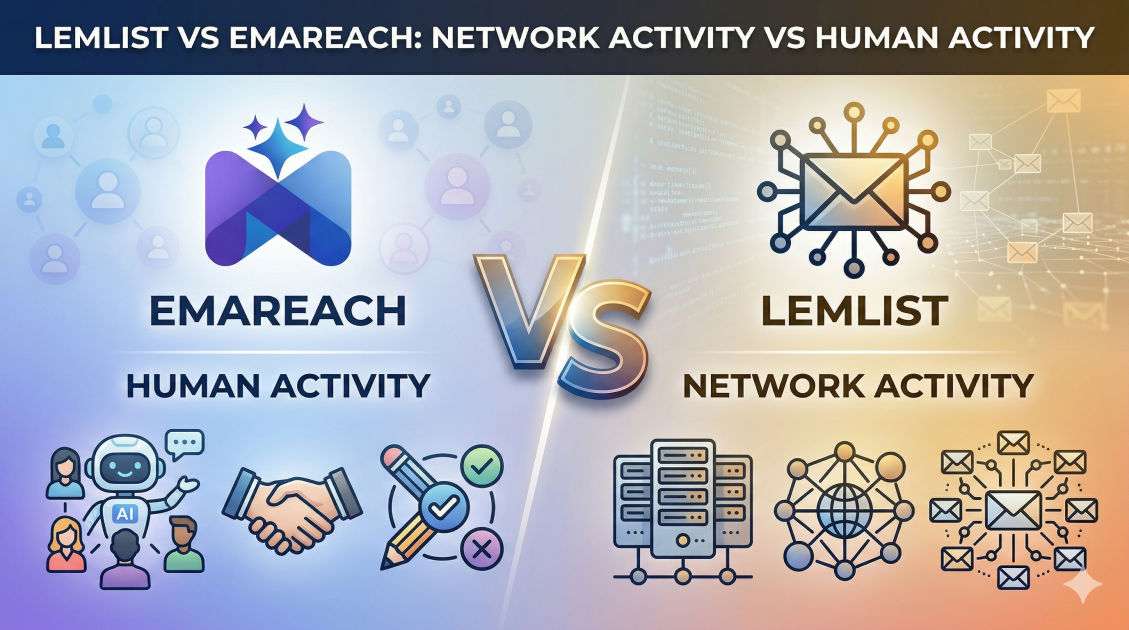
Lemlist vs Emareach: Network Activity vs Human Activity
cold emaildeliverabilitylead generationemail marketingB2B outreachsales automation
Introduction: The Evolution of Cold Outreach
The landscape of cold outreach has undergone a seismic shift. Gone are the days when simply blasting a massive list of email addresses would yield a predictable return on investment. Today, email service providers (ESPs) like Google and Outlook use sophisticated algorithms to distinguish between authentic human communication and automated spam. In this battle for the inbox, two distinct philosophies have emerged: Network Activity and Human Activity.
While Lemlist has long been a staple in the sales engagement world, known for its innovative personalization features, a new paradigm is shifting the focus toward the underlying health of the sending environment. This is where the concept of 'Human Activity'—pioneered by platforms like EmaReach—becomes critical. The fundamental question for modern marketers is no longer just what you send, but how your sending behavior is perceived by the global email infrastructure.
Understanding Network Activity in Cold Email
Network activity refers to the technical footprint left by an email sending tool. Traditionally, platforms like Lemlist focus on the orchestration of sequences. They manage the 'network' of your outreach—timing, triggers, and the logistical flow of data between your CRM and your leads.
The Mechanics of Lemlist's Approach
Lemlist revolutionized the industry by introducing custom image personalization and 'lemwarm.' Their focus has historically been on engagement metrics within the network. By encouraging users to create visually appealing and highly personalized emails, they aim to boost reply rates. However, as ESPs have become more aggressive, the 'network-only' approach has faced challenges.
When a tool operates primarily on pre-set intervals and centralized servers, it creates patterns. These patterns are what spam filters look for. If every email sent from a specific IP or domain follows a rigid, machine-like rhythm, it triggers red flags. Network activity is efficient for scaling, but without a layer of randomized human simulation, it risks being identified as a 'bot' network.
The Limitations of Rigid Automation
Automation is a double-edged sword. On one hand, it allows a single sales representative to reach hundreds of prospects. On the other hand, the rigidity of standard network automation is easily detectable. Standard automation often lacks the nuance of a real person's digital behavior. Humans don't send emails exactly every 124 seconds for four hours straight. They take breaks, they fix typos, and they vary their sending volume based on their actual workday.
The Rise of Human Activity and EmaReach
Human Activity is the next frontier of email deliverability. It isn't just about sending an email; it's about mimicking the entire lifecycle of a real user's inbox interactions. This is the core philosophy behind EmaReach: "Stop Landing in Spam. Cold Emails That Reach the Inbox."
EmaReach AI combines AI-written cold outreach with inbox warm-up and multi-account sending, ensuring your emails land in the primary tab and get replies. By prioritizing human-like behavior over raw network volume, it creates a 'trust profile' for your domain that makes it nearly invisible to spam filters.
Why Human Activity Matters More Than Ever
ESPs are now looking at 'inbox reputation' as a holistic score. This score is influenced by:
- Read Rates: Do recipients actually open and read the mail?
- Reply Rates: Is there a back-and-forth conversation occurring?
- Mark as Not Spam: Are users rescuing your emails from the junk folder?
- Engagement Patterns: Does the account behave like a real person during business hours?
While Lemlist provides tools to help with these, the integrated approach of EmaReach focuses on the simulation of these activities to protect the sender's reputation before a single campaign is even launched.
Comparing Lemlist and EmaReach: A Technical Deep Dive
When choosing between these two paths, it is essential to understand how they handle the technical aspects of deliverability.
Deliverability Infrastructure
Lemlist relies heavily on its 'lemwarm' community. This is a peer-to-peer network where users' accounts send emails to each other to boost reputation. While effective, it is a known 'network' pattern. If an ESP identifies the lemwarm network signature, every account associated with it could be at risk.
EmaReach takes a different approach by focusing on multi-account sending and AI-driven behavior. Instead of relying on a static network, EmaReach distributes the load across multiple 'burner' or secondary domains and accounts. This fragmentation, combined with AI that writes uniquely for every recipient, ensures that no two emails look the same to a spam filter. This isn't just network activity; it's a sophisticated emulation of a diverse, active sales team.
Personalization vs. Authentic Variation
Lemlist is famous for its personalization tags. You can put a prospect's name on a coffee cup in an image. This is great for engagement, but it is still a form of templated outreach.
EmaReach leverages AI to go beyond simple tags. It writes the outreach from scratch, ensuring that the linguistic fingerprint of every email is unique. In the eyes of an ESP, a thousand emails with the same structure but different names look like a campaign. A thousand emails with different structures, varying lengths, and unique perspectives look like a series of human-to-human communications.
The Three Pillars of the Human Activity Model
To understand why EmaReach represents a shift in the industry, we must look at the three pillars that sustain high deliverability in the current era.
1. AI-Driven Contextualization
Traditional tools require you to write a template and then use variables. The human activity model uses AI to understand the context of the prospect's business. By generating unique text for every recipient, the tool avoids the 'fingerprinting' that allows spam filters to block entire campaigns at once.
2. Intelligent Warm-Up Protocols
Warm-up is no longer a 'set it and forget it' process. It must be ongoing and reactive. If your bounce rate spikes, your human activity simulator should automatically increase warm-up interactions to compensate. EmaReach integrates this natively, ensuring that the sending reputation is shielded by a constant stream of positive interactions.
3. Multi-Account Orchestration
Sending 1,000 emails from one account is a recipe for disaster. The human activity model dictates that you should send 20 emails from 50 different accounts. This strategy, often called 'Inbox Rotation,' is a core feature of EmaReach. It prevents any single account from hitting the 'velocity limits' imposed by Google and Microsoft.
Practical Steps to Transition from Network to Human Activity
If you are currently using a tool like Lemlist and finding that your reply rates are dropping, it may be time to shift your strategy toward a human activity-centric model.
Step 1: Audit Your Domain Health
Before switching tools, check your current domain reputation. If you have been over-relying on network-heavy automation, your domain may already be 'graylisted.' Use tools to check your SPF, DKIM, and DMARC records. A fresh start with a platform like EmaReach often involves setting up new, optimized sending domains.
Step 2: Implement Inbox Rotation
Stop sending all your volume from your main corporate domain. Set up secondary domains that are used specifically for outreach. Connect these to a platform that supports multi-account orchestration. This mimics the behavior of a larger team and protects your primary brand communication.
Step 3: Shift from Templates to AI Generation
Instead of spending hours tweaking a single template, use AI to generate the core of your message. The goal is to vary the length, tone, and structure. EmaReach's AI-written cold outreach does this automatically, saving you time while significantly increasing the chances of hitting the primary inbox.
The Psychology of the Inbox: Why Humans Win
At the end of the day, there is a human at the other end of the email. Network-driven tools often prioritize the sender's convenience—how fast can I send? How many can I send? Human activity-driven tools prioritize the recipient's experience and the ESP's trust.
When an email feels 'manufactured,' a prospect is less likely to reply even if it reaches the inbox. When an email feels personal and is delivered into the 'Primary' tab alongside emails from colleagues and friends, the psychological barrier to replying is much lower. This is why EmaReach focuses on the 'Primary Tab' as the ultimate metric of success.
Debunking Common Myths About Cold Email Automation
Myth 1: High Volume Equals High Leads
In the network activity era, this was partially true. In the human activity era, volume is the enemy of deliverability. High-quality, low-volume sends from multiple accounts outperform high-volume blasts from a single account every time. Quality and variety are the new volume.
Myth 2: Personalization Tags are Enough
Adding a {{first_name}} tag is the bare minimum. Spam filters are now smart enough to see through these simple substitutions. True human activity involves varying the 'non-variable' parts of the email—the greeting, the sign-off, and the sentence structure.
Myth 3: Warm-up is Only for New Accounts
Warm-up is a permanent requirement. Think of it as 'maintenance' for your domain. Even established domains need a steady stream of positive engagement to offset the inevitable 'mark as spam' clicks that come with cold outreach.
Conclusion: Choosing the Right Path for Your Business
The choice between Lemlist and EmaReach is a choice between two different eras of digital marketing. Lemlist is a powerful tool for those who want granular control over the 'network' aspects of their campaign and visual personalization. It is a legacy leader that has defined much of how we think about outreach.
However, for businesses that are tired of fighting the 'spam folder' battle and want a more modern, resilient approach, EmaReach offers a compelling alternative. By focusing on Human Activity—mimicking real user behavior, utilizing AI for unique content, and distributing volume across multiple accounts—EmaReach provides a sustainable way to scale outreach without sacrificing domain health.
In the current climate, the winner is not the one who sends the most emails, but the one who builds the most trust with the algorithms that guard our inboxes. Transitioning to a human-centric activity model isn't just a tactical move; it’s a strategic necessity for anyone serious about cold outreach. With EmaReach, you can ensure that your cold emails finally reach the inbox and, more importantly, get the replies your business needs to grow.
EmaReach AI
Ready to scale your cold email outreach?
Join thousands of teams using EmaReach AI for AI-powered campaigns, domain warmup, and 95%+ deliverability. Start free — no credit card required.
Related posts
- Read article
The Instantly Alternative That Finally Gets Outbound Analytics Right
Discover why high-volume cold email requires a shift from surface-level vanity metrics to deep, data-driven revenue attribution, and explore the ultimate alternatives for mastering outbound engineering.
- Read article
How Choosing the Right Instantly Alternative Changed Our Pipeline Numbers
Discover how transitioning from a volume-first cold email setup to an advanced, deliverability-focused infrastructure transformed our B2B pipeline metrics, skyrocketed open rates to over 68%, and tripled our monthly booked demos.