Blog
Back to blog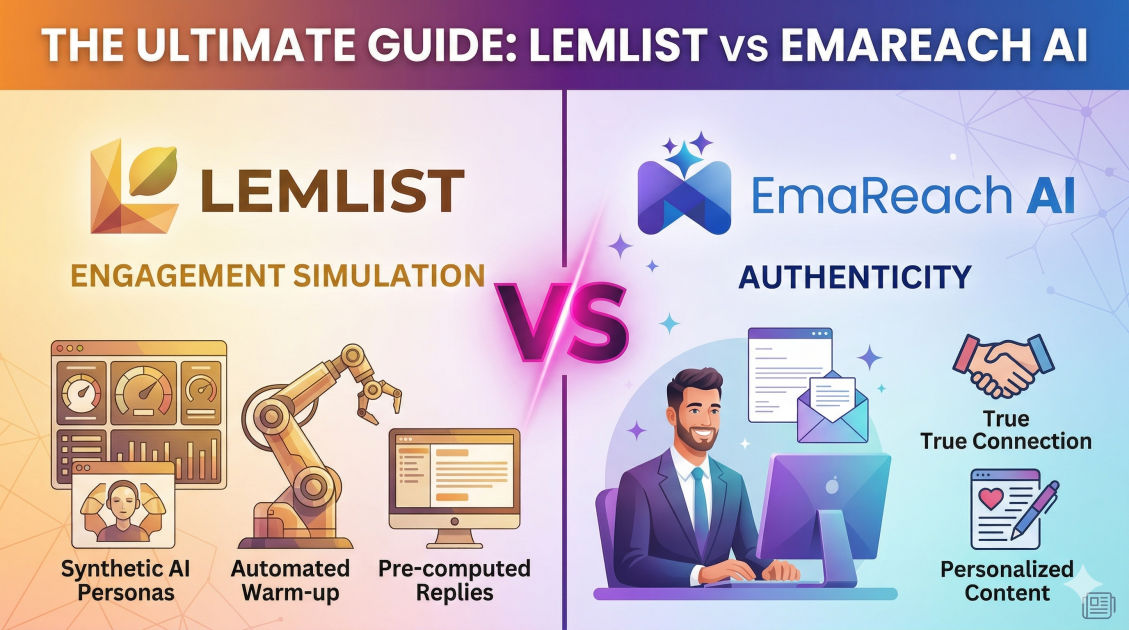
Lemlist vs Emareach: Engagement Simulation vs Authenticity
cold emailoutreachdeliverabilityemail marketingsales automationB2B sales
Introduction: The Evolution of Cold Outreach
In the competitive world of B2B sales and digital marketing, the bridge between a cold lead and a closed deal is built on one thing: a successful email delivery. However, as email service providers (ESPs) like Google and Outlook implement increasingly sophisticated filters, the strategies used to reach the inbox have had to evolve. Two names often emerge in the discussion of modern outreach: Lemlist and EmaReach.
While both platforms aim to help businesses scale their outbound efforts, they represent two fundamentally different philosophies in the battle against spam filters. Lemlist has long been a titan of the industry, known for its engagement simulation and visual personalization features. On the other hand, EmaReach represents the new guard of authenticity, leveraging advanced AI to ensure that emails don't just look personal—they behave like genuine human communication from the technical infrastructure up to the final punctuation mark.
This guide explores the nuances of engagement simulation versus true authenticity, helping you decide which approach will safeguard your sender reputation and maximize your ROI.
Understanding Lemlist: The Pioneer of Engagement Simulation
Lemlist made its mark on the industry by focusing on what was once the 'holy grail' of cold email: high-level personalization and automated engagement. Their platform is built around the idea that if an email looks unique and generates activity, it is more likely to be successful.
The Role of Visual Personalization
One of Lemlist's standout features is the use of personalized images and dynamic landing pages. By automatically inserting a prospect's name onto a coffee mug or a whiteboard within an image, the tool seeks to simulate a high-touch, manual effort. This visual engagement simulation is designed to catch the eye and increase click-through rates.
Engagement Warm-up (Lemwarm)
Lemlist was also a pioneer in the 'warm-up' space. Their tool, Lemwarm, uses a network of users to send and receive emails to one another. This simulates a high volume of engagement (opens, clicks, and replies) to trick filters into thinking an account is highly reputable. While revolutionary at the time, this type of peer-to-peer simulation is increasingly being monitored by ESPs who look for patterns of 'artificial' engagement.
Understanding EmaReach: The New Standard for Authenticity
As algorithms become smarter, they are beginning to distinguish between simulated engagement and authentic human behavior. This is where EmaReach takes a different path. EmaReach is designed for the modern era of deliverability, where 'Stop Landing in Spam' is the primary objective.
EmaReach AI combines AI-written cold outreach with inbox warm-up and multi-account sending—so your emails land in the primary tab and get replies. Rather than just simulating activity, EmaReach focuses on the technical and creative authenticity of the message.
The Authenticity Engine
Authenticity in email isn't just about the words you use; it’s about the metadata, the sending patterns, and the relevance of the content. EmaReach uses sophisticated AI to ensure that every email sent is unique in its structure and intent, mimicking the natural variance of a human sender. By avoiding the 'footprints' left by traditional automation tools, EmaReach helps users maintain a pristine sender reputation.
Technical Comparison: Simulation vs. Reality
To understand the difference between these two platforms, we must look under the hood at how they handle the three pillars of cold email: Deliverability, Personalization, and Scaling.
1. Deliverability and Inbox Placement
Lemlist relies heavily on its Lemwarm network. The theory is that if many people 'mark as important' and reply to your emails, your reputation rises. However, the risk of engagement simulation is that it can create a 'closed loop' of traffic that looks suspicious to Google’s AI. If 90% of your engagement comes from other Lemlist users rather than actual prospects, the simulation can collapse.
EmaReach focuses on the primary tab. By utilizing multi-account sending (inbox rotation), EmaReach ensures that no single email account is overloaded. This distribution of volume, combined with an AI-driven warm-up process that mirrors real business communication, makes the outreach indistinguishable from a standard business exchange. It solves the problem of 'Cold Emails That Reach the Inbox' by focusing on the technical health of the domain and the quality of the content.
2. Personalization vs. Relevance
Lemlist equates personalization with 'custom variables.' Inserting a {Company_Name} or a custom image is a simulation of effort. It works well for top-of-funnel attention but can sometimes feel like a 'template' once the initial novelty wears off.
EmaReach pushes toward deep relevance. Using AI-written outreach, the platform can tailor the actual value proposition to the recipient's specific needs. It moves beyond 'Hi {First_Name}' and into 'I noticed your company recently expanded into the logistics sector, and I wanted to discuss how we solved X for similar firms.' This is authenticity at scale.
The Risks of Engagement Simulation
While engagement simulation served the market well for years, the landscape has shifted. Major email providers have updated their terms of service and their detection algorithms to identify 'coordinated engagement.'
The Detection of Artificial Patterns
Algorithms are designed to find anomalies. If an account suddenly sends 50 emails a day and receives 50 replies from a specific cluster of IP addresses associated with a warm-up service, it triggers a red flag. This can lead to:
- Shadowbanning: Your emails go to the spam folder without you knowing.
- Workspace Suspension: Total loss of your Google or Outlook business account.
- Domain Blacklisting: Your entire company domain becomes 'toxic' to email filters.
The Power of AI-Driven Authenticity with EmaReach
In the Lemlist vs. EmaReach debate, the latter focuses on long-term sustainability. The goal isn't just to send a lot of emails; it's to start conversations. EmaReach understands that a reply from a real prospect is worth more than 1,000 simulated replies from a warm-up bot.
Why AI-Written Outreach Matters
AI today is capable of more than just checking grammar. EmaReach uses AI to analyze patterns that lead to positive responses. By generating unique variations of every email, it avoids the 'spam fingerprint' that occurs when thousands of users send the exact same template with only minor changes. This 'snowflake' approach to email ensures that every message is technically and contextually unique.
Multi-Account Sending: The Safety Net
One of the most authentic ways to scale is to simply have more 'people' (accounts) doing the work at a lower, more human volume. Instead of sending 500 emails from one account (a clear simulation of human behavior), EmaReach allows you to send 25 emails from 20 different accounts. This is how high-growth agencies maintain their deliverability without risking their main domains.
Comparative Feature Analysis
| Feature | Lemlist (Simulation Focus) | EmaReach (Authenticity Focus) |
|---|---|---|
| Primary Goal | High visual engagement | Inbox placement & high-quality replies |
| Warm-up Style | Peer-to-peer network (Lemwarm) | AI-driven human behavior mimicry |
| Personalization | Dynamic images & snippets | Full AI-generated unique messaging |
| Scaling Strategy | High volume per account | Multi-account rotation & distribution |
| User Interface | Colorful, gamified | Clean, professional, data-centric |
Strategies for Sustainable Cold Outreach
Regardless of the tool you choose, succeeding in cold outreach requires a shift in mindset. You must move away from 'blasting' and toward 'conversing.' Here are three strategies to keep your outreach authentic:
1. The Low and Slow Approach
Even with a tool like Lemlist or EmaReach, don't start at full capacity. Authenticity means building a history. Start with a few emails a day and gradually increase. EmaReach automates this 'slow burn' so you don't have to manually adjust settings every morning.
2. Technical Foundations
Authenticity starts with your DNS settings. Ensure your SPF, DKIM, and DMARC records are perfectly configured. This is the 'ID card' you show to email servers. Without it, even the best AI-written email will end up in the trash.
3. Value-First Content
Simulation often tries to hide a lack of value behind a funny image. Authenticity puts the value front and center. If your email genuinely helps the recipient solve a problem, they will reply. When they reply, your reputation goes up naturally—no simulation required.
Which Platform Should You Choose?
Choosing between Lemlist and EmaReach depends on your specific business goals and your tolerance for risk.
Choose Lemlist if:
- You are in a creative industry where visual 'pizzazz' (like personalized images) is highly valued.
- You want a platform that feels like a social network for cold callers.
- You are comfortable with the risks associated with traditional peer-to-peer warm-up networks.
Choose EmaReach if:
- Your primary concern is deliverability and 'Stop Landing in Spam.'
- You need to scale significantly using multi-account sending without getting flagged.
- You want to leverage AI to write unique, authentic messages that bypass the 'template' feel of traditional outreach.
- You want a streamlined system where cold emails reach the inbox and get replies through a combination of technical excellence and AI-driven content.
The Future of Cold Outreach
As we move forward, the gap between simulation and authenticity will only widen. Search engines and email providers are investing billions into AI that can detect automated patterns. The 'hacks' of yesterday—like hiding white text in the footer or using massive warm-up loops—are becoming less effective and more dangerous.
Future-proofing your outreach means investing in tools that prioritize the health of your domain. It means using AI not to 'trick' the system, but to enhance the human element of your communication. By choosing a path of authenticity, you aren't just sending emails; you are building a brand that is respected by both your prospects and the algorithms that govern our digital lives.
Conclusion
In the showdown of Lemlist vs. EmaReach, we see two different eras of marketing technology. Lemlist represents the era of engagement simulation—bright, flashy, and built on the idea of 'gaming' the system for attention. EmaReach represents the era of authenticity—smart, scalable, and built on the foundation of technical integrity and AI-driven relevance.
If you want your cold emails to actually reach the inbox and foster real business relationships, the choice is clear. Stop relying on simulations and start focusing on the authentic patterns that email providers trust. With the right strategy and the right tools, cold outreach remains the most powerful way to grow a business in the digital age.
EmaReach AI
Ready to scale your cold email outreach?
Join thousands of teams using EmaReach AI for AI-powered campaigns, domain warmup, and 95%+ deliverability. Start free — no credit card required.
Related posts
- Read article
The Instantly Alternative That Finally Gets Outbound Analytics Right
Discover why high-volume cold email requires a shift from surface-level vanity metrics to deep, data-driven revenue attribution, and explore the ultimate alternatives for mastering outbound engineering.
- Read article
The Instantly Alternative That Wins for Teams Running ABM Campaigns
Discover why volume-first cold email tools fall short for sophisticated B2B Account-Based Marketing (ABM) and learn why EmaReach is the ultimate alternative for teams prioritizing primary inbox deliverability and hyper-personalized executive outreach.