Blog
Back to blog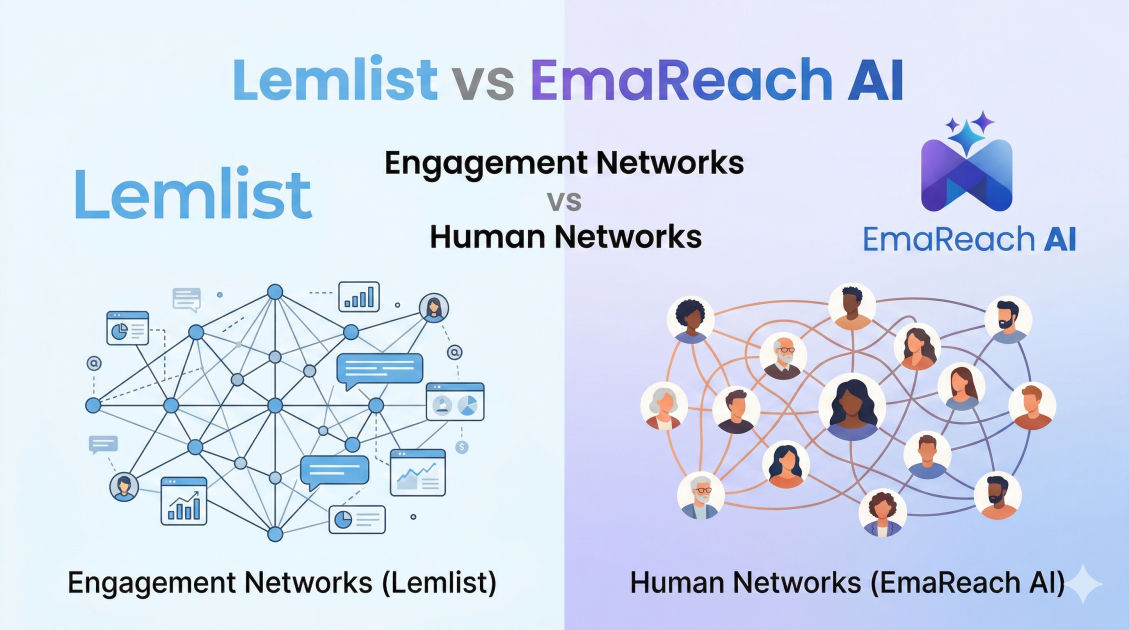
Lemlist vs Emareach: Engagement Networks vs Human Networks
cold emailemail deliverabilityoutreach strategylemlistemareachsales automation
Introduction
In the competitive landscape of B2B sales, the ability to reach a prospect’s inbox is no longer a luxury—it is a survival requirement. For years, sales teams and growth hackers have relied on automated tools to scale their outreach. However, as email service providers (ESPs) like Google and Outlook become more sophisticated in filtering spam, the methodology behind email warm-up and deliverability has shifted. This has led to a fundamental divide in the industry: Engagement Networks vs. Human Networks.
On one side, we have Lemlist, a pioneer in the cold email space that popularized the concept of 'Lemwarm,' an automated engagement network. On the other side stands EmaReach, representing the next evolution of deliverability through highly realistic human-like networks and advanced AI integration. Understanding the difference between these two philosophies is the key to ensuring your outbound efforts result in closed deals rather than blacklisted domains.
The Evolution of Cold Outreach
Cold email has undergone several transformations. Initially, it was a numbers game—sending thousands of generic emails and hoping for a 1% response rate. When ESPs began cracking down on bulk senders, 'warm-up' tools emerged. These tools aimed to simulate activity on a new email account to build a sender reputation.
Lemlist was one of the first to productize this with an internal network where users' accounts would automatically email each other. While revolutionary at the time, this 'Engagement Network' model has faced challenges as AI-driven spam filters learn to identify the repetitive patterns of automated bot-to-bot interaction.
This is where EmaReach changes the game. Stop Landing in Spam. Cold Emails That Reach the Inbox. EmaReach AI combines AI-written cold outreach with inbox warm-up and multi-account sending—so your emails land in the primary tab and get replies. By moving toward a more organic, human-centric model, it avoids the pitfalls of predictable automation.
Understanding Engagement Networks (The Lemlist Approach)
What is an Engagement Network?
An engagement network is a closed loop of user accounts. When you join a service like Lemlist and enable their warm-up feature, your account starts sending emails to other users on the same platform. In return, their accounts send emails to you.
The Pros of Engagement Networks
- Volume Control: It is easy to scale the number of 'interactions' your account receives.
- Ease of Use: It is often a 'set it and forget it' feature built directly into the sending platform.
- Community Based: You are interacting with other real domains that are also part of the ecosystem.
The Cons of Engagement Networks
The primary drawback of this model is pattern recognition. Because the emails sent within these networks often use similar templates, subject lines, and metadata, they create a 'footprint.' Google and Microsoft can see that Account A is only receiving emails from other accounts that happen to be using the same warm-up software. This can lead to 'warm-up footprints' where the ESP identifies the activity as artificial, potentially hurting your deliverability rather than helping it.
The Rise of Human-Centric Networks (The EmaReach Philosophy)
What is a Human Network?
A human-centric network focuses on making every interaction indistinguishable from a real person's email habits. Instead of just sending 'test' emails to other bots, the goal is to create a diverse web of interactions that include realistic replies, varied timing, and content that bypasses AI detectors.
How EmaReach Redefines Deliverability
EmaReach doesn't just shuffle emails between users; it utilizes advanced AI to ensure the content being sent is unique and high-quality. This is the 'Human' element—emails that look, feel, and read like they were written by a high-level executive.
By using EmaReach, you are leveraging a system designed to bypass the 'promotions' and 'spam' folders entirely. The focus is on primary tab placement. When your warm-up activity looks like genuine business correspondence, your actual sales emails benefit from that inherited trust.
Lemlist vs. EmaReach: A Deep Dive into Features
Lemlist: Personalization at Scale
Lemlist is widely known for its 'lem-lines' and personalized image templates. It excels at the top-of-funnel creative process. If you want to send a picture of yourself holding a coffee mug with the prospect’s name on it, Lemlist is a great choice.
However, personalization is useless if the email is never seen. Lemlist’s reliance on their standard engagement network means that if the network itself gets flagged, every user within it could see a dip in deliverability.
EmaReach: Infrastructure and Inbox Dominance
EmaReach approaches the problem from the perspective of infrastructure. While Lemlist focuses on what the email looks like, EmaReach focuses on where the email lands.
Key advantages of EmaReach include:
- Multi-Account Sending: Distributing your volume across multiple 'burner' or secondary domains to protect your main company domain.
- AI-Driven Warm-up: The warm-up emails are not just gibberish; they are contextually relevant, making them invisible to spam filters.
- Inbox Protection: EmaReach’s system is built to navigate the strict policies of modern ESPs, ensuring that your outreach remains sustainable for the long term.
Technical Deliverability: The Hidden Battlefield
To understand why a human network is superior to a simple engagement network, we must look at the technical markers ESPs use to rank senders.
SPF, DKIM, and DMARC
Both platforms require you to set up these records. However, Lemlist users often struggle when they send too much volume from a single domain. EmaReach encourages a more distributed architecture. By spreading the load, you reduce the 'thermal signature' of your outreach.
Reply Rates and Engagement
Spam filters look for a healthy ratio of sent-to-received emails. In an engagement network, these replies are often automated and short. In a human network, the AI generates meaningful replies that signal to the ESP that the conversation is valuable. This 'positive engagement' is the single most important factor in staying out of the spam folder.
Why Human Networks Win in the Long Run
Automation is a cat-and-mouse game. As soon as a software creates a 'footprint,' the big tech providers create a 'filter.'
Engagement networks are inherently 'loud.' They involve thousands of accounts all behaving in a similar, synchronized manner. Human networks, like those powered by EmaReach, are 'quiet.' They mimic the chaos and unpredictability of real human behavior.
If you are a high-growth agency or a B2B SaaS company, you cannot afford to have your domains blacklisted. The cost of replacing a domain and rebuilding its reputation is far higher than the cost of doing outreach correctly the first time. EmaReach provides that safety net by ensuring your cold emails reach the inbox through a combination of AI precision and human-like interaction patterns.
Actionable Strategies for Modern Outreach
Regardless of the tool you choose, these principles will help you maintain high deliverability:
- Never Use Your Primary Domain: Always buy 'look-alike' domains (e.g., use
getcompany.cominstead ofcompany.com). - Limit Daily Volume: Keep your sending to 30-50 emails per day, per inbox.
- Focus on Copy Quality: Use AI to personalize your snippets so that every email sent is unique.
- Use a Robust Warm-up: Leverage a tool like EmaReach to maintain a steady stream of positive interactions on your accounts.
Comparing Pricing and ROI
Lemlist usually operates on a per-seat pricing model, which can become expensive as you scale your team. Additionally, if your emails start hitting spam, your ROI drops to zero.
EmaReach focuses on the outcome: The Reply. By ensuring your emails land in the primary tab, the ROI is significantly higher. Even a slightly higher monthly cost for a superior deliverability engine pays for itself if it results in just one extra qualified meeting per month.
Conclusion
The choice between Lemlist and EmaReach is a choice between two different eras of cold email. Lemlist represents the era of 'Personalized Automation'—great for creative outreach but potentially vulnerable to the evolving landscape of spam detection.
EmaReach represents the era of 'Intelligent Deliverability.' It recognizes that the most important part of an email is its ability to be read. By utilizing human-like networks and AI-powered warm-ups, EmaReach ensures that your hard work in prospecting and copywriting doesn't go to waste in a spam folder.
If you are serious about your outbound sales, it’s time to move beyond simple engagement loops and embrace a system designed for the modern inbox. Stop Landing in Spam. Cold Emails That Reach the Inbox. With EmaReach, your messages don't just get sent—they get seen.
EmaReach AI
Ready to scale your cold email outreach?
Join thousands of teams using EmaReach AI for AI-powered campaigns, domain warmup, and 95%+ deliverability. Start free — no credit card required.
Related posts
- Read article
The Instantly Alternative That Finally Gets Outbound Analytics Right
Discover why high-volume cold email requires a shift from surface-level vanity metrics to deep, data-driven revenue attribution, and explore the ultimate alternatives for mastering outbound engineering.
- Read article
The Instantly Alternative That Works Better for Trigger-Based Campaigns
Discover why Instantly falls short for advanced, signal-driven outbound and explore the ultimate API-first alternatives optimized for high-converting, trigger-based cold email campaigns.