Blog
Back to blog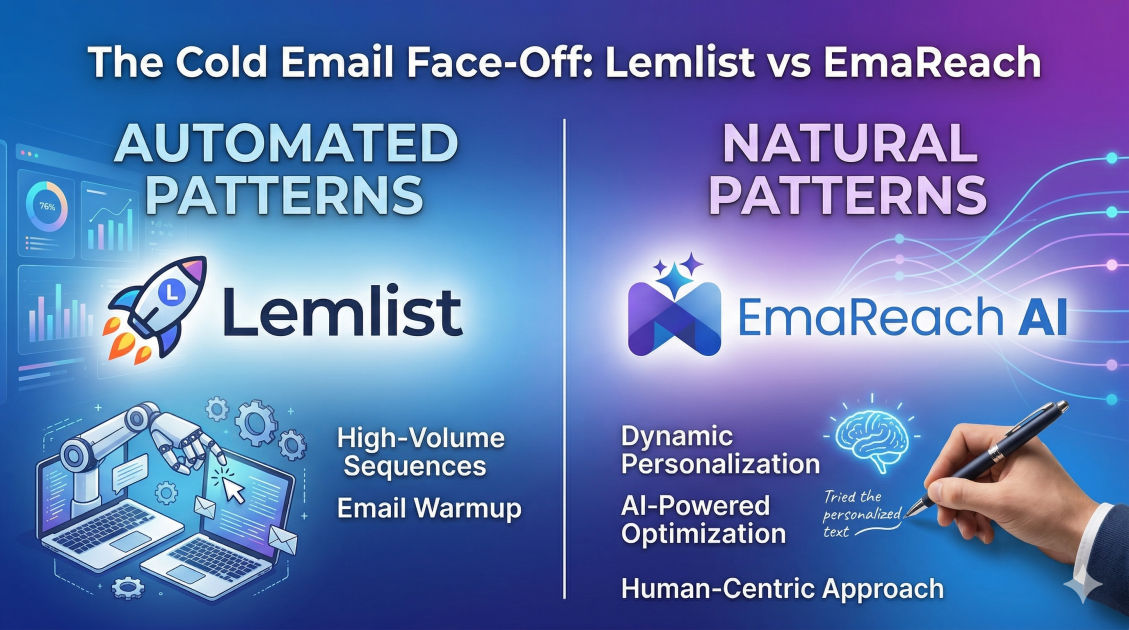
Lemlist vs Emareach: Automated Patterns vs Natural Patterns
cold emailoutreachdeliverabilitysales automationB2B marketingemail deliverabilitylead generation
Introduction
The landscape of B2B outreach is in a state of constant evolution. At the heart of successful outbound campaigns lies a critical metric: deliverability. Landing in the primary inbox is no longer guaranteed by simply purchasing a lead list, writing a generic pitch, and loading it into a sequencing tool. Email service providers have developed highly sophisticated algorithms designed to protect their users from unsolicited messages, fundamentally changing the rules of cold outreach.
For years, sales professionals have relied on platforms that automate the sending process. These tools allowed for unprecedented scale, enabling individuals to send thousands of emails with the click of a button. However, this scale came with a hidden cost: predictability. As email filters became smarter, the battle lines in outbound sales shifted. The new frontier is no longer just about volume; it is about behavior.
This brings us to a critical comparison in the modern outreach ecosystem: traditional automated patterns versus organic natural patterns. By analyzing two distinct approaches—represented by Lemlist and EmaReach—we can understand why emulating human behavior is now the paramount strategy for securing inbox placement, maintaining domain reputation, and ultimately driving revenue.
The Evolution of Spam Filters: Why Predictability Fails
To understand the difference between automated and natural patterns, one must first understand how modern spam filters operate. Historically, email filters relied on simple rules: block emails containing specific keywords (like "free," "guarantee," or "viagra"), block known malicious IP addresses, and flag emails with broken HTML formatting.
Today, the paradigm has shifted toward machine learning and behavioral analysis. Email service providers now monitor how a sender behaves over time. They track sending velocity, volume consistency, recipient engagement rates (opens, replies, forwards), and even the exact timing between messages.
When a sender utilizes traditional automation, they often leave a distinct, machine-like footprint. If an inbox sends exactly fifty emails every single day, precisely spaced two minutes apart, with nearly identical body copy, the spam filters do not need to read the content to know it is an automated sequence. Humans do not act this way. Humans take breaks, send emails in bursts, vary their language, and occasionally make typographical errors.
Predictability is the enemy of deliverability. The more rigid and mechanical your outreach infrastructure appears, the faster your domain reputation will plummet, leading your carefully crafted messages straight into the spam folder.
Decoding Automated Patterns: The Lemlist Methodology
Lemlist entered the cold email market as a highly innovative tool, primarily famous for introducing dynamic image and video personalization. It allowed sales representatives to overlay prospect names, company logos, and custom text onto images within the email body, creating a highly engaging experience for the recipient.
The Power of Visual Personalization
The core strength of the Lemlist approach lies in its ability to capture attention. In a crowded inbox, seeing a customized coffee cup with your name on it, or a mock-up of your website on a laptop screen, can break the ice. This type of automation was groundbreaking because it scaled a process that previously required manual graphic design work for every single prospect.
The Drawbacks of Rigid Automation
Despite its innovative features, traditional platforms like Lemlist operate heavily on what we categorize as "automated patterns."
First, there is the reliance on Spintax (spinning syntax). Spintax allows users to provide a few variations of a greeting or a closing line, which the software then cycles through. While this provides some level of variety, it is mathematically finite and often results in phrasing that feels slightly unnatural or disjointed.
Second, the sending infrastructure often follows a strict, rules-based logic. You set a daily limit, define working hours, and the software dispatches the emails evenly across that timeframe. This creates a uniform pacing that, as discussed earlier, is highly detectable by modern spam filters.
Finally, heavy reliance on HTML-rich elements (like personalized images or tracking pixels) increases the overall size and complexity of the email. Many strict corporate firewalls and email gateways automatically quarantine or heavily scrutinize emails containing complex HTML or external tracking links, viewing them as potential security threats. While automated personalization is impressive, it often sacrifices stealth for flash.
The Rise of Natural Patterns in Cold Outreach
As deliverability rates across the industry began to decline, outbound experts realized that brute-forcing scale was no longer viable. The solution was not to send more emails, but to send smarter emails. This realization birthed the concept of "Natural Patterns."
Natural patterns in cold email are essentially a form of digital camouflage. The goal is to make programmatic, large-scale outreach indistinguishable from a human sales representative manually typing and sending emails from their personal inbox.
Human Jitter and Variable Sending
One of the foundational elements of natural patterns is "jitter." Instead of sending an email exactly every three minutes, a system utilizing natural patterns will randomize the delays. One email might send after two minutes, the next after seven minutes, followed by a sudden burst of three emails within a five-minute window, followed by an hour of silence. This erratic pacing mimics a human working at a desk, taking phone calls, stepping away for coffee, and returning to clear their outbox.
Semantic Variation Over Spintax
Instead of relying on rigid, pre-defined spintax, natural patterns leverage advanced language models to entirely rewrite and rephrase the core message for every single recipient. This ensures that no two emails are ever structurally or semantically identical, completely neutralizing signature-based spam filters that look for identical bulk messages.
EmaReach: Engineering Natural Patterns for Maximum Deliverability
This shift toward organic, behavioral mimicry is where modern platforms differentiate themselves. Stop Landing in Spam. Cold Emails That Reach the Inbox. EmaReach AI combines AI-written cold outreach with inbox warm-up and multi-account sending—so your emails land in the primary tab and get replies.
The Core Philosophy of EmaReach
EmaReach is built from the ground up to prioritize deliverability above all else. Instead of focusing on flashy HTML elements that trigger corporate firewalls, EmaReach focuses on the invisible mechanics of successful inbox placement. It recognizes that the most personalized, compelling sales pitch is utterly useless if it languishes in the recipient's spam folder.
AI-Written Outreach and Semantic Variance
Instead of asking users to manually write complex spintax, EmaReach utilizes artificial intelligence to dynamically generate the outreach text. By understanding the core value proposition and the intended call-to-action, the AI crafts unique emails for each prospect. This means the vocabulary, sentence structure, and paragraph length vary organically from message to message. To the email service provider scanning the outgoing traffic, this looks exactly like a human sitting at a keyboard typing individual, bespoke messages.
Inbox Warm-Up and Multi-Account Sending
Another crucial aspect of natural patterns is volume distribution. A single human cannot physically send 1,000 highly personalized emails in a single day. Therefore, trying to force 1,000 emails through a single inbox is a massive red flag.
EmaReach solves this through seamless multi-account sending. Rather than overloading one domain or inbox, the platform allows you to distribute your campaign across dozens of different sender accounts. A campaign targeting 1,000 prospects might be divided across ten different inboxes, with each inbox sending a highly conservative, human-like volume of 100 emails per day.
Furthermore, these accounts are continuously nurtured through automated inbox warm-up. This process involves the platform's network of seed accounts sending emails back and forth, opening them, marking them as important, and rescuing them from spam. This generates positive engagement metrics, proving to the email providers that your domains are trustworthy and active members of the email ecosystem.
Lemlist vs EmaReach: A Feature-by-Feature Breakdown
To fully appreciate the difference between automated patterns and natural patterns, we must compare the core functionalities of these platforms directly.
1. Content Generation and Spinning
Lemlist (Automated): Relies on user-generated Spintax and custom variables ({{FirstName}}, {{CompanyName}}). While effective for basic personalization, the underlying structure of the email remains static. If you send 500 emails, the skeleton of those 500 emails is identical, creating a detectable fingerprint.
EmaReach (Natural): Leverages AI to rewrite the email contextually. The AI understands the goal of the campaign and generates unique phrasing, varied sentence lengths, and different structural approaches for each prospect. The lack of a static "skeleton" makes the campaign virtually undetectable as an automated sequence.
2. Sending Infrastructure and Pacing
Lemlist (Automated): Traditionally focuses on single-inbox or limited-inbox linear sequencing. Users set daily limits and timeframes, leading to a steady, predictable drip of emails that algorithms can easily identify as programmatic behavior.
EmaReach (Natural): Built natively for horizontal scaling through multi-account sending. It distributes the load across multiple inboxes and introduces algorithmic "jitter" to the sending schedule. The randomized delays and organic volume distribution perfectly emulate a team of humans working sporadically throughout the day.
3. Deliverability Protection and Warm-up
Lemlist (Automated): Offers "Lemwarm" as a supplementary feature to generate activity. However, when combined with heavy image tracking and predictable sending patterns, the warm-up activity often has to work overtime to counteract the negative deliverability signals generated by the primary campaign.
EmaReach (Natural): Treats deliverability as a holistic ecosystem. The AI-written plain-text nature of the emails, combined with distributed sending and an integrated warm-up network, ensures that all signals sent to the ESPs are positive. The platform proactively protects the domain reputation rather than just trying to repair it after the fact.
The Role of Engagement Metrics in Natural Patterns
Beyond just the sending mechanics, natural patterns also take into account how recipients interact with the emails. Email providers look closely at the ratio of emails sent versus emails opened, replied to, or marked as spam.
Automated patterns that rely on heavy tracking pixels often suffer here. Tracking pixels are frequently blocked by default by major corporate email clients. This means your actual open rates might be higher than reported, but more importantly, the presence of the pixel itself can be a negative ranking factor.
Natural patterns prioritize plain text or incredibly light HTML. By stripping away heavy tracking and relying on AI-generated, conversational copy, the emails look less like marketing broadcasts and more like genuine one-to-one communication. This naturally increases the likelihood of a reply. In the eyes of an email provider, a reply is the ultimate positive signal. It proves that the sender is legitimate and that the recipient values the communication. EmaReach's focus on conversational, naturally structured AI copy is specifically designed to solicit these reputation-boosting replies.
Adapting to the Future of B2B Outreach
The technological arms race between cold emailers and spam filters will only continue to escalate. As artificial intelligence becomes deeply integrated into email filtering algorithms, basic automation will become entirely obsolete.
Spam filters are no longer looking for bad words; they are looking for bad behavior. They are analyzing the entropy of your send times, the semantic variance of your outbox, and the ratio of your inbound to outbound traffic.
In this environment, relying on traditional automated patterns is a high-risk strategy. It may yield short-term results, but it will inevitably lead to burned domains, blackened IP addresses, and collapsed sales pipelines. The future belongs to those who can operate under the radar, seamlessly blending into the organic flow of normal human communication.
Conclusion
The choice between traditional automation and natural patterns is ultimately a choice between brute force and finesse. Platforms that champion automated patterns, like Lemlist, have historically offered powerful ways to visually stand out in an inbox, provided the email actually arrives. However, as the digital landscape shifts, the priority has moved from visual flair to fundamental deliverability.
Embracing natural patterns means recognizing that the most effective way to scale outreach is to make it appear unscalable. By utilizing platforms that dynamically distribute volume across multiple accounts, inject organic variability into sending schedules, and leverage artificial intelligence to craft contextually unique messages, revenue teams can future-proof their outbound engines. In the modern era of sales, blending in is the only way to ensure your message gets seen.
EmaReach AI
Ready to scale your cold email outreach?
Join thousands of teams using EmaReach AI for AI-powered campaigns, domain warmup, and 95%+ deliverability. Start free — no credit card required.
Related posts
- Read article
The Instantly Alternative That Finally Gets Outbound Analytics Right
Discover why high-volume cold email requires a shift from surface-level vanity metrics to deep, data-driven revenue attribution, and explore the ultimate alternatives for mastering outbound engineering.
- Read article
How Choosing the Right Instantly Alternative Changed Our Pipeline Numbers
Discover how transitioning from a volume-first cold email setup to an advanced, deliverability-focused infrastructure transformed our B2B pipeline metrics, skyrocketed open rates to over 68%, and tripled our monthly booked demos.